2027 Online MS in Psychology - Forensic Psychology After an International Psychology Degree: Compare Prerequisites and Admission Options
Audited and Verified:
Our Editorial and Data Verification Process
Research.com uses government datasets, official education statistics and primary institutional information to support its career and degree guides. Our review process checks factual accuracy, occupational definitions, source dates and the requirements associated with the credentials discussed.
How This Article Was Fact-Checked
Our editorial team verifies salary estimates, employment projections, education requirements and program information against original data providers and official organizations. Salary figures are checked against the relevant occupational definitions and reporting periods. Information about licensure, accreditation and required in-person training is reviewed separately.
Fact-checked and verified on:

Co-Founder and Chief Data Scientist
An international psychology degree may qualify you for a U.S. online MS in forensic psychology, but the answer depends on how a university evaluates your credential and coursework - not just your degree title. This guide is for applicants educated outside the United States who want to compare admission routes without overlooking overseas enrollment restrictions or professional licensing limits. You'll learn which documents and prerequisites to check, how to compare programs, and when another qualification would better serve your goal.
Key Things You Should Know
- An overseas psychology bachelor's degree can meet a U.S. master's entry requirement if the admitting university accepts its level and academic content; a three-year degree is not automatically accepted or rejected.
- Compare formal prerequisites separately from recommended preparation. Statistics and research methods can matter even when a program does not require a U.S. psychology major.
- An online forensic psychology MS does not itself authorize forensic assessment or psychologist practice. Check overseas enrollment rules, total cost, and the qualification required for your intended job before applying.
What Is an Online MS in Forensic Psychology After an International Psychology Degree?
It is a U.S. graduate degree that applies psychological science to questions arising in legal and justice settings. Depending on the program, coursework may address research on offending, eyewitness evidence, victimization, corrections, ethics, or the interpretation of psychological evidence. "Online" describes how instruction is delivered; it does not establish that every activity can be completed from another country.
Your first decision is whether you need graduate specialization or an accepted bachelor's-level credential. If a university will not recognize your prior degree as meeting its graduate-entry standard, additional undergraduate study may be necessary. Compare that option with shorter routes through forensic psychology bachelor's coursework, but obtain an individual credit and degree evaluation before assuming any route will shorten your studies.
The MS is most relevant when you already have acceptable undergraduate preparation and want research or nonclinical justice-sector skills. It is a poor shortcut if your actual objective is U.S. psychologist licensure, criminal-investigation authority, or legal practice.
Can an International Psychology Degree Meet U.S. Master's Admission Requirements?
Yes, potentially. The graduate school decides whether your institution and degree meet its entry standard; the department may separately decide whether your psychology and quantitative preparation meet program expectations. Neither an English-language degree title nor a third-party equivalency report guarantees admission.
The distinctions below help you compare schools whose websites all say they accept international applicants but apply different academic tests:
| Admission question | What the university may examine | Decision to request |
| Degree level | Institutional recognition, program length, credit volume, and equivalence to its bachelor's-entry standard | Whether your specific qualification is acceptable for graduate admission |
| Subject preparation | Psychology courses, research methods, statistics, and course content | Which prerequisites are satisfied and which remain |
| Academic standing | Original grades and the school's own GPA or classification policy | How your grading system will be interpreted |
| Applicant readiness | Writing, research, relevant experience, recommendations, and stated goals | Whether these are required, preferred, or considered individually |
If a credential falls short of a school's entry standard, ask whether qualifying coursework or completion of a bachelor's degree is possible; do not assume a prerequisite course alone fixes a degree-level deficiency. When further undergraduate study is needed, finding psychology colleges that consider prior credits can help you identify options, but only the receiving institution can determine which credits apply to its degree.
What Prerequisites Are Required for an Online Forensic Psychology Master's?
Requirements vary by program. Some admit applicants with a psychology bachelor's degree; others consider related fields if applicants have specified psychology coursework. Common areas to check are introductory psychology, statistics, research methods, and, where stated, abnormal or social psychology. A course in forensic psychology is not necessarily an admission prerequisite.
Read each admissions page as three separate categories: required before application, permitted after conditional admission, and recommended for competitiveness. Ask whether an overseas statistics course counts if it was taught in another department, and provide its syllabus when the title does not make the content clear. Confirm whether the school accepts online prerequisite courses and whether a minimum grade or course-recency rule applies.
If several core courses are missing, compare the cost and sequencing of individual prerequisites against fast-track psychology degree programs online. A second degree is usually an unnecessarily large commitment when a university will accept a small set of standalone courses; the reverse may be true if it does not accept your original degree level.
A foreign transcript evaluation explains your credential and coursework in terms a U.S. institution can assess. Schools differ on whether they perform the review themselves, require a particular outside evaluator, or need a course-by-course report rather than a general degree statement. Paying for the wrong report can delay an application without resolving prerequisite questions.
Use this sequence before ordering documents or booking a language test:
- Ask graduate admissions which evaluator and report type it accepts for your country, degree, and intended entry term.
- Ask the department whether it needs syllabi for psychology, statistics, or research-methods equivalencies.
- Confirm who must send official transcripts and translations; applicant-uploaded copies may be sufficient for initial review but not final enrollment.
- Check accepted English tests, score validity, minimum scores, and any waiver based on prior instruction in English.
- Request written clarification if a prerequisite or language requirement could be completed after an admission offer.
Requirements can differ even among programs with similar names. Use comparisons of forensic psychology program costs and entry requirements to build a shortlist, then confirm each policy directly with the university. A credential evaluator describes academic comparability; the admitting school makes the admissions decision.
Check institutional accreditation for the university and the precise award it grants. Then ask a different question: does this specific degree meet the education requirements for the occupation and jurisdiction you have in mind? Institutional accreditation does not answer that question. APA accreditation should not be assumed for a general or nonclinical forensic psychology MS; APA's professional accreditation applies to covered doctoral programs and training settings, not every psychology master's degree.
An MS in forensic psychology generally does not, by itself, qualify someone to use a protected psychologist title, conduct independent forensic evaluations, provide psychotherapy, or testify as an expert. Relevant pathways may require a qualifying professional degree, supervised practice, examinations, and jurisdiction-specific approval. Prior professional registration overseas does not automatically transfer to a U.S. state.
If your goal is therapy rather than research or nonclinical justice work, compare a qualifying counseling pathway instead of relying on a forensic degree's mental-health electives. Accelerated online master's preparation in mental health counseling may be worth investigating, but verify the applicable state board's educational and supervised-training rules before choosing any program.
Curricula differ, but a useful comparison looks beyond course titles. Examine how much instruction a program devotes to research design, statistics, psychological evidence, ethics, and the justice context relevant to your goal. A course about assessment may teach you to evaluate research or understand professional reports; it does not grant authority to administer restricted tests.
For research-oriented applicants, a supervised thesis or substantial methods project may offer stronger evidence of readiness for later doctoral applications than a concentration label alone. For applicants seeking nonclinical agency work, an applied project may be more useful if it develops careful documentation, program evaluation, and communication with justice or community partners. Ask what data and supervision students can actually access from abroad; a proposed project involving identifiable case records requires institutional permission and appropriate privacy safeguards.
Some graduates instead want community-based support roles related to substance use or justice involvement. Explore careers in addiction treatment and support settings to distinguish support responsibilities from jobs requiring a separate counseling credential.
Completion time depends on required credits, course availability, enrollment pace, prerequisite gaps, and any thesis, capstone, or field experience. Request a term-by-term plan for your intended pace rather than treating an advertised fastest-completion timeline as your likely outcome. Confirm live-session times in your location and whether a leave or reduced course load changes completion limits.
For a meaningful cost comparison, calculate required credits multiplied by the applicable per-credit tuition, then add mandatory fees, evaluation and translation charges, textbooks, technology, and any travel or placement expenses. Ask whether tuition differs for overseas students and which payment methods are available. U.S. federal student aid should not be assumed available merely because you enroll in a U.S. online university; eligibility depends on individual circumstances and federal rules.
Compare the resulting total—not just the per-credit figure—with lower-tuition psychology master's options. A cheaper general psychology MS could be the better value if its methods training and outcomes fit your goal; a forensic label alone does not establish a financial return.
Online delivery can let you study without relocating, but it may provide less access to a campus laboratory, local faculty projects, or U.S.-based agencies. Campus study may improve access to those opportunities, yet it introduces relocation and immigration considerations. Neither format guarantees a placement, and an online admission offer is not a U.S. visa or employment authorization.
Compare the actual requirements: asynchronous versus scheduled classes, examination time zones, residency visits, research supervision, approved placement locations, and whether the university enrolls students living in your country. A program that requires a local agency site may be unsuitable if you cannot obtain approval and supervision where you live.
If the credential review shows you need more undergraduate study before either format is available, investigate the separate costs of that route, including financial aid for substance abuse counseling bachelor's degrees, when such a program genuinely fits your career aim. Aid rules and eligibility must be checked for your own status; a different bachelor's specialization is not a substitute for an unapproved psychology prerequisite.
Potential nonclinical directions include victim-services coordination, corrections or reentry program support, justice-related research assistance, and program evaluation. Employers may value your research, writing, language, or prior service experience as much as the degree title. Each job posting—not the MS alone—determines whether you meet its education, experience, background check, citizenship, or work authorization conditions.
Match the curriculum to actual tasks. Research roles call for methods and data-handling evidence; support roles often require respectful communication, referral judgment, confidentiality, and knowledge of agency procedures. Neither permits independent diagnosis, psychotherapy, forensic psychological assessment, or law enforcement duties without the applicable authorization.
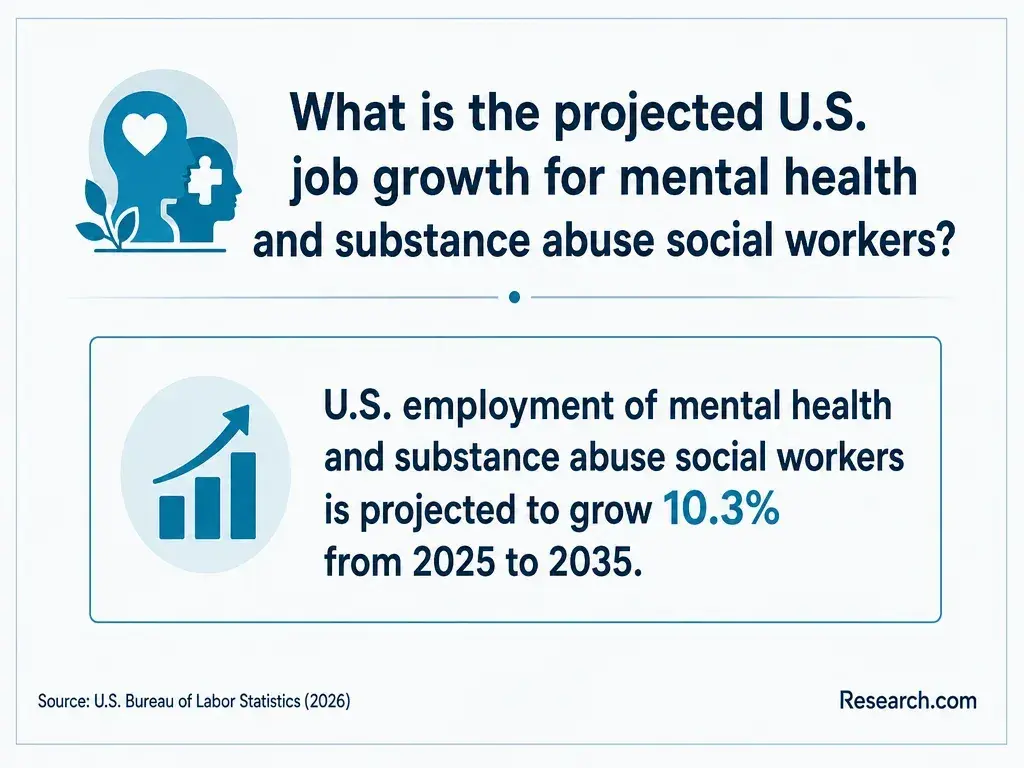
If your target is an entry-level substance-use support job rather than graduate research or forensic specialization, compare direct experience and the applicable local credential rules with bachelor's-level substance use counseling tuition and career value. Additional education is not automatically the most direct route into every support position.
What Are Forensic Psychology Salaries and Job Outlooks in the United States?
There is no single U.S. salary or job-growth figure for graduates of an online forensic psychology MS. "Forensic psychology" spans occupations with different duties and entry requirements. A psychologist wage estimate, for example, describes an occupation whose practitioners generally need substantially more professional training; it is not an earnings forecast for someone holding this MS.
For a realistic estimate, identify the job title and hiring location first. Then consult the most recent U.S. Bureau of Labor Statistics Occupational Outlook Handbook entry for the closest occupation and check its wage reference year, projection period, and typical entry education. Compare that occupation-wide figure with local job postings and your eligibility to work in the United States. Public agencies may also use fixed pay grades, making a degree-based salary assumption especially unreliable.
Finally, weigh expected job access against the full education bill and any further credentials required. If your intended outcome is licensed therapy, comparing mental health counseling education costs after aid may be more informative than projecting a return on a forensic MS that does not qualify you for that work.
Other Things You Should Know About Psychology
Often, yes, if the university accepts an in-progress transcript. Ask when it needs proof of graduation and whether your offer would be conditional until then.
Usually, if the program accepts academic references and the professor can describe your work. Check the required submission method and whether a translation is needed.
Tell admissions before documents are reviewed. Ask which official name-change or identity documents it requires to match your records.
Only after checking how that program uses optional scores. Strong evidence from relevant coursework and research may be more useful, especially when international test access adds cost.
- NYS Mental Health Practitioners: FAQ Education Requirements | nysed.gov https://www.op.nysed.gov/professions/marriage-and-family-therapists/faqs-education-requirements
- Evaluation of Foreign Degrees - United States Department of State https://www.state.gov/global-community-liaison-office/family-member-employment/family-member-employment-in-the-d-c-area/evaluation-of-foreign-degrees
- 49 Pa. Code § 49.13. Licensed professional counselor. | pacodeandbulletin.gov https://www.pacodeandbulletin.gov/secure/pacode/data/049/chapter49/s49.13.html
- Requirements Related to the Practice of Counseling - NCBI https://www.ncbi.nlm.nih.gov/books/NBK259170/
- Recognition of Foreign Qualifications | ed.gov http://www.ed.gov/about/initiatives/international-affairs/recognition-of-foreign-qualifications
- Application Checklist for International Applicants | University of San Diego (USD) https://www.sandiego.edu/admission-and-aid/graduate/apply/graduate-application/international-applicants/application-checklist.php
- Master's in Forensic Psychology Degree Online & On Campus | University of North Dakota https://und.edu/programs/forensic-psychology-ma-ms/index.html
- Prospective Students | University of North Texas https://pahs.unt.edu/psychology/academics/counseling-psychology/prospective-students.html
- Practicum Education Manual - VI. Practicum Education Placement Policies, Procedures, and Processes https://socialwork.wayne.edu/practicum/manual/policies
- Tuition & Financial Aid | John Jay College of Criminal Justice https://www.jjay.cuny.edu/admissions/tuition-financial-aid