2027 Online MLIS Programs Compared by Library Technology and Systems Preparation

Co-Founder and Chief Data Scientist
An online MLIS can teach you to use a library catalog, but that is different from preparing you to configure a discovery system, manage metadata, or improve access to digital collections. The distinction matters when you are choosing a degree for systems-focused work.
The U.S. Bureau of Labor Statistics projects 2.6% employment growth for librarians and media collections specialists from 2025 to 2035, making relevant skills and experience important considerations. This guide shows prospective students and career changers how to compare online programs by curriculum, hands-on opportunities, cost, and the jobs they actually want.
Key Things You Should Know
- Look beyond a "technology" label: compare required systems coursework, available electives, and opportunities to build and document a working project.
- Confirm the specific master's program's ALA accreditation and ask when systems electives run; neither accreditation nor a catalog listing guarantees a particular course or online schedule.
- The May 2025 median pay for librarians and media collections specialists was $68,270, but that occupational figure is not a salary prediction for systems-focused MLIS graduates.
What are online MLIS programs with the strongest library technology and systems preparation?
The strongest fit is an ALA-accredited online master's program in which you can progress from information organization to systems-focused coursework and complete an applied project. No single program is strongest for every goal: a future systems librarian needs a different mix from someone aiming to manage digital collections or research data.
A defensible comparison of named universities requires current, program-specific evidence about course requirements, online availability, and project access. A concentration title alone does not establish those details, so it should not be treated as a ranking. When reviewing library science programs worth applying to, use the same criteria for each school rather than relying on a general reputation list.
The following profiles distinguish the preparation needed for common technology-oriented goals. They are selection criteria, not claims that any particular university offers a named track:
| Career goal | Coursework to prioritize | Useful evidence of applied preparation | Important limitation to check |
| Library systems and discovery | Integrated library systems, discovery, databases, and user experience | A documented configuration, usability study, or workflow improvement | Whether students can work with a real system rather than only read about one |
| Metadata and digital collections | Cataloging, metadata schemas, digital libraries, and preservation | A collection description or metadata-mapping project | Whether advanced electives are offered during the student's enrollment |
| Research data and repositories | Data management, scholarly communication, repositories, and privacy | A data-management plan or repository workflow project | Whether the program provides access to a suitable project partner |
Ask each program to identify a recent course schedule and examples of projects students can complete online. An officially named concentration is helpful only if its required courses match your target work; a flexible elective pathway can be just as useful when its courses and projects are accessible.
Why does ALA accreditation matter for online MLIS programs and library careers?
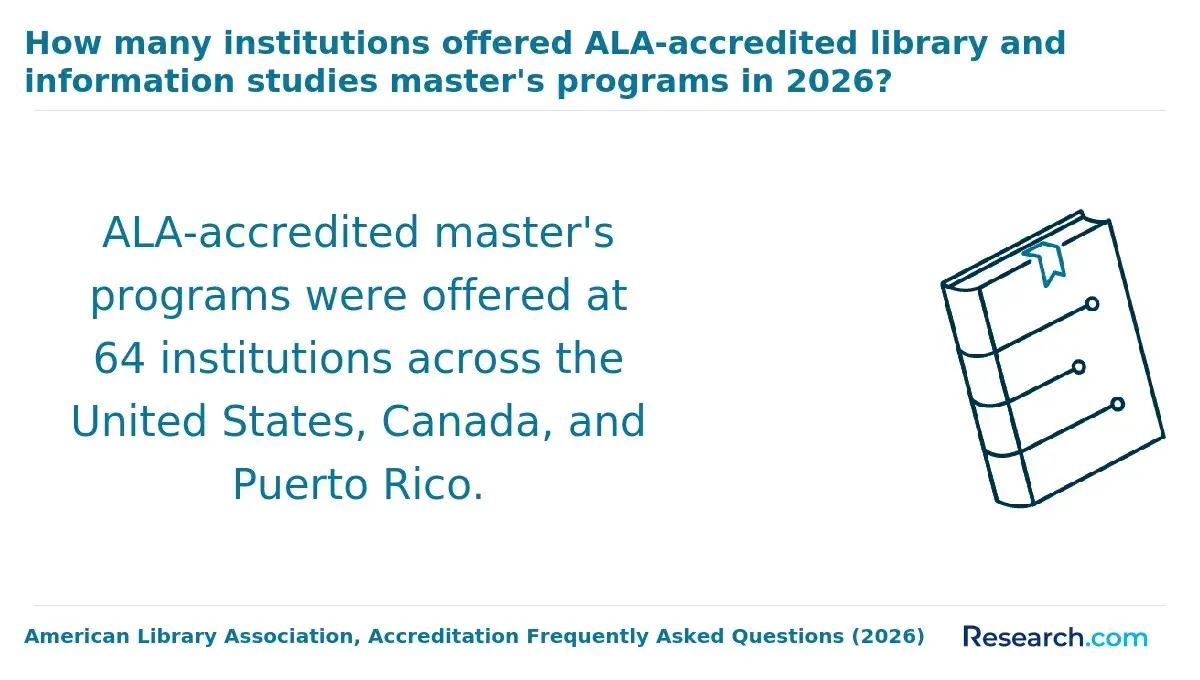
American Library Association accreditation applies to a specific master's program, not automatically to every degree at an accredited university. It matters because many professional librarian employers require or prefer a degree from an ALA-accredited program.
Check the current ALA directory for the exact degree you intend to earn, including programs titled MLS or Master of Science in Library Science rather than MLIS.
Accreditation evaluates the program as a whole. It does not certify that a systems elective will be offered next term, that an online student can access a particular internship, or that the degree meets school librarian licensing rules in a given state. Confirm those separately with the program and, where applicable, the state education authority.
How do online MLIS programs compare with campus programs for technology training?
Delivery format does not, by itself, determine technical depth. An online student may be able to practice in a hosted repository or discovery-system environment, while a campus student may have easier access to an in-person lab or local library partner. The deciding factor is what each program lets you do with its tools, instructors, and projects.
This comparison highlights practical differences to verify rather than assuming either format is more hands-on:
| Factor | Online format: verify | Campus format: verify |
| Systems access | Remote access to training environments and needed software | Access to labs or operational systems outside scheduled class time |
| Applied experience | Whether a project or placement can be completed near home | Availability of local placements relevant to systems work |
| Scheduling | Live-session times, group work, and elective rotation | Commute, class times, and elective rotation |
Online does not necessarily mean asynchronous. Before choosing a format, request a sample syllabus for a technical elective and ask how students obtain software access, feedback, and project supervision.
Which technology and information systems courses should an online MLIS program include?
Start with information organization and how library services work, then look for coursework that lets you design, test, or maintain the systems behind those services. Required courses provide a baseline; electives determine much of the technical depth. Compare descriptions and assignments, not just course titles.
For a systems-oriented pathway, these subjects serve different purposes and are most valuable when students can apply them:
- Cataloging and metadata: MARC and RDA describe and organize resources; BIBFRAME and other linked-data approaches address how descriptions can connect across systems.
- Library systems and discovery: Learn how records move among a library management system, discovery interface, and other services, including troubleshooting and vendor-related decisions.
- Databases, web technologies, and accessibility: Practice structuring, retrieving, and presenting information so people can use it effectively.
- Digital collections and preservation: Examine repository workflows, metadata quality, file management, and long-term access.
- Privacy and responsible AI: Evaluate how search tools and automated workflows affect patron data, transparency, and access.
A course that introduces a standard is not the same as one that asks students to use it. Request recent syllabi and look for assignments such as mapping metadata between schemas, testing a discovery interface, or documenting an accessible digital-collection workflow.
What admission requirements do online MLIS programs typically have?
Applicants generally need a bachelor's degree and must submit the materials specified by the graduate program, which may include transcripts, a statement of purpose, recommendations, and a résumé.
Minimum grades, testing policies, deadlines, and prerequisite rules vary. Verify the requirements for the exact degree and entry term rather than assuming one school's policy applies elsewhere.
Prior library employment or programming experience can strengthen an application, but neither should be assumed to replace a published academic requirement.
Applicants considering a library degree without prior coursework should ask admissions staff whether any prerequisites apply and whether relevant experience is considered in review. If you have already completed graduate study, ask separately whether those credits are eligible for transfer and how transfer would affect the systems courses you can take.
How long do online MLIS programs take, and how much do they cost?
Completion time depends on required credits, enrollment pace, course sequencing, and any project or practicum. A student may be able to study quickly yet still wait for an elective that runs infrequently. If speed is a priority, compare an accelerated librarian degree online with the slower schedule needed to take the technical courses you actually want.
There is no reliable single price for an online MLIS. Calculate each program's published tuition using the rate that applies to your residency and enrollment status, then add mandatory fees and likely expenses for books, equipment, travel, or placements. Confirm whether online students pay the same rate as campus students; do not assume they receive in-state pricing.
Separate the gross program cost from what you would pay after confirmed employer support or other aid, and from what you would borrow. Ask the financial aid office which aid applies to your intended enrollment period and pace. A lower advertised per-credit rate may not produce a lower total cost if a program requires more credits or adds fees.
What library technology careers can an online MLIS prepare you for?
A technology-focused MLIS can support applications for systems librarian, discovery librarian, metadata librarian, digital collections librarian, or repository-related roles. Titles overlap, so read job descriptions for the actual responsibilities: maintaining access tools, improving search, describing resources, managing digital objects, training colleagues, or coordinating with vendors and IT staff.
Professional librarian positions commonly require or prefer an ALA-accredited master's degree, but requirements differ by employer.
Related work in web development, database administration, user experience, or information technology may favor different degrees or substantial technical experience instead. Library technician roles are also distinct from professional librarian roles and do not universally require an MLIS.
For career changers, a useful bridge is a supervised project at a library or information organization: document the problem, your contribution, testing, and results. An MLIS is a better fit if the work you want combines technical systems with library services and professional librarian responsibilities; a focused technical credential or job experience may be more efficient for an IT-only goal.
What salaries and job outlooks can MLIS graduates expect in technology-focused roles?
The Bureau of Labor Statistics reports a May 2025 median annual wage of $68,270 for librarians and media collections specialists. That occupation includes many kinds of positions; it is not a separate salary estimate for systems librarians or a forecast of what a new graduate will earn. Location, employer, duties, and experience all matter.
Compare actual job postings for your target title and region with the cost of the degree and your current earnings. A higher-paying adjacent technology job may also have different education requirements, so evaluate roles rather than treating every figure in a list of library science career advancement pay as an expected MLIS outcome.
The occupational growth projection in the introduction describes the broader field, not demand for any one specialization.
Do online MLIS graduates need licenses or professional certifications?
Most library systems and metadata positions do not have a universal professional license. Employers may ask for particular systems experience or prefer additional training, but an optional certificate should not be confused with a legal requirement.
School librarian positions are different: states set their own certification or endorsement rules, which may include educator preparation or other requirements beyond the MLIS. Check the state education authority before enrolling, especially if you plan to qualify in a state other than the one where the university is located.
For a state-specific starting point, review Illinois library science degree and licensure, then confirm current requirements with the relevant authority. ALA accreditation alone does not establish school librarian eligibility in every state.
How should you evaluate an online MLIS program's library systems preparation?
Build a short list around the job descriptions you hope to meet, then ask each program for evidence that you can complete the relevant coursework and applied work. Use the same questions for every school so an attractive concentration name does not outweigh a better-supported elective pathway.
These checks turn a course catalog into a realistic study plan:
- Confirm the exact master's degree in the current ALA directory and identify which relevant courses are required versus elective.
- Ask when each desired elective was last offered online and when it is next expected; a catalog entry is not an enrollment guarantee.
- Request a recent syllabus and ask what systems, datasets, or software students can actually use.
- Check whether a practicum or project can address your target role, who supervises it, and whether remote participation is permitted.
- Compare total expected cost and a term-by-term course sequence, including what happens if a key elective is unavailable.
Favor the program that gives you a credible route to demonstrable skills within your budget and schedule. If two options appear similar, ask how graduates may present projects in a portfolio without exposing patron records or restricted institutional data. That answer can reveal more about the quality of systems preparation than a list of software names.
Other Things You Should Know About Library Science
Not necessarily. Check each program's prerequisites and the assignments in the courses you want. Basic familiarity with spreadsheets, data structures, or web concepts can make technical coursework easier, but requirements vary.
Often, if the course schedule permits it. Ask about live classes, group meetings, and expected weekly workload before committing to an enrollment pace.
Only with the organization's permission and appropriate privacy safeguards. A fictional dataset or approved, de-identified material may let you demonstrate the same skills without disclosing sensitive information.
Degree titles alone do not establish a difference in systems preparation. Compare the specific program's accreditation, curriculum, projects, and the requirements in jobs you want.
References
- Integrating Competencies and Learning Outcomes in Core Courses for the MPH - PMC https://pmc.ncbi.nlm.nih.gov/articles/PMC4037465/
- Cybersecurity and privacy | NIST https://www.nist.gov/cybersecurity-and-privacy
- Summary of the HIPAA Security Rule | hhs.gov https://www.hhs.gov/hipaa/for-professionals/security/laws-regulations/index.html
- Understanding College Costs | studentaid.gov https://studentaid.gov/resources/prepare-for-college/students/choosing-schools/consider-costs
- Online Master's Degree: Information Sciences | Vols Online https://volsonline.utk.edu/program/masters/information-sciences-ms/
- How to Become a School Librarian: Your Complete Career Guide | Syracuse University https://ischool.syracuse.edu/how-to-become-a-school-librarian/
- MLIS Curriculum, Specialties & Courses | University of Arizona College of Information Science https://infosci.arizona.edu/ma-library-information-science/curriculum-specialties-courses
- Library Media Specialist Career Paths & Requirements | Missouri Baptist University (Mobap) https://www.mobap.edu/news/library-media-specialist-career-paths-education-and-certification-guide/
- Online Library Science Degree | MLIS Program at Mizzou Online https://online.missouri.edu/degrees-programs/mu/education/library-and-information-science/mlis
- Competencies and Learning Outcomes | Strengthen Workforce Prep in your Program https://serc.carleton.edu/integrate/programs/workforceprep/competencies_and_LO.html