2027 Online Family Nurse Practitioner (FNP) Programs for Missouri Residents: Costs and Clinical Training

Co-Founder and Chief Data Scientist
Choosing an online family nurse practitioner program in Missouri means comparing more than coursework. An online MSN or doctoral FNP track still requires supervised, in-person care, and the school's location can affect tuition, placement support, and eligibility.
This guide is for registered nurses weighing Missouri-based programs against out-of-state alternatives. It explains how to compare costs, plan clinical training, and check the requirements that matter if you intend to practice in Missouri - so you can decide which options fit your budget, schedule, and career plans.
Key Things to Know About Online FNP Programs in Missouri
- Missouri-based online FNP options include programs at Maryville University in St. Louis, Missouri State University in Springfield, and Saint Louis University in St. Louis; confirm each program's current campus-visit and placement requirements.
- Online coursework does not eliminate in-person training: FNP certification pathways generally require at least 500 faculty-supervised clinical hours, and a school may require more.
- Missouri residence does not automatically secure a lower online tuition rate or a nearby clinical site; obtain a program-specific cost estimate and written placement policy before enrolling.
What online FNP programs are available in Missouri?
Several institutions physically located in Missouri offer online or substantially online FNP coursework. An FNP is an advanced practice registered nurse educated to provide primary care across the lifespan; the FNP track may be part of a master of science in nursing (MSN), a doctor of nursing practice (DNP), or a post-master's certificate. "Online" describes coursework, not the required clinical visits or any campus activities.
The examples below are Missouri institutions, not out-of-state schools recruiting Missouri residents. Delivery details can change by track and entering term, so use the current FNP program page and catalog - not a general university listing - when comparing them.
| Missouri institution | Institution location | FNP option to investigate | Confirm before applying |
| Maryville University | St. Louis | Online FNP graduate pathways | Track-specific clinical hours, placement assistance, and tuition |
| Missouri State University | Springfield | Online graduate FNP pathway | Current degree format, campus requirements, and graduate tuition category |
| Saint Louis University | St. Louis | Online FNP graduate pathway | Required visits, clinical-site approval, and program fees |
These examples are not a ranking or a complete inventory. Check nursing-program accreditation at the program level, along with each school's current admission rules. An RN license, prior nursing degree, and clinical experience may matter, but requirements differ; the guide to FNP program entry criteria can help you prepare questions for each admissions office.
Can Missouri residents enroll in online FNP programs based in other states?
Missouri residents may be able to enroll in an out-of-state online FNP program, but online advertising alone does not establish eligibility. The institution must be able to enroll a student residing in Missouri, approve any Missouri clinical placement, and disclose whether its curriculum meets the professional requirements where the student intends to seek recognition or licensure.
For example, the University of Cincinnati is in Ohio, and the University of South Alabama is in Alabama; either would be an out-of-state alternative, not an online program in Missouri. Treat any such program as an option to verify rather than assuming it currently admits Missouri residents or approves a proposed local site.
Ask an out-of-state school for written answers about Missouri enrollment eligibility, clinical placement permission, required travel, and its professional-licensure disclosure for Missouri. State authorization concerns permission to offer education; it does not, by itself, establish eligibility to practice as an FNP. If you expect to work in another state after graduation, check that state's requirements separately.
How much do online FNP programs cost in Missouri?
The cost of a Missouri-based online FNP program depends on the specific degree, credit requirement, tuition rate, mandatory fees, and clinical expenses. A quoted price per credit is not the total price of attendance. Current, comparable program-wide tuition-and-fee figures are not available here, so a numerical range would risk comparing unlike tracks or outdated rates.
Use the same cost categories for every school you consider. This table separates charges on a university bill from expenses that may fall to you during clinical training.
| Cost category | What to request or budget for |
| Tuition | Current rate for your exact MSN, DNP, or certificate track multiplied by its required credits |
| University and program fees | Mandatory online, technology, nursing, course, and graduation charges |
| Clinical compliance | Background checks, immunizations, drug screening, insurance, and required equipment |
| Placement and travel | Any placement-related charges, transportation, lodging, and missed work for required visits |
| Financing | Interest and loan fees, if borrowing is necessary |
Request an itemized estimate for your entry term from Maryville, Missouri State, or Saint Louis University, and ask which charges can change before graduation. Compare total tuition plus mandatory fees on the same basis; then add your likely clinical and travel expenses separately. For a fuller budgeting worksheet, see family nurse practitioner degree expenses.
Do Missouri residents pay in-state tuition for online FNP programs?
Missouri residents do not automatically receive an in-state price for every online FNP program. A Missouri public university may apply residency rules to some graduate tuition, while a private university may charge by program without an in-state distinction. An out-of-state school may instead use an online rate that is the same for students in multiple states.
For Missouri State University, ask which published graduate rate applies to the specific online FNP track and whether any additional program charges apply. For Missouri-based private institutions such as Maryville and Saint Louis University, ask for the program rate rather than assuming a Missouri-resident discount. If comparing an out-of-state alternative, request its rate for a student living in Missouri; the school's home-state price may not be yours.
Residency for tuition, permission to enroll online, and permission to complete Missouri clinicals are separate decisions. Getting all three answers in writing prevents a low advertised rate from obscuring a higher actual cost or an unusable placement plan.
Are there scholarships or grants for FNP students in Missouri?
Missouri FNP students may find financial help through their university, employers, federal programs, and selected service-based opportunities, but eligibility is not automatic. Some widely advertised Missouri student grants serve undergraduates rather than graduate FNP students, so check degree-level restrictions before counting an award in your budget.
Focus on aid that applies to your track and intended work. The following sources are worth checking early because their deadlines and service commitments can affect which school makes financial sense.
- Ask each Missouri nursing school about graduate scholarships, assistantships, and whether an award applies to online FNP students.
- Ask your employer whether tuition assistance covers advanced-practice education and whether accepting it creates a work commitment.
- Check current federal Nurse Corps scholarship or loan-repayment rules if you are willing to work at an eligible shortage-area facility; these are competitive and may carry service obligations.
- Ask the Missouri Department of Health and Senior Services about currently funded nursing or health-professional assistance programs and whether your degree and intended practice site qualify.
Submit the Free Application for Federal Student Aid if you want to be considered for applicable federal aid, then compare each school's actual award offer. Do not treat a possible scholarship or future loan repayment as money already secured.
How many clinical hours do online FNP programs require for Missouri students?
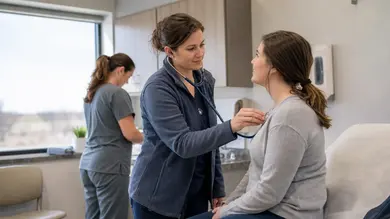
Missouri students must complete the clinical hours required by their FNP program, even when classes are online. National FNP certification pathways generally call for at least 500 faculty-supervised clinical hours; individual MSN, DNP, and certificate tracks may require more. That baseline is not a promise that 500 hours will satisfy every school or every later credentialing requirement.
Ask each program for its current total and a term-by-term breakdown. Hours must usually be completed with approved preceptors and patients appropriate to the FNP role - not simply logged during a student's existing RN shifts. Schools may also specify experiences across age groups and care settings.
The scheduling effect can be substantial: hours on site come on top of coursework, preparation, and commuting. If you plan to keep your RN job, review a guide to family nurse practitioner education alongside employment and ask whether clinical terms can be taken part time. A slower schedule may ease weekly demands but extend tuition, fees, or time away from an advanced-practice role.
What types of clinical sites are available to FNP students in Missouri?
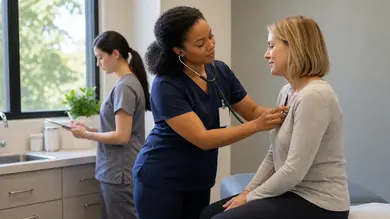
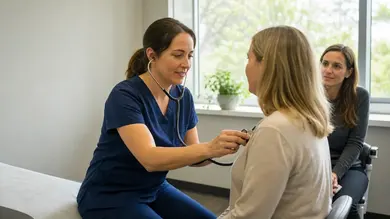
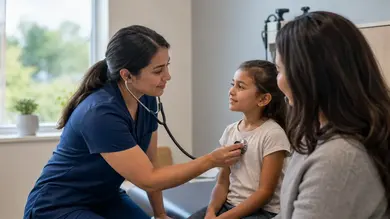
Missouri FNP students may train in approved primary care settings that serve patients across the lifespan, such as family medicine practices, community health centers, rural health clinics, pediatric offices, and women's health practices. A site's suitability depends on the course objectives, patient mix, available preceptor, and school approval - not merely its proximity to home.
The available mix can differ across Missouri. A student near a large health system may have several potential practices within commuting distance, while a student in a rural area may need to approach a smaller clinic or travel for a particular patient population. Neither situation guarantees an open student placement: clinics decide whether they can take learners, and schools must approve educational arrangements.
If you hope to use your workplace, ask whether its setting and proposed preceptor meet the school's rules and whether student hours can be kept distinct from paid RN duties. Avoid committing to a site before the program confirms its approval process.
Can Missouri students complete FNP clinical rotations near home?
Missouri students can often propose clinical rotations near home, but no online FNP program should be assumed to guarantee a nearby placement. The deciding factors are an eligible site, an available qualified preceptor, school approval, and any required affiliation agreement. Placement policies differ even among schools whose courses are fully online.
Before accepting an offer, ask the clinical-placement office how its process works in your part of Missouri. These questions expose the difference between meaningful placement support and a school that primarily expects you to find contacts yourself.
- Ask who identifies prospective preceptors and what help the school provides if your first site declines.
- Ask when site requests must begin and how long approvals and affiliation agreements typically take.
- Ask which patient populations or course rotations may require travel beyond your home area.
- Ask what happens to your progression if a confirmed preceptor withdraws.
Request the answers in writing and speak with the clinical team, not only an admissions representative. The guide to online FNP programs with preceptor support can help you frame that comparison. Waiting until the clinical term begins is a costly mistake if an agreement or backup site is still missing.
How can Missouri students determine if an FNP program aligns with their goals?
A Missouri student should choose an FNP program only after checking that its education, clinical plan, cost, and credential pathway match where they intend to practice. If your goal is outpatient primary care across the lifespan, an FNP track may fit; if your goal is principally inpatient acute care, ask whether a different population focus or dual-track pathway is more appropriate.
Use a short verification sequence rather than relying on a school's general claim that graduates are "licensure-ready." These checks address different requirements that are easy to confuse.
- Confirm the exact FNP degree or certificate, nursing-program accreditation, admission requirements, and eligibility for the national certification examination you intend to take.
- Ask the Missouri State Board of Nursing about the current route to advanced-practice recognition, and check Missouri's rules for the clinical activities and prescribing you expect to perform.
- Get written confirmation of Missouri enrollment eligibility, clinical-site rules, placement support, required visits, and an itemized cost estimate.
- If you might practice outside Missouri, check that jurisdiction's requirements independently before enrolling.
Missouri's practice rules are not the same thing as a school's curriculum or its accreditation. If you are comparing family practice with acute care, the guide to FNP and acute care dual-track admission requirements can help you identify questions about both tracks. Graduating from an online program alone does not grant authority to practice in Missouri.
Is an online FNP program worth the investment for Missouri students?
An online FNP program may be worth the investment for a Missouri RN who wants a qualifying advanced-practice role and can complete the required clinical training without taking on an unsustainable cost or schedule. It is a weaker fit if the proposed clinical sites, degree track, or likely borrowing do not support the student's intended job.
Missouri nurse practitioner employment and wage information can provide context, but an occupation-wide figure is not an FNP graduate salary or a job offer. Consult the latest Missouri figures in the U.S. Bureau of Labor Statistics' state occupational employment and wage estimates, then compare actual job postings in the part of Missouri where you intend to work. Pay and responsibilities can differ by employer and setting, and occupation data do not isolate the return from any one school.
A practical decision is to compare each program's full expected cost, the income or work hours you may forgo during clinical terms, and its documented ability to support your intended Missouri practice pathway. Choose on those combined facts - not on a tuition advertisement or the assumption that online study makes clinical training flexible.
Other Things You Should Know About Family Nurse Practitioner
FNP programs generally require an RN license, but schools set their own rules about license status at admission and during clinicals. Check the requirements for the exact track and the state where you will complete patient care.
The degree and FNP preparation depend on the accredited program and completed curriculum, not on whether lectures are online. Compare the credential awarded, certification eligibility, and required in-person activities rather than the delivery label alone.
Possibly, if the school approves the site and qualified preceptor and permits an arrangement that separates supervised student learning from paid RN work. Obtain approval before counting on the placement.
That depends on your existing degree and goals. An MSN is a graduate-degree route, a DNP adds doctoral study, and a post-master's certificate is intended for nurses who already hold an applicable graduate degree. Ask each school how your prior coursework affects its requirements.
References
- Board of Nursing - Missouri Division of Professional Registration https://pr.mo.gov/nursing-licensure-rn.asp
- Tuition and Fees | dhewd.mo.gov https://dhewd.mo.gov/data/tuition-and-fees
- Family Nurse Practitioner | missouri.edu https://online.missouri.edu/degrees-programs/mu/nursing/family-nurse-practitioner/ms
- Clinical Experience for MS(N), DNP and Graduate Certificates | Sinclair School of Nursing https://nursing.missouri.edu/academic-programs/clinical-experience/
- FNP - Admissions - UMKC School of Nursing and Health Studies https://sonhs.umkc.edu/admissions/fnp.html
- Family Nurse Practitioner Option | missouristate.edu https://www.missouristate.edu/Nursing/Graduate/family-nurse-practitioner-option.htm
- 20 CSR 2200-3.085 - Preceptors | State Regulations | US Law | LII / Legal Information Institute https://www.law.cornell.edu/regulations/missouri/20-CSR-2200-3-085
- NP Clinical Hours, Preceptors and Placement Explained | Arkansas State University Online https://degree.astate.edu/online-programs/healthcare/msn/np-clinical-hours-and-placement/