2027 Online Environmental Science Master's Programs Under $20,000: Total Tuition and Required Fees

Co-Founder and Chief Data Scientist
An advertised online environmental science master's tuition below $20,000 can become less affordable once per-credit pricing, mandatory fees, prerequisites, and residency rules are counted. This guide helps working professionals, career changers, and recent graduates compare the real cost and value of low-cost programs.
The U.S. Bureau of Labor Statistics projects 6% employment growth for environmental scientists and specialists from 2023 to 2033, making relevant, affordable graduate preparation especially important. Readers will learn how to verify a program's final price, fit, accreditation, and career alignment before applying.
Key Things You Should Know
- An online environmental science master's stays under $20,000 only when tuition plus all mandatory institutional and program fees remain below that limit; advertised tuition alone is not enough.
- Credit count is the central cost driver: a 30-credit program at $600 per credit has $18,000 in tuition before required fees, while a 36-credit program at the same rate has $21,600 in tuition.
- The Bureau of Labor Statistics projects 6% growth in environmental scientist and specialist employment from 2023 to 2033, but the best-value degree is one that matches the student's target role, technical skills, schedule, and employer expectations.
How Much Does an Online Environmental Science Master's Degree Under $20,000 Cost in Total?
A genuinely under-$20,000 online environmental science master's program has a published, school-confirmed cost below $20,000 after required tuition and mandatory fees are added. Total cost is not the same as the amount shown on a program advertisement. Schools may quote a per-credit rate, a term rate, or a flat program price, and each presentation can exclude charges that every enrolled student must pay.
Use this calculation before treating a program as affordable: (required credits × applicable tuition rate) + mandatory program and institutional fees = estimated required educational cost. This estimate should exclude optional living expenses but include any non-waivable charge required to enroll or graduate.
The comparison below shows why the published credit requirement matters as much as the advertised rate. These are illustrative calculations rather than quotations from a particular institution.
| Cost structure | Required credits | Tuition calculation | Tuition before mandatory fees | Under $20,000 before fees? |
| Lower per-credit rate | 30 | $500 × 30 | $15,000 | Yes |
| Moderate per-credit rate | 30 | $600 × 30 | $18,000 | Yes, with limited room for fees |
| Moderate per-credit rate | 36 | $600 × 36 | $21,600 | No |
| Flat-rate program | Varies | Published program price | Confirm inclusions | Depends on mandatory fees |
A low-cost online program can be a strong choice for professionals seeking applied environmental analysis, sustainability, conservation, environmental management, geographic information systems, or regulatory work. It may be less suitable when a student needs extensive laboratory research, a thesis supervisor in a narrow specialty, in-person field equipment, or a program that specifically supports doctoral research preparation.
For each finalist, request or download the current graduate tuition schedule, fee schedule, degree plan, and online-program disclosure. Confirm whether the listed price applies to the full degree, the current academic year only, or a single term. A school can change rates before a student completes a multiyear program.
What Required Fees Can Increase the Cost of an Online Environmental Science Master's Degree Beyond $20,000?
Mandatory fees are charges a student cannot reasonably avoid while completing the program. They can turn a tuition figure below $20,000 into a total cost above the target, particularly when a school charges them every term rather than once per degree.
Review the fee schedule alongside the curriculum because the following charges are commonly relevant to online graduate students.
- Application, admission, graduation, and degree-conferral fees.
- Technology, distance-learning, learning-management-system, and online-course fees.
- Student services, library, health, campus, or enrollment fees that may apply even to fully online learners.
- Laboratory, field-course, software, proctoring, practicum, or capstone fees tied to particular courses.
- Required books, data subscriptions, hardware, travel, lodging, background checks, or insurance when the curriculum requires them.
Separate required fees from personal and optional expenses. A laptop upgrade or voluntary conference travel can matter to a budget, but it should not be presented as a mandatory program charge unless the institution requires it. Conversely, do not dismiss a required field experience as optional simply because tuition is charged online.
A common mistake is multiplying tuition by credits and stopping there. Avoid it by asking the bursar or graduate enrollment office for a written estimate based on your residency, intended start term, delivery format, and planned course load. Also ask whether fees are charged per course, per term, per credit, or once.
How Does Per-Credit Tuition Affect the Total Cost of an Online Environmental Science Master's Degree Under $20,000?
Per-credit tuition makes the total price predictable only after students know the exact number of credits required for graduation. A program marketed at an attractive per-credit rate can exceed $20,000 when it requires additional foundation courses, a thesis sequence, or credits beyond the stated minimum.
The practical ceiling is simple: divide $20,000 by the required number of credits before fees. A 30-credit program must average less than $666.67 per credit to remain below $20,000 in tuition alone. A 36-credit program must average less than $555.56 per credit. Mandatory fees reduce those ceilings further.
This table translates the $20,000 threshold into maximum tuition rates before fees. It helps applicants identify when a rate that looks low is not actually compatible with their program length.
| Required program credits | Maximum average tuition per credit before fees | Budget implication |
| 30 credits | $666.67 | Leave a fee cushion below this rate |
| 33 credits | $606.06 | Small rate changes can affect eligibility |
| 36 credits | $555.56 | Programs need a lower tuition rate or flat price |
| 42 credits | $476.19 | Prerequisites and extended curricula become significant |
Ask whether the degree has a fixed tuition guarantee, whether all students pay the same online rate, and whether courses such as research methods, capstone work, or thesis advising carry additional credits. Students strengthening quantitative prerequisites may also benefit from reviewing a Math degree online pathway when deciding whether further foundational study is needed before graduate enrollment.
Per-credit pricing usually works best for students who can transfer approved graduate credit or who expect to take a standard, fixed curriculum without extras. A flat-rate program may offer better budget certainty if it includes all required courses and does not penalize a slower pace, but students should still verify fees and the maximum time allowed for completion.
Most online environmental science master's degrees are structured around approximately 30 to 36 graduate credits, but the completion timeline depends on course sequencing, transfer credit, capstone or thesis requirements, and how many courses a student takes each term. A student studying part time while employed will commonly need longer than a full-time student, even when the curriculum is fully online.
Format affects both time and cost. Asynchronous courses can fit variable work schedules and may reduce travel costs, but students need the discipline to meet weekly deadlines. Synchronous courses provide real-time interaction but may conflict with work shifts or time zones. Hybrid programs can add travel, lodging, and scheduling expenses if labs, residencies, or fieldwork are required.
Before applying, map the program sequence against work and family obligations. The following checks can reveal whether a low tuition price may be offset by a longer or more complex path to graduation.
- Confirm the minimum and typical completion timelines, not just the fastest possible timeline.
- Check whether required courses are offered every term or only once each year.
- Identify thesis, capstone, internship, fieldwork, and residency requirements before committing.
- Ask whether taking fewer courses changes fees, financial-aid eligibility, or tuition guarantees.
- Verify the maximum time allowed to complete the degree and the consequences of stopping out.
Students whose long-term goal is advanced research should consider whether the master's includes methods training, faculty mentorship, and a thesis option. Those planning beyond a master's can compare the structure of one year doctoral programs, while recognizing that accelerated doctoral formats are not automatically substitutes for research-intensive environmental science doctoral preparation.
Start with institutional accreditation. In the United States, students should confirm that the college or university is accredited by an accreditor recognized by the U.S. Department of Education or the Council for Higher Education Accreditation. Institutional accreditation matters for federal aid eligibility, transfer-credit evaluation, employer confidence, and future education options.
Environmental science does not have one universal programmatic accreditor that applies to every master's degree. Instead, students should evaluate the degree title, curriculum, faculty qualifications, laboratory or field components, and the requirements of the career they intend to pursue. Environmental consulting, sustainability, conservation, public-sector science, compliance, and data-focused roles can value different combinations of coursework and experience.
Use these verification steps rather than relying on a logo or an unsupported statement on a marketing page.
- Check the institution's accreditation status in an official U.S. accreditation directory and confirm that it is current.
- Compare the catalog degree requirements with the online program page to ensure the online pathway awards the same credential.
- Ask whether the program has specialized recognition, professional affiliations, laboratory standards, or discipline-specific review relevant to its concentration.
- Confirm with an employer, state agency, or licensing board when a target role has specific science-course, fieldwork, or credential requirements.
Accreditation expectations vary by profession. For example, applicants considering clinical psychology need to evaluate online PsyD programs accredited by APA, while environmental science students usually need to focus on institutional accreditation and the fit between coursework and their intended technical role.
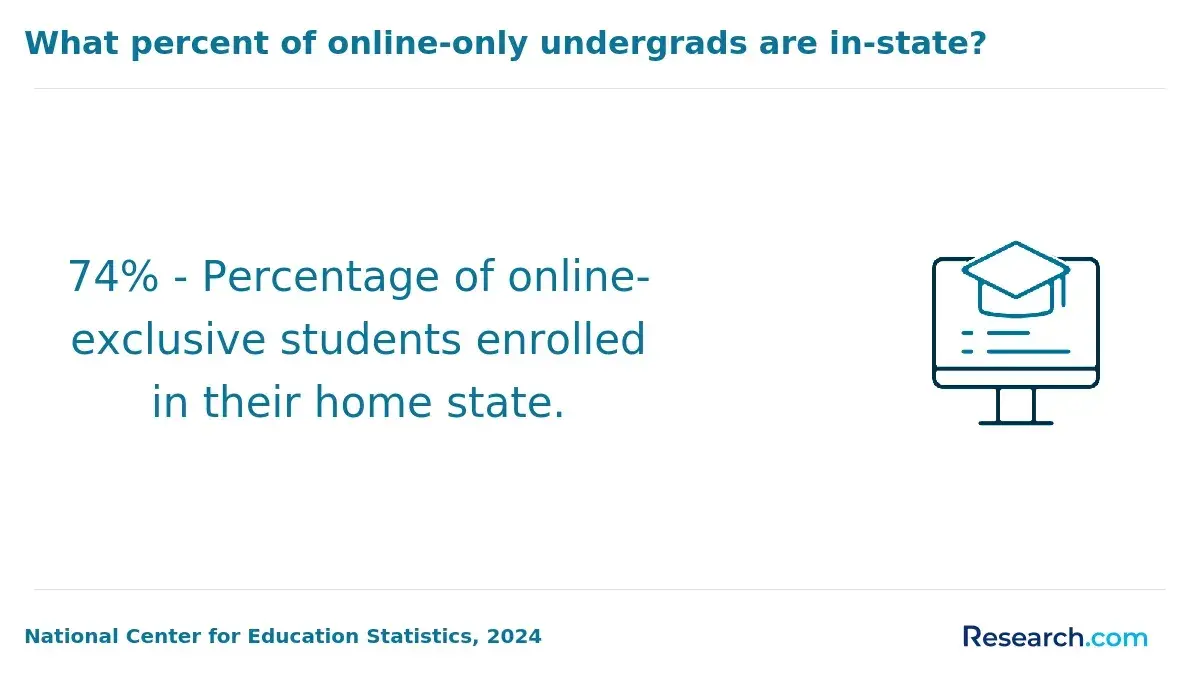
Out-of-state students may pay more, the same, or a separate online tuition rate depending on the institution. Public universities often distinguish resident and nonresident graduate tuition, while some online programs use one nationwide rate. Never assume that a program's prominently displayed price applies to every applicant.
The most favorable arrangement for a nonresident is a published online rate available to all eligible students regardless of location. The least predictable arrangement is a program that lists only general graduate tuition, because the student may need to determine whether online enrollment is billed at the resident, nonresident, or distance-learning rate.
This comparison identifies the residency questions that most directly affect the under-$20,000 calculation.
| Tuition policy | Effect on nonresident students | What to verify |
| Single online rate | Usually predictable across states | Whether all mandatory fees are also uniform |
| Resident and nonresident rates | Nonresident total may exceed the target | Eligibility rules and online billing category |
| Regional or military discount | May lower cost for eligible students | Documentation, renewal, and exclusions |
| Flat program tuition | Can simplify comparison | Whether tuition increases affect continuing students |
Also confirm whether the institution is authorized to enroll online students in your state and whether a required practicum can be completed where you live. Comparable affordability questions arise across disciplines; students evaluating technical alternatives can also review an affordable online computer science degree when considering a data, geospatial, or environmental-technology career direction.
A common red flag is a school representative giving a verbal estimate without identifying the applicable rate category. Request the tuition calculation in writing and retain it with the catalog year and fee schedule.
Transfer credits can reduce the number of credits a student must buy from the new institution, but they are not guaranteed. Graduate programs commonly limit the number, age, grade, and subject match of transferred courses. A prior course may be accepted as elective credit but not replace a required core course, which changes its financial value.
Transfer credit makes the most sense for students with recent, graduate-level coursework in areas such as environmental policy, ecology, statistics, geographic information systems, chemistry, sustainability, or research methods. It is less likely to help when the program has a tightly sequenced cohort curriculum, specialized capstone, or required institutional residency credits.
Before counting any savings, obtain a formal evaluation. The following documentation improves the chance of receiving a clear decision before enrollment.
- Official transcripts showing completed graduate coursework and grades.
- Course syllabi, catalog descriptions, assignments, and learning outcomes when requested.
- A written statement of which courses will transfer, what requirements they satisfy, and how many credits remain.
- Confirmation that transfer credits will not shorten eligibility for financial aid, employer reimbursement, or a tuition guarantee.
Do not enroll based only on an informal statement that credits "should transfer." If a school accepts fewer credits than expected, the extra required courses can push a projected under-$20,000 degree above the limit. Also compare the loss of networking or specialized training against the money saved; transferring a foundational course may be sensible, while transferring out of a career-defining practicum may not be.
Financial aid can lower a student's net out-of-pocket cost, but it does not change the program's published tuition and mandatory-fee total. Students should first determine whether the program is under $20,000 before aid, then calculate how grants, scholarships, employer benefits, savings, and federal loans change their personal cost.
Graduate students should submit the FAFSA when eligible and ask the institution whether online enrollment, part-time attendance, and summer terms affect aid availability. Federal Direct Unsubsidized Loans and Graduate PLUS Loans may be available to eligible students, but loans create repayment obligations and should not be treated as a discount.
Use funding sources in an order that protects the budget and limits borrowing.
- Apply for institutional scholarships, departmental awards, and external environmental or conservation scholarships early.
- Ask an employer whether tuition assistance covers online graduate courses, fees, books, or only tuition.
- Review federal aid eligibility and annual borrowing limits through the financial-aid office.
- Compare the remaining balance with savings and realistic monthly repayment capacity before accepting loans.
- Recalculate the budget each academic year because tuition, fees, aid offers, and enrollment plans can change.
Students who are still building an academic foundation may find that a lowest cost online bachelor's degree is a more appropriate first investment than beginning a master's program without the science and quantitative prerequisites needed to succeed.
Be cautious about scholarship claims that do not explain renewal criteria, enrollment requirements, or whether the award applies to fees. The most useful financial-aid comparison is net price over the full expected enrollment period, not the size of a first-term award.
An under-$20,000 online environmental science master's can be worthwhile when it supplies skills and credentials that are directly relevant to a realistic career target. Common targets include environmental scientist, environmental specialist, sustainability analyst, environmental compliance professional, conservation program staff member, natural-resources professional, geographic information systems analyst, and environmental project coordinator. Responsibilities can include collecting and interpreting environmental data, preparing compliance documentation, evaluating risks, supporting remediation projects, and communicating findings to agencies, employers, or communities.
The U.S. Bureau of Labor Statistics reported a median annual wage of $80,060 for environmental scientists and specialists in May 2023 and projected 6% employment growth from 2023 to 2033. This is an occupation-level benchmark, not a promise for master's graduates: pay varies by location, industry, experience, job duties, and whether an employer requires a graduate degree.
Value is strongest when the curriculum builds usable capabilities, such as environmental sampling, statistics, GIS, remote sensing, environmental law and policy, impact assessment, sustainability reporting, data visualization, technical writing, and project management. AI-enabled data analysis and remote-sensing tools are increasingly relevant in environmental work, but students should look for instruction in data quality, scientific interpretation, ethics, and field context rather than assuming a general AI course alone will improve employability.
An inexpensive program may not be the best investment if it lacks the specialization, field access, research mentorship, professional network, or local regulatory preparation needed for the desired role. Paying more can be justified when a program provides a required practicum, targeted concentration, employer relationships, or technical training that materially matches a student's career plan. Conversely, a lower-cost generalist program can be sufficient for an experienced professional seeking advancement in environmental management or sustainability.
How Should Students Choose the Best-Value Flat-Rate Online Environmental Science Master's Program?
A flat-rate online program charges one stated amount for the degree or a defined course sequence rather than billing solely by credit. It can be the easiest format to budget for, but only if the price covers every required course and the school clearly explains fees, time limits, and charges for retaking or extending coursework.
Compare finalists by total educational cost and career fit, not by flat price alone. The table below identifies the features that distinguish a low price from genuine value.
| Comparison factor | Better-value signal | Potential red flag |
| Published total price | Clear statement of included tuition and mandatory fees | "Starting at" price without a degree estimate |
| Curriculum | Courses match the intended environmental role or concentration | Generic coursework with no relevant technical depth |
| Format | Schedule, deadlines, and field requirements fit the student's life | Unclear synchronous, residency, or travel expectations |
| Completion policy | Reasonable time limit and transparent extension charges | Extra tuition or fees if the student needs more time |
| Career support | Accessible advising, faculty contact, and applied project opportunities | Broad outcome claims without program-specific evidence |
Make a final decision only after completing a consistent review for each school.
- Write down the required credits, all mandatory fees, and the estimated total using the rate that applies to you.
- Read the full curriculum and identify the courses that develop skills for your intended job.
- Confirm institutional accreditation, state authorization, and any fieldwork or residency obligations.
- Compare the expected completion timeline with your work schedule and tuition-guarantee rules.
- Ask admissions and financial aid for written answers, then compare the complete cost and fit of at least two or three programs.
The best-value choice is not always the least expensive one. It is the accredited program with a verified total cost, workable format, relevant curriculum, and level of support that fits the student's professional objective without requiring unnecessary borrowing.
Other Things You Should Know About Environmental Science
Many programs accept environmental science, biology, chemistry, geology, geography, engineering, or related majors. Applicants from other fields may be admitted conditionally or asked to complete prerequisites in areas such as chemistry, biology, statistics, calculus, or earth science.
Some do, particularly programs with applied ecology, natural-resources, environmental monitoring, or laboratory components. Fieldwork may be completed locally, during a short residency, or through an approved employer site. Confirm travel, equipment, supervision, and safety requirements before enrolling.
Environmental science generally emphasizes scientific investigation of natural systems, pollution, climate, ecology, and data. Environmental management often emphasizes policy, compliance, sustainability strategy, organizational decision-making, and project implementation. The right option depends on whether the student wants a more scientific, technical, regulatory, or managerial career focus.
Requirements vary. Some programs offer a thesis, while others use a capstone project, applied research paper, comprehensive exam, or practicum. A thesis can be valuable for research-oriented careers or future doctoral study, whereas an applied capstone may better suit professionals seeking immediate workplace relevance.
- Environmental science (M.S.) | University of Idaho https://www.uidaho.edu/academics/degree-finder/environmental-science-ms
- Master of Environmental Studies Online | Batten University https://online.batten.edu/graduate/master-of-environmental-studies
- Online Master's Degree: Environmental Management https://www.umgc.edu/online-degrees/masters/environmental-management
- Going Green: Scholarships for the Environmentally Friendly https://www.mefa.org/article/going-green-scholarships-for-the-environmentally-friendly/
- 2026 Best Online Environmental Science Master's Degrees https://www.onlineu.com/degrees/masters-environmental-science
- 30 Great Scholarships For Online Graduate Students https://www.gradschoolhub.com/scholarships/online-school/
- NEHA/AAS Environmental Health Scholarships https://www.neha.org/scholarships