2027 Online BA in Psychology - Mental Health for Mental Health Support for Refugee Communities: Which Courses Should You Look For?
Audited and Verified:
Our Editorial and Data Verification Process
Research.com uses government datasets, official education statistics and primary institutional information to support its career and degree guides. Our review process checks factual accuracy, occupational definitions, source dates and the requirements associated with the credentials discussed.
How This Article Was Fact-Checked
Our editorial team verifies salary estimates, employment projections, education requirements and program information against original data providers and official organizations. Salary figures are checked against the relevant occupational definitions and reporting periods. Information about licensure, accreditation and required in-person training is reviewed separately.
Fact-checked and verified on:

Co-Founder and Chief Data Scientist
If you want to support refugee communities, a psychology degree should teach more than the vocabulary of mental illness. You need to understand development, culture, displacement-related stress, research evidence, and the limits of a nonclinical role.
This guide is for prospective online BA students and community-service workers deciding which courses are worth prioritizing. It shows how to build a useful course sequence, evaluate opportunities to learn alongside a community organization, and avoid paying for a degree that does not match your intended work.
Key Things You Should Know
- Prioritize developmental, social and cultural psychology, psychopathology, research methods, and ethics; add migration- or refugee-focused study and supervised community experience where available.
- A typical US bachelor's degree requires about 120 semester credits, but accepted transfer credits, course sequencing, and any placement determine your actual time and cost.
- A psychology BA can prepare you for nonclinical outreach and service coordination; it does not authorize diagnosis or psychotherapy.
What is an online bachelor's degree in psychology for refugee mental health support?
It is usually a general psychology BA whose courses and experiences a student chooses to make relevant to refugee-serving organizations - not a standardized refugee mental health credential. Online delivery describes how coursework is taught, not whether the degree includes a refugee-focused concentration, a local placement, or clinical training. Compare actual major requirements and electives when reviewing undergraduate psychology degree program choices.
Refugee mental health support can mean helping people understand available services, coordinating referrals, assisting with outreach, or evaluating a community program. Needs differ among individuals and families; displacement history alone is neither a diagnosis nor evidence that someone wants mental health services. If your goal is immediate case-management work, an existing human-services qualification plus employer training and relevant language or community experience may be more direct than a second bachelor's degree.
Which psychology courses prepare students to support refugee communities?
Build from psychology's scientific core toward community application. The table distinguishes courses that develop broadly useful judgment from electives that depend on the school's catalog; course names and availability vary.
| Course or subject | Value in refugee-serving work | Important limit |
| Developmental psychology | Provides context for children's, adolescents', and adults' changing needs. | Does not qualify a student to assess a child clinically. |
| Social and cultural psychology | Examines identity, belonging, prejudice, family systems, and social context. | Coursework cannot substitute for learning from a particular community. |
| Psychopathology and health psychology | Builds literacy about distress, coping, and interactions between health and environment. | Studying disorders is not training to diagnose or treat them. |
| Statistics, research methods, and ethics | Helps students judge evidence and understand responsible program evaluation. | Access to client data requires separate authorization and safeguards. |
| Community psychology or migration-focused electives | Connects individual well-being with housing, language access, social support, and service systems. | These electives may not be offered regularly or count toward the major. |
A workable sequence is introductory psychology, statistics and research methods, then developmental and social or cultural psychology, followed by applied electives and an approved project or placement. Check prerequisites before choosing an elective that may be offered infrequently. If substance-use outreach is your specific goal, compare bachelor's study in addiction psychology online; it adds relevant subject matter but does not itself confer a counseling credential.
How can you choose an accredited online psychology program?
First verify that the institution holds accreditation recognized by the US Department of Education or the Council for Higher Education Accreditation. Then request the current BA curriculum, an individual degree audit if transferring, and written details about placement approval, supervision, online scheduling, and any required campus visits. Institutional accreditation establishes neither refugee-specific training nor eligibility for a clinical license.
Ask who helps online students find locally relevant experiences and whether an existing job at a refugee-serving organization can count toward an approved placement. Confirm that cultural psychology, community psychology, methods, and ethics courses will be available during your planned terms.
Do not assume accreditation rules for a professional doctoral psychology program apply to a general BA. The distinction also matters when comparing undergraduate study with faster online forensic psychology master's completion: a different degree title or pace does not establish clinical or refugee-service preparation.
Cultural responsiveness is a practice, not a course certificate. It includes asking how a person understands their situation, recognizing strengths and preferences, working through qualified interpreters when needed, and avoiding assumptions about trauma, religion, family roles, or willingness to seek care. A trauma-informed approach emphasizes choice, privacy, and safety without requiring someone to recount distressing experiences to obtain support.
Students also need to recognize how housing, employment, language access, discrimination, and legal uncertainty may shape well-being and access to care. Learn an organization's confidentiality, safeguarding, referral, and interpreter policies before interacting with clients. Where legal proceedings affect a family, know when to refer questions to qualified legal professionals; forensic psychology academic pathways and tuition are a different educational decision, not a substitute for culturally responsive support or legal expertise.
Requirements depend on whether you are a first-year applicant, a transfer student, or a returning student. Schools commonly request prior transcripts and proof of secondary education or its equivalent; some have separate standards for entry to the psychology major. A prior psychology major is not ordinarily necessary to begin undergraduate study.
Transfer applicants should obtain an official evaluation showing not just which credits are accepted, but which satisfy general education, psychology prerequisites, major requirements, and credits that must be completed at the institution. Ask whether prior statistics or research-methods courses are equivalent before planning advanced coursework. Admission and financial-aid eligibility are separate decisions; students weighing a substance-use-services route can consult financial support for substance abuse counseling majors while confirming aid rules with their chosen school.
A typical US bachelor's degree is roughly 120 semester credits and is often planned as four years of full-time study. Your remaining time depends on evaluated transfer credit, course availability, enrollment pace, and any placement or residency requirement. Online does not necessarily mean self-paced: live meetings and locally arranged fieldwork may constrain a working student's schedule.
Compare a written estimate of remaining credits multiplied by the applicable tuition rate, then add mandatory fees, materials, travel, and potential unpaid placement hours. Ask whether a slower pace changes aid eligibility or extends fees. Listings of affordable bachelor's study in psychology online can help form a shortlist, but the lowest advertised tuition may not produce the lowest cost for your transfer history and schedule.
Either format can teach psychology's core concepts. The consequential difference for this goal is access to supervised, community-connected learning. An online student may be able to work with a nearby refugee-serving organization, but must confirm the school will approve the site and supervisor. A campus student may have easier access to local faculty projects or partner agencies, but a campus location does not guarantee a relevant placement.
Compare the formats on live-session times, faculty contact, research participation, placement coordination, and time away from work or caregiving. Ask to see a representative term schedule rather than relying on "flexible" marketing. This matters even more if you later consider intensive online graduate psychology study, where a short calendar can still carry substantial weekly obligations.
Depending on employer requirements and experience, graduates may seek nonclinical roles such as outreach assistant, intake or referral coordinator, community-program assistant, or human-services worker. Duties can include explaining services, scheduling, documenting permitted interactions, connecting clients to qualified providers, and supporting program reporting. Language ability, trusted community relationships, and experience with the local service network may matter as much as the major.
Read job descriptions for the actual tasks and required credentials. If a posting centers on substance-use treatment rather than outreach or referrals, compare the qualification and cost implications of comparing the financial value of addiction counseling bachelor's study; some treatment roles require state-specific credentials beyond a bachelor's degree. A current nonprofit worker may benefit more immediately from a supervised project, interpreter-access training, or evaluation skills than from starting another degree.
There is no single US "refugee mental health support" license. Requirements follow the work performed and the jurisdiction, not the population served. Nonclinical outreach jobs may rely on employer training and background checks; particular peer-support, community-health, or addiction roles may require a state-recognized credential. Verify the intended job title and permitted duties with the employer and responsible state authority.
Providing psychotherapy or clinical diagnosis requires a separate qualifying professional pathway, such as one leading to counseling or clinical social work licensure, with jurisdiction-specific education and supervised experience. An online psychology BA is academic preparation, not that qualification. If therapy is your goal, examine short counseling master's formats and career planning against your state board's educational and placement rules before assuming an accelerated option will qualify you.
What salaries and job outlook apply to refugee mental health support careers?
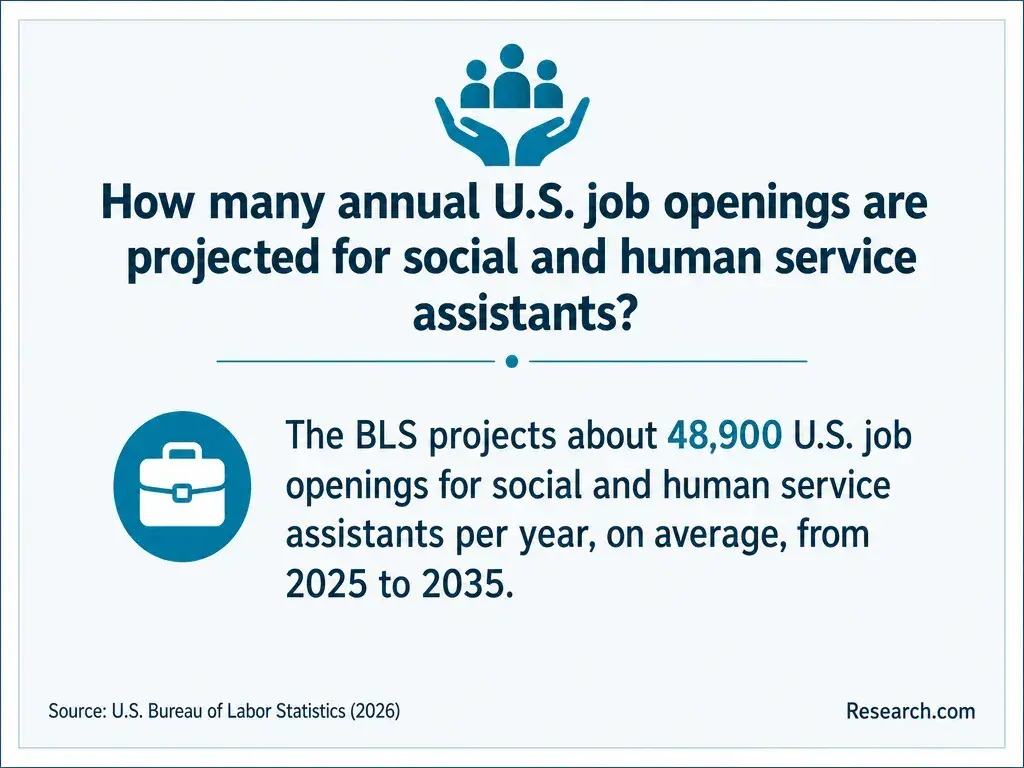
US labor-market figures are published by occupation, not for "refugee mental health support" graduates. The Bureau of Labor Statistics' Occupational Outlook Handbook category for social and human service assistants is a closer comparison for many nonclinical support tasks than its psychologist category. Its occupation-wide median wage and projected growth are useful benchmarks, but neither predicts pay at a particular resettlement agency or for a new BA graduate.
For a meaningful comparison, match several local postings by duties, location, required experience, language skills, benefits, and whether a role is full-time or grant-funded. Compare licensed therapy jobs separately: their salaries and outlook reflect a different qualification pathway. Articles on accelerated clinical counseling degrees and study length can inform that longer-term decision, but should not be used to estimate returns from an undergraduate support role.
Other Things You Should Know About Psychology
They may be sufficient for a specific volunteer or employer-defined support task, but not for a job that requires a bachelor's degree or a professional license. Check the role's requirements before paying for either option.
Choose a site with clear supervision, manageable duties, referral procedures, and support for staff well-being. Do not use classmates or clients as a substitute for professional supervision.
Yes. A literature review or analysis of public, appropriately sourced information may be feasible. Client interviews or restricted records require organizational permission and any applicable ethics review.
Possibly in a defined nonclinical role, but the organization must confirm its policies, privacy obligations, supervision, and applicable state rules. Online enrollment alone grants no authority to provide cross-state clinical services.
- Ethical Considerations in Research With People From... - PMC https://pmc.ncbi.nlm.nih.gov/articles/PMC11289226/
- Refugee and migrant mental health | who.int https://www.who.int/news-room/fact-sheets/detail/refugee-and-migrant-mental-health
- Frequently Asked Questions for Mental Health Counselors | nysed.gov https://www.op.nysed.gov/professions/mental-health-counselors/faqs-education-requirements
- Courses at Yale Relevant to Humanitarian and Refugee Health https://ysph.yale.edu/hrl/courses-humanitarian-refugee-global-health/
- Trauma and Migration | Springer Nature Link https://link.springer.com/chapter/10.1007/978-3-030-67712-1_2
- What is Service-Learning? https://servicelearning.duke.edu/what-service-learning
- Module 8: Cultural Competence & Cultural Humility | unc.edu https://ready.web.unc.edu/section-1-foundations/module-8/
- Immigrant and Refugee Mental Health | University of Colorado School of Medicine https://medschool.cuanschutz.edu/psychiatry/PatientCare/immigrant-and-refugee-mental-health
- Exploring International Internships in Social Work Education | Applied Learning in Social Work Education Journal https://alswe.simmons.edu/article/exploring-international-internships-in-social-work-education/
- Training Qualified Interpreters for IEP Meetings | Illinois https://tqii.education.illinois.edu/program-information/training-modules/interpreter-training