2027 Online BA in Psychology - Addictions: Evaluating Evidence-Based Practice in an Undergraduate Addictions Curriculum
Audited and Verified:
Our Editorial and Data Verification Process
Research.com uses government datasets, official education statistics and primary institutional information to support its career and degree guides. Our review process checks factual accuracy, occupational definitions, source dates and the requirements associated with the credentials discussed.
How This Article Was Fact-Checked
Our editorial team verifies salary estimates, employment projections, education requirements and program information against original data providers and official organizations. Salary figures are checked against the relevant occupational definitions and reporting periods. Information about licensure, accreditation and required in-person training is reviewed separately.
Fact-checked and verified on:

Co-Founder and Chief Data Scientist
An online psychology BA with an addictions focus can teach students to evaluate research on substance use and recovery. It cannot, by itself, qualify them to provide addiction treatment. That distinction matters when comparing programs that advertise similar concentrations but offer different methods courses, applied experiences, and career preparation. This guide is for prospective and returning undergraduates who want to judge whether a curriculum teaches evidence-based practice - and whether its cost, format, and outcomes fit their goals.
Key Things You Should Know
- Look for statistics, research methods, critical appraisal, and addiction-specific coursework that connects evidence to prevention and recovery - not just courses describing disorders.
- A bachelor's degree commonly requires about 120 semester credits, but transfer evaluations and course sequencing determine how many credits a particular student still needs.
- An addictions concentration does not confer a counseling license; state credential rules and employer requirements control access to regulated roles.
What is an online bachelor's degree in psychology with an addictions focus?
It is an undergraduate psychology degree that adds focused study of substance use, prevention, treatment research, and recovery systems. The focus might be an officially named concentration, a set of electives, or simply a program theme; those are not interchangeable on a transcript. A BA usually retains broad psychology and general-education requirements rather than functioning as professional counselor training.
Online describes course delivery, not necessarily the whole experience. Check for scheduled classes, group projects, campus visits, and locally arranged placements. When reviewing online psychology education pathways, compare the actual degree audit and learning activities rather than the concentration label alone.
Is an online addictions psychology bachelor's degree accredited?
Accreditation belongs to a specific institution or program; it cannot be inferred from a degree title. Confirm that the institution has recognized institutional accreditation and that it applies to the school awarding the online degree. Then ask whether the addictions focus is formally recorded and whether any separate recognition is relevant to your intended credential.
The American Psychological Association does not accredit general psychology bachelor's programs. Institutional accreditation is important for educational quality review and may matter for aid or future applications, but it does not establish that a BA meets a state's addiction-counselor requirements. Use addiction psychology undergraduate degree selection as a starting point, then verify accreditation status and credential claims with the institution and the appropriate state authority.
What careers can you pursue with an online addictions psychology degree?
Graduates may pursue nonclinical positions in recovery organizations, prevention programs, human services, or behavioral-health administration. Duties can include outreach, resource navigation, appointment coordination, program support, and documentation under an employer's policies. Hiring depends on experience, local requirements, and the duties attached to the job title - not the concentration alone.
Someone already working in community services may gain more from combining the BA with supervised projects and employer training than from coursework alone. Explore roles in community recovery organizations, then compare postings for required credentials and experience. Independent diagnosis, psychotherapy, and protected clinical titles require separate qualifications.
Evidence-based practice means using credible research alongside professional judgment and the needs, preferences, and circumstances of the people served. At the undergraduate level, students should learn to assess evidence and recognize appropriate services - not assume they are trained to deliver clinical interventions.
A strong curriculum should explain what research says about prevention, screening and referral, motivational approaches, medications for substance use disorders, harm reduction, and continuing recovery support. It should distinguish knowledge about an intervention from supervised competence in providing it. Students should also encounter co-occurring conditions, cultural responsiveness, stigma, and ethical referral boundaries.
The clearest test is an assignment: can students compare study designs, identify who was included, distinguish association from causation, and explain limits to applying a finding in a particular community? Compare those expectations with addiction counseling degree curriculum choices if your goal is counselor preparation; overlapping topics do not make the degrees professionally equivalent.
Expect the psychology foundation - such as development, learning, biological or social psychology - plus statistics and research methods. Addiction-focused offerings may address substance-use science, prevention, recovery systems, public health, and ethics. Exact requirements vary, so distinguish required courses from electives that might not run every term.
Sequence matters: statistics and methods should precede an evidence-review capstone where possible. Ask for a sample assignment and determine whether students evaluate original studies, systematic reviews, and conflicting findings. An internship can add insight into services, but observation, outreach, or referrals are not a clinical practicum.
Keep future study tied to your actual goal. For example, a student considering justice-system research should evaluate methods preparation and time-to-degree planning for forensic psychology graduate students separately; an addictions elective does not establish readiness for that different specialization.
Institutions typically ask first-year applicants for evidence of secondary-school completion and transfer applicants for prior college transcripts. Additional GPA, prerequisite, or major-admission rules are school-specific. Admission to the university does not necessarily mean admission to a limited-access concentration.
Returning students should request a written degree audit showing which accepted credits satisfy general education, psychology, statistics, and residency requirements. Ask when required courses are offered before estimating a finish date. Plan aid alongside admission: financial aid planning for a substance use counseling bachelor's can help frame questions, but the school must confirm eligibility for its particular program and enrollment level.
A bachelor's degree commonly totals about 120 semester credits. Your remaining time depends on credits that apply to requirements, course availability, enrollment pace, and any placement or capstone. Accepted transfer credit is not automatically credit toward the major.
Ask an advisor for a term-by-term plan that includes statistics prerequisites, addiction electives, and any supervised experience. Working students should check whether placements and live meetings fit their schedules rather than assuming online means asynchronous. If choosing between concentrations, published shorter forensic psychology BA and BS timelines are useful only as comparisons; they cannot predict how quickly you will complete an addictions-focused degree.
There is no reliable single price for the degree: schools charge differently by residency, credit load, and fees. Compare the cost of remaining required credits, not just the advertised per-credit rate. Include technology charges, books, possible placement travel, and the cost of courses that do not apply to your degree.
Request a written cost estimate tied to your degree audit and intended pace. Compare it with lower-tuition undergraduate psychology options, checking whether a less expensive general major still offers the methods training or addiction electives you need. A targeted course or employer training may cost less than a second bachelor's degree if you already hold one.
The BA is not a license. State addiction-counselor credentials can differ in required coursework, supervised hours, examinations, and permissible duties; some roles require graduate education. Peer-support certifications may have distinct training or lived-experience criteria. Check the regulator or certifying body for the state and job you intend to pursue before enrolling.
Ask the program to map specific courses to a named credential's requirements in writing, while recognizing that the credentialing authority makes the final determination. If your goal is licensed mental health counseling rather than addiction-focused support work, compare qualifying graduate programs and comparing tuition assistance for mental health counseling study before committing to a BA on the assumption it provides clinical eligibility.
What are the salary and job outlook for addictions-related careers?
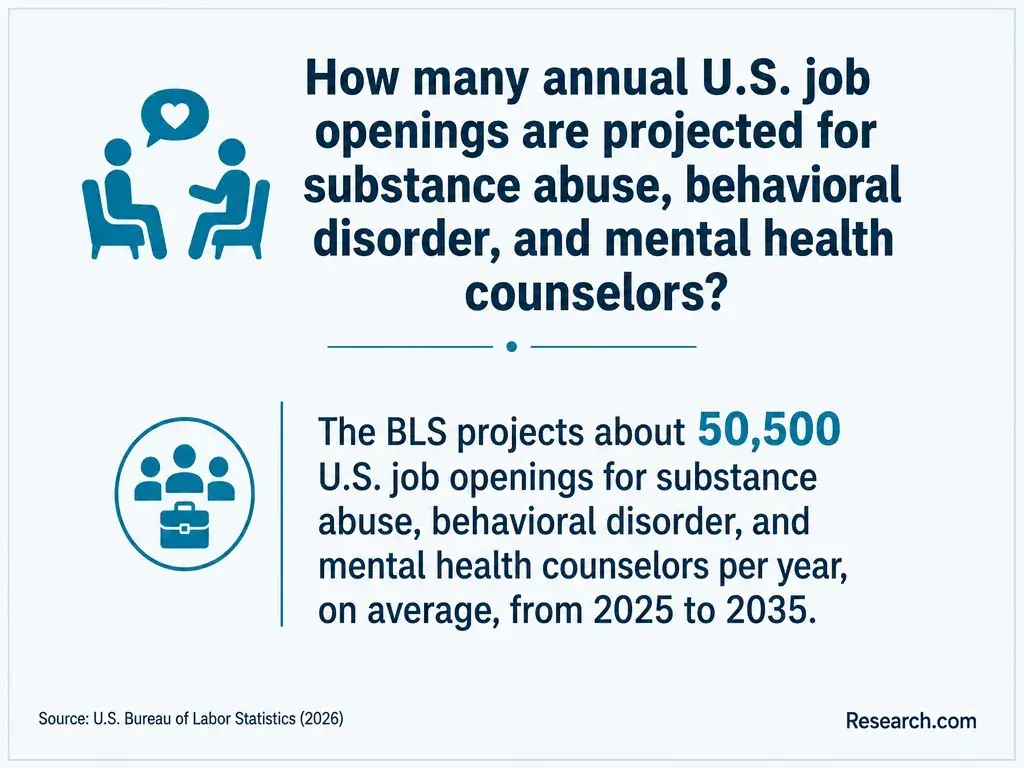
Salary depends on the occupation and credential, not the degree label. The U.S. Bureau of Labor Statistics groups substance abuse, behavioral disorder, and mental health counselors together in its Occupational Outlook Handbook; that category includes jobs whose education and licensing requirements may exceed a BA. Its occupation-wide wage and growth figures should therefore not be presented as outcomes for addictions-focused psychology graduates.
For a useful return-on-investment comparison, identify local postings you could qualify for immediately, then compare their stated pay and advancement requirements with the degree's total cost. If the desired work is research rather than counseling, affordable MA and MS psychology programs online may be worth investigating later - but only after checking whether a graduate degree is actually required for your target role.
Other Things You Should Know About Psychology
Often, through guest speakers or approved community activities. Ask how the program includes practitioner and community perspectives while protecting confidentiality and avoiding claims that one person's experience represents everyone's recovery.
Yes, as part of understanding the evidence and referral landscape. Learning why medications are used does not authorize a student to prescribe, recommend an individual treatment plan, or advise someone to stop medication.
Only with the necessary employer and instructor permissions. Remove identifying details where appropriate, follow workplace privacy rules, and ask whether the project needs additional institutional review before collecting or sharing information.
Ask to see a recent syllabus. Look for current reviews and guidelines alongside foundational studies, and assignments that require students to question study quality rather than repeat a textbook's conclusions.
- Eligibility Requirements for the Practice of Social Work | njconsumeraffairs.gov https://www.njconsumeraffairs.gov/sw/Pages/eligibilityrequirements.aspx
- Evidence-Based Practices Resource Center | samhsa.gov https://www.samhsa.gov/libraries/evidence-based-practices-resource-center
- Types of Financial Aid: Grants, Work-Study, and Loans | studentaid.gov https://studentaid.gov/understand-aid/types
- Cost of Attendance (Budget) | 2025-2026 Federal Student Aid Handbook https://fsapartners.ed.gov/knowledge-center/fsa-handbook/2025-2026/vol3/ch2-cost-attendance-budget
- General Schedule Qualification Policies | U.S. Office of Personnel Management https://www.opm.gov/policy-data-oversight/classification-qualifications/general-schedule-qualification-policies/
- Step 4 - Gather Credible Evidence | Program Evaluation https://www.cdc.gov/evaluation/php/evaluation-framework-action-guide/step-4-gather-credible-evidence.html
- Study designs - Oxford Centre for Evidence-Based Medicine https://www.cebm.ox.ac.uk/resources/ebm-tools/study-designs
- Transfer FAQ - Undergraduate Studies - University of Miami https://undergraduate.earth.miami.edu/admission/admission-options-deadlines/transfer-faq/index.html
- Addiction Concentration | Walden University https://www.waldenu.edu/online-bachelors-programs/concentrations/addiction
- How Do Transfer Credits Work When You Go Back to School? | Whitworth Online https://online.whitworth.edu/news-articles/how-do-transfer-credits-work-when-you-go-back-to-school/