2027 Online BA in Psychology - Addictions After an AAS in Occupational Therapy Assisting: Compare Transfer Credit and Remaining Coursework
Audited and Verified:
Our Editorial and Data Verification Process
Research.com uses government datasets, official education statistics and primary institutional information to support its career and degree guides. Our review process checks factual accuracy, occupational definitions, source dates and the requirements associated with the credentials discussed.
How This Article Was Fact-Checked
Our editorial team verifies salary estimates, employment projections, education requirements and program information against original data providers and official organizations. Salary figures are checked against the relevant occupational definitions and reporting periods. Information about licensure, accreditation and required in-person training is reviewed separately.
Fact-checked and verified on:

Co-Founder and Chief Data Scientist
An AAS in occupational therapy assisting gives you experience with clients and rehabilitation, but it may not cover the psychology major requirements of an online BA with an addictions focus. The distinction matters if you hope to finish efficiently while working as an occupational therapy assistant - or eventually move into recovery services. This guide shows how to compare transfer evaluations, identify remaining courses, estimate time and cost, and check whether the degree advances your intended career. The deciding document is not a transfer-credit maximum; it is a written degree audit showing exactly what you still need to graduate.
Key Things You Should Know
- An occupational therapy assisting AAS may supply general education and electives, but accepted credits do not necessarily satisfy psychology major, addictions-focus, or graduation requirements.
- For an illustrative 120-credit BA, 50 accepted AAS credits that fulfill only 40 degree requirements would leave 80 credits - not 70 - to complete; obtain a written audit before estimating savings.
- An addictions-focused psychology BA can support nonclinical recovery work, but it does not by itself qualify you to provide addiction counseling; compare the degree with your state's credential rules.
How many credits can an AAS in Occupational Therapy Assisting transfer to an online psychology bachelor's degree?
There is no reliable transfer number based on the AAS title alone. A university first decides which courses it will accept, then determines which accepted credits apply to its BA. Occupational therapy assisting courses may become free electives even when they do not replace psychology requirements. Transfer caps, minimum grades, course equivalencies, and credits that must be earned at the university also affect the result.
The following example shows why two transfer totals can produce different graduation plans. It is illustrative, not an estimate for a particular school.
| Illustrative audit item | Credits | Meaning |
| BA graduation requirement | 120 | Total credits needed for this example |
| AAS credits accepted | 50 | Credits the university will place on the record |
| Accepted credits that fulfill BA requirements | 40 | Credits that reduce this student's remaining work |
| Credits remaining | 80 | Subject to major, upper-level, and residency rules |
Ask for a course-by-course evaluation and a degree audit, not just an acceptance letter. Compare how each school applies English composition, anatomy, lifespan development, any psychology or statistics course, and OTA-specific classes. Schools may differ in whether an AAS completes a general education block. For a broader comparison of delivery and academic policies, see evaluating psychology degree programs for online learning; the individual university still has final authority over your credits.
What coursework remains after transferring an occupational therapy assisting degree into psychology?
Expect the largest gaps to be in the psychology major rather than in client-facing experience. An AAS may include anatomy, medical terminology, communication, and supervised OTA fieldwork, while a BA commonly requires psychology theory, statistics, research methods, advanced electives, and upper-level credits earned at the degree-granting school. Some students also need general education courses that their applied associate degree did not include.
Use the audit to separate the remaining work into three categories: unmet general education, psychology and addictions coursework, and graduation rules such as a capstone or residency requirement. Then check prerequisites and course rotation. Statistics may need to precede research methods, and an addictions elective offered infrequently can delay completion even when enough elective credits transfer. If shorter terms appeal to you, psychology degrees with condensed course schedules are worth comparing against your work schedule; shorter classes do not eliminate the required coursework.
Can an online psychology degree prepare you for addiction counseling careers?
It can provide relevant academic preparation, but preparation and professional eligibility are different. Psychology courses can help an OTA understand learning, motivation, substance use, research evidence, and recovery-support systems. Experience communicating with clients and working on interdisciplinary teams is also valuable. Neither that experience nor an addictions focus automatically authorizes counseling, diagnosis, or treatment.
If addiction counseling is the goal, compare the BA's actual courses and any approved field experience with your state's credential requirements before enrolling. Some pathways require specific addiction coursework, supervised practice, an examination, or a qualifying graduate degree. A psychology BA may leave gaps that a more directly aligned program addresses; compare addiction counseling programs and education requirements against the rules for the state and job title you want.
Online delivery does not determine accreditation. Verify that the university holds recognized institutional accreditation and that the accreditation covers the institution awarding the degree. Check the university's published degree name, whether addictions is an official concentration or a collection of electives, and whether required courses are actually offered online on a workable schedule.
Do not look for APA accreditation as a test of a general psychology BA: APA accreditation applies to specified professional psychology training programs, not ordinary undergraduate psychology majors. Nor does institutional accreditation establish eligibility for an addiction-counselor credential. If you may later pursue counseling, evaluate that future program under the rules relevant to its credential. Its additional expense matters too; mental health counseling education costs after aid provide a separate comparison, not a price estimate for this BA.
Requirements depend on the university's catalog and your entry term. A psychology BA commonly builds from introductory psychology into statistics and research methods, then covers areas such as development, social behavior, biological or cognitive psychology, and abnormal psychology. An addictions focus may add substance-use studies, prevention, recovery systems, or related electives. Verify which courses are required, which are optional, and which can count toward more than one requirement.
Your OTA coursework may strengthen your understanding of disability, functional goals, and client communication without substituting for psychological research training. Ask the department whether a prior statistics course meets its methods prerequisite and whether an OTA course warrants a documented substitution. If a later graduate degree is possible, preserve room for the prerequisites that that specific program expects. A psychology BA and psychology master's programs with intensive pacing are distinct academic steps; neither a quick BA nor a general psychology master's automatically supplies clinical credentials.
Universities typically request official transcripts from every college attended and evaluate the AAS under their transfer-admission rules. Minimum grades, GPA standards, application dates, and any separate requirements for entering the psychology major vary. Admission to the university does not guarantee that a particular OTA course will replace a psychology course - or that all accepted credits will count toward graduation.
Send the transfer office your transcripts and request the psychology department's review of potential major equivalencies. Keep course descriptions and syllabi, especially for statistics, development, behavioral health, and research-related classes. If an evaluation appears to overlook course content, ask about the formal substitution or appeal process before registering for a repeat course. Apply to the degree you actually intend to complete: evaluating forensic psychology degree admissions, for example, is a different comparison and does not establish the rules for an addictions-focused BA.
Start with credits remaining on the approved audit, then map required courses by term. For illustration, 60 remaining credits at 15 credits per semester would take four semesters if every needed course were available and prerequisites permitted that sequence. Working while enrolled, taking fewer courses, or waiting for a required class can extend that timeline. A compressed term may change scheduling without reducing the total credits.
For cost, multiply remaining billable credits by the school's published tuition rate, then add required fees, books, technology, and any travel or placement expenses. Compare the net cost of schools using their own audits: a lower per-credit price may be less attractive if more coursework remains. Ask the financial-aid office how your enrollment level and prior study affect eligibility; aid eligibility for online substance use counseling study can help frame those questions, but aid for another program is not a promise of funding for this BA.
Your OTA credential may remain your clearest qualification for OTA work. Combined with a psychology BA, it may also help you compete for nonclinical roles in recovery-program coordination, rehabilitation services, community outreach, intake support, or research and program support, depending on employer requirements and your experience. In those roles, responsibilities can include documentation, referrals, education, and coordination - not independent diagnosis or psychotherapy.
Compare postings by their actual duties rather than their titles. A recovery-support position may require a peer credential or lived-experience criteria; a case-coordination position may prioritize local service knowledge; a counseling position may require a state credential. If your interest shifts toward forensic work, short-duration online forensic psychology graduate options represent a separate educational decision, not a shortcut into addiction treatment or licensed forensic practice. If your aim is advancement within rehabilitation, first ask whether employer-supported training would serve it better than another degree.
There is no single nationwide addiction-counselor license. States define protected titles, permitted duties, education, supervised experience, examinations, and application procedures. Requirements can also differ between an entry-level substance-use credential and independent clinical practice. OTA licensure is a separate credential; it does not extend an OTA's scope of practice to addiction counseling.
Before selecting BA electives or paying for an internship, identify the exact title in your intended state and check that state board's published pathway. Ask whether the BA's courses qualify, who may supervise required hours, and whether experience can begin before the degree is awarded. If the target role requires a qualifying counseling master's, compare online clinical counseling graduate completion options only after checking the program against the state's education and clinical-training rules. An undergraduate placement should not be assumed to count as license-supervised practice.
What are the salaries and job outlook for psychology and addiction careers?
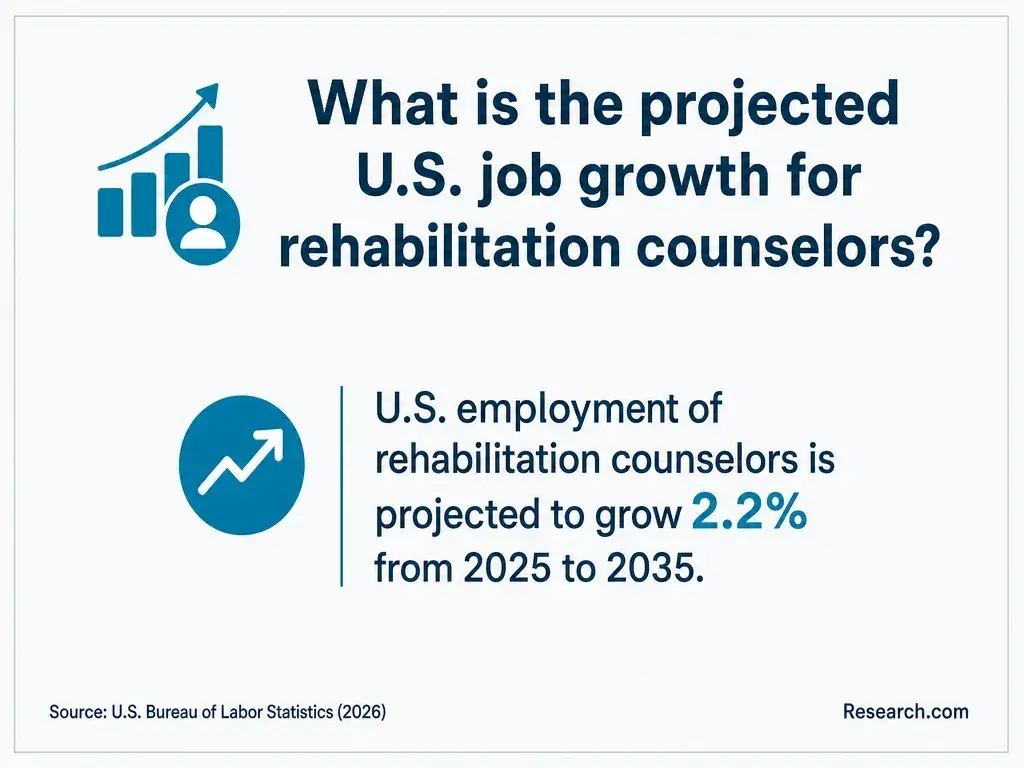
Use occupation-specific labor data, not "psychology graduate salary" claims. The U.S. Bureau of Labor Statistics groups substance abuse, behavioral disorder, and mental health counselors in one occupation; its published median and projected growth describe that combined workforce, not the pay or job prospects of an OTA who earns this BA. Many jobs in that group also require credentials beyond a bachelor's degree.
For a decision you can act on, compare local postings for the precise role you could qualify for after graduation with your current OTA pay, expected tuition, and any additional credential costs. Separate nonclinical recovery-support jobs from licensed counseling jobs when comparing wages. Understanding career progression in addiction recovery can help identify which next role you are pricing; the written degree audit and state credential rules determine whether the educational investment fits that role.
Other Things You Should Know About Psychology
Often, yes, if you maintain your OTA credential and can meet course deadlines. Check for live classes, group work, and any required visits before choosing a course load.
It can provide useful context for an essay or advising conversation, but it does not replace academic admission requirements. Describe your responsibilities accurately without presenting OTA work as counseling experience.
Yes. Compare written audits for the same entry term, including credits applied to requirements, remaining upper-level courses, residency rules, and course availability - not just total credits accepted.
You do not have to leave it to explore psychology. Identify the specific work you want to do differently, then compare employer training, targeted coursework, and the full BA before committing to the degree.
- Counselor Certification - DHCS - CA.gov https://www.dhcs.ca.gov/providers-partners/counselor-certification/
- .14 Evaluation and Review Process for Transfer of Courses and Credits. | Library of Maryland Regulations https://regs.maryland.gov/us/md/exec/comar/13B.06.02.14
- Online Bachelor's Degree in Psychology in Addictions | Purdue Global https://www.purdueglobal.edu/degree-programs/psychology/bachelor-psychology-addictions/
- Psychology (PSY) | Utah Tech University Catalog https://catalog.utahtech.edu/courses/psy/
- Applied Psychology: Addictions Studies, B.S. - CPS, CPSO | University of New Hampshire https://www.unh.edu/program/bachelor-science/applied-psychology-addictions-studies
- 4.1.18 Credit Earned through Transfer, Examination, and Prior Learning | Illinois State https://policy.illinoisstate.edu/academic/4-1-18/
- External Credit - Psychology - University of Pennsylvania https://psychology.sas.upenn.edu/node/164
- Transfer Credits to MC from US and Non-US Colleges and Universities | Montgomery College, Maryland https://www.montgomerycollege.edu/academics/learning-recognition-and-advancement/faq.html
- BAS Core General Education Requirements | University College Online Degree Programs https://basbls.uc.uiowa.edu/degree-requirements/bachelor-applied-studies/bas-core-general-education-requirements
- Online Psychology B.A. or B.S. Degree Completion Program | gsu.edu https://online.gsu.edu/program/psychology-ba-or-bs-completion-program/