
2027 Online BA in Psychology - General Psychology: Choosing a Program When Your Job Duties Already Match the Curriculum
Audited and Verified:
Our Editorial and Data Verification Process
Research.com uses government datasets, official education statistics and primary institutional information to support its career and degree guides. Our review process checks factual accuracy, occupational definitions, source dates and the requirements associated with the credentials discussed.
How This Article Was Fact-Checked
Our editorial team verifies salary estimates, employment projections, education requirements and program information against original data providers and official organizations. Salary figures are checked against the relevant occupational definitions and reporting periods. Information about licensure, accreditation and required in-person training is reviewed separately.
Fact-checked and verified on:

Co-Founder and Chief Data Scientist
If your job already involves outreach, case coordination, training, or behavioral data, an online BA in general psychology may teach concepts you use every day. That overlap can be valuable - or an expensive way to repeat what you know. This guide is for working professionals deciding whether the degree will meet a hiring requirement, strengthen skills they lack, or prepare them for further study.
It shows how to compare coursework with your actual duties, check the practical demands of online programs, and identify more direct alternatives before enrolling.
Key Things You Should Know
- Choose the BA for a specific unmet requirement or skill gap, not simply because its course titles resemble your job description.
- Compare required statistics, research methods, and electives with evidence you can already show an employer; job experience may not replace degree credits.
- A general psychology BA alone provides no clinical license. Confirm transfer credits, total remaining cost, scheduling, and the target job's qualifications before committing.
What Is an Online BA in General Psychology?
An online Bachelor of Arts in general psychology is a broad undergraduate degree covering behavior and psychological science, usually alongside general education requirements. Programs commonly include research methods and statistics, with electives that may address development, social behavior, cognition, or mental health as academic subjects. A BA is not automatically less rigorous than a BS; compare the required courses rather than the letters on the diploma.
For someone already employed in community services, education, human resources, or research support, the degree's potential value lies in what the job has not taught systematically: evaluating evidence, understanding measurement, writing research-based reports, and meeting a bachelor's-degree requirement.
Start with a degree audit and a course-by-course comparison, not a program's description of its ideal student. Online psychology degree program comparisons can help you identify options to investigate, but confirm each program's current requirements directly with the school.
Is an Online Psychology Bachelor's Degree Accredited?
Accreditation generally applies to the institution awarding a general psychology BA, not to the online format as a separate credential. Check the school's current institutional accreditation with its accreditor and the U.S. Department of Education's accreditation database. Also confirm that the degree, rather than merely a selection of online courses, is available to you in your state.
Do not expect American Psychological Association accreditation for a general psychology bachelor's program: APA accreditation applies to specified professional psychology training programs, not general BA degrees. A specialized title does not change that distinction.
If you are considering addiction-focused undergraduate psychology degrees, ask separately whether the coursework meets any education requirements for the particular state credential or job you want. Institutional accreditation alone does not establish that eligibility.
What Jobs Can You Get with a Bachelor's in Psychology?
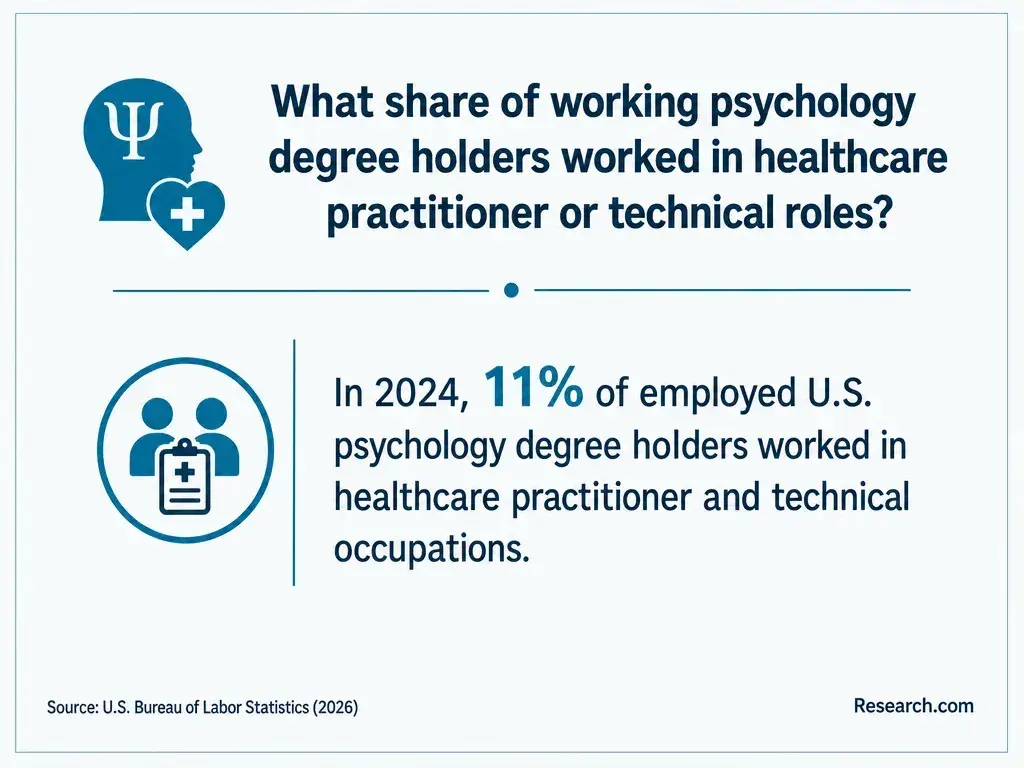
A psychology BA can support applications for nonclinical positions such as program assistant, intake or referral coordinator, research assistant, community outreach worker, or human-resources specialist. Employers may also accept other majors, require relevant experience, or specify additional training. Your current work may be the stronger qualification; the BA may matter chiefly where an employer requires a completed bachelor's degree for hiring or advancement.
Match the credential to the target job posting. For example, a recovery-support worker considering a different position in substance-use services should compare that position's degree and state credential requirements before selecting a broad BA or exploring lower-tuition bachelor's pathways in substance use counseling. Neither route should be presumed to authorize treatment.
If your employer already accepts your education and experience for the next role, supervised experience or targeted training may offer a more direct return.
Job-duty overlap is most useful when you separate performing a task from understanding its evidence base. The comparison below identifies where a general psychology BA might deepen existing work - and where a course cannot substitute for workplace authorization or supervision.
| Current duty | Potential academic gain | Important limit |
| Coordinating referrals or outreach | Developmental and social psychology can inform accessible communication. | Coursework does not authorize diagnosis or therapy. |
| Tracking service outcomes | Statistics and research methods can improve measure selection and interpretation. | Access to client data still requires organizational permission and privacy safeguards. |
| Training or supporting staff | Learning and motivation research can sharpen training design. | Promotion may depend more on management experience than on the major. |
| Assisting a research team | Methods and scientific writing can strengthen protocol and reporting skills. | Research roles may require specific software, supervision, or project experience. |
Mark each required course as new knowledge, useful formal evidence, or substantial repetition. Then ask whether electives, a supervised nonclinical project, or a different qualification address the gaps. A justice-services employee, for instance, should not assume that broader psychology study or evaluating faster-paced forensic psychology master's degrees is necessary for duties already covered by employer training. Check the requirements of the intended next position first.
Online delivery can reduce commuting, but it does not automatically make a program self-paced. An asynchronous lecture may coexist with fixed exam windows, group meetings, scheduled research collaboration, or an approved placement. Campus study may make in-person mentoring and research participation easier, though access varies by institution.
Ask for sample syllabi and the upcoming course schedule. Identify mandatory live sessions, any campus visits, how often major requirements run, and whether working students can obtain faculty feedback on research or applied work. If your shifts change, the difference between a recorded lecture and a required evening meeting may determine whether you can finish.
Fast-track bachelor's study in psychology is worth considering only if its course intensity and scheduling fit your work obligations; a shorter advertised timeline is not a personalized graduation date.
Schools set their own first-year and transfer admission rules, typically requesting prior academic records and other application materials. Admission to the institution does not settle how existing credits apply to the psychology major. If you have studied before, request an official evaluation showing general education, major, elective, and remaining residency requirements - not just the number of credits accepted.
Work experience may strengthen an application, but it ordinarily does not replace required courses unless the institution has an approved prior-learning-credit process. Ask the registrar or transfer office how statistics and research-methods coursework is evaluated, and obtain a written degree plan before estimating time or cost.
If you already hold a bachelor's degree and need a clinical credential rather than another undergraduate major, fast-track mental health counseling master's planning may be a more relevant investigation; verify prerequisites and state licensing requirements before applying.
Completion time depends on credits that apply to the degree, your enrollment pace, prerequisite order, and when required courses are offered. A returning student can have many accepted credits yet still need a sequence of major courses. Working full time may make a lighter, predictable load more sustainable than repeatedly withdrawing from accelerated terms.
Ask an advisor to map every remaining requirement to an actual term, including any capstone or experiential requirement. If the BA is intended as a step toward counseling, include the later program - not just the BA - in your timeline. Information on clinical counseling master's duration and earning potential can frame that larger decision, but the qualifying degree and supervised practice requirements depend on the intended state and occupation.
There is no reliable single price for an online psychology BA. Compare the school's current tuition basis, mandatory fees, required materials, remaining credits, and any travel or placement expenses. Multiply charges by the credits in your evaluated degree plan, not by the credits you hope will transfer. Include the effect of reduced work hours, if relevant.
Before enrolling, ask financial-aid staff about eligibility at your intended course load and ask your employer whether tuition assistance covers this degree, has grade conditions, or requires repayment after departure.
If your long-term goal requires graduate professional training, budget for that separately; budget planning for mental health counseling study can help you compare the subsequent expense. A lower-priced BA is not economical if it leaves required prerequisites unfinished or extends your time in school.
A general psychology BA itself does not require a clinical license, and it does not qualify a graduate to practice as a licensed psychologist or counselor. Some jobs accessible to BA graduates have separate state, employer, or program-specific requirements - particularly roles involving substance-use counseling, peer support, or services to vulnerable populations. Verify the actual job duties and the responsible state regulator's rules rather than relying on a degree title.
If your aim is psychotherapy, investigate a qualifying professional pathway and its education, supervised experience, and examination requirements. When comparing accelerated accredited clinical mental health counseling programs, confirm that the particular program and your planned location align with the applicable licensing board. Faster coursework does not eliminate required supervised training.
What Are the Salaries and Job Outlook for Psychology Graduates?
There is no single salary or employment forecast for "psychology graduates." The U.S. Bureau of Labor Statistics reports wages and projections by occupation, not by undergraduate major.
An intake coordinator, research assistant, and human-resources specialist may have different pay structures and qualification requirements even when each uses psychology-related skills. A psychologist's occupational median is particularly misleading as a BA outcome because psychologist roles generally require substantial further education and licensure.
For a useful comparison, identify the exact job title and location you want, consult the latest relevant Bureau of Labor Statistics Occupational Outlook Handbook entry, and compare it with current local postings and your employer's pay scale. Then ask whether the BA changes your eligibility or advancement prospects enough to justify its remaining cost.
If the next role instead calls for graduate-level research or applied training, compare its requirements and financing with affordable MA and MS psychology programs online; a general psychology master's should not be mistaken for a clinical license.
Other Things You Should Know About Psychology
Possibly, but employment alone does not establish academic credit. Ask the program whether it permits workplace-based projects, what supervision and approvals it requires, and whether your employer will authorize the proposed work.
Use only material you have permission to share. Remove confidential client and organizational information; even a report without names may disclose sensitive details. A newly written, hypothetical sample may be safer.
Diploma wording is institution-specific. Request a sample diploma and transcript description from the registrar if the distinction matters to you or an employer.
Ask whether any accredited bachelor's degree satisfies the requirement. If so, compare programs by credits remaining, cost, schedule, and relevance; psychology may not be your fastest or most useful completion route.
- Cost of Attendance (Budget) | 2026-2027 Federal Student Aid Handbook https://fsapartners.ed.gov/knowledge-center/fsa-handbook/2026-2027/vol3/ch2-cost-attendance-budget
- Work-Based Learning Quality Expectations | colorado.gov https://dhr.colorado.gov/work-based-learning-quality-expectations
- Career Outcomes - Psychology Major https://www.scranton.edu/academics/cas/psychology/professional-outcomes/careers-with-bachelors-degree.shtml
- Online Bachelor's in Psychology | University of Kansas https://online.ku.edu/undergraduate-programs/online-bachelors-psychology
- BSW vs BA Psychology: Jobs, Salary & More - AU https://online.aurora.edu/program-resources/social-work-vs-psychology-degree/
- Transferable Skills: Examples for Psychology Graduates | East Carolina University https://onlineprograms.ecu.edu/blog/transferable-skills-examples/
- Careers in Psychology | Cal State LA https://www.calstatela.edu/nss/psychology/careers-psychology
- What's the Difference Between Asynchronous and Synchronous Learning? | Ohio State Online https://online.osu.edu/content-hub/blogs/whats-the-difference-between-asynchronous-and-synchronous-learning/
- Undergraduate Transfer Credit Policies | baylor.edu https://registrar.web.baylor.edu/records-services/undergraduate-transfer-credit/undergraduate-transfer-credit-policies
- How Do Transfer Credits Work When You Go Back to School? | Whitworth Online https://online.whitworth.edu/news-articles/how-do-transfer-credits-work-when-you-go-back-to-school/


