2027 Online BA in Psychology - Addictions Admissions with an Employer Recommendation Instead of an Academic Reference: What to Ask Before Applying
Audited and Verified:
Our Editorial and Data Verification Process
Research.com uses government datasets, official education statistics and primary institutional information to support its career and degree guides. Our review process checks factual accuracy, occupational definitions, source dates and the requirements associated with the credentials discussed.
How This Article Was Fact-Checked
Our editorial team verifies salary estimates, employment projections, education requirements and program information against original data providers and official organizations. Salary figures are checked against the relevant occupational definitions and reporting periods. Information about licensure, accreditation and required in-person training is reviewed separately.
Fact-checked and verified on:

Co-Founder and Chief Data Scientist
If you have been working rather than studying, an employer may know your abilities better than a former professor. But an online BA in psychology with an addictions focus may require an academic reference, permit a professional one, or request no recommendation at all. That difference matters before you pay an application fee or ask your supervisor for a letter.
This guide helps returning students and career changers confirm the policy, present relevant work experience, and judge whether the degree fits their education and career goals.
Key Things You Should Know
- An employer recommendation can replace an academic reference only if the specific program permits it; ask whether the rule differs for first-year, transfer, and returning applicants.
- Confirm the required number and type of letters before requesting one: some programs require no recommendations, while others distinguish professional references from academic ones.
- A psychology BA commonly entails about 120 semester credits in total, but an admissions decision does not establish how many of your prior credits will satisfy degree requirements.
What Is an Online BA in Psychology With an Addictions Focus?
It is an undergraduate psychology degree that includes study of substance use, behavior, prevention, and recovery. "Addictions focus" might mean an official concentration recorded by the school, a set of electives, or simply a program description. Ask which applies: the distinction affects what appears on your transcript and how much specialized coursework you can expect.
The degree can suit someone moving from customer service, community outreach, health administration, or another field into nonclinical behavioral-health work. It is not the same as a program designed specifically to meet addiction-counselor credential rules. If counseling is your intended occupation, compare the curriculum with distance learning degrees in addiction counseling and check your state's requirements before choosing either route.
Can You Apply With an Employer Recommendation Instead of an Academic Reference?
Possibly, but do not assume the letters are interchangeable. The application instructions for your entry term control. A school may accept a supervisor's letter from every applicant, accept one only from people who have been out of school for a specified period, or require an instructor regardless of work history. Some online bachelor's programs do not request letters.
Send admissions a short, specific question before approaching a recommender: "I am applying as a returning transfer student and last took classes several years ago. If a recommendation is required, may my current supervisor submit the professional letter in place of an academic reference? Does the answer change for admission to the psychology major or addictions concentration?" Ask for a reply in writing and confirm the deadline, submission method, and whether a work email address is required.
If an employer letter is allowed, choose someone who has directly observed your work. Give them your résumé, the program description, and examples they can substantiate: careful documentation, communication with diverse clients, ethical handling of sensitive information, or dependable teamwork. They should describe your readiness to study, not claim that workplace experience qualifies you to counsel or diagnose people. When comparing psychology degree schools and online formats, check each school's own reference policy rather than relying on a general program listing.
What Admission Requirements Do Online Psychology Programs Accept?
Requirements depend on whether you seek first-year admission, transfer admission, readmission, or entry into a separately administered major. An employer letter addresses only the recommendation requirement; it does not replace transcripts, minimum academic standards, or an evaluation of prior credit.
The following distinctions help you identify what to submit and what still needs a school decision.
| Application item | What may vary by school | What it does not establish |
| Transcripts | Which prior schools must report and whether unofficial copies suffice initially | That accepted courses satisfy psychology-major requirements |
| Recommendation | Whether none, an academic letter, or a professional letter is required | Admission when other criteria are unmet |
| Work experience | Whether a résumé, essay, or experience description is requested | Automatic academic credit or placement approval |
| Transfer evaluation | How prior courses apply to general education, the major, electives, and residency rules | A graduation date until the degree audit is complete |
Collect transcripts from every prior institution, relevant course syllabi if you hope to establish statistics or research-methods equivalence, and any name-change documentation needed to match records. Request an official degree audit from the receiving school's transfer or registrar office; ask the psychology department to review disputed major equivalencies. Even programs with similar names can differ: fast-track bachelor's study in forensic psychology, for example, should be checked against its own admissions and transfer rules rather than treated as interchangeable with an addictions-focused BA.
Check the institution's current accreditation status with the accreditor and the U.S. Department of Education's recognized-accreditor information, then confirm that the online degree is offered by that institution. Ask the school whether any specialized approval it advertises covers this exact program. Accreditation of a different degree at the same university does not transfer to the BA.
The American Psychological Association does not accredit general psychology bachelor's programs. Institutional accreditation can matter for credit mobility and eligibility for federal student aid, but it does not certify that an addictions focus meets a state's counselor rules. This scope distinction also matters when reviewing forensic psychology degree accreditation comparisons: verify the institution, degree level, and claimed professional recognition separately.
Expect a foundation in psychology alongside general education. Relevant major courses may include statistics, research methods, developmental or social psychology, biological bases of behavior, and psychopathology. Addiction-related options may address substance use, prevention, recovery systems, and the effects of social context. The actual catalog - not the concentration label - shows which courses are required, which are electives, and when they are offered.
For a returning student, sequencing matters as much as course titles: a statistics prerequisite or an addiction elective offered infrequently can extend the time needed to finish. If your longer-term goal is licensed counseling, compare the BA's educational content with the substantially different graduate training described in reviewing accelerated clinical counseling program formats. Undergraduate exposure to counseling concepts is not supervised professional counseling preparation.
A bachelor's degree commonly requires about 120 semester credits overall, but your remaining time depends on the receiving school's degree audit, course sequence, enrollment pace, and residency requirement. Accepted transfer credits may count only as electives; an accepted statistics course, for example, may not fulfill the major's statistics requirement without departmental approval.
Compare the cost to finish, not just advertised tuition per credit. Request a written estimate of remaining required credits and charges for tuition, mandatory fees, materials, and any travel or unpaid applied experience. Ask financial aid staff how your planned enrollment pace affects aid, and check whether an employer's education benefit has grade, course-approval, or repayment conditions. Lower-tuition undergraduate psychology options are worth comparing only after each school evaluates how your prior coursework would apply.
Online study can reduce commuting, but it does not necessarily remove scheduled obligations. Ask whether classes are asynchronous, whether live discussions or exams occur at fixed times, and whether internships, research activities, or campus visits are required. A campus program may offer easier access to a local research team or agency partnership; an online program may be more workable alongside a job if its actual schedule fits yours.
Do not confuse a short advertised completion time with a feasible plan. When considering accelerated undergraduate psychology program choices, ask for a term-by-term plan based on your approved transfer audit and available courses. If you hope to use your current workplace for an applied assignment, obtain both academic approval and employer permission before assuming it will count.
Depending on the employer, location, and your experience, the BA may support applications for recovery-service support, community outreach, intake coordination, case support, prevention programming, or research-assistant roles. Duties might include explaining resources, maintaining records, coordinating referrals, or helping evaluate a program - not independently diagnosing or treating substance use disorders.
Start with the job you want and read local postings for its required credential, experience, and permitted duties. Existing work in client communication, scheduling, data handling, or community partnerships may be valuable, while supervised experience may fill a more important gap than another elective. If you are comparing substantially different graduate career paths, higher-paying career paths after forensic psychology graduate study concern different qualifications and should not be treated as outcomes of this addictions-focused BA.
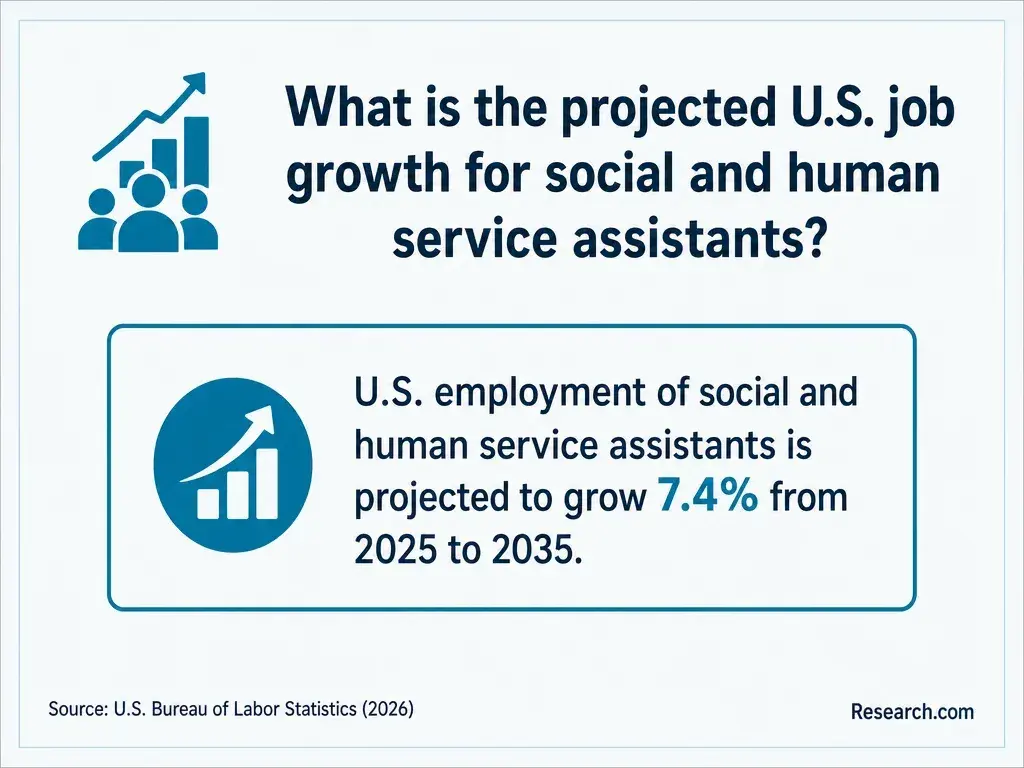
There is no single salary or growth rate for graduates of an addictions-focused psychology BA. Pay follows the occupation, location, employer, experience, and any required credential. The U.S. Bureau of Labor Statistics groups substance abuse, behavioral disorder, and mental health counselors in one occupation; its occupation-wide wage and employment projections are useful for researching counseling demand, but they are not a starting-salary estimate for BA holders. Many jobs in that group require additional education, supervised experience, or licensure.
For a meaningful comparison, match the duties and credentials in a local job posting to the corresponding Bureau of Labor Statistics occupation, then compare likely pay with your degree's remaining cost and the income you might forgo while studying. If licensed counseling is your goal, a separate look at the mental health counseling master's investment and pay outlook is more relevant than assuming a BA leads to a counselor's wage.
What Licenses or Certifications Are Needed for Addiction Counseling Careers?
Requirements vary by state and job title. A state may distinguish substance-use counseling credentials from licensed mental health counseling and from peer-support certification; each can have different education, examination, supervised-experience, and scope-of-practice rules. An addictions-focused psychology BA alone does not authorize independent therapy, diagnosis, or use of a protected professional title.
Before applying, identify the exact role and state where you intend to work. Ask that state's licensing or certification authority whether the proposed BA's courses count, what additional training and supervision are required, and whether an approved addiction-counseling or other professional program would be a more direct route. If further counseling education is necessary, include that next credential - not just the BA - when evaluating the net cost of counseling education. If your goal is nonclinical outreach or coordination, targeted workplace training may be more direct than pursuing a clinical credential.
Other Things You Should Know About Psychology
Ask for the policy applicable to your applicant category and entry term in writing. If the application portal conflicts with that answer, contact the admissions office before submitting or paying.
Often, if professional references are accepted and the person can describe your work directly. Confirm any school rules about how recently they supervised you and which email address they must use.
Follow the application's instructions and make the choice you are comfortable with. Waiving access does not change whether an employer letter satisfies an academic-reference requirement.
It may document professional strengths, but a future graduate program may request academic evidence. If graduate study is a possibility, build relationships with psychology instructors and seek opportunities to demonstrate your writing and research skills during the BA.
- When to use personal vs. professional recommendations | Oak Ridge Institute for Science and Education (ORISE) https://orise.orau.gov/internships-fellowships/blog/personal-vs-professional-references.html
- Substance Abuse and Addictions Concentration, Counseling and Applied Psychological Science Degree, BS | ASU https://degrees.asu.edu/bachelors/major/ASU00/LSCAPSAABS/counseling-and-applied-psychological-science-substance-abuse-and-addictions
- Transfer requirements - UC Admissions - University of California https://admission.universityofcalifornia.edu/counselors/preparing-transfer-students/transfer-requirements.html
- Providing employee references - UW Human Resources https://hr.uw.edu/policies/providing-work-references-to-prospective-employers/
- Preparing to Use Your Bachelor's Degree in Psychology | apa.org https://www.apa.org/education-career/guide/bachelors
- Reference Check Guidelines - UF Administrative | Administrators https://admin.hr.ufl.edu/hiring/making-offer/reference-check-guidelines/
- Applied Psychology: Addictions Studies, B.S. - CPS, CPSO | University of New Hampshire https://www.unh.edu/program/bachelor-science/applied-psychology-addictions-studies
- Online Bachelor's Degree in Psychology in Addictions | Purdue Global https://www.purdueglobal.edu/degree-programs/psychology/bachelor-psychology-addictions/
- Letters of Recommendation Guide | uoregon.edu https://urds.uoregon.edu/letters-recommendation-guide
- Letters of Recommendation - The Writing Center https://writingcenter.unc.edu/tips-and-tools/letters-of-recommendation/