2027 Online AGACNP Programs for Nurses in Ohio: MSN Options and Acute Care Clinicals
Audited and Verified:
Our Editorial and Data Verification Process
Research.com uses government datasets, official education statistics and primary institutional information to support its career and degree guides. Our review process checks factual accuracy, occupational definitions, source dates and the requirements associated with the credentials discussed.
How This Article Was Fact-Checked
Our editorial team verifies salary estimates, employment projections, education requirements and program information against original data providers and official organizations. Salary figures are checked against the relevant occupational definitions and reporting periods. Information about licensure, accreditation and required in-person training is reviewed separately.
Fact-checked and verified on:

Co-Founder and Chief Data Scientist
An online adult-gerontology acute care nurse practitioner (AGACNP) MSN can let an Ohio RN complete much of the coursework remotely, but it cannot make supervised acute care training remote. The right choice depends on whether a program accepts Ohio students, offers an adult gerontology acute care track, and can support clinical placements you can realistically complete.
This guide compares Ohio university options, explains the education-to-licensure path, and identifies the questions to settle before committing tuition or changing your work schedule.
Key Things You Should Know
- Ohio nurses can investigate online or hybrid AGACNP MSN tracks at the University of Cincinnati, Ohio University, and Kent State University; confirm each track's current format and Ohio enrollment eligibility directly.
- Online coursework does not replace supervised, program-approved acute care clinicals. ANCC's AGACNP certification pathway specifies at least 500 faculty-supervised clinical hours; a school may require more.
- Graduation, national AGACNP certification, and Ohio APRN licensure are separate steps. The two relevant national certification options are ANCC's AGACNP-BC and AACN Certification Corporation's ACNPC-AG.
What are online AGACNP programs for nurses in Ohio?
An online AGACNP program prepares an already-licensed RN to assess, diagnose, and manage acutely ill adults, including older adults, within the nurse practitioner role. The population focus is adult gerontology; the care focus is acute illness and complex conditions. It is not an initial RN program, and it is not interchangeable with a family nurse practitioner (FNP) or adult-gerontology primary care track.
"Online" usually describes didactic coursework. A track may still require scheduled live classes, skills assessments, campus visits, and in-person clinical rotations. Nurses whose highest nursing credential is an associate degree should first check whether a university accepts them into an appropriate bridge; online ADN-to-MSN program comparisons can help frame that separate entry route decision, but a bridge must specifically lead to AGACNP preparation to serve this goal.
Which Ohio universities offer online AGACNP MSN programs?
The following Ohio universities are reasonable starting points for an AGACNP MSN search. Program offerings and delivery arrangements can change by admission term, so treat this as a shortlist to verify—not a guarantee of an open, fully online cohort.
| Ohio university to investigate | Comparison question that matters most |
| University of Cincinnati | Which AGACNP MSN courses or assessments require attendance, and what placement support is available in your part of Ohio? |
| Ohio University | Is the adult-gerontology acute care MSN track enrolling for your intended term, and how are clinical sites approved? |
| Kent State University | What is the track's current online/on-site mix, and can required clinical experiences be completed near home? |
Ask each school for the current AGACNP-specific curriculum, total program cost, clinical handbook, and written Ohio eligibility statement. Check institutional accreditation and the nursing program's applicable accreditation separately; neither alone establishes that a particular clinical site will be approved. A lower advertised tuition rate is only a starting point: cost-focused MSN pathways for bachelor's-prepared nurses offer broader price context, but an inexpensive MSN without the acute care NP track will not meet this objective.
What are the Ohio AGACNP education and licensure requirements?
For an Ohio RN seeking AGACNP practice, the sequence is appropriate graduate population-focus preparation, graduation, qualifying national certification, and an Ohio APRN license under Ohio Board of Nursing requirements. The program must provide advanced practice education and supervised experiences appropriate to adult-gerontology acute care; an MSN in education, leadership, or another NP population focus is not a substitute.
Before enrolling, have the school confirm that its specific track meets the educational requirements for the certification exam you intend to take and supports an application for Ohio APRN licensure. Check the board's current application, RN license, certification, and prescribing-related requirements directly. An RN's existing critical care experience strengthens clinical readiness but does not replace required graduate coursework or approved NP clinical hours. Likewise, exploring RN-to-BSN nontraditional clinical formats may help an associate-prepared RN plan an earlier academic step, but RN-to-BSN experiential work does not satisfy AGACNP clinical preparation.
AGACNP clinicals involve supervised direct patient care in settings that meet the program's acute care objectives. Depending on school approval and available preceptors, experiences may occur in hospital services, specialty inpatient teams, emergency or critical care environments, and other settings treating acutely ill adults. A hospital job does not automatically count as a student placement.
Clarify placement responsibility before paying a deposit. Some schools identify sites or preceptors; others require students to propose them, with faculty approval and affiliation agreements still needed. Ask who initiates contracts, how far from home students may travel, whether a current workplace is eligible, which professionals may precept, and what happens if a site withdraws. Confirm that the patient population, documented hours, supervision, and evaluation will count toward both graduation and your intended certification pathway. ANCC specifies at least 500 faculty-supervised clinical hours for its AGACNP certification eligibility; do not assume that figure is a school's complete requirement or that simulation or RN employment can replace it.
Placement practices differ across NP specialties. Family NP programs with clinical placement assistance illustrate a useful question to ask about support, but FNP sites and preceptors cannot simply be substituted for adult-gerontology acute care experiences.
An AGACNP MSN typically combines graduate nursing foundations with advanced assessment, pathophysiology, and pharmacology, followed by adult-gerontology acute care diagnosis and management courses. Coursework may address complex illness, diagnostic reasoning, therapeutics, transitions of care, evidence appraisal, and professional practice. Clinical courses connect those subjects to supervised encounters and faculty assessment.
Compare course sequences, not just titles: a school may require foundational courses before specialty clinicals, affecting when an employed RN must reduce shifts. Simulation can help develop and assess skills, but applicants should ask what is simulated and what must occur with patients under supervision. A practice-focused DNP is a different award with additional requirements; comparing DNP practice and project requirements should not be mistaken for a way to bypass the direct-care education required for an AGACNP role.
AGACNP MSN tracks generally expect a current RN license, qualifying prior nursing education, and graduate academic readiness. Schools may also assess GPA, recommendations, a statement of goals, and relevant experience; some specify recent acute care or critical care nursing experience. Admission criteria can differ from what a hospital or preceptor later requires for clinical clearance.
Submit a résumé that distinguishes RN responsibilities from NP-level experiences you hope to learn. Ask admissions to evaluate your exact degree and RN license history, and ask the clinical office separately about background checks, immunizations, site access, and placement timing. A non-nurse first needs an initial RN pathway: ABSN eligibility and application requirements concern that earlier step, not direct entry into a postlicensure AGACNP MSN.
Time to completion depends on credits, course sequencing, enrollment intensity, and clinical availability. Request a term-by-term plan for both full-time and part-time study rather than relying on an advertised fastest completion time. A delayed clinical contract or a required course offered only in certain terms can extend enrollment.
Compare each school's written estimate using the same cost categories: tuition by credit, mandatory university and nursing fees, books and technology, clinical compliance expenses, travel or lodging for placements and campus visits, certification and licensure fees, and income lost if you cut work hours. Ask whether employer tuition assistance covers graduate nursing credits and whether repayment conditions apply. If you are choosing between MSN and doctoral entry, a guide to shorter DNP programs provides a separate timeline comparison; a shorter advertised DNP schedule is not proof of lower total cost or easier clinical access.
The two national credentials to investigate are the American Nurses Credentialing Center's AGACNP-BC and AACN Certification Corporation's ACNPC-AG. Both relate to adult-gerontology acute care NP practice, but they have their own eligibility rules, applications, examinations, and renewal requirements. Confirm that your program documents the education and supervised clinical hours required by the certifier you choose.
National certification is distinct from an Ohio APRN license and does not itself authorize practice. An MSN-prepared NP considering a later population focus change may investigate family NP certificate options for MSN-prepared nurses; an FNP certificate would require its own approved preparation and would not retroactively broaden an AGACNP's scope.
After meeting certification, Ohio licensure, and employer credentialing requirements, an AGACNP may pursue roles on hospital medicine, critical care, cardiology, surgical, or other acute and specialty teams serving adults. Actual duties depend on the position, institutional privileges, collaborative workflows, and applicable law. Graduation alone does not qualify someone to start independent practice or bypass specialty onboarding.
Compare job postings for patient population, rotating shifts or calls, procedural expectations, orientation length, physician and NP team support, and required prior RN or NP experience. An ICU RN may bring valuable acuity experience yet still need a structured transition to NP decision-making. If the goal is longitudinal care across the lifespan rather than acute adult care, a guide to accelerated family nurse practitioner study describes a different population-focus decision—not a substitute credential for an AGACNP opening.
What salary and job outlook can Ohio AGACNPs expect?
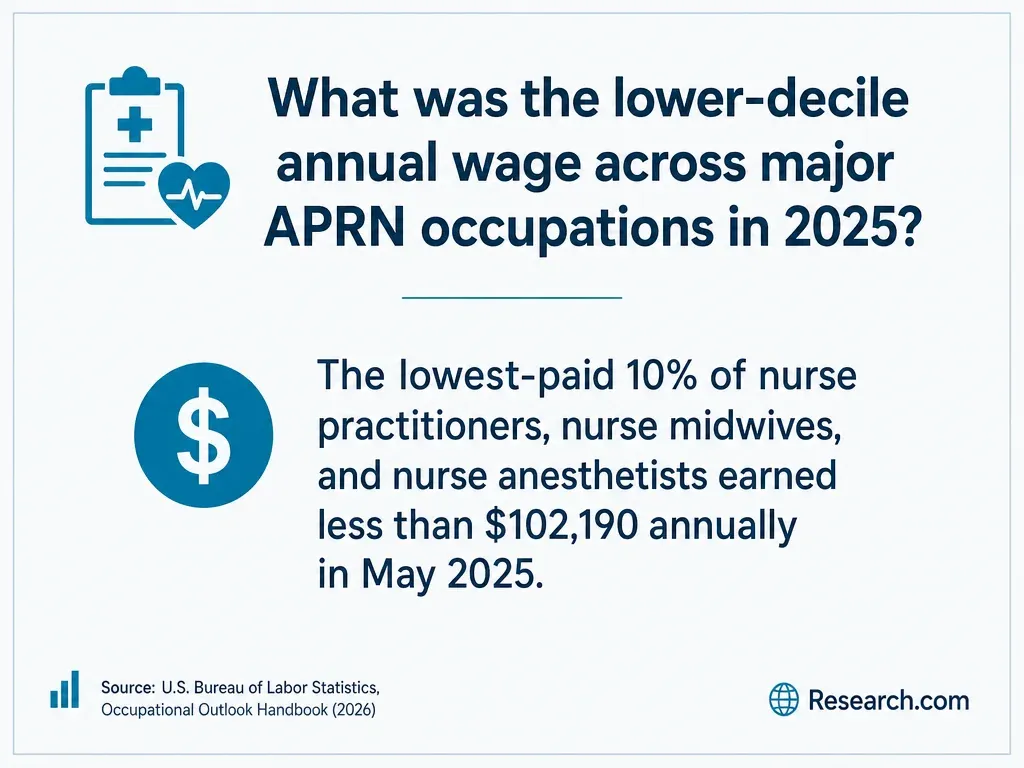
The U.S. Bureau of Labor Statistics reports pay and employment projections for the broader nurse practitioner occupation, not a separate Ohio AGACNP category. Those national figures can indicate demand for NPs generally, but they cannot predict an Ohio acute care offer. Pay can vary substantially with location, specialty service, experience, shift expectations, and employer type; a new graduate should compare actual Ohio postings and written offers rather than treat an occupation-wide median as a starting salary.
For a useful return-on-investment comparison, set expected compensation against total education costs and any earnings forgone during clinical terms. Include the value of staying in an RN role if it already meets your professional goals. If considering another advanced degree instead, DNP study options beyond highly selective programs may broaden an academic search, but admissions accessibility does not establish AGACNP eligibility, local clinical capacity, or a salary premium.
Other Things You Should Know About Nursing
Possibly during some coursework. Ask for the clinical-term schedule and attendance requirements before assuming full-time shifts will remain feasible.
Potentially. Obtain written confirmation that the school accepts Ohio students, can approve your Ohio clinical placements, and supports the certification and licensure route you intend to use.
No. RN multistate practice privileges do not replace the APRN authorization required for an advanced practice role in Ohio.
Not necessarily. Ask an AGACNP post-graduate certificate program for a formal review of prior courses and clinical documentation; it must determine the additional population-focus preparation required.
- Rule 4723-5-20 - Ohio Administrative Code https://codes.ohio.gov/ohio-administrative-code/rule-4723-5-20
- Cost of Attendance (Budget) | 2025-2026 Federal Student Aid Handbook https://fsapartners.ed.gov/knowledge-center/fsa-handbook/2025-2026/vol3/ch2-cost-attendance-budget
- APRN - Advanced Practice Registered Nurses | Ohio Board of Nursing https://nursing.ohio.gov/advanced-practice-registered-nurses-aprn
- Online Acute Care Nurse Practitioner (AG-ACNP) | Georgetown https://nursing.georgetown.edu/degree-programs/masters/ag-acnp-online/
- AGACNP Career Profile - nursing | Purdue Global https://www.purdueglobal.edu/blog/nursing/agacnp-career-guide/
- Clinical Placements | College of Nursing https://nursing.osu.edu/clinical-placements
- Adult-Gerontology-Acute Care Nurse Practitioner - MSN https://catalogs.ohio.edu/preview_program.php
- Adult-Gerontology Acute Care Nurse Practitioner MSN | University of Cincinnati https://www.nursing.uc.edu/academic-programs/msn/adult-gerontology-acute-care.html
- Adult-Gerontology Acute Care Nurse Practitioner - AGACNP | Ohio University https://www.ohio.edu/chsp/nursing/graduate/masters/adult-gerontology-acute-care-nurse-practitioner