2027 Nursing Doctoral Interviews: Explaining Your Research Interests and Career Goals
Audited and Verified:
Our Editorial and Data Verification Process
Research.com uses government datasets, official education statistics and primary institutional information to support its career and degree guides. Our review process checks factual accuracy, occupational definitions, source dates and the requirements associated with the credentials discussed.
How This Article Was Fact-Checked
Our editorial team verifies salary estimates, employment projections, education requirements and program information against original data providers and official organizations. Salary figures are checked against the relevant occupational definitions and reporting periods. Information about licensure, accreditation and required in-person training is reviewed separately.
Fact-checked and verified on:

Co-Founder and Chief Data Scientist
A nursing doctoral interview asks you to do more than name a clinical topic. You need to explain the problem you want to address, why it matters, and how the program could help you do credible work on it. That can be difficult when your interests are still developing or your career goal spans practice, teaching, and research. This guide helps experienced nurses and research-oriented applicants build a focused answer, distinguish PhD from DNP expectations, and identify the program details worth checking before committing.
Key Things You Should Know
- Prepare a three-part answer: the nursing problem, the question or improvement goal you would pursue, and why this program is a feasible place to pursue it.
- For a PhD interview, emphasize your potential to develop and investigate research questions; for a DNP interview, emphasize applying evidence and evaluating change in a practice setting.
- Bring one primary interest and a workable alternative - not a promised dissertation topic, guaranteed clinical site, or claim that a doctoral degree automatically qualifies you for a new license or job.
What questions are asked in nursing doctoral interviews about research interests and career goals?
Interviewers commonly test whether you can connect a nursing problem to an achievable course of study. They may ask what led you to the topic, what is already known, whose outcomes matter, how you might study or improve the problem, and why their faculty and resources fit your plans. Expect follow-ups about your intended role after graduation, your preparation for doctoral work, and how you would respond if data or site access proved difficult.
Practice answering these questions aloud rather than memorizing a speech:
- "What problem in your practice or prior research would you like to investigate, and why?"
- "What would you need to learn before choosing a design, intervention, or outcome measure?"
- "Which faculty interests or program resources connect to your goals?"
- "What do you hope to do professionally five years after graduation?"
A panel may also ask why doctoral study, rather than another qualification, is necessary. For example, an applicant whose sole goal is to become a psychiatric nurse practitioner should evaluate an appropriate graduate specialty pathway - including comparing accelerated psychiatric nursing master's programs - instead of treating a research doctorate as a route to NP eligibility.
How should you explain your nursing research interests during a doctoral interview?
Start with a specific population and setting, then name the uncertainty you want to address. A strong answer distinguishes an observation from a conclusion: seeing inconsistent follow-up after discharge might motivate a question, but it does not establish the cause or prove a proposed solution works.
Use this sequence to make your answer concrete without pretending your project is already approved:
- Describe the problem and the nursing perspective that makes it important.
- State a provisional question or improvement aim, including a population and an outcome that could be measured.
- Explain what evidence, methods training, collaborators, and access you would need to refine the work.
- Name a faculty or program connection you have verified, while inviting feedback on fit.
For example: "In outpatient care, I have seen how difficult it can be to sustain follow-up after a mental health referral. I would like to examine which parts of the referral process patients find hardest to navigate, then develop a question that fits the available evidence and data. I'm interested in this program's work on care access, and I want stronger methods training before selecting a design." This is a proposed direction, not a claim about patient outcomes or permission to use records.
If your real objective is a different clinical population focus, say so. Comparing online PMHNP certificate schedules may be more relevant for an already-qualified APRN seeking additional specialty preparation than a doctorate centered on original research; eligibility depends on the certificate program, certifier, and state.
How can you connect your nursing career goals to doctoral study?
Explain the work you want to do, the capabilities it requires, and the doctoral experiences that would build those capabilities. "I want to improve community care" is a motivation; "I want to design and evaluate community-based interventions while developing an independent research program" describes a potential PhD trajectory. Leading an organization-wide evidence-based change effort and evaluating its implementation may point instead toward a DNP.
Be honest if your plan has more than one possible endpoint. You might say that you are exploring a faculty role but want to learn whether the program offers sustained research mentorship, teaching opportunities, and support for scholarly publication. A doctorate can strengthen preparation; it does not guarantee a faculty appointment or promotion.
Keep regulated clinical goals separate from scholarly ones. If the immediate goal is family NP practice, compare the required population-focused education and supervised preparation first. Even 12-month family NP study schedules should be assessed against your prior credentials, clinical placement needs, certification eligibility, and state requirements - not treated as interchangeable with doctoral research training.
Programs set their own entry requirements. Some admit BSN-prepared nurses, while others expect a master's degree or specific graduate preparation. Applicants can draw on clinical practice, quality-improvement work, evidence appraisal, statistics or methods coursework, teaching, and collaboration with researchers. Publications and a thesis can help demonstrate readiness, but neither is universally required.
Prepare two brief examples: one showing how you identified and investigated a nursing problem, and another showing how you handled uncertainty, feedback, or an unsuccessful first approach. Distinguish your contribution from the team's work. If you have participated in quality improvement, describe the setting, your role, the measures considered, and the limits of what the results can show; do not relabel the work as original research.
Applicants entering through an unconventional academic route should verify the actual doctoral entry credential rather than assume their path rules them in or out. For instance, associate-to-master's nursing pathways may help some licensed RNs reach graduate study, but the doctoral program decides whether the resulting preparation meets its admission requirements.
The distinction is the work you are preparing to lead. A nursing PhD generally develops researchers who generate new knowledge; a DNP generally develops nurses who apply and evaluate evidence in practice or systems. Individual programs differ, so ask about their actual dissertation or project expectations.
This comparison can help you choose the emphasis of your interview answer:
| Decision point | Nursing PhD | Nursing DNP |
| Typical scholarly focus | Formulating and conducting original research | Implementing and evaluating evidence-based practice or systems change |
| Common culminating work | Dissertation under faculty supervision | Practice-focused doctoral project, as defined by the program |
| Interview emphasis | Research question, methods readiness, faculty fit, and sustained scholarly agenda | Practice problem, stakeholders, feasible implementation, and evaluation |
| Important limitation | A PhD alone does not authorize advanced clinical practice | A DNP alone does not establish APRN eligibility or a new population focus |
Not every DNP is an APRN program. If your goal is systems leadership after an MSN, examine the curriculum and project expectations of leadership DNP education after a nursing master's. "Without clinicals" should not be interpreted as a promise of no practice activities, site involvement, or doctoral project requirements.
Before telling an interviewer that a program fits your goals, verify what its credentials cover. Institutional accreditation concerns the university; nursing program accreditation concerns the applicable nursing degree or program; state boards and certifying bodies make separate decisions about practice eligibility. Accreditation of a university does not, by itself, establish that a particular doctoral track qualifies you for APRN certification or licensure.
Ask the program to identify the accreditation status and scope of the exact degree and track you would enter. If you seek an APRN role, ask which population focus it prepares students for, how required supervised experiences are arranged, and where graduates can pursue the relevant certification and state authorization. A research-focused PhD and a non-APRN DNP should not be presented as substitutes for that preparation.
The same verification applies when comparing psychiatric NP program affordability comparisons: a low price matters only if the specific track meets your educational, placement, certification, and jurisdictional needs.
For an interview, "fit" means more than a convenient course format. Compare access to an appropriate advisor, methods instruction, research groups, data or practice sites, and feedback on scholarly work. Ask whether faculty with relevant expertise are accepting students and how mentoring works when interests or project plans change.
Clarify required live sessions, campus visits, residencies, project meetings, and deadlines. An online course may still require scheduled collaboration or approved local activities. If you work full time or have caregiving responsibilities, ask for a sample term schedule and the policies on part-time enrollment and leave before assuming the format is workable.
Applicants who previously studied online may have encountered very different attendance rules. For example, comparing no-traditional-clinical RN-to-BSN options does not predict a doctoral program's site, residency, mentoring, or project obligations. Evaluate the doctoral requirements directly.
PhD study commonly emphasizes theory, research design, quantitative and qualitative methods, ethics, and dissertation development. DNP study commonly emphasizes evidence appraisal, implementation, quality and safety, systems leadership, evaluation, and a practice-focused project. Course titles and sequences vary; request a curriculum map rather than inferring training from the degree name.
Ask how students move from an initial idea to a defensible question, choose measures, gain access to data, and obtain the required institutional review or other oversight. Patient records and organizational data are not available for a project merely because an applicant works at the site. Interviewers may value your recognition of privacy, stakeholder permission, bias, and the possibility that a proposed design will need revision.
If your interest is primarily clinical specialty preparation, compare its coursework and supervised patient-care requirements separately from doctoral methods training. Lower-tuition advanced practice nursing programs may be a more direct comparison for an NP goal, provided the exact population focus and eligibility requirements align.
There is no reliable universal timeline or price: entry credential, full- or part-time enrollment, dissertation progress, project access, and continuing-enrollment rules all matter. A short advertised course sequence may omit the time needed to secure a site, complete a project, defend a dissertation, or finish required revisions.
Build a program-specific estimate using tuition and mandatory fees for your expected enrollment pattern, then add books and technology, travel for required visits, project or research expenses you must personally pay, and potential lost earnings. For a PhD offer, distinguish guaranteed funding from competitive or renewable assistantships, and ask what work and progress conditions apply. For either degree, ask what you pay if completion extends beyond the planned term.
Short-format DNP degree programs can be useful comparison points, but the faster option is not necessarily the lower-cost one if its schedule reduces your ability to work or its project requirements delay completion.
What careers, salaries, and job outlook can nursing doctoral graduates expect?
Possible destinations include nursing research, faculty teaching, practice leadership, quality improvement, and roles that combine them. The relevant qualification depends on the actual job: research-intensive faculty positions may favor a PhD and a developing publication record, while practice leadership jobs may value a DNP alongside substantial operational experience. Neither degree guarantees an appointment, a management role, or higher pay.
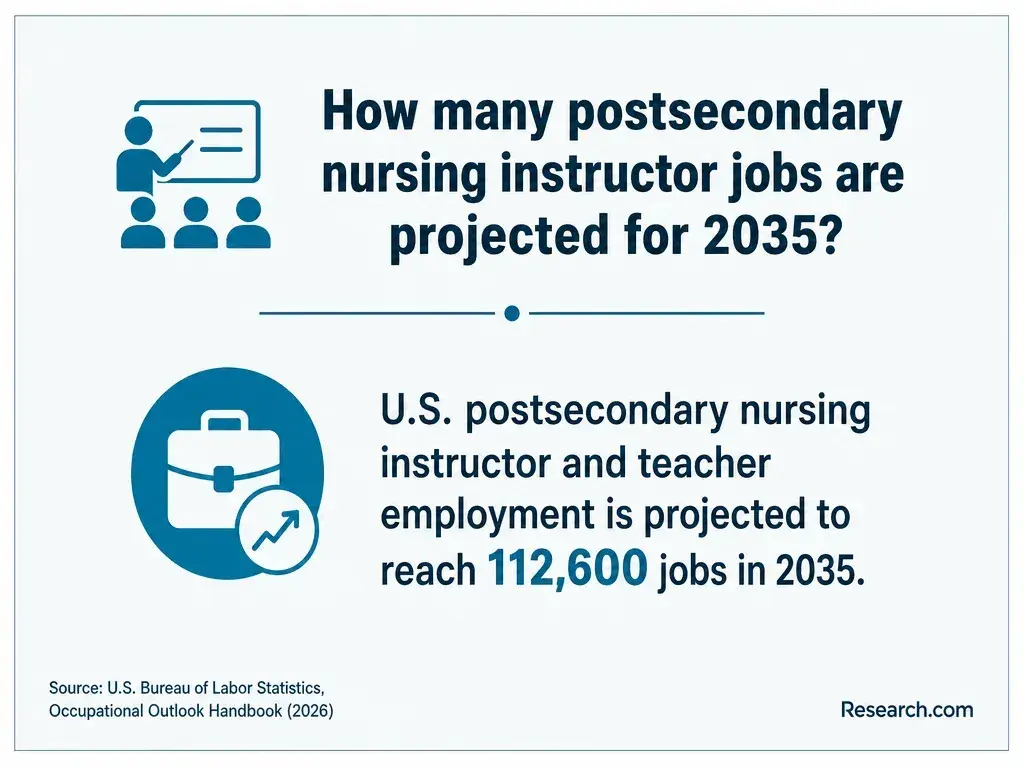
Use occupation-specific labor data rather than a "doctoral nurse salary" figure. The U.S. Bureau of Labor Statistics reports wages and employment projections for occupations such as postsecondary nursing instructors and nurse practitioners, not for everyone holding a PhD or DNP. Those figures can help you understand a target occupation, but they cannot predict an individual offer or show the earnings return from a doctorate. Compare local postings, required credentials, employer pay structures, and the cost of leaving or reducing work during study.
If your target position requires graduate teaching preparation or an MSN rather than doctoral scholarship, a doctorate may be unnecessary. Cost-focused MSN pathways for bachelor's-prepared nurses offer a useful alternative to examine against the specific job requirements before you commit to doctoral study.
Other Things You Should Know About Nursing
Often, yes, but program rules vary. Present your interview topic as a serious starting point, then ask how students refine proposals and when advisor, committee, site, or ethics approvals become necessary.
Check the program's guidance first. If contact is welcome, send a short message explaining the overlap in interests and asking whether the faculty member expects to mentor incoming students. A reply is not an admission or advising commitment.
Discuss the general practice problem without identifiable details or confidential employer information. An interview does not create permission to share records, internal reports, or patient-specific material.
Do not bluff. Explain what you know, identify the part you would need to investigate, and describe how you would seek methodological guidance. That demonstrates sound judgment as well as readiness to learn.
- Reconciling evidence and experience in the context of... - PMC https://pmc.ncbi.nlm.nih.gov/articles/PMC8480374/
- Writing Personal and Research Statements for Grad School | nih.gov https://www.training.nih.gov/oite-careers-blog/writing-personal-and-research-statements-for-grad-school/
- Interview Techniques - StatPearls https://www.ncbi.nlm.nih.gov/books/NBK526083/
- Choosing a Doctoral Degree: PhD, EdD, DBA and DNP Compared | GCU https://www.gcu.edu/resources/doctoral/choosing-a-doctoral-degree
- Graduate School Applications and Interviews | Career Development Center https://career.oregonstate.edu/graduate-school-applications-and-interviews
- DNP vs. NP: What's the Difference? | Chamberlain University https://www.chamberlain.edu/blog/dnp-vs-np-whats-the-difference
- Sample Interview Questions | umn.edu https://nursingcurrentstudents.umn.edu/career-resources/interviewing/sample-interview-questions
- Research Statement - Graduate School - Cornell University https://gradschool.cornell.edu/career-and-professional-development/pathways-to-success/prepare-for-your-career/take-action/research-statement/
- CPH Blog: DNP or PhD: Which Degree is Right for You? | gmu.edu https://nursing.gmu.edu/news/2023-01/cph-blog-dnp-or-phd-which-degree-right-you
- Research/Clinical/Student Project Proposal Guidelines | Yale School of Nursing https://nursing.yale.edu/researchclinicalstudent-project-proposal-guidelines