2027 MPH vs MS in Global Health for International Program Careers

Co-Founder and Chief Data Scientist
International program jobs can involve running a vaccination partnership, evaluating its results, or designing the study that informs its next phase. An MPH and an MS in Global Health can prepare you for different parts of that work, but degree names alone reveal little about field placements, methods training, or employer connections.
This guide compares the two paths for US-based readers seeking work across borders and for applicants considering a US degree from abroad. You'll learn which program features matter most for your target role and when experience or targeted training may be a better investment.
Key Things You Should Know
- Choose an MPH when your target work centers on implementing, managing, or evaluating population-health programs; favor a research-intensive MS when it centers on study design and analysis.
- International employers assess relevant skills, language ability, regional knowledge, and field experience, not just whether your degree says "global health."
- Many full-time master's paths take roughly 2 years, but thesis, placement, and part-time requirements can change the timeline and total cost.
What is the difference between an MPH and an MS in Global Health?
An MPH is generally a professional public health degree: it emphasizes applying population-health evidence to programs, policy, and practice.
An MS in Global Health may emphasize research, quantitative methods, or a specialized subject, although its structure varies substantially by institution. "Global health" describes the field of study; it does not establish a uniform curriculum for either degree.
The comparison below is a starting point, not a substitute for reading each program's required courses and graduation rules.
| Decision factor | MPH with a global health focus | MS in Global Health |
| Typical emphasis | Public health practice, implementation, policy, and evaluation | Research or specialized analysis; emphasis varies by program |
| Common culminating work | Applied practice experience and integrative project where required by the program | Thesis, research project, or other program-specific requirement |
| Stronger fit when you want to | Coordinate partnerships, improve services, or manage and evaluate programs | Design studies, analyze complex data, or prepare for research-intensive work |
| Key item to verify | Whether fieldwork develops the responsibilities you want | How much supervised research and advanced methods training is required |
A thesis alone does not make every MS more rigorous than every MPH, and an MPH can include substantial quantitative training. If your eventual goal is doctoral study, compare the master's research opportunities with the expectations of public health doctorates for research and practice; a research-focused PhD and a practice-focused DrPH prepare for different work.
Which degree is better for international global health careers?
For program implementation and management, an MPH is often the more direct fit; for research and advanced analysis, a methods-intensive MS may be better. Neither choice automatically provides international experience, a job abroad, or the authority to lead a project. Start with the work you want to do, then check whether the program lets you demonstrate it under appropriate supervision.
For example, a prospective program officer should look for budgeting, partner coordination, implementation, and monitoring experience. A prospective research analyst should prioritize epidemiology, statistics, reproducible analysis, and access to a suitable research supervisor.
In either case, regional expertise, language skills, and experience working responsibly with local partners can matter more than the degree's title. A US-based applicant should also check whether a field placement can realistically be completed with an overseas partner; an international applicant should verify whether a US program permits enrollment from their location.
Do not choose a master's chiefly because you assume a future doctorate will be required. If your target role truly calls for doctoral preparation, examine comparing online doctorate admission routes in public health separately: doctoral eligibility and research or leadership readiness are different questions from which master's best prepares you for your first international program role.
What careers can you pursue with an MPH or MS in Global Health?
Relevant employers may include US government contractors, nonprofit organizations, universities, health systems, and international partnerships. Titles vary, so compare job descriptions by tasks and required experience rather than treating either degree as a job credential.
These examples show where the degrees can align and what additional evidence employers may expect.
| Role or pathway | Typical work | Evidence beyond the degree |
| Program coordinator or officer | Tracks activities, supports partners, budgets, and reporting | Implementation experience and communication across organizations |
| Monitoring and evaluation associate | Develops indicators, checks data quality, and interprets program results | Evaluation deliverables and appropriate qualitative or quantitative skills |
| Research assistant or analyst | Supports protocols, data management, analysis, and reporting | Methods training, supervised research, and responsible data handling |
| Epidemiologist | Studies disease patterns and interprets population-health data | Job-specific epidemiology and statistical preparation; requirements vary |
Leadership positions commonly require substantial experience beyond a master's. For US salary comparisons, use the Bureau of Labor Statistics occupation that matches the job's actual duties, not a broad "global health" label: an occupational median is not an expected starting salary or an outcome of a particular degree.
Comparing MPH graduate earning opportunities can provide context, but international assignments, employer type, location, and prior experience can change compensation substantially.
Both paths may cover epidemiology, health systems, ethics, and the social and structural factors that shape health. An MPH commonly adds practice-oriented work in program planning, community engagement, policy, and evaluation.
An MS may devote more required coursework to research design, biostatistics, qualitative inquiry, or a defined specialty. Check required courses rather than assuming an elective provides advanced competence.
For international program work, methods depth should match the decisions you will make. Someone responsible for routine indicators needs to define measures, assess data quality, and explain limitations.
Someone designing a multi-country study may need stronger statistical preparation, research ethics training, and supervision. Neither classroom exercises nor software familiarity alone establish readiness to use restricted health data; permissions and data governance still apply.
If quantitative analysis is the main career gap, compare the curriculum with a dedicated methods route such as biostatistics master's schedules for employed students. A targeted course or supervised project may be sufficient if you already have the relevant degree and need a narrower skill.
Choose the format that makes your required work feasible, not the one that merely advertises flexibility. Online study may let you keep a job or remain near a field partner. Campus study may offer easier access to faculty, research teams, and local recruiting. Neither format guarantees an overseas placement or employer introductions.
Ask how live sessions work across time zones, whether fieldwork can occur where you live, who approves the site and supervisor, and whether a thesis or group project requires regular synchronous meetings.
For international applicants, permission to enroll online from abroad is separate from permission to enter or work in the United States; an online degree itself does not provide a visa or employment authorization.
If schedule and price are major constraints, use affordable public health programs with faster schedules as a comparison starting point, then confirm that any appealing option offers the global health coursework and supervised experience your intended role requires.
Requirements differ by school and degree. Applicants generally need a qualifying bachelor's degree and must submit the documents the specific program requests, which may include transcripts, recommendations, a statement of purpose, and evidence of relevant experience.
A research-intensive MS may expect more quantitative or research preparation than a practice-oriented MPH, but neither expectation should be treated as universal.
Use your statement to connect your existing experience to a specific function, such as implementation, evaluation, or research, rather than relying on a broad desire to "work internationally."
Applicants educated outside the United States should check the school's credential-evaluation and English-language policies when applicable. They should also confirm application deadlines, financing eligibility, and any restrictions on enrolling from their location.
If grades are a concern, distinguish a published minimum from how the program evaluates the full application. Public health master's options after a weak GPA may help you frame that review, but only the admitting institution can confirm its current standards or exceptions.
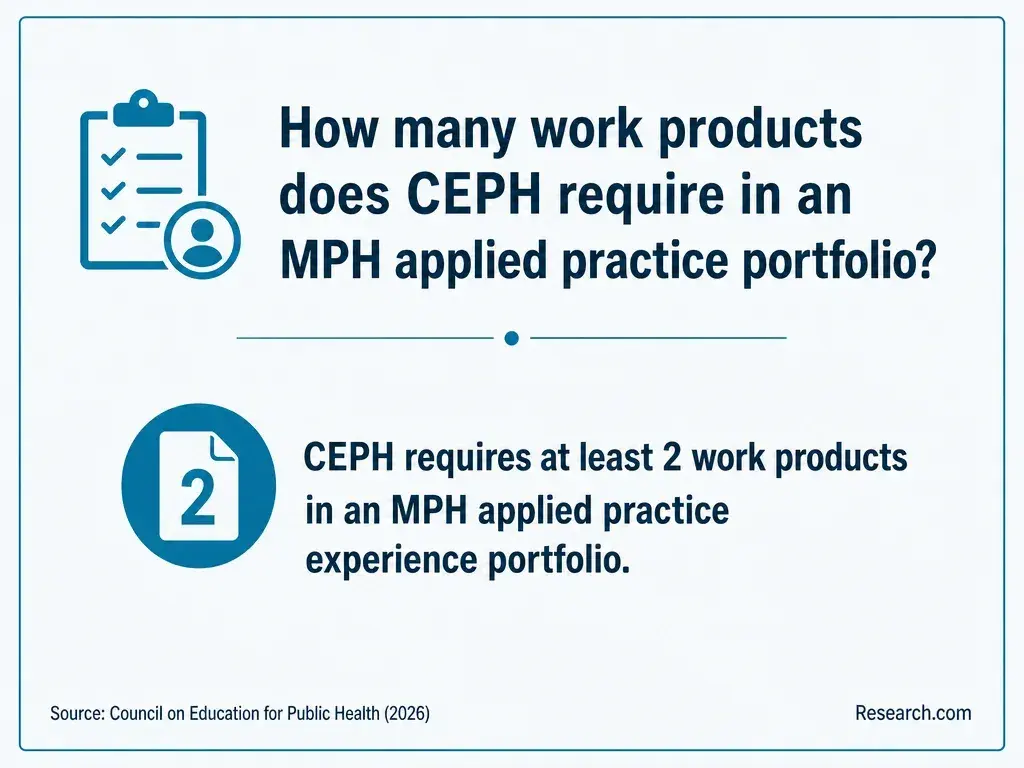
Many full-time master's pathways are designed around approximately 2 academic years. Accelerated, part-time, and thesis-based schedules can differ, and a required field placement may affect when you finish even after coursework is complete. Compare the actual course sequence and term offerings rather than relying on an advertised minimum.
Ask when you may begin fieldwork, whether the school helps arrange it, and how long thesis approval or data-access arrangements typically take. Working students should also check whether part-time enrollment changes access to aid or required courses.
If you have not yet completed a bachelor's degree, that is a separate timeline and decision; inexpensive public health bachelor's education may be worth comparing before budgeting for graduate study.
There is no reliable single price for an MPH or MS in Global Health. Compare each school's current tuition against the credits you must complete, then add mandatory fees, materials, and any travel or living costs. A lower tuition rate may not mean a lower total cost if the program requires additional terms or an unpaid placement.
For an international program career, budget for the placement you can actually secure, not an assumed overseas trip. Ask whether travel is required, whether local or remote sites qualify, whether placements are paid, and what funding conditions apply. International applicants should confirm whether listed tuition, scholarships, loans, or assistantships are available to them specifically.
Scholarship-supported online public health master's options can help identify questions to ask, but calculate your own net cost from an institution's offer and renewal terms.
Many international program coordination, evaluation, and research-support jobs do not require a general global health license. Requirements depend on the position and jurisdiction: clinical practice requires the applicable professional license, while a particular employer may request a public health or health education credential. An MPH or MS does not itself award licensure or automatic certification.
Read the exact job posting before paying for an additional credential. Distinguish a required license from a preferred certification and from training, such as research ethics or a particular data system, that an employer may provide.
If the role primarily involves leading research or organizational practice rather than regulated clinical work, a future doctorate may be relevant, but it is not a substitute for any license the job requires.
If you are also contemplating a later doctorate, keep that potential expense separate from the master's decision; comparisons of affordable public health doctorates and earning potential address a different investment.
How do you choose an accredited global health master's program?
First, verify the institution's accreditation and then check whether the exact public health school, unit, or program and the degree you want falls within any Council on Education for Public Health (CEPH) accreditation. Institution-level accreditation does not establish that a particular MS is covered by CEPH. Confirm current status and scope with the accreditor and school rather than inferring it from a related MPH.
Next, compare the required curriculum, placement or thesis rules, available supervisors, and documented connections to the kind of employer you seek. Ask for examples of approved project types and how students obtain supervision; do not assume a current job or prospective overseas host will satisfy academic requirements. Request total-cost estimates and outcomes that identify the cohort and response rate.
Accessible admissions can matter, but they do not replace these checks. When reviewing online MPH programs with flexible entry criteria, evaluate each program's accreditation scope and career-relevant training independently. The best choice is the one whose verified requirements let you build credible evidence for your target work at a cost and schedule you can sustain.
Other Things You Should Know About Public Health Programs
Not by itself. Match the organization's vacancy requirements for experience, language ability, technical skills, work authorization, and location before choosing a degree.
Not universally. Relevant domestic work with migrant communities, health systems, or cross-border partners may also demonstrate useful preparation; check each program's admissions criteria.
Possibly, if the school approves the site, supervision, learning objectives, and deliverable. Employer support alone does not constitute academic approval or permission to use organizational data.
It can be valuable when a target region or employer uses that language. Choose language study based on actual job descriptions and the level of proficiency needed for your intended responsibilities.
- Quantitative Approaches for the Evaluation of Implementation Research Studies - PMC https://pmc.ncbi.nlm.nih.gov/articles/PMC7176071/
- Research and Evaluation Analyst, Bureau of Epidemiology Services | City of New York Jobs https://cityjobs.nyc.gov/job/research-and-evaluation-analyst-bureau-of-epidemiology-services-in-queens-jid-47036
- Curriculum - Master of Public Health https://keck.usc.edu/mph-program/curriculum/
- MPH in Global Health | In-Person & Online | NYU GPH https://publichealth.nyu.edu/master-public-health/concentrations/global-health
- Where MPH Graduates Work: Careers Across Sectors | tufts.edu https://medicine.tufts.edu/news-events/news/where-mph-graduates-work-careers-across-sectors
- MPH vs MS vs MHA: Which Public Health Master's Degree Is Right for You? | Tulane WSPH https://sph.tulane.edu/mph-vs-ms-vs-mha
- What Is the Difference Between an MPH and MSPH Degree? | Emory University https://sph.emory.edu/degrees-programs/faq/mph-msph
- MPH in Global Health | UW School of Public Health https://sph.washington.edu/program/mph-global-health
- What to Expect from an MPH Program | University of Bridgeport https://www.bridgeport.edu/news/mph-program-expectations/
- Curriculum - Master of Public Health | UW Department of Global Health https://globalhealth.washington.edu/education-and-training/academic-programs/master-of-public-health/curriculum/