2027 Most Affordable Professional Certificates

Co-Founder and Chief Data Scientist
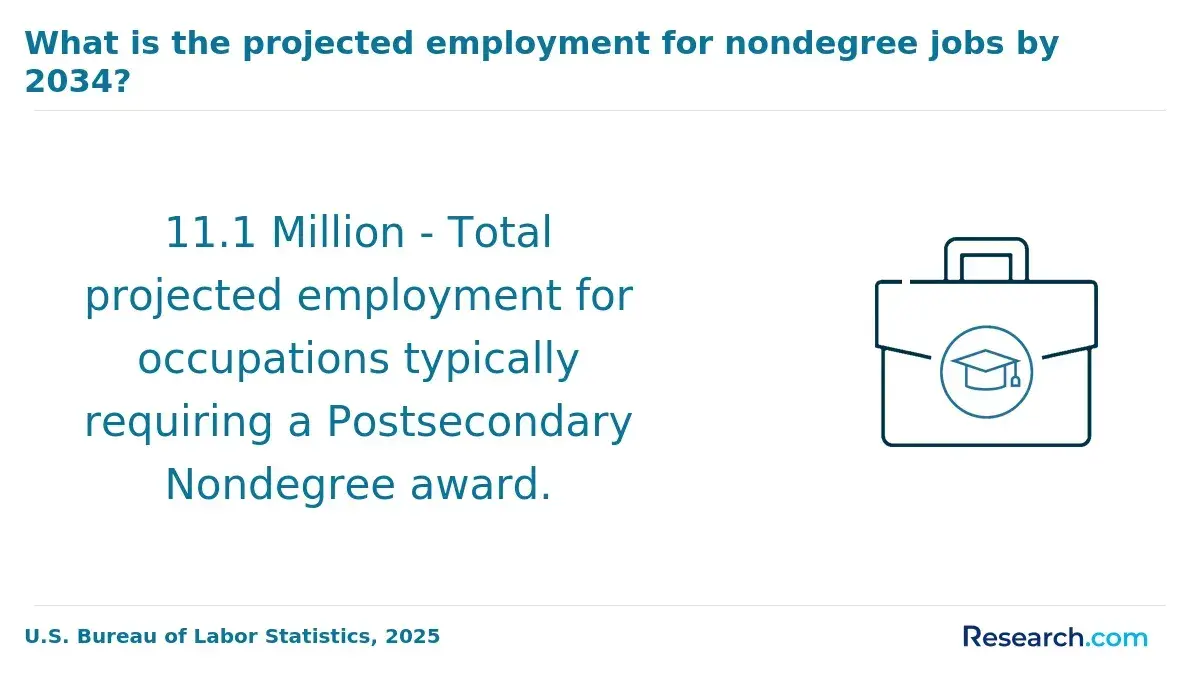
Choosing a low-cost professional certificate can be difficult because the cheapest advertised tuition is not always the lowest total price or the best route to employment. The U.S. Bureau of Labor Statistics reported that occupations typically requiring postsecondary nondegree awards had a 2024 median annual wage of $48,980.
This guide helps career changers, recent graduates, and working adults compare affordable certificate options, identify hidden costs, verify career relevance, and decide when a certificate makes more sense than an associate or bachelor's degree.
Key Things You Should Know
- Affordable usually means low total cost, not simply low tuition, after books, tools, exam fees, uniforms, clinical requirements, and lost work time are included.
- Community-college certificates, public workforce programs, employer-sponsored training, and short industry programs can be economical, but they differ in academic credit, transferability, and eligibility for federal aid.
- For context, BLS reports a $48,980 median annual wage for occupations typically requiring postsecondary nondegree awards in 2024. Pay still varies substantially by occupation, state, experience, licensure, and employer.
Top 10 Most Affordable Professional Certificates
Popular Trade School Programs
Affordable trade certificates commonly include welding, HVAC/R, electrical technology, plumbing, automotive service, commercial driving, and industrial maintenance. Most combine safety instruction with supervised lab work and may take weeks to about a year; associate degrees usually take longer but can add general education and broader advancement options.
For regulated or safety-sensitive work, verify that training meets state, employer, union, or exam requirements. A low-cost online-only program is rarely enough for hands-on trades unless it includes local lab, shop, apprenticeship, or clinical arrangements.
Healthcare Programs
Lower-cost healthcare pathways include medical assisting, phlebotomy, pharmacy technician, dental assisting, nursing assistant, medical billing and coding, and sterile processing certificates. These programs may be credit-bearing college certificates or noncredit workforce training.
Clinical placement, background checks, vaccinations, drug screening, uniforms, and certification exams can raise the total cost. State rules matter most for nursing assistants, practical nurses, and other licensed roles. Before enrolling, confirm whether graduates are eligible for a recognized certification examination and whether the school arranges required clinical experiences.
Criminal Justice / Law Programs
Common affordable options include paralegal studies, legal office assisting, court reporting support, corrections, security, emergency management, and criminal justice certificates or associate degrees. A paralegal certificate can be useful for people who already hold a degree, while an associate degree may better suit new college students.
Neither credential automatically authorizes someone to practice law. Security officer training and private-investigator requirements vary by state. Compare programs based on local employer recognition, internship access, legal-software training, and whether the curriculum aligns with the role, not solely on speed.
Arts & Design Programs
Affordable arts and design certificates may cover graphic design, digital media, UX basics, photography, video production, web content, animation, fashion, or interior design support. Portfolio quality often matters more to employers than the credential title, so prioritize programs with project feedback and current software access.
A short certificate can build a targeted skill set, while an associate degree can provide more time for portfolio development. Check software, equipment, printing, studio, and portfolio-hosting costs. For regulated design roles, confirm whether a certificate meets any state-specific education expectations.
What defines an affordable professional certificate and who are these programs best for?
An affordable professional certificate is a focused, usually short educational program designed to build job-related knowledge or skills at a manageable total cost.
It may be offered by a community college, university continuing-education division, public workforce agency, employer, trade school, union, or private training provider. Some certificates carry college credit; others are noncredit career-training credentials. Neither format is automatically better.
A certificate documents completion of education or training. A certification is generally awarded by a professional body after a candidate meets its standards, often through an examination, work experience, or continuing education. A certificate may prepare a learner for certification, but readers should not assume it does.
These programs are often a strong fit for people who need an entry-level skill quickly, workers adding a defined capability, or adults testing a field before committing to a degree. They are less suitable when the target occupation requires a bachelor's degree, graduate degree, extensive supervised practice, or a state license that the program does not support.
Use this comparison to decide which route matches the outcome you want.
| Option | Best fit | Main advantage | Important limitation |
| Credit-bearing college certificate | Learners who may continue to an associate degree | May stack into a longer program | Can take longer and have broader course requirements |
| Noncredit professional certificate | Workers seeking a narrow, immediate skill | Often flexible and focused | Usually does not transfer for college credit |
| Industry certification | Applicants needing employer-recognized validation | May signal tested competency | May require an exam, experience, and renewal |
| Apprenticeship | Hands-on trade entrants | Paid work experience can offset training costs | Availability and entry rules vary locally |
Do not choose a certificate merely because it is short. First identify the exact job title, then check job postings and state rules to see whether employers ask for a certificate, a certification, experience, a degree, or a license.
How much do professional certificate programs cost, and what financial aid is available?
Total cost can range from relatively inexpensive public noncredit courses to several thousand dollars for private career schools. Tuition is only one part of the decision.
College Board's 2024-25 figures placed average published tuition and fees at $4,050 for public two-year in-district students, a useful benchmark for comparing credit-bearing community-college routes; individual certificate prices can be lower or higher depending on credits, residency, and program requirements.
Ask for a written, itemized estimate before applying. It should identify the expenses most likely to change the real cost.
- Tuition, mandatory institutional fees, and payment-plan charges
- Books, digital access codes, tools, equipment, uniforms, and protective gear
- Background checks, drug screening, immunizations, liability insurance, and transportation for clinicals or labs
- Industry examination, licensing, fingerprinting, and renewal fees where applicable
- Income lost if required daytime labs, internships, or clinical rotations reduce work hours
Federal Pell Grants and federal student loans generally apply to eligible students in eligible programs at participating institutions; many short, noncredit, and third-party certificates do not qualify. Workforce Innovation and Opportunity Act funding, state workforce grants, veterans' education benefits, employer tuition assistance, union benefits, and school scholarships may be available depending on location and eligibility.
Readers seeking aid-eligible online options can compare the cheapest online colleges that accept FAFSA in USA before assuming every online certificate can use federal aid.
A practical affordability test is to compare the all-in price with the credential's direct relevance to local openings, required credentials, and likely time out of work. Avoid high-interest private financing for a program that cannot clearly explain its training outcomes, refund policy, and job relevance.
How do online and campus-based professional certificate programs compare for flexibility and value?
Online professional certificates can reduce commuting and scheduling costs, while campus-based programs provide access to equipment, instructors, labs, studios, and classmates. The best value depends on whether the target skill can be demonstrated remotely.
Coding, bookkeeping, project coordination, digital marketing, and some legal-support coursework can work well online. Welding, electrical work, medical assisting, dental assisting, and many healthcare roles require in-person practice or clinical experiences.
The comparison below separates convenience from career readiness so that a lower online price is not mistaken for equivalent training.
| Factor | Online or mostly online | Campus, hybrid, or employer site |
| Schedule | Often better for asynchronous study and working adults | Usually fixed labs, meetings, or clinical shifts |
| Direct costs | May reduce commuting and housing expenses | May include facility, lab, or equipment costs |
| Hands-on learning | Limited unless local placements are arranged | Better suited to supervised technical practice |
| Networking | Requires deliberate participation | Can provide local instructor and employer contact |
| Licensure preparation | Must be verified state by state | May simplify required practical components |
Before choosing an online program, confirm where labs, externships, and proctored exams occur; whether the program accepts students in your state; and whether required software or equipment is included. For a broader institutional comparison, review the top online universities and then verify the specific certificate rather than relying on a school's overall reputation.
A common mistake is assuming online means self-paced. Many programs have weekly deadlines, group work, live sessions, or fixed clinical rotations. Get the calendar in writing and calculate whether it fits your work and caregiving obligations.
What accreditation and licensing requirements should affordable professional certificate programs meet?
Accreditation is most important when it affects federal aid eligibility, transfer credit, employer confidence, clinical placements, certification eligibility, or state licensure. Institutional accreditation evaluates a college or school broadly.
Programmatic accreditation evaluates a particular discipline or program. A reputable institution can still offer a program that does not meet a profession's separate accreditation or licensing expectations.
For healthcare, legal, technical, and skilled-trade programs, verify requirements with the relevant state board, licensing agency, certifying organization, or prospective employer before paying a deposit. Ask the school to identify the exact accreditor, approval status, examination eligibility, completion requirements, and any geographic restrictions in writing.
Watch for red flags: vague claims that a program is "accredited" without naming the accreditor; promises of licensure without explaining state requirements; pressure to enroll immediately; unclear refund terms; or an inability to provide total charges. For certifications, also check whether the certifying organization recognizes the training.
Licensing rules can change, especially in healthcare and regulated trades. If you intend to work outside the school's state, confirm portability before enrolling. A school's statement that its program is "online nationwide" does not establish that it meets every state's professional requirements.
How long do professional certificate programs take to complete, and what schedules are offered?
Professional certificate timelines range from a few weeks for tightly focused software or workplace training to roughly one year for many college or technical certificates.
Programs with labs, clinical placements, internships, or required seat time usually follow fixed terms and cannot be accelerated simply by studying faster. Credit-bearing certificates may be stackable into an associate degree, but transfer policies vary by institution.
Choose the schedule based on required learning, not marketing language. The following questions can prevent an "accelerated" option from becoming an expensive delay.
- Ask whether the published completion time assumes full-time attendance, prior coursework, or immediate access to clinical and lab placements.
- Request the weekly workload, live-session times, deadlines, and required travel dates.
- Confirm whether missed labs or clinical shifts can be made up without waiting for the next term.
- Compare the certificate with a longer credential if your intended role routinely requires an associate or bachelor's degree.
For learners whose goal is ultimately a degree rather than a standalone skill credential, an online accelerated bachelor's degree may offer a more direct path than completing multiple unrelated noncredit certificates. That choice makes sense only when the degree matches the role and the pace is realistic alongside work.
What admission requirements do affordable professional certificate programs typically have?
Admission requirements depend on provider and credential type. Short noncredit certificates may use simple registration and have no GPA requirement. Credit-bearing college certificates commonly require an application, identity or residency information, placement measures or prior transcripts where relevant, and prerequisites for technical or clinical coursework.
Selective healthcare programs may add entrance testing, immunization documentation, background checks, drug screening, CPR training, or a minimum grade in prerequisite classes.
Do not confuse open admission to a college with guaranteed entry to every certificate. Programs with limited lab stations or clinical placements can have separate application deadlines and competitive selection.
Applicants looking for lower-barrier institutional entry points may explore online colleges with open enrollment and no application fee. Still, verify the requirements of the exact certificate, especially if it leads to clinical work, licensing preparation, or advanced technical courses.
Before applying, ask whether prior learning, military training, industry certifications, or transfer credits can reduce time and cost. Obtain any credit evaluation in writing; noncredit coursework and private-provider certificates frequently do not transfer.
What core courses and skills are covered in most professional certificate curricula?
Most professional certificate curricula focus on a narrow set of employable competencies rather than the broad general education found in degree programs. Core instruction often combines technical concepts, workplace communication, documentation, ethics, safety, digital tools, and supervised application.
The exact balance should reflect the occupation: a medical assistant needs patient-care and administrative practice, while an IT support learner needs troubleshooting and systems skills.
Compare course lists against actual entry-level job descriptions in your area. Strong programs make it possible to identify what learners will be able to do, what software or equipment they will use, and how competence is assessed.
- Technical foundations and vocabulary specific to the field
- Tools, software, equipment, documentation, or workflow systems used by employers
- Safety, privacy, ethics, accessibility, and regulatory practices when relevant
- Communication, customer service, teamwork, and problem-solving
- Projects, simulations, labs, clinical practice, internships, or portfolio work that demonstrate skill application
AI tools are changing task design in office, marketing, design, IT, and legal-support work. Look for programs that teach responsible use, fact-checking, privacy, and workflow judgment rather than presenting AI as a substitute for foundational skills. In hands-on fields, technology literacy complements safe supervised practice.
What jobs can you get with affordable professional certificates in high-demand fields?
Affordable certificates can support entry into high-demand fields, but the credential alone may not satisfy every employer, certification, or licensing requirement. Job seekers should match the program to a specific role and build evidence of competence through a portfolio, practicum, clinical experience, apprenticeship, or relevant certification when required.
This table shows common directions a certificate can support and the additional factors that commonly affect employability.
| Field | Possible entry-level direction | Certificate value | Common additional requirement |
| Information technology | IT support specialist, help desk technician | Builds foundational troubleshooting and systems skills | Portfolio, vendor certification, or hands-on experience may help |
| Healthcare support | Medical assistant, phlebotomist, pharmacy technician | Provides structured job preparation | Clinical training, exam eligibility, certification, or state rules may apply |
| Skilled trades | HVAC helper, welding trainee, maintenance technician | Introduces technical and safety practices | Apprenticeship, employer training, or licensing may be needed |
| Business operations | Bookkeeping clerk, project coordinator, office specialist | Demonstrates software and workflow knowledge | Experience with common tools and communication skills matter |
| Digital creative work | Junior designer, content-production assistant | Can create focused portfolio projects | Portfolio quality usually remains central |
A practical job-search strategy is to collect 15 to 20 local postings for the role you want, identify repeated requirements, and enroll only if the curriculum closes important gaps. This method is more reliable than selecting a certificate based on a broad occupational label.
What salary ranges and job outlook can graduates expect after earning a professional certificate?
Salary and outlook should be evaluated by occupation, not by a blanket promise attached to a certificate. BLS occupational figures describe workers in an occupation with varied education and experience levels; they do not show what certificate completers specifically earn. They are still useful for comparing fields and setting realistic expectations.
The 2024 BLS figures below illustrate why job title and required credential matter more than the generic term "professional certificate."
| Occupation | 2024 median annual wage | Projected growth, 2023-33 | Certificate-related caution |
| Medical assistants | $44,200 | 15% | Employers may prefer certification; state and employer requirements vary. |
| Phlebotomists | $43,660 | 10% | Training and certification expectations differ by state and employer. |
| Heating, air conditioning, and refrigeration mechanics and installers | $59,810 | 9% | EPA refrigerant handling certification may be required for certain work. |
| Computer user support specialists | $60,810 | 6% | Some employers may prefer a degree, vendor certification, or prior experience. |
Higher wages can reflect licensing, hazardous work, shift differentials, geographic demand, union coverage, experience, or a degree beyond a certificate. Compare local wage postings and entry-level requirements, then estimate how long it could take to recover all training costs. If the target role has weak local demand or requires a credential beyond the program, consider an apprenticeship, associate degree, or employer-sponsored pathway instead.
Other Things You Should Know About the Most Affordable Professional Certificates
Start with a local community college, public workforce agency, employer, union, or apprenticeship sponsor. Compare total charges, not just tuition, and ask whether grants, employer assistance, veterans' benefits, or workforce funding can cover eligible costs.
They can be worthwhile for skills that can be taught and demonstrated remotely, such as software, business operations, or digital content work. They are a weaker fit for occupations requiring extensive supervised labs, clinical practice, or state-approved hands-on training unless those components are included.
It can strengthen preparation for roles that accept postsecondary nondegree training, but results depend on the occupation, local demand, prior experience, licensing rules, and the employer. Review job postings before enrolling to confirm that the credential is relevant.
Ask the school for the exact certification examination or state license it addresses, then independently confirm eligibility with the certifying organization or licensing board. Do not rely on broad phrases such as "career-ready," "approved," or "certification preparation."
References
- 10 Quick Certifications That Lead To High-Paying Jobs | Become With Lantern https://www.learnhowtobecome.org/career-resource-center/quick-certifications-that-pay-well/
- Professional Business Certifications to Boost Your Career in 2025 https://www.business.com/articles/best-business-certifications/
- The Value of Certificates vs. Degrees: What's Right for You? https://www.calmu.edu/the-value-of-certificates-vs.-degrees-whats-right-for-you
- 20 Necessary IT Certifications + Salaries I Skillsoft - Skillsoft https://www.skillsoft.com/blog/top-paying-it-certifications
- 7 in-demand certifications in 2025 | edX https://www.edx.org/resources/in-demand-professional-certifications
- Online Certificate Programs | Certifications Programs https://www.uscareerinstitute.edu/online-certificate-programs
- Upskilling Certificates: An Affordable Way to Increase Income https://allcampus.com/newsroom/upskilling-certificates-an-affordable-way-to-increase-income/