
2027 Retrieval-Augmented Generation Evaluation Capstones: What to Look for in a Data Science Master's

Co-Founder and Chief Data Scientist
A retrieval-augmented generation (RAG) capstone can show whether a data science master's program teaches students to test AI systems, not just build convincing demos. For prospective students interested in applied AI, the deciding issue is whether a program provides the coursework, data access, supervision, and time needed to evaluate retrieval and generated answers rigorously.
This guide explains what a credible project should measure and what to ask before enrolling.
Key Things You Should Know
- A strong RAG capstone compares a documented baseline with an improved system and evaluates retrieval quality, answer accuracy, citation support, and failure cases on held-out questions.
- Look beyond an "AI capstone" label: confirm that students can access suitable documents, expert feedback, computing resources, and enough project time to run repeatable tests.
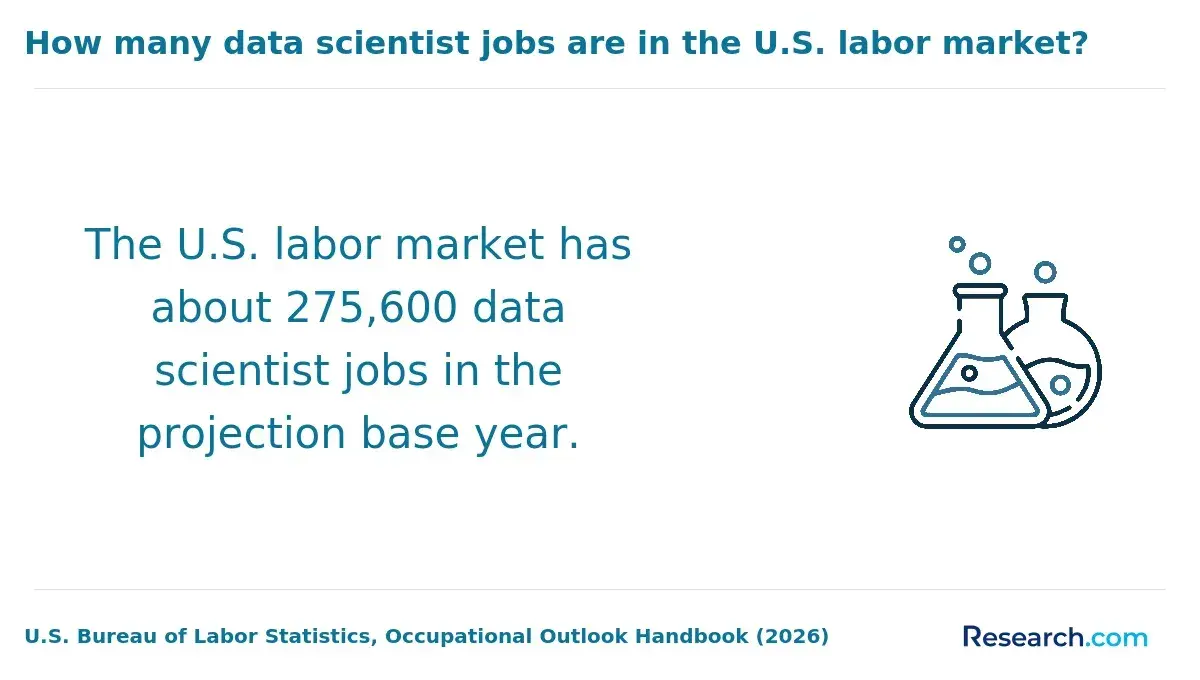
- The U.S. Bureau of Labor Statistics projects 35% growth in data scientist employment from 2025 to 2035, but that occupation-wide forecast does not establish demand for RAG specialists or guarantee a capstone-related job.
What Is a Retrieval-Augmented Generation Evaluation Capstone?
A RAG system retrieves information from a document collection and supplies it to a language model to help produce an answer. An evaluation capstone asks a harder question than "Does the chatbot work?": under which conditions does the system retrieve the right evidence, answer faithfully, and decline to answer when evidence is missing?
For example, a student might build a question-answering system over a collection of versioned policy documents. A credible project would define its intended users, create questions with known supporting passages, compare a simple retrieval baseline with a proposed improvement, and report where both systems fail. Its final deliverables should include a methodology, results, limitations, and a demonstration or reproducible implementation - not just a polished interface.
Programs need not advertise a capstone specifically named "RAG evaluation." The useful distinction is whether a student may propose this topic and obtain appropriate supervision and data access, rather than being restricted to a fixed project menu.
Why Does RAG Evaluation Matter in a Data Science Master's?
RAG work connects skills that are often taught separately: data preparation, information retrieval, experimental design, statistical interpretation, software engineering, and responsible use of AI. A generated answer can sound plausible even when its retrieved passages are irrelevant or contradict it. Evaluating the full pipeline helps students identify which component failed and whether a proposed change actually helped.
That distinction matters when comparing programs. A course assignment that produces a working prototype may teach implementation; a graduate capstone should also establish a defensible test set, compare alternatives fairly, and explain trade-offs to a stakeholder. Choose a program with room for that deeper work if your goal is to demonstrate applied AI evaluation. A general analytics capstone may be a better fit if you primarily want experience with forecasting, causal analysis, or another specialty.
What Should a Strong RAG Capstone Project Measure?
A capstone should assess retrieval and generation separately, then test the user-facing system as a whole. The comparison below shows what each evaluation dimension reveals; no single score establishes that a RAG system is reliable.
| Dimension | Evidence a capstone could report | What it reveals |
| Retrieval relevance and coverage | Passage-level judgments and measures such as recall at a stated cutoff | Whether needed evidence reaches the model |
| Answer quality | Human-reviewed correctness against reference answers, with explicit scoring criteria | Whether users receive accurate, useful answers |
| Grounding and citations | Checks that claims are supported by the cited passages | Whether apparent evidence actually supports the response |
| Unanswerable questions | Results on questions whose answers are absent from the collection | Whether the system appropriately expresses uncertainty or abstains |
| Operational trade-offs | Latency and measured processing or API costs under stated test conditions | Whether gains are practical for the intended use |
A strong design also specifies the document version and question set, keeps test questions separate from development examples, and includes difficult cases such as outdated policies or conflicting passages. If automated model-based scoring is used, students should disclose the scoring instructions and check a sample against human judgments. Otherwise, a high score may reflect the grader's preferences rather than trustworthy answers.
Red flag: a project reports only a handful of favorable example prompts or an overall "accuracy" figure without explaining the questions, evidence labels, baseline, or scoring method. Those results are difficult for a reader - or an employer - to interpret.
Which Courses Prepare Students for RAG Capstone Work?
Look for a sequence that builds from statistics and programming toward retrieval, NLP, and evaluation. Relevant course titles may include information retrieval, natural language processing, machine learning systems, databases, experimental design, or responsible AI. A catalog title alone does not show whether students practice building test sets or diagnosing system failures; inspect assignments and ask which faculty supervise projects of this kind.
Data engineering is particularly useful when a project must ingest documents, track versions, preserve metadata, and update an index reliably. If those foundations are a priority, compare AI master's pathways for data engineering skills alongside data science programs. Favor the curriculum that gives you both the infrastructure skills and the evaluation methods your proposed capstone requires.
A dedicated NLP elective offers more depth than a single lecture on language models, but substantial capstone work can sometimes compensate for a missing RAG-specific course. Ask to see a recent project rubric or anonymized example rather than assuming a course list proves project readiness.
How Do Online and Campus RAG Capstones Compare?
Neither format inherently produces a stronger technical project. The meaningful differences are access and coordination: how students meet advisers, obtain approved datasets, use computing resources, collaborate with sponsors, and present results.
An online program may suit an employed student who can develop an approved project related to work, provided its meeting schedule and data policies are workable. Campus study may make in-person lab collaboration or sponsor meetings easier. In either format, ask who approves proposals, how often advisers give feedback, whether remote students receive the same computing access, and what happens if a dataset becomes unavailable.
If your schedule is the main constraint, compare online graduate data science options while employed. Then verify each program's actual capstone meeting and milestone requirements; a flexible course format does not necessarily mean an individually paced project.
What Technical Skills Should Students Demonstrate in a RAG Capstone?
The strongest portfolio evidence shows that a student can make defensible engineering and measurement choices, not merely connect a language model to a vector database. A capstone report or demonstration should make these capabilities visible:
- Data stewardship: document collection, cleaning, version control, metadata, and permissions, including how those choices affect retrieval.
- System design: a reproducible baseline and a justified alternative, such as a different chunking method, retrieval approach, or reranking step.
- Evaluation design: representative questions, evidence labels, held-out tests, stated metrics, and uncertainty or disagreement in human judgments.
- Failure analysis: concrete examples distinguishing missing evidence from model misuse of evidence, plus a clear account of remaining risks.
- Communication: findings that a nontechnical stakeholder can use to decide whether the system is suitable for its intended task.
Deployment can strengthen a project, but it should not displace evaluation. A limited, reproducible prototype with honest failure analysis is more informative than an elaborate interface whose answers were never systematically tested.
What Are the Admission Requirements for Data Science Master's Programs?
Requirements vary by institution. Applicants should check each program's current policy for a bachelor's degree, transcripts, quantitative and programming preparation, recommendations, and any statement, test, or experience requirements. For this capstone goal, readiness in Python, probability or statistics, and data handling matters more than having previously built a RAG application. Preparation that helps you succeed in the curriculum is not automatically a formal admissions prerequisite.
If an application essay is an obstacle, finding machine learning master's programs without essays may help identify alternatives. Verify requirements directly before applying, and do not let a shorter application outweigh whether the program supports rigorous evaluation projects.
How Can Students Verify a Data Science Program's Accreditation?
First, confirm the institution's current institutional accreditation through the accreditor or the U.S. Department of Education's accreditation database; do not rely solely on a program's marketing page. Then confirm that the particular master's degree is offered by that institution and ask whether any separate programmatic accreditation is claimed. Institutional accreditation establishes an important baseline, but it does not certify that a curriculum teaches RAG or that a proposed capstone will be approved.
For an online program, also confirm that it can enroll students in your state. If an employer's tuition benefit or a future doctoral application depends on a particular accreditation status, obtain the relevant policy in writing before enrolling.
What Career Outcomes Can RAG Capstones Support?
A well-documented capstone can provide interview evidence for applied data science, machine learning engineering, search relevance, or AI evaluation work. The strongest signal is not the RAG label itself but the candidate's ability to explain test design, diagnose errors, justify trade-offs, and show their own contribution. Employers' requirements differ, and a capstone does not substitute for all the engineering experience a particular role may require.
The U.S. Bureau of Labor Statistics reports a median annual wage of $120,230 for data scientists in May 2025. That occupation-wide figure is context, not an expected salary for a new graduate or a measure of the value added by a RAG capstone. For a broader comparison of roles and sectors, see data science compensation across industries; weigh any salary information against your existing experience, location, and target job.
How Much Do Data Science Master's Programs Cost and How Long Do They Take?
There is no defensible single price or completion time for a data science master's: tuition rates, credit requirements, fees, and full- or part-time schedules vary by program. For a RAG-focused applicant, the relevant budget also includes any separately billed computing, model APIs, software, travel, and extra terms needed to finish an ambitious project. Obtain the current tuition schedule and ask which project resources are included before comparing offers.
Compare programs on the cost and time to complete the same intended course of study, including the electives and capstone you need. If affordability is decisive, explore lower-cost online AI programs, but check whether each option offers adequate supervision and evaluation depth. A cheaper degree is not necessarily better value if its project rules prevent the work you want to show employers.
Other Things You Should Know About Data Science
Only with the employer's permission and the program's approval. Ask about data-use agreements, storage rules, publication restrictions, and whether a de-identified or public substitute is needed.
Not necessarily. The required resources depend on the models and experiments you choose. Confirm available computing and any usage limits before committing to a project design.
Ask the program about contingency plans before accepting a sponsored project. A suitable public dataset and a narrowly defined backup question can reduce the risk of losing the capstone timeline.
That depends on university policy, sponsor agreements, dataset licenses, and service terms. Clarify publication rights early if a public portfolio is one of your main reasons for choosing the project.
References
- Training and Skills Development Resources | Duke Research & Innovation https://research.duke.edu/resource/training-and-skills-development-resources/
- Capstone Research Projects | Khoury College of Computer Sciences https://www.khoury.northeastern.edu/research/capstone-projects/
- RAG Evaluation Metrics: Assessing Answer Relevancy, Faithfulness, Contextual Relevancy, And More - Confident AI https://www.confident-ai.com/blog/rag-evaluation-metrics-answer-relevancy-faithfulness-and-more
- Retrieval Quality VS. Answer Quality: Why RAG Evaluation Fails | Deepchecks https://deepchecks.com/retrieval-vs-answer-quality-rag-evaluation/
- How to evaluate your RAG pipeline with Braintrust - Articles https://www.braintrust.dev/articles/rag-evaluation-metrics
- RAG Evaluation in Production: Groundedness, Faithfulness, and Retrieval Quality (July 2026) | Openlayer https://www.openlayer.com/blog/rag-pipeline-evaluation-groundedness-faithfulness
- What is RAG (Retrieval Augmented Generation)? | IBM https://www.ibm.com/think/topics/retrieval-augmented-generation


