2027 MLIS Programs for Legal Information Services Teams

Co-Founder and Chief Data Scientist
Choosing an MLIS for legal information services takes more than finding a course labeled "law librarianship." The work spans legal research, collection management, technology, and service to people with very different information needs.
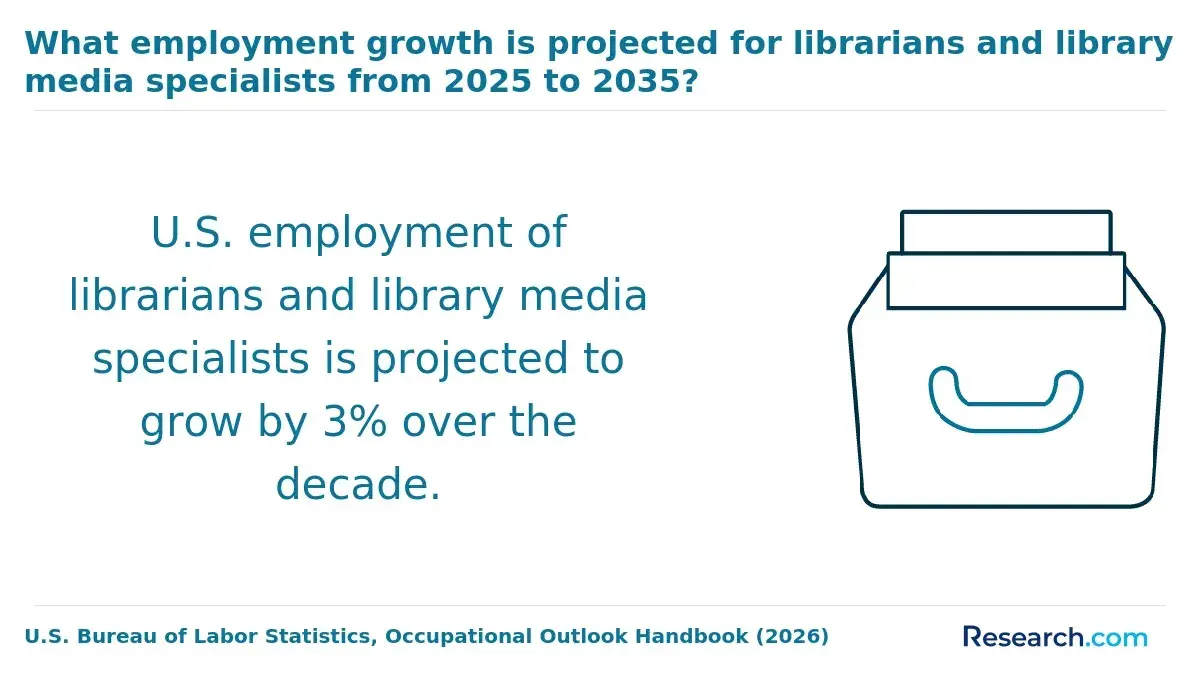
The U.S. Bureau of Labor Statistics projects 2.6% employment growth for librarians and media collections specialists from 2025 to 2035, making careful preparation more useful than assuming a degree alone will secure a role. This guide helps prospective students and career changers assess credentials, coursework, experience, costs, and job fit before committing to a program.
Key Things You Should Know
- Seek an ALA-accredited master's program, then verify legal research electives and applied opportunities separately; accreditation does not establish that a law-library track exists.
- Academic law library positions may prefer or require a JD, while many firm, court, government, and public-service roles assess legal research experience alongside the MLIS.
- The May 2025 median annual wage was $68,270 for the broad U.S. category of librarians and media collections specialists, not specifically for law librarians or new graduates.
What are MLIS programs for legal information services teams?
They are graduate library and information science programs that can prepare students to support legal research and information access. "MLIS program for legal information services" describes a career goal, not necessarily an officially named concentration.
A suitable program might combine general LIS requirements with a documented law librarianship course, relevant electives, and an applied project; another might offer only broader skills that a student must supplement through work experience.
Legal information services teams work in law firms, law schools, courts, government agencies, and public law libraries. Their responsibilities can include locating statutes and case law, teaching researchers to use legal databases, maintaining print and digital collections, managing licensed resources, and organizing internal knowledge.
The best preparation depends on whether a student hopes to serve attorneys, teach law students, support self-represented patrons, or manage an organization's legal information.
What education is required for careers in law librarianship?
An MLIS or another appropriately accredited LIS master's degree is a common qualification for professional librarian positions, but requirements vary by employer and job.
MLS, Master of Science in Library Science, and institution-specific information degrees may serve similar purposes; the degree name alone does not establish its accreditation or curricular fit. This library science credentials explained guide can help applicants compare degree labels before checking individual programs.
Some academic law library positions, especially roles with substantial legal research instruction, prefer or require both an LIS master's and a Juris Doctor (JD). That is a position-specific requirement, not a universal credential for law librarians.
Firm and government employers may place greater weight on demonstrated legal research, database administration, or knowledge-management experience. A library technician or assistant position can offer an entry point without an MLIS, although it is not the same as a professional librarian role.
Start with several current job descriptions in your intended setting. Compare their required and preferred qualifications before deciding whether an MLIS, a JD, legal-sector experience, or a combination is worth pursuing.
Which MLIS programs are accredited for legal information services careers?
The relevant check is whether the specific master's program appears in the American Library Association's current directory of accredited programs.
A university's institutional accreditation does not, by itself, mean its LIS master's has ALA accreditation. Nor does ALA accreditation certify a legal specialization, a particular elective, or an internship placement.
Rather than treating an unverified list of schools as a law-library ranking, use the current directory to create a shortlist. Then inspect each program's catalog and ask whether legal research courses are offered often enough to fit your schedule, whether relevant placements are available, and what graduates can demonstrate in a portfolio.
A library science masters program comparison can organize the broader search, but confirm every program-specific feature with the school before applying.
Are online MLIS programs suitable for legal information services work?
Yes, an online MLIS can be suitable if the program meets your credential needs and lets you build legal research skills and relevant experience.
Online delivery does not weaken program accreditation, but it also does not guarantee asynchronous classes, remote internships, or access to legal research platforms outside scheduled coursework.
Before enrolling, ask when required and legal-focused courses run, whether live sessions are mandatory, and whether a practicum can be completed with a local court, law library, firm, or government office. Working students should also check how prerequisites affect course sequencing.
An online option is strongest when its schedule permits both degree completion and sustained, hands-on practice - not merely when travel to campus is unnecessary.
What courses do MLIS programs offer for legal information services?
A strong course plan pairs core LIS skills with the legal research methods needed for the intended workplace. Catalog titles vary, and a listed elective may not run during a student's enrollment. The curriculum areas below show what to look for and how each can translate into team responsibilities:
| Curriculum area | Legal information services application |
| Reference and research instruction | Interviewing requesters, planning searches, and teaching effective use of sources. |
| Legal research or law librarianship, where offered | Working with cases, statutes, regulations, citators, and jurisdiction-specific sources. |
| Collection development and licensing | Evaluating legal resources, subscriptions, access terms, and collection needs. |
| Knowledge organization and information technology | Improving discovery, metadata, and retrieval across catalogs or internal repositories. |
| Management, privacy, and assessment | Supporting service workflows while protecting sensitive requests and measuring usefulness. |
Ask for recent syllabi when course titles are ambiguous. A capstone that compares search strategies or improves access to a legal collection may provide stronger evidence of readiness than an elective title alone. Documented competency based MLIS outcomes can help you identify what a program expects students to demonstrate, but you should still verify how those outcomes are assessed.
What are the admission requirements for legal information services MLIS programs?
Applicants generally need a bachelor's degree and must meet the individual graduate program's published requirements. Schools may request transcripts, a statement of purpose, recommendations, a résumé, or evidence of English-language proficiency where applicable.
Minimum academic standards, testing policies, deadlines, and prerequisite rules differ; legal work experience and a JD should not be assumed to be required.
Use the statement of purpose to connect your intended setting to specific program opportunities, without claiming that a general elective is a formal legal specialization.
If your academic record or prior legal training does not fit a program's standard application categories, request an individual review from admissions. Ask separately whether any prior graduate coursework can transfer; admission and graduate transfer credit are different decisions.
How long do MLIS programs for legal information services take and cost?
Completion time depends on required credits, course load, sequencing, and whether a legal-focused elective or practicum fits the student's schedule. Full-time study can shorten the calendar time, while part-time study may be easier to combine with legal-sector work. An MLIS completion plan is useful only after you confirm the program's actual course rotation and any placement requirements.
There is no reliable single price for this pathway. For each shortlisted program, calculate tuition from its published rate and required credits, then add mandatory fees, books or software, and any travel or practicum expenses.
Confirm which tuition rate applies to an online student in your state; do not assume online enrollment means in-state pricing. Compare the gross program cost with your likely out-of-pocket cost after confirmed employer support or awards, and track borrowing separately. Ask the financial aid office about eligibility and loan terms for your intended enrollment period rather than relying on a generic aid estimate.
For return on investment, compare that total commitment with the qualifications in jobs you would actually pursue and the earnings you would forgo or retain while studying. If an employer values existing legal research experience more than a second degree, a shorter training route may be the better first step.
What careers can an MLIS graduate pursue in legal information services?
Legal information work spans service, instruction, collection operations, and internal knowledge management. The table distinguishes common settings and the evidence a candidate could bring to an application; titles and degree requirements still need to be checked against each posting:
| Potential role and setting | Typical focus | Useful evidence of preparation |
| Law firm librarian or research specialist | Attorney research support, source evaluation, and resource management. | Legal database searches and clearly documented research workflows. |
| Academic law librarian | Research instruction, reference, and law-school collections. | Teaching experience and legal research practice; some positions seek a JD. |
| Court or government law librarian | Access to legal materials for staff or the public. | Jurisdiction-specific research and effective service to varied users. |
| Legal knowledge-management specialist | Organizing and retrieving an organization's internal information. | Taxonomy, search, and information-governance projects; an MLIS may be one of several qualifying backgrounds. |
A student entering from another field can seek a supervised project or part-time role before committing to an additional credential. For example, a portfolio might show a research guide for a defined jurisdiction or an improved discovery workflow, with confidential material excluded.
Job markets also vary geographically; readers considering one state can use Illinois MLIS programs and careers as a starting point, then examine current local postings for legal-specific expectations.
How much do legal information services professionals earn?
The U.S. Bureau of Labor Statistics reports a May 2025 median annual wage of $68,270 for librarians and media collections specialists. That broad occupational category includes jobs outside legal information services, so its median is not a law-librarian salary, a starting offer, or a program outcome. Pay for a specific role depends on its duties, employer, location, and the candidate's experience and credentials.
Use salary information alongside actual job advertisements when evaluating a degree. Compare the compensation and qualifications of roles you could plausibly enter after graduation, not a broad median alone, with the full cost of study and your current earnings.
What certifications and professional standards apply to law librarians?
There is no single certification that every U.S. law librarian must hold. Employers set role-specific qualifications, which may include an ALA-accredited LIS master's, a JD, or relevant experience.
Professional development through the American Association of Law Libraries can help practitioners build legal research and service skills, but association participation should not be confused with a universal license to practice.
Standards matter most in daily decisions: verify the authority and currency of legal sources, distinguish jurisdictions, respect database license terms, protect patron or client confidentiality, and make services accessible.
AI-assisted research can help locate leads, but staff still need to check cited authorities and avoid exposing sensitive information through tools their organization has not approved.
Other Things You Should Know About Library Science
Providing access to sources and helping someone find information is different from advising them on what legal action to take. Staff should follow their organization's service policies and refer requests for legal advice to an appropriately qualified legal professional.
A citator helps researchers trace how later authorities have treated a case or statute. It supports currency checking, but its results still require interpretation in the relevant jurisdiction and context.
Only with permission and appropriate safeguards. A simulated or thoroughly de-identified project is often safer than sharing client questions, internal documents, or licensed content.
Rules and binding authorities can differ among federal, state, and local systems. Establishing the relevant jurisdiction early keeps a search focused on sources that may actually govern the issue.
References
- Types of Financial Aid: Grants, Work-Study, and Loans | studentaid.gov https://studentaid.gov/understand-aid/types
- Supreme Court Internship Program https://www.supremecourt.gov/jobs/internship/internshipprogram.aspx
- Cost of Attendance (Budget) | 2025-2026 Federal Student Aid Handbook https://fsapartners.ed.gov/knowledge-center/fsa-handbook/2025-2026/vol3/ch2-cost-attendance-budget
- Master's in Library and Information Science | UNC Greensboro https://www.uncg.edu/degrees/library-and-information-science-m-l-i-s/
- Online Master of Library and Information Science | DEN-EDU https://morgridgeonline.du.edu/online-mlis-program/
- MLIS Curriculum, Specialties & Courses | University of Arizona College of Information Science https://infosci.arizona.edu/ma-library-information-science/curriculum-specialties-courses
- Law Librarianship FAQ - UW Information School https://ischool.uw.edu/programs/mlis/degree-options/law-librarianship/faq
- Law Librarianship - SJSU - School of Information https://ischool.sjsu.edu/post/law-librarianship
- Accreditation Frequently Asked Questions | ALA https://www.ala.org/educationcareers/accreditedprograms/faq