2027 LPN-to-RN Bridge Programs in Georgia: Admission, Schedules, and Campus Requirements
Audited and Verified:
Our Editorial and Data Verification Process
Research.com uses government datasets, official education statistics and primary institutional information to support its career and degree guides. Our review process checks factual accuracy, occupational definitions, source dates and the requirements associated with the credentials discussed.
How This Article Was Fact-Checked
Our editorial team verifies salary estimates, employment projections, education requirements and program information against original data providers and official organizations. Salary figures are checked against the relevant occupational definitions and reporting periods. Information about licensure, accreditation and required in-person training is reviewed separately.
Fact-checked and verified on:

Co-Founder and Chief Data Scientist
For a Georgia LPN, the best RN bridge is not necessarily the one advertising the shortest schedule. Prerequisites, nursing-course sequencing, required campus visits, and clinical assignments can change when you finish - and whether you can keep working while enrolled.
This guide explains what LPN-to-RN programs typically require, how to compare their schedules and costs, and which approvals to check before applying. Use it to narrow your options and request a written, term-specific plan from each school.
Key Things You Should Know
- Georgia LPN-to-RN bridges lead toward an associate or bachelor's degree and initial RN licensure; an LPN license does not replace required RN coursework or the NCLEX-RN.
- Compare three separate scheduling commitments: classroom learning, campus labs or simulation, and supervised clinical shifts. "Online" coursework does not eliminate the latter two.
- Before paying an application fee, confirm both admission to the nursing track and how your LPN education applies to its prerequisites, nursing sequence, and graduation requirements.
What are LPN-to-RN bridge programs in Georgia?
An LPN-to-RN bridge is a prelicensure nursing pathway for a licensed practical nurse seeking eligibility to apply for RN licensure. Georgia programs may award an associate degree in nursing or a BSN. Some use a transition course or competency evaluation to place qualified LPNs into an advanced point in the nursing sequence; the school decides which credit applies and what must still be completed.
The destination matters more than the word "bridge." An associate-degree route may be the more direct choice if your immediate goal is RN practice and its schedule works for you. A BSN route may fit if you want that degree at initial RN graduation and can accommodate its additional requirements. After earning an associate degree and an RN license, continuing from an ADN into MSN study is a separate, later decision - not a shortcut around initial RN preparation.
What are the admission requirements for Georgia LPN-to-RN programs?
Expect the school to evaluate your LPN license, practical-nursing transcript, college prerequisites, and eligibility for its nursing track. Requirements differ by institution and entry term: a college acceptance letter may not mean you have a seat in the bridge cohort.
Request the current nursing-track checklist rather than relying on general college admissions pages. In particular, compare the following requirements against your records:
- License status, any required LPN work experience, and documentation of prior practical-nursing education.
- Anatomy and physiology, microbiology, mathematics, English, or other prerequisites, including minimum grades, lab rules, and science-course age limits.
- GPA thresholds, entrance testing or selection scores, application deadlines, and whether prerequisites must be finished before applying.
- Clinical-site eligibility requirements, which may include a background check, health documentation, immunizations, and drug screening.
Not every school uses the same entrance exam. If testing is a barrier, planning nursing applications without TEAS or HESI can help frame questions, but verify the Georgia bridge's own selection policy. Ask for a written evaluation showing which prior courses satisfy prerequisites and which, if any, shorten the nursing sequence.
How long do LPN-to-RN bridge programs take in Georgia?
There is no single Georgia-wide completion time. Your timeline depends on prerequisites already completed, the entry point awarded for LPN preparation, the number and order of nursing terms, and whether required courses or clinical placements are offered each term. A published "program length" may begin after prerequisites are finished.
Ask each school for a term-by-term plan showing your earliest possible entry date and graduation date. Check whether the transition course is offered once or more than once a year and what happens if you must repeat a course or pause enrollment. Be cautious with unusually short advertised pathways: this guide to six-month LPN-to-RN claims and alternatives provides context, but only the school can document a feasible timeline for your record and cohort.
Expect at least some in-person learning. A program may put lectures or assignments online while requiring campus skills labs, scheduled simulation, proctored activities, and supervised clinical practice at approved sites. "Hybrid" describes course delivery, not permission to complete the entire bridge from home.
The distinctions below help you test whether a format actually fits your work and travel commitments.
| Program component | What may be remote | What to verify in person |
| Didactic courses | Recorded lectures, readings, assignments | Live-session times, exams, and proctoring |
| Skills and simulation | Preparation or follow-up work | Campus dates, duration, and attendance rules |
| Clinical education | Related documentation or coursework | Approved sites, assigned shifts, travel, and supervision |
For a working LPN, a predictable clinical shift may matter more than asynchronous lectures. If you are comparing programs intended for people who are not already LPNs, online coursework options for aspiring nurses address a different entry point; do not assume their admission or attendance rules apply to a Georgia LPN bridge.
Campus obligations may include orientation, nursing skills checkoffs, simulation, laboratory sessions, examinations, and faculty evaluations. Clinical shifts may occur away from campus but still require travel to an assigned, approved healthcare site. Attendance and competency rules can be stricter than those for ordinary online courses.
Before accepting a seat, ask the nursing department for the cohort calendar and clinical-placement policy. Find out how much notice students receive, whether evening or weekend shifts are possible or required, who assigns sites, whether a current LPN workplace can ever be approved, and how absences are made up. Employment as an LPN does not automatically count as supervised RN-program clinical education.
Be especially careful when comparing "no clinicals" marketing across degree levels. Online DNP executive and organizational pathways serve already-licensed nurses pursuing different goals; they are not evidence that an initial RN bridge can omit its required clinical preparation.
A bridge commonly combines any outstanding general-education and science prerequisites with an LPN-to-RN transition course and sequenced RN-level nursing courses. Depending on the curriculum, those courses may address health assessment, pharmacology, adult and family care, mental health, community health, clinical judgment, and supervised practice.
The transition is not simply a review of LPN tasks. RN preparation places greater emphasis on assessing changing conditions, prioritizing care, planning and evaluating interventions, and coordinating care within the RN scope of practice. Ask for the actual course sequence and clinical objectives: a course title alone does not reveal when you must attend campus or which competencies faculty will assess.
RN-level mental health content should also not be confused with advanced practice training. Shorter psychiatric-mental health nursing master's pathways concern a later educational goal and do not substitute for bridge coursework or initial RN licensure.
There is no reliable single price for a Georgia bridge. Charges depend on the institution, residency classification, required credits, accepted prior coursework, enrollment pace, and fees. Compare a written estimate for your degree audit rather than multiplying an advertised per-credit rate by an assumed program length.
This cost breakdown separates charges on a school bill from expenses that can substantially affect a working LPN's budget.
| Cost category | What to include in your estimate |
| School charges | Tuition, nursing and lab fees, technology fees, and any required repeat courses |
| Clinical and study expenses | Books, equipment, uniforms, health requirements, screening, and transportation |
| Completion and licensure expenses | Graduation, NCLEX registration, and Georgia RN application costs |
| Household impact | Reduced work hours, childcare, and travel to campus or clinical sites |
Ask financial aid staff how your planned credit load affects aid and whether employer reimbursement requires particular grades or continued employment. Do not include the cost of a later specialty credential in the RN bridge estimate; time-efficient PMHNP certificate pathways, for example, are separate postlicensure education with separate eligibility and expenses.
Check three distinct things before enrolling: the institution's recognized accreditation, the status of the specific nursing program with a nursing accreditor such as ACEN or CCNE where applicable, and the Georgia Board of Nursing's approval status for the prelicensure RN program. Institutional accreditation alone does not establish that a nursing track meets the requirements for initial RN licensure.
Confirm the exact campus, award, and program - not merely the college's name - using the school's published information and the responsible accreditor's and board's listings. Ask about any conditions or changes affecting your entry cohort. Published NCLEX results can add useful context, but check the reporting period and cohort size before treating a pass rate as a prediction of your result.
Accreditation and approval must also match the credential sought. Resources on comparing DNP admission criteria address graduate applicants, not whether a Georgia LPN-to-RN program is approved for prelicensure RN education.
Completing an appropriately approved prelicensure RN program is a step toward applying for RN licensure, not a license by itself. Graduates must follow the Georgia Board of Nursing's applicable application and eligibility process, register for the NCLEX-RN through the examination administrator, receive authorization to test, and pass the exam. The board makes the licensing decision, including review of any required documentation and background information.
Keep the milestones separate: an LPN license authorizes LPN practice; graduation documents RN education; NCLEX-RN passage fulfills an examination requirement; and an issued RN license establishes RN practice authority. Check the board's instructions for your circumstances before scheduling work as an RN.
An accelerated BSN program is another prelicensure option for eligible applicants, but it is not automatically a better fit for a licensed LPN. Compare how each school applies your prior nursing education and what it requires before NCLEX-RN eligibility.
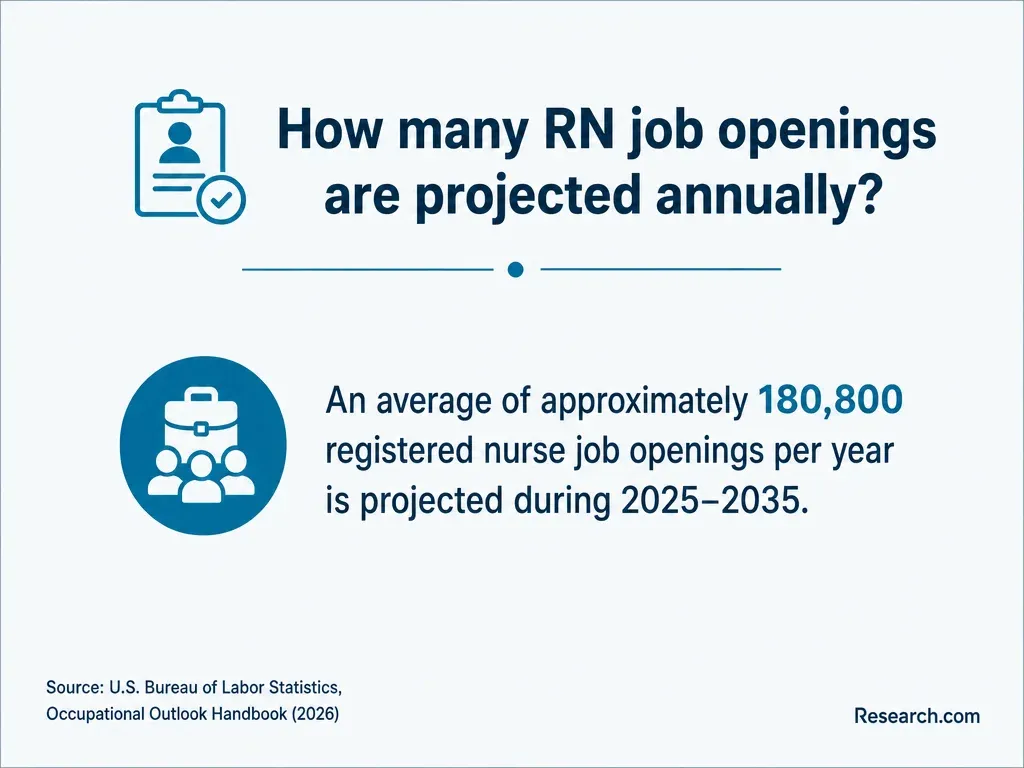
What careers, salaries, and job outlook follow an RN bridge program?
After licensure, an LPN-to-RN graduate can seek RN roles in settings such as hospitals, outpatient care, long-term care, and home health, subject to employer hiring and orientation requirements. The transition brings different responsibilities, including broader assessment, care planning, coordination, and RN-level clinical judgment. Prior LPN experience is valuable, but it does not replace orientation to a new RN role or specialty.
The U.S. Bureau of Labor Statistics reports wages and employment projections for the registered nurse occupation, not for Georgia bridge graduates or for associate- versus bachelor's-degree holders separately. Use its latest Registered Nurses Occupational Outlook Handbook figures as broad labor-market context, then compare local postings by setting, shift, experience requirements, and pay. Neither an occupation-wide median nor a national growth projection predicts your first offer.
If an associate-degree bridge best fits your immediate schedule, ask prospective employers whether a BSN is preferred or expected later. Flexible BSN completion routes for licensed RNs may offer a subsequent academic option; first confirm the RN bridge's own licensure pathway and the employer's actual requirements.
Other Things You Should Know About Nursing
Possibly. Ask the school which LPN license status it accepts for admission and clinical participation, and confirm your authority to practice in Georgia separately if you plan to work while enrolled.
Do not assume so. The nursing program must approve clinical arrangements; an employer's willingness to host you does not itself make your work hours eligible for course credit.
Ask about limits on science-course age, required recent LPN practice, and transition-course eligibility. Request a written review before assuming your previous coursework will shorten the program.
Some students do, but feasibility depends on the assigned clinical shifts, campus dates, study load, and your employer's flexibility. Obtain a term-specific schedule before committing to full-time hours.
- How to Guide: Registered Nurse | Georgia Secretary of State https://sos.ga.gov/how-to-guide/how-guide-registered-nurse
- LPN to RN Bridge Option | Chattahoochee Technical College https://www.chattahoocheetech.edu/school-of-nursing/lpn-to-rn-bridge-option.html
- Associate of Science in Nursing - LPN to RN Bridge Option https://northgatech.edu/academic-programs/health-sciences/lpn-to-rn-bridge-program/
- Clinical Information - Nursing Students - UW-Madison https://students.nursing.wisc.edu/clinical-information/
- Class Formats | Ivy Tech Community College https://www.ivytech.edu/classes/class-formats/
- Clinical Placements | College of Nursing https://nursing.osu.edu/clinical-placements
- Application and Admission | Gordon State College https://www.gordonstate.edu/academics/school-nursing-health-sciences/department-of-nursing/lpn-rn-bridge-program/lpn-rn/index.html
- School of Nursing - South Georgia State College https://www.sgsc.edu/academics/school-nursing