2027 How to Evaluate Data Science Master's Outcomes for Part-Time Students

Co-Founder and Chief Data Scientist
A part-time data science master's can help a working professional change roles, advance with an existing employer, or build technical skills, but a program's advertised employment rate may reveal little about any of those goals. The useful question is whether graduates with backgrounds like yours achieved the outcomes you want, at a cost and pace you can sustain.
This guide shows you how to compare program evidence, identify missing data, and decide whether a degree is likely to be a better fit than another route.
Key Things You Should Know
- Compare outcomes for part-time, working students separately from full-time graduates. Ask who was surveyed, how many responded, and when results were measured.
- For a career-change goal, examine new roles and relevant projects. For advancement, examine changes in responsibility and pay, not employment rates alone.
- The U.S. Bureau of Labor Statistics reports a $120,230 median annual wage for data scientists in May 2025, but that occupation-wide figure is not a graduate salary or a predicted return on tuition.
What outcomes should part-time students expect from a data science master's degree?
The most useful expected outcome depends on your starting point. Someone already employed in analytics may value more complex assignments or a promotion. Someone moving from another field may need evidence of technical competence and access to relevant roles. A graduate survey showing that most respondents are employed cannot distinguish those results if many students held jobs before enrolling.
Define your target before comparing schools: a specific role or responsibility, skills you need to demonstrate, a completion deadline, and the maximum total cost you can accept. Then look for evidence of change from enrollment to after graduation, rather than treating a graduate's job title or salary as an effect of the degree. Prior experience, employer support, location, and the wider job market can all affect results.
If your target is primarily AI-focused, compare the curriculum and expected cost of AI master's degrees with lower tuition costs against data science options. A more specialized degree is worthwhile only if its training and graduate evidence fit the work you intend to pursue.
How can you compare career outcomes across part-time data science master's programs?
Use the same outcome definition and measurement period for every program. The table separates measures that are often presented together but answer different questions; it is a comparison framework, not a set of reported results for particular schools.
| Measure | What it describes | Key limitation for part-time students |
| Employment after graduation | Respondents working at a stated point in time | May include people employed before enrollment |
| Relevant-role placement | Respondents working in defined data-related roles | Role definitions may differ across schools |
| Career change or advancement | Respondents reporting a new role, promotion, or expanded duties | Self-reports may not show whether the degree caused the change |
| Reported salary | Pay for a specified group and period | A post-degree level does not show an increase from prior pay |
| Completion | Students finishing within a defined time window | Full-time and part-time pacing may be combined |
For each figure, request the cohort dates, number eligible, number responding, response rate, time since graduation, and whether results are broken out by enrollment status and prior work experience.
A small or self-selected response group can make an impressive figure unrepresentative. If programs cannot provide comparable part-time results, treat their published figures as context, not a ranking.
Compare role outcomes with the work you actually want. A program can have strong general placement yet weak evidence for your target occupation. Data science program selection by career demand offers another way to narrow that role-to-program match.
What careers can a part-time data science master's degree lead to?
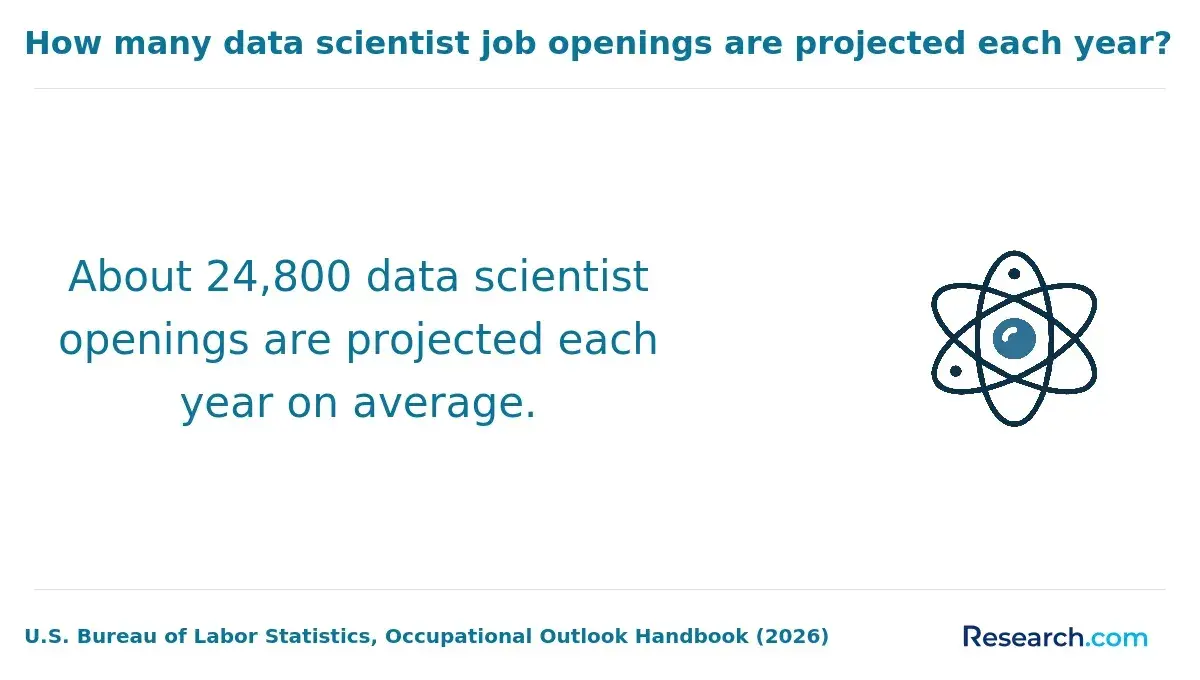
Potential directions include data scientist, machine learning practitioner, analytics specialist, and data-focused roles within a student's existing industry. These are possible paths, not automatic outcomes of a degree. Employers set their own expectations, and a graduate's prior occupation can make an internal move more realistic than an immediate move into an unfamiliar industry.
Evaluate a program against a specific target role. Look for graduate job titles and employers, then examine whether required projects demonstrate the methods and communication that role demands.
For an internal advancement goal, evidence of graduates taking on model development, experimentation, or decision-making responsibilities may be more informative than a count of external job offers. For a career switch, relevant projects and documented transitions from backgrounds similar to yours matter more.
How do online and campus-based data science master's outcomes compare?
Delivery format alone does not establish stronger employment outcomes. A comparison is credible only when programs report similarly defined cohorts and outcomes; differences in student experience and prior employment can otherwise overwhelm any apparent format effect. For working students, the practical distinction is often access to the experiences that support their particular goal.
Online study may make continued employment easier, while campus study may provide more convenient access to in-person events or collaborators. Neither benefit should be assumed.
Ask whether career advising, recruiting events, faculty contact, group projects, and alumni introductions are available to part-time students in the format you would use. Confirm any required live sessions or travel before treating an online option as flexible.
If connections in AI are central to your goal, examine how alumni access actually works rather than relying on network size alone. The same questions apply when considering AI master's programs with strong graduate networks: can working students participate, and are graduates active in the roles you seek?
Which curriculum features predict strong data science master's outcomes?
No course list can reliably predict an individual graduate's job result. Curriculum is more useful as evidence that the program lets you build skills and work samples aligned with your goal. Look beyond course titles. Syllabi, project descriptions, assessment methods, and recent capstone examples reveal whether students merely encounter a topic or apply it substantially.
For technical roles, examine the depth of statistics, programming, data management, modeling, and evaluation. For advancement in an existing organization, also look for opportunities to frame problems, explain limitations, and communicate results to decision-makers. A substantial project can be particularly valuable if it requires defensible methods and a clear account of your individual contribution.
A warning sign is a curriculum that emphasizes tools without showing how students test models, handle imperfect data, or communicate uncertainty. Another is a required capstone that cannot accommodate your target domain or working schedule. Ask to see what a part-time student can realistically complete, not just what the catalog permits.
How do accreditation and professional standards affect program credibility?
Verify the institution's accreditation through the accreditor and the institution's current disclosures, and confirm that the credential is the master's degree being advertised. Accreditation is an important credibility check, but it does not validate a program's placement claim, guarantee that credits will transfer, or show that its curriculum fits a particular employer's needs.
Professional or curriculum standards can help you frame questions about statistical rigor, responsible data use, and reproducible work. They are not a substitute for examining courses and graduate projects.
If a program advertises a specialized endorsement or accreditation, verify exactly which program it covers and whether it is current; do not assume an institution-level status applies to every degree.
What admission requirements should part-time data science students expect?
Requirements vary by program. Check the current admissions page for the required degree, transcripts, quantitative and programming preparation, recommendations, essays, and any applicable tests. A background outside computer science need not rule out admission, but professional experience or self-study should not be assumed to satisfy a formal prerequisite unless the school confirms it.
Admissions fit also affects outcomes: entering without enough preparation can make a part-time workload harder to sustain. Ask whether foundation courses count toward the degree, add tuition or time, and must be finished before advanced work. If you are comparing adjacent credentials, AI master's programs with bridge courses illustrate why the availability and cost of preparatory study belong in a program comparison.
How long and how much does a part-time data science master's take?
There is no reliable universal duration or price: credits, course frequency, enrollment pace, residency rules, and fees vary by institution. Obtain a part-time degree plan showing when each required course is offered, whether prerequisites delay progress, the maximum time allowed to finish, and what happens if you pause enrollment.
For a meaningful cost comparison, calculate required credits at the tuition rate that applies to you, then add mandatory fees, any foundation courses, materials or technology, and travel if required. Consider financing costs and time away from paid work where relevant.
Employer assistance can lower your personal cost, but verify eligibility and any repayment conditions. Compare full estimated costs on the same basis; a low per-credit price is not necessarily a low-cost degree. A starting point for alternatives is data science master's programs with lower tuition.
To assess return, compare that personal investment with a plausible range of career changes, not an assumed graduate salary. Staying employed while studying may reduce foregone earnings, but a longer schedule can delay when you can use the credential or completed portfolio.
What salary and job outlook should data science graduates evaluate?
The U.S. Bureau of Labor Statistics reports that the median annual wage for data scientists was $120,230 in May 2025. It projects employment in the occupation to grow 35% from 2025 to 2035. Those national, occupation-wide figures describe a labor market, not the pay or hiring prospects of newly qualified master's graduates.
For a personal decision, compare pay for the roles and locations you could realistically enter with your current compensation and experience. A graduate salary figure is most informative when a school discloses whose salaries it includes, whether respondents were already employed, and whether it reports starting pay or changes in pay. Do not use the national median as the expected benefit in a tuition-payback calculation.
How should you verify data science master's employment and graduate outcomes?
Start with the program's published methodology, then request clarification from admissions, career services, or the department. The following checks help separate useful part-time evidence from a headline that cannot support your decision.
- Identify the population: ask whether the report includes part-time students, online students, nonrespondents, and graduates who were employed before enrolling.
- Check timing and definitions: record the graduation cohort, survey date, meaning of "employed" or "relevant role," and whether salary is reported for all respondents or a smaller group.
- Compare with your baseline: ask for role changes, expanded responsibilities, or pay changes where available, and note whether outcomes are broken out by prior experience.
- Seek independent context: speak with recent graduates who studied part time, including people who stayed with an employer and people who tried to switch careers.
Do not interpret a missing subgroup report as proof of poor outcomes, but do not replace it with an unsupported assumption. If comparable evidence remains unavailable, decide whether the curriculum, cost, scheduling, and graduate accounts provide enough confidence for your goal. A strong choice is one that still makes sense under a conservative outcome scenario.
Other Things You Should Know About Data Science Programs
Record it in your personal timeline, but do not automatically attribute it to the degree. Note what coursework you had completed and what other factors, such as prior performance or an open position, may have contributed.
Only with the appropriate employer permission. Ask whether you can publish a sanitized account of the problem, methods, and your contribution without exposing protected data, code, or business information.
Yes, if you can find reliable information about their experiences. Graduate-only surveys exclude people who left the program, so completion evidence and conversations about workload provide important context.
They may, depending on the survey's definition. Ask whether a program reports contract work separately from permanent employment so you can interpret its results against the kind of work you want.
References
- College Student Employment - COE https://nces.ed.gov/programs/coe/indicator/ssa/college-student-employment
- Delayed Time-to-Degree and Post-college Earnings - PMC https://pmc.ncbi.nlm.nih.gov/articles/PMC7875953/
- Cost of Attendance (Budget) | 2025-2026 Federal Student Aid Handbook https://fsapartners.ed.gov/knowledge-center/fsa-handbook/2025-2026/vol3/ch2-cost-attendance-budget
- Demand for Data Science Drives Graduate Career Success | virginia.edu https://datascience.virginia.edu/news/demand-data-science-drives-graduate-career-success
- What impact might lower response rates have had on the latest Graduate Outcomes statistics? | HESA https://www.hesa.ac.uk/insight/04-11-2025/impact-lower-response-rates-graduate-outcomes
- Develop a Capstone | Assessment and Curriculum Support Center https://manoa.hawaii.edu/assessment/resources/capstone-experiences/
- In-Person Program - UChicago Data Science Institute https://datascience.uchicago.edu/education/masters-programs/in-person-program/
- What to Look for in an Online Data Science Master's Degree | njit.edu https://online.njit.edu/blog-posts/what-to-look-for-online-data-science-masters-degree