2027 Online Data Science Master's for Archivists: A Career Transition Guide

Co-Founder and Chief Data Scientist
Archivists already organize complex information, document its origins, and make it usable, skills that can matter in data science. The harder question is whether an online master's will build enough programming, statistics, and applied-project experience to support a career change.
This guide helps working archivists identify realistic target roles, compare programs against their skill gaps, and decide whether a graduate degree is worth the time and cost.
Key Things You Should Know
- An online data science master's can support an archivist's transition, but the best fit depends on technical readiness and the role sought; the degree alone is not a job qualification.
- Look for substantive work in Python, SQL, statistics, and evaluated projects - not just courses that mention AI or data analytics.
- The U.S. Bureau of Labor Statistics reports a $120,230 median annual wage for data scientists in May 2025; that occupation-wide figure is not an expected starting salary for a career changer.
What Is an Online Data Science Master's for Archivists?
It is a data science graduate program taken primarily online by someone bringing archival experience to analytical work - not usually a degree designed specifically for archivists. The useful transition is from preserving, describing, and retrieving records to preparing data, testing questions, building models, and explaining results.
Archival expertise remains valuable when datasets have unclear origins, inconsistent descriptions, access restrictions, or long retention histories. An archivist interested mainly in automated description or digital-collection discovery may need targeted technical training rather than a full data science degree.
If the goal is to build predictive models or move into broader analytics roles, a master's with rigorous quantitative and programming work may be more appropriate.
Those weighing a specialized AI credential against a broader degree can use how to evaluate AI degrees for career fit to clarify which skills their target jobs require.
Can Archivists Transition to Data Science Through an Online Master's?
Yes, but admission and graduation are separate from becoming competitive for a particular job. Archivists may bring strengths in metadata, provenance, data quality, documentation, stakeholder needs, and responsible access. They typically need to demonstrate additional ability to write code, work with databases, apply statistics, and evaluate analytical results.
The most direct first move may be an adjacent role, such as data analyst, research data specialist, or metadata-focused data engineer, rather than a job titled data scientist.
For an archivist who already writes queries and analyzes collection-use data, a focused course sequence and a strong project may be enough to test that move before paying for a master's. A degree is more compelling when target job descriptions repeatedly call for deeper statistical or machine-learning preparation.
A convincing transition project should connect both skill sets: for example, cleaning a collection's inconsistent metadata, documenting its provenance, analyzing a measurable discovery problem, and explaining the limits of the results. Use material you have permission to analyze and publish.
What Are the Admission Requirements for Online Data Science Master's Programs?
Requirements vary by program. Applicants should expect a bachelor's degree and should check each school's stated expectations for calculus, linear algebra, statistics, and programming. An archival or library-science background neither automatically qualifies nor disqualifies an applicant. Professional experience can strengthen an application, but it does not necessarily fulfill a formal prerequisite.
Before applying, compare your transcript with the program's actual requirements and ask whether missing coursework can be completed before enrollment or through a designated preparatory route. A small Python-and-SQL project can demonstrate readiness, but confirm whether the admissions office accepts project work as evidence.
Application materials also vary; an archivist considering a different, more specialized route can compare machine learning master's programs that do not require an application essay without assuming those programs have lighter technical prerequisites.
How Do Online Data Science Programs Compare With Campus-Based Programs?
The curriculum may cover similar subjects, but the learning experience depends on the individual program. For a working archivist, the decisive differences are access to feedback, scheduling, projects, and career support, not simply whether classes are online.
The comparison below identifies what each format may make easier and what to verify before enrolling:
| Consideration | Online program | Campus-based program |
| Work continuity | May allow continued archival employment; live sessions can still constrain scheduling | May require commuting, relocation, or a reduced work schedule |
| Technical help | Depends on remote office hours, tutoring, and response times | May offer more in-person access, but support still varies |
| Projects and networking | Can support distributed teams and remote employer connections | Can offer in-person collaboration and local employer contact |
Avoid treating "online" as synonymous with self-paced. Ask for the course timetable, live-attendance rules, project expectations, and maximum time allowed to finish. Archivists trying to change careers quickly can explore data science master's programs with shorter timelines, then check whether the pace leaves enough time to master unfamiliar mathematics and coding.
What Courses Do Data Science Master's Programs Typically Include?
Common subjects include programming, databases, statistical inference, machine learning, data visualization, and applied projects. For archivists, course titles are less informative than the work students actually produce: "data analytics" could mean anything from interpreting dashboards to building and validating models.
Match the curriculum to a specific gap. Python and SQL help turn collection or operational records into analyzable data; statistics helps distinguish a useful finding from a misleading pattern; machine learning introduces model evaluation and error analysis.
A capstone is especially valuable when students can define a real problem, document data rights and limitations, and produce reproducible work suitable for a portfolio. Ask for course descriptions and sample capstone expectations rather than assuming an AI elective provides that depth.
How Long Does an Online Data Science Master's Take and Cost?
There is no reliable single timeline or price: credit requirements, pacing, tuition policies, and fees differ by institution. An archivist who needs prerequisite courses should account for that preparation separately from the advertised degree length. A faster schedule may also reduce the hours available for paid work or portfolio development.
Compare each school's published tuition using the credits required for graduation, then add mandatory fees and any prerequisite, software, travel, or financing costs that apply to you. Ask whether tuition changes by residency or enrollment pace and whether employer education benefits cover the program.
Economical online data science master's options can help build a shortlist, but verify current charges directly with each institution. Do not calculate a return on investment by treating an occupation-wide salary median as a guaranteed post-degree salary.
Which Data Science Careers Can Archivists Pursue After Graduation?
The most plausible destination depends on how much technical work an archivist can demonstrate. A data analyst may investigate collection use, operations, or program outcomes. A research data specialist may combine data preparation with documentation and stewardship.
Data engineering roles can draw on metadata and quality-control experience but generally require stronger database and software skills. Data scientist roles usually call for substantial statistical modeling and evaluation.
Domain knowledge can help an archivist stand out, but it does not replace technical evidence. Someone with experience in health-records stewardship, for example, could investigate master's pathways connecting AI and healthcare if that is the intended field; they should also assess the field's data-access and privacy requirements.
Choose a target role before choosing electives, and compare several actual job descriptions with the projects graduates are expected to complete.
What Salaries Can Archivists Earn After Moving Into Data Science?
The U.S. Bureau of Labor Statistics reports that the median annual wage for data scientists was $120,230 in May 2025. That is the midpoint for workers in the occupation, not a forecast for an archivist's first analytical job. Pay for a career changer depends on the role obtained, technical experience, employer, location, and responsibilities.
For a useful financial comparison, look at pay ranges for the specific roles and locations you would pursue, then compare a plausible starting offer with your current compensation and the full cost of study.
A move into an adjacent analyst role could be strategically valuable even if it does not immediately increase pay; conversely, a higher-paying target role may require experience beyond the degree.
What Is the Job Outlook for Data Science Careers in the United States?
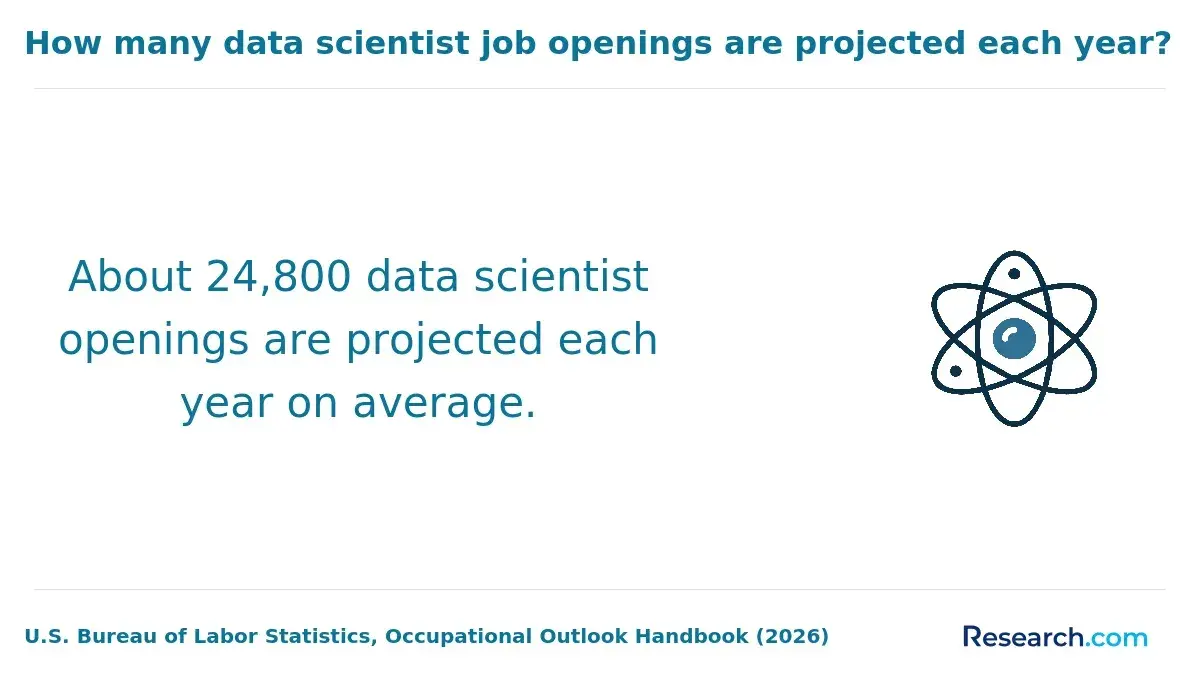
The U.S. Bureau of Labor Statistics projects data scientist employment to grow 35% from 2025 to 2035, much faster than the average for all occupations. This signals demand across the occupation, but it does not measure openings reserved for new graduates or for archivists changing fields.
In particular, growth is not a reason to overlook entry requirements. Review postings for your intended role to see whether employers expect production coding, statistical modeling, domain expertise, or a combination.
As AI tools change analytical workflows, the ability to assess data quality, document methods, and check outputs remains relevant; an archivist should be prepared to demonstrate those abilities with technical work, not rely on the degree title alone.
How Can Archivists Choose an Accredited Data Science Master's Program?
Start by verifying the institution's recognized accreditation through an official institutional, accreditor, or U.S. Department of Education source.
Then evaluate the program itself: institutional accreditation does not establish that a particular curriculum fits an archivist's career goal. If you will study from another state, confirm that the institution can enroll students where you live.
A manageable shortlist should answer the following questions before you commit:
- Which published prerequisites are required, and how will the school assess your prior coursework?
- Do required courses teach programming, databases, statistics, and model evaluation at the depth your target roles need?
- Can you complete a substantial project using appropriately accessible data, with meaningful faculty feedback?
- What is your estimated total cost and workable completion schedule - not just the advertised tuition or fastest possible pace?
- What career services are available to online students, and does the school publish relevant outcomes with enough detail to interpret them?
A common mistake is selecting the least expensive or quickest program before checking prerequisites and project depth. If a school does not publicly report career outcomes for its online data science students, do not infer a placement rate; ask what evidence it can provide and judge the program primarily on verifiable curriculum, support, and cost.
Other Things You Should Know About Data Science
Not generally. A certificate may help you learn or demonstrate a specific skill, but it does not automatically satisfy a program's coursework requirements. Check the admissions policy before paying for one primarily to qualify.
Yes, when it supports the role. Explain how the credential relates to provenance, metadata, information governance, or user needs, and pair it with clear evidence of your analytical skills.
Only when you have the necessary permissions and have addressed access, privacy, and rights restrictions. If public release is inappropriate, use an openly available dataset or describe a project without exposing protected records.
No. Many digital-collections responsibilities center on description, systems, and stewardship rather than statistical modeling. Choose training based on the work you want to perform, not the presence of "data" in a job title.
References
- Fast Facts: Tuition costs of colleges and universities (76) | ed.gov https://nces.ed.gov/fastfacts/display.asp
- What preparations do I need for graduate education? | Statistics & Data Science Graduate Interdisciplinary Program https://stat.arizona.edu/what-preparations-do-i-need-graduate-education
- Program Details | Statistics + Data Science MS | Portland State University https://www.pdx.edu/math/program-details-statistics-data-science-ms
- Digital Preservation Framework | UTSA Libraries https://lib.utsa.edu/about/policies/digital-preservation-framework
- What Can I Do With a Degree in Data Science? Career Paths & Skills | Harvard SEAS https://seas.harvard.edu/news/what-can-i-do-degree-data-science-career-paths-skills
- Course Offerings - UT iSchool - The University of Texas at Austin https://ischool.utexas.edu/programs/course-offerings
- Understanding the Ethics of Data Collection and Responsible Data Usage | University of the Cumberlands https://www.ucumberlands.edu/blog/understanding-the-ethics-of-data-collection
- Online Program - UChicago Data Science Institute https://datascience.uchicago.edu/education/masters-programs/online-program/
- Data Analytics Career Change Guide for Working Professionals | Arkansas State University Online https://degree.astate.edu/online-programs/technology/ms-applied-digital-technology/bus-analytics/data-analyst-career-path-guide/
- Online Master's in Data Science - Graduate School https://asegrad.tufts.edu/program/online-masters-data-science