2027 How to Address Rejection and Reapply to a Data Science Master's

Co-Founder and Chief Data Scientist
A rejection from a data science master's program does not tell you, by itself, whether you lacked a prerequisite, presented weak evidence of readiness, or faced a competitive applicant pool. If you are deciding whether to reapply, the useful question is what you can change before the next deadline. This guide helps you assess the likely gap, build a stronger application, and decide whether the same program - or a better-fitting one - deserves your next application.
Key Things You Should Know
- You can generally reapply after rejection, but check each program's repeat-applicant rules and submit a materially stronger application rather than the same materials again.
- Prioritize documented readiness in programming, statistics, mathematics, and applied work; self-study can build skills but may not satisfy a formal course prerequisite.
- Career demand is a reason to assess fit, not to rush: the U.S. Bureau of Labor Statistics projects 35% growth in data scientist employment from 2025 to 2035, but that does not predict your admission or job outcome.
Why were you rejected from a data science master's program?
Unless a program provides feedback, you cannot know its exact reason. A rejection may reflect an unmet requirement, an application that did not demonstrate your skills clearly, or competition for available places. Separate those possibilities before paying another application fee.
Compare your submitted materials with the program's published requirements and curriculum. Look for a missing required course, weak grades in relevant subjects, limited programming or project evidence, a statement that did not explain your goals, or recommendations that could not speak to your analytical work. Also check for incomplete documents or missed instructions. These are diagnostic possibilities, not a claim about what the committee decided.
If the program offers feedback, ask politely whether it can identify a gap you could address before reapplying. Some programs cannot provide individual explanations. In that case, an admissions adviser may still be able to clarify requirements and whether planned coursework would meet them.
Can you reapply to a data science master's program after rejection?
Often, yes, but the program's current policy controls. Check whether it permits applications in consecutive cycles, requires a new application and fee, retains earlier materials, or limits how often someone may apply. Do not assume a previous recommendation, test score, or transcript will carry forward.
Reapply to the same program when you still want its curriculum and can show a meaningful change, such as completed prerequisite coursework, stronger grades, substantial analytical work, or a clearer match between your goals and its offerings. Consider other programs instead when your background fits their entry requirements better or the original program cannot support your intended work. Waiting is sensible if a required course or credible project cannot be finished before the next deadline.
A repeat application should make the improvement easy to see without arguing against the earlier decision. Briefly explain relevant new preparation in your statement, then support it with transcripts, work samples, or recommendations.
How can you strengthen your data science master's application?
Strengthen the weakest verifiable part of your application, not every part at once. The following sequence helps you decide what to do before the next deadline.
- Match each published requirement to evidence you submitted; identify anything missing or difficult for a reviewer to verify.
- Confirm with admissions whether planned courses or credentials will satisfy any formal prerequisite before enrolling in them.
- Complete the highest-priority gap and retain evidence: a graded transcript for coursework or a documented project showing your methods, evaluation, and contribution.
- Revise your statement to connect your preparation and career goal to specific parts of that program's curriculum.
- Ask recommenders who have observed your quantitative, programming, research, or problem-solving work to provide current, specific examples.
For a project, explain the question, data limitations, methods, results, and what you would change. A polished dashboard alone may reveal less about your readiness than a smaller, reproducible analysis with sound reasoning. If your goal has shifted toward artificial intelligence, compare the curriculum you need with online AI degree options before rewriting your statement around a different field.
What admission requirements do data science master's programs have?
Requirements vary by institution and program. A bachelor's degree and academic transcripts are common starting points, while expectations for mathematics, statistics, computing, professional experience, recommendations, statements, and tests must be checked on each program's current admissions page. A related undergraduate major may help demonstrate preparation, but its title alone does not establish eligibility.
Read admissions language carefully. A required prerequisite must be met under the program's rules; a recommended skill signals what may help you succeed or compete. If a program accepts applicants from varied majors, that does not necessarily mean it waives specific coursework. Ask whether a course must be completed before application, before enrollment, or during an approved preparatory pathway.
Which prerequisites should you complete before reapplying?
Start with any course the target program explicitly requires and you have not completed. If no formal gap exists, choose preparation that addresses the clearest weakness in your record or the technical demands of the curriculum. Common areas to check are calculus or linear algebra, probability and statistics, programming, and foundational computing; their required depth differs across programs.
Use the program's course descriptions to distinguish an introductory skill from graduate-level preparation. These checks can keep you from spending time on the wrong credential.
- For a missing formal prerequisite, obtain written clarification about acceptable credit, minimum grade, and completion deadline before registering.
- For weak statistics evidence, consider graded coursework that includes inference and model evaluation rather than relying only on a software tutorial.
- For weak programming evidence, build or document work that shows code quality, data handling, and reproducibility.
- For an unfamiliar specialization, use self-study or a short course to test your interest, but do not assume it replaces transcripted credit.
If your intended focus is machine learning rather than a broad data science curriculum, comparing affordable online machine learning master's options may help you decide which preparation is most relevant before reapplying.
How should you choose an accredited data science master's program?
Do not treat accreditation as a shortcut for judging fit. Verify the institution's current accreditation status with the recognized accreditor or an official U.S. Department of Education listing, and check whether the specific program makes any separate accreditation claim. Then assess the program itself: required courses, prerequisite flexibility, faculty or project opportunities, delivery schedule, student support, and the work its graduates are being prepared to do.
For a reapplicant, the decisive question is whether a program's entry expectations and curriculum match the evidence you can realistically provide. A less expensive degree in an adjacent field is not automatically a substitute. For example, review lower-cost artificial intelligence master's options only if an AI-focused curriculum also serves your goals; compare required courses and total costs, not degree titles alone.
Should you choose an online or campus-based data science master's?
Choose by the learning conditions you need, not by an assumption that one format is inherently easier to enter or complete. The comparison below shows the format differences most worth checking when building a new program list; individual programs may offer exceptions.
| Consideration | Online program | Campus-based program |
| Scheduling | May offer more location flexibility, but can still require live classes or scheduled exams | Typically requires travel to campus at set times |
| Interaction | May rely more on virtual office hours and remote group work | Provides in-person access to classes and campus activities |
| Practical constraints | Requires a suitable study setup and confirmation of availability where you live | May require relocation or regular commuting |
An online option may fit a working applicant who can study independently; campus study may suit someone who needs frequent in-person interaction. Confirm live-session times, group-project expectations, access to support, and any residency requirements before applying. If you are widening your search, online AI degree options are relevant only when their technical emphasis matches the roles you want.
What do you learn in a data science master's program?
Curricula differ, but applicants should expect to evaluate some combination of statistical reasoning, data preparation, programming, modeling, communication, and responsible use of data. The useful question after a rejection is not whether a catalog mentions these topics; it is whether you are prepared for the program's required starting level and whether its advanced work supports your goal.
Inspect course descriptions and project requirements. A program emphasizing model development may call for stronger mathematics and coding preparation; one emphasizing applied decision-making may give more weight to domain problems and communicating results. If healthcare is your goal, compare data science coursework with artificial intelligence graduate study for healthcare applications, paying particular attention to whether projects address the data and practical constraints of that setting.
How much do data science master's programs cost and take to complete?
There is no reliable single price or completion time for these programs. Before reapplying, obtain each school's current required credits, tuition rate, mandatory fees, expected course load, and completion rules. An online label does not establish a lower total cost, and a stated minimum duration may assume a pace you cannot maintain while working.
Calculate tuition and mandatory fees separately from books, technology, travel, and any income you would forgo. Ask whether prerequisite courses add cost or time before admission, whether tuition changes by residency or enrollment status, and what scholarships, assistantships, or employer support you may actually qualify for. Compare like-for-like totals; advertised tuition alone is not the amount you will necessarily pay.
If price is driving a change in direction, affordable online machine learning master's options can provide a comparison point, but verify their current fees and whether a narrower curriculum meets your objectives.
What careers, salaries, and job outlook follow a data science master's?
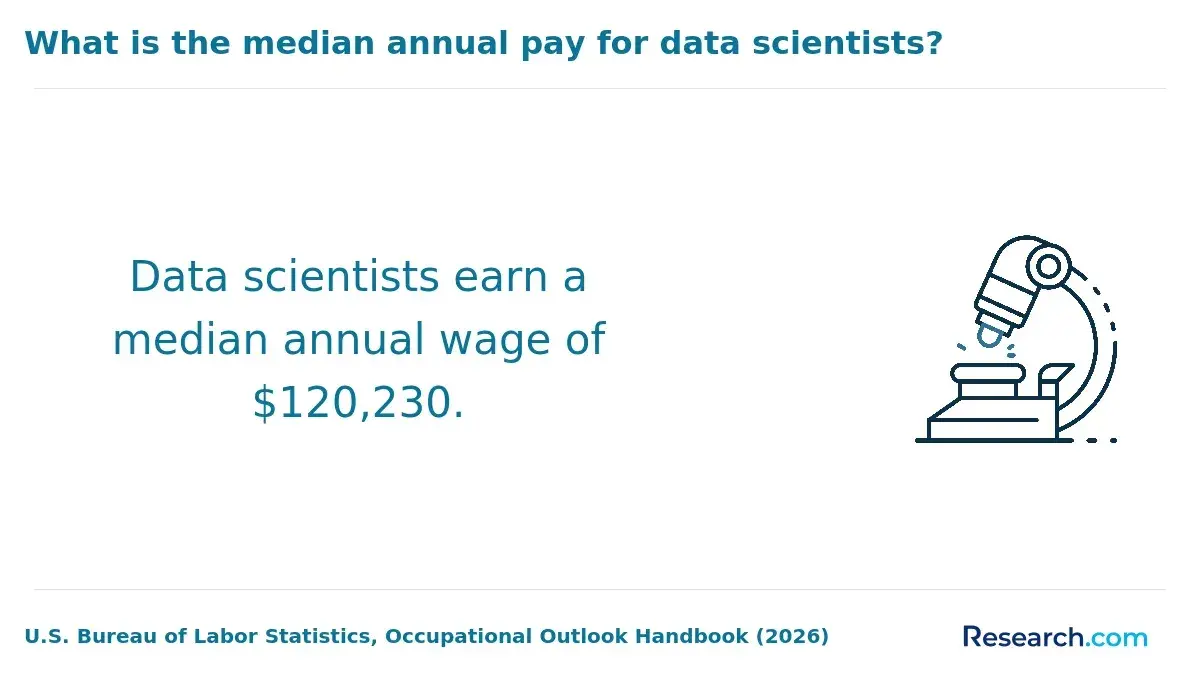
A master's may support a move toward data scientist or related analytical work, but the degree alone does not determine a job title or offer. The U.S. Bureau of Labor Statistics reports a $120,230 median annual wage for data scientists in May 2025. That is a wage for people in the occupation - not a starting salary or a measured return for master's graduates.
BLS projects 35% employment growth for data scientists from 2025 to 2035. This signals demand across the occupation, not the odds of employment for an individual applicant.
Before committing to another application, examine whether your target roles require the skills your prospective program teaches and whether your existing experience helps you qualify. Earnings also vary by sector; sector-by-sector data science earnings comparisons can inform a career plan, but should not be treated as a salary promise.
Other Things You Should Know About Data Science
Check whether the program has a formal appeal process and what grounds it accepts. An appeal is most appropriate when you can document a procedural error or newly available information the policy permits - not simply disappointment with the decision.
Ask the program whether it retains letters and whether recommenders must submit new ones. Even when reuse is allowed, an updated letter may better describe work you completed after the rejection.
Follow the program's waitlist instructions and deadlines. Ask whether it accepts updates, and continue evaluating other offers; a waitlist place is not an admission offer.
Generally, you can, subject to each application's terms. Tailor your statement and prerequisite check to each program, and give recommenders enough notice to meet different deadlines.
References
- Advice on Application Sections | Grants & Funding https://grants.nih.gov/grants-process/write-application/advice-on-application-sections
- Ten simple rules for writing compelling recommendation letters | nih.gov https://pmc.ncbi.nlm.nih.gov/articles/PMC7906297/
- FAQ | Data Science Institute | Brown University https://dsi.brown.edu/academics/masters-programs/masters-data-science/faq
- A Guide to Choosing Between Data Science vs. Data Analytics | UCLA MSOL Data Science https://www.msol.ucla.edu/data-science-engineering/articles/demystifying-data-guide-choosing-between-data-science-vs-data-analytics/
- Master's in Data Science | utexas.edu https://cdso.utexas.edu/msds
- MS Admissions FAQ | Department of Statistics https://statistics.stanford.edu/msadmissions/ms-admissions-faq
- Writing a killer Statement of Purpose | Rice University https://graduate.rice.edu/current-news/writing-killer-statement-purpose
- Alumni Perspective: Do I Need a Master's Degree for Data Science? - School of Data Science https://datascience.virginia.edu/news/alumni-perspective-do-i-need-masters-degree-data-science
- Letters of Recommendation | Dr. Jason King https://jtking.wordpress.ncsu.edu/letters-of-recommendation/
- Does Computer Science Require Math? | Coursera https://www.coursera.org/articles/does-computer-science-require-math