
2027 Online Data Science Master's After a Bachelor's in Public Health: Prerequisites and Program Fit

Co-Founder and Chief Data Scientist
A bachelor's in public health can be a useful foundation for an online data science master's, but it does not establish readiness for every program. Your coursework may already cover research methods and biostatistics while leaving gaps in programming, calculus, or linear algebra.
This guide helps public health graduates identify those gaps, compare programs against health-data career goals, and decide whether to apply now or prepare first.
Key Things You Should Know
- A public health degree does not automatically qualify or disqualify you; compare your transcript with each program's stated math, statistics, and programming requirements.
- Prioritize programs that teach technical skills at the depth your target role needs and let you apply them to credible health-data projects.
- The U.S. Bureau of Labor Statistics projects 35% growth in data scientist employment from 2025 to 2035, but that is a national, all-industry projection - not a forecast of public health openings or graduate outcomes.
Can you earn an online data science master's after a bachelor's in public health?
Yes. A public health bachelor's can provide relevant preparation in population health, study design, epidemiology, statistics, and communicating findings to decision-makers. What you studied matters more than the degree title: a graduate who used statistical software extensively may be better prepared for some coursework than one whose program emphasized policy and community practice.
The key distinction is between eligibility to apply and readiness to succeed. Some master's programs accept applicants from varied majors and offer introductory coursework; others expect substantial quantitative and computing preparation before enrollment. Check each program's published requirements, then compare them with specific courses and projects on your transcript. Do not assume that public health experience substitutes for a required calculus or programming course without written confirmation from admissions.
What prerequisites do public health graduates need for a data science master's?
Requirements vary by program. The comparison below separates strengths you may already have from gaps worth checking; it is a preparation map, not a universal admissions checklist.
| Preparation area | Possible public health foundation | Gap to check against program requirements |
| Statistics | Biostatistics, regression, or epidemiologic analysis | Probability, mathematical statistics, or more advanced modeling |
| Mathematics | Quantitative research methods | Calculus and linear algebra, if explicitly required |
| Programming | Analysis with R, SAS, Python, or similar tools | Writing, testing, and explaining code independently |
| Data management | Survey, surveillance, or research-data experience | SQL, database concepts, and reproducible data workflows |
| Domain judgment | Population-level interpretation and research ethics | Translating that judgment into technically rigorous projects |
Start with the required courses for two or three programs you would actually attend. Match each requirement to a transcript entry or documented experience, and ask admissions whether an equivalent course will count. If formal credit is required, self-study or a short course may help you learn but may not satisfy the rule. Where no formal prerequisite applies, a small, reproducible project can still demonstrate readiness: for example, analyze a publicly available health dataset, document your code, assess missing data, and explain the limitations of your conclusions.
How do you choose an accredited online data science master's program?
First, verify the institution's accreditation through its official listing and confirm that it applies to the institution awarding the degree. Then check the program's current curriculum, admissions rules, online availability for your state of residence, and any required campus visits. Institutional accreditation is important, but it does not by itself show that a program teaches the skills you need.
For a public health graduate, the strongest fit depends on the intended work. A program with rigorous statistics, data management, and room for health-related projects may suit epidemiologic or population-health analysis. One centered on software engineering and machine learning may be more appropriate for building predictive systems - provided its entry requirements are realistic for you. Ask whether health-focused electives, faculty supervision, or an approved health-data capstone are actually available rather than assuming the word "data" in a program title guarantees them.
If your goal is specifically AI rather than broader health-data analysis, compare the curriculum and full price with lower-cost artificial intelligence degrees online. Choosing on price or a fashionable degree title alone is a mistake if the required courses and projects do not match the work you want to do.
What data science coursework is included in an online master's program?
Curricula differ, but relevant areas may include statistical modeling, programming, databases, machine learning, data visualization, and a project or capstone. For health-data work, look beyond course names: a single machine-learning unit is different from a dedicated course in which students validate models, examine bias, and explain results to stakeholders.
Public health knowledge becomes especially useful when coursework addresses sampling, confounding, missing data, and the limits of drawing causal conclusions from observational data. Compare required courses - not just electives that may be offered irregularly - and inspect project descriptions for evidence of substantial hands-on work. A guide to data science degrees linked to in-demand skills can help frame that curriculum comparison, but the individual program catalog should determine what you will actually study.
What are the admission requirements for online data science master's programs?
Expect requirements to vary across institutions. Programs may ask for a bachelor's degree, transcripts, evidence of quantitative preparation, a statement of purpose, recommendations, a résumé, or examples of technical work. Testing policies and minimum grades also vary; check the current admissions page rather than relying on an older overview.
Use your application to make the transition legible. Name the statistical and computing methods you used in public health coursework or employment, explain your individual contribution, and connect your proposed study to a plausible target role. If you are missing a stated prerequisite, ask admissions which credit-bearing courses or other evidence they accept before paying an application fee. Do not present a completed tutorial as equivalent to college credit unless the program says it is.
How long does an online data science master's take and cost?
There is no reliable single price or completion time for all online programs. Both depend on required credits, tuition rules, course availability, and whether you study full time or part time. A prerequisite course can also add time and expense before the master's begins. Request a current, program-specific estimate rather than multiplying an advertised per-credit rate without checking fees.
When comparing offers, separate tuition from mandatory fees, prerequisite courses, software or equipment, and any travel requirements. Ask how long your planned enrollment pace would take, whether required courses are offered often enough to support it, and whether employer tuition assistance has grade or repayment conditions.
Compare the same cost components across schools. If a machine-learning-focused alternative is on your shortlist, an online machine learning master's budget guide can help you examine tuition and required fees without treating the advertised price as the entire cost.
How does online data science study compare with campus-based programs?
An online program can make it easier to keep working in public health while studying, but "online" does not necessarily mean self-paced. Scheduled live classes, group projects, timed exams, and fixed course sequences can still constrain your week. A campus program may offer easier access to in-person research groups or local employer events; whether that advantage matters depends on the opportunities you would use.
Before choosing a format, ask for a sample schedule and clarify live-attendance rules, time zones, project collaboration, academic support, and any visits. If finishing quickly is essential, verify the actual course sequence rather than assuming online delivery makes acceleration possible. The same check applies when considering online AI master's programs under two years: a published fast track may not fit a working student who needs prerequisite courses.
What careers can public health graduates pursue with a data science master's?
Potential paths include health-data analyst, population-health analyst, healthcare data scientist, and research-focused analytics roles. Titles overlap, so inspect job descriptions for the actual mix of coding, statistical inference, data engineering, domain knowledge, and stakeholder communication. A master's can build skills, but it is not automatically necessary for every analyst position.
Your public health background may be most valuable where results must be interpreted in context: who was included in the data, what a measure represents, and whether an apparent pattern supports the proposed decision. Build a portfolio project that shows both technical execution and those limitations. If the roles you want emphasize developing AI systems instead, use the target job descriptions when selecting an artificial intelligence qualification for your next role rather than assuming a general data science degree is always the best fit.
What salaries can data science graduates earn in public health?
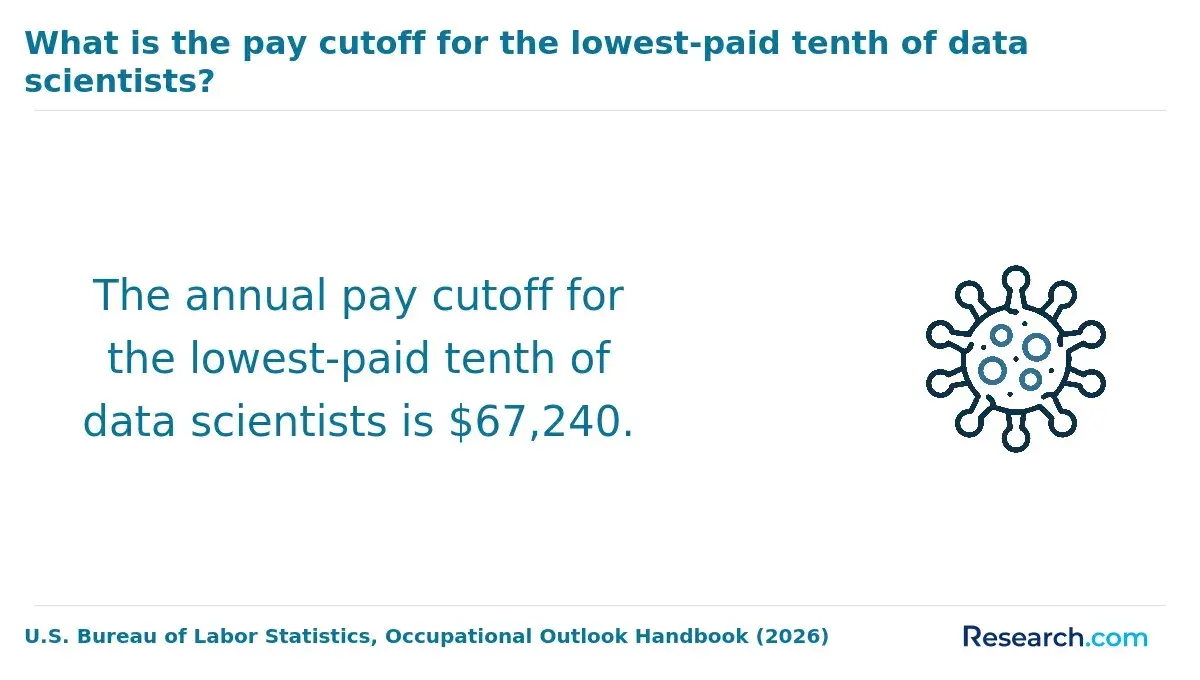
The U.S. Bureau of Labor Statistics reports a $120,230 median annual wage for data scientists in May 2025. That figure covers the occupation across industries; it is not a public health salary estimate, an entry-level offer, or an outcome attributable to a master's degree.
For a useful personal comparison, review current postings for your intended role and location, including required experience and technical skills. Consider the salary you could earn without the degree, the total cost of studying, and any income you would forgo. A broad occupational median should not be used as a promised return on tuition.
What is the job outlook for data scientists in public health?
The Bureau of Labor Statistics projects 35% employment growth for data scientists from 2025 to 2035. This indicates strong projected growth for the occupation nationally, but it does not isolate public health employers or indicate how many positions will suit a new graduate.
Test the local or remote market against your goal: compare public health agencies, healthcare organizations, and research employers for the tools and experience they request. If most appealing openings require substantial engineering or prior healthcare-data experience, favor a program that offers relevant projects and a feasible route to gaining that experience. Strong national growth is a reason to investigate fit - not to overlook a mismatch between a curriculum and the jobs you want.
Other Things You Should Know About Data Science
Yes, if you have permission to use it and can comply with its access and privacy rules. Publicly released datasets are often the simpler choice. Do not upload patient-level or employer-controlled data to a public portfolio without explicit authorization.
Not universally. Some programs may require or offer one, while employers assess experience differently. If an internship is important to your transition, confirm whether the program helps online students find and complete placements.
There is no universal certification requirement for the occupation. A targeted course or certificate may help you address a specific skill gap, but compare it with the evidence requested in the jobs you want before adding another credential.
It may, particularly if it includes rigorous methods coursework and a substantial research project. Doctoral programs set their own expectations, so check whether prospective programs expect particular mathematics courses, research experience, or faculty recommendations.
References
- Master's in Health Informatics and Data Analytics | Texas State https://online.txst.edu/degrees/graduate/masters-health-information-management/data-analytics/
- Online Master of Science | HSPH | Harvard T.H. Chan School of Public Health https://hsph.harvard.edu/program/online-master-of-science/
- Top 12 Data Science Programming Languages | MDS@Rice https://csweb.rice.edu/academics/graduate-programs/online-mds/blog/programming-languages-for-data-science
- PhD in Population Health Sciences | cornell.edu https://phs.weill.cornell.edu/education/phd-program
- Health Data Science, M.S. | Saint Louis University https://www.slu.edu/medicine/medical-education/graduate-programs/health-analytics-and-outcomes/health-data-science-ms/index.php
- MS in Health Data Science Online | Dartmouth Health Sciences https://healthsciences.dartmouth.edu/education/degree-programs/master-science-health-data-science/online/program-overview
- Admission Requirements - Public Health Data Science MS Program https://keck.usc.edu/public-health-data-science-ms-program/admission-requirements/
- Data Science Specialization | uw.edu https://bime.uw.edu/datascience/
- Choosing Your Path in Public Health - Biostatistics | Columbia MSPH https://apply.publichealth.columbia.edu/choosing-your-path-in-public-health-chapter-1
- Graduate Program: Public Health | UCLA Graduate Programs https://grad.ucla.edu/programs/school-of-public-health/public-health/


