2027 Experiment Tracking in an Online Data Science Master's: Courses, Projects, and Program Selection

Co-Founder and Chief Data Scientist
An online data science master's can teach strong modeling skills without giving students much practice managing experiments across a real project. If you want to build, evaluate, and hand off machine learning systems, that distinction matters.
This guide explains what substantial experiment-tracking training looks like, which courses and projects provide it, and how to compare programs before committing your time and money.
Key Things You Should Know
- Look for repeated practice recording data versions, code, parameters, metrics, and model artifacts - not just a course description that mentions MLOps.
- A strong portfolio project should let someone reproduce a model comparison and explain why the selected model was chosen.
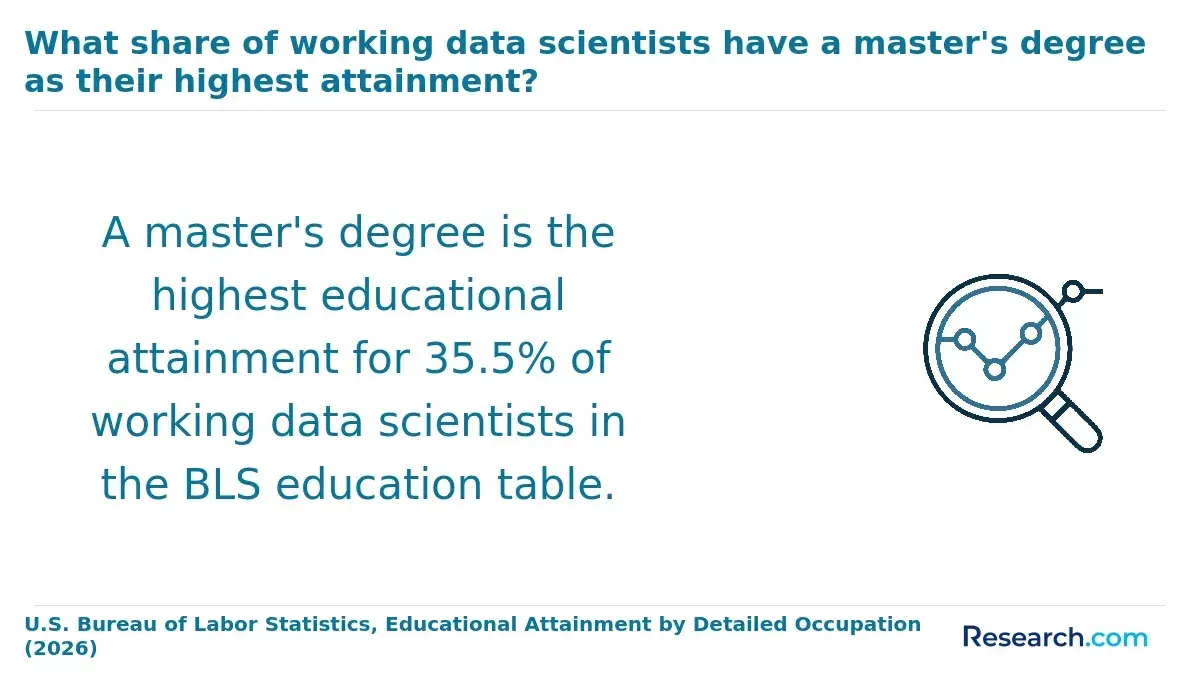
- The U.S. Bureau of Labor Statistics projects 35% growth in data scientist employment from 2025 to 2035; that is occupational context, not a prediction of any program's graduate outcomes.
What is experiment tracking in an online data science master's program?
Experiment tracking is the practice of recording what changed between model runs and what happened as a result. A useful record connects a run to its dataset or data version, code version, preprocessing choices, hyperparameters, evaluation metrics, and saved outputs. It lets a student answer a practical question: Can I reproduce this result and defend the comparison?
At graduate level, tracking should be part of a broader machine learning workflow. Students should understand how to prevent data leakage, choose appropriate evaluation measures, document limitations, and compare runs under consistent conditions. Tools such as MLflow, Weights & Biases, Git, and dataset-versioning systems can support that work, but learning a product's interface is not the same as learning sound experimental design.
For program selection, the distinction is whether tracking is taught and assessed. A brief demonstration offers exposure; a graded project requiring reproducible comparisons offers practice. A workflow that continues through a team project or capstone provides stronger evidence of depth.
Which courses teach experiment tracking, MLOps, and machine learning workflows?
Experiment tracking may appear in machine learning, applied data science, software engineering for data science, cloud computing, or MLOps courses. It requires foundations in Python, data preparation, model evaluation, and version control. A course title alone does not show how far the instruction goes.
The table distinguishes common levels of coverage. Use it to interpret syllabi and assignment descriptions rather than treating a mention of a tool as proof of proficiency.
| Evidence in the curriculum | Likely depth | What it demonstrates |
| Tracking appears in a topic list | Passing mention | Awareness, with no clear evidence of practice |
| A lab logs model runs | Single-unit exposure | Basic tool use in a bounded exercise |
| Multiple graded assignments compare recorded runs | Applied course depth | Practice connecting experiments to evaluation decisions |
| A dedicated MLOps course and substantial project use reproducible workflows | Advanced depth | Experience maintaining experiments across a larger workflow |
When reviewing a syllabus, look for assignments involving baseline models, repeatable pipelines, dataset and code versions, model registries, and evaluation reports. Ask whether students must explain discrepancies between runs and whether instructors assess reproducibility, not just model accuracy. If your interests extend beyond data science workflows to AI-focused curricula, an artificial intelligence online degree guide can help frame that separate choice; verify experiment-tracking depth in either type of program.
What projects help students build practical experiment-tracking skills?
The best project is not necessarily the one with the most complex model. It is one with a clear prediction or analytical question, usable data, a defensible baseline, and enough experimental choices to make tracking consequential. A capstone might compare feature sets or modeling approaches while recording each run against the same evaluation design.
These project components turn a model comparison into credible evidence of skill:
- Define the decision the model supports, the target outcome, and a simple baseline before tuning.
- Record the dataset or snapshot, preprocessing steps, code version, parameters, and metrics for every consequential run.
- Use an appropriate held-out evaluation strategy and document how leakage was prevented.
- Explain the selected model's trade-offs, including relevant error patterns, resource demands, and limitations.
- Provide instructions and permissible artifacts that allow an instructor or reviewer to reproduce the comparison.
A common mistake is logging dozens of runs without a consistent test set or a written decision rule. That produces a busy dashboard, not trustworthy evidence. Before choosing a program, ask whether its capstone permits this kind of project and whether students receive feedback on documentation and reproducibility as well as results.
How does online study compare with campus-based data science programs?
Online delivery does not inherently limit experiment-tracking practice: students can collaborate through code repositories, remote computing environments, and shared run records. The consequential difference is how a particular program organizes feedback and access. A campus-based lab may make spontaneous troubleshooting easier; a well-designed online course may leave a clearer written record of experiments and team decisions.
Choose online study if its schedule fits your obligations and it provides adequate computing access, instructor support, and structured collaboration. A campus program may be more suitable if you need regular in-person lab support or access to equipment and research groups that the online option cannot offer. For either format, confirm synchronous meetings, time-zone expectations, group-project arrangements, software costs, and any required campus visits before enrolling.
What are the admission requirements for an online data science master's?
Requirements vary by institution, so no single checklist determines eligibility. Programs may ask for evidence of quantitative preparation, programming ability, prior coursework, professional experience, recommendations, or a statement of purpose. Some allow applicants to address gaps through preparatory coursework; whether that coursework formally satisfies a requirement is a program decision.
For experiment-tracking coursework, the most useful readiness check is practical: can you write and debug basic Python, work with datasets, interpret evaluation metrics, and use version control? If not, ask whether these skills are taught before advanced machine learning projects begin. Applicants weighing data science against AI programs may also find it useful to compare AI master's options for non-CS backgrounds, while confirming the actual prerequisites of each program.
How long does an online data science master's take, and what does it cost?
Completion time and total cost depend on the program's credit requirements, course availability, enrollment pace, tuition rules, and fees. A published fastest-possible timeline may not reflect part-time study or the sequence needed to reach an MLOps elective or capstone. Likewise, tuition alone may exclude mandatory fees, computing resources, software, and any required travel.
Request a written estimate for your intended pace and ask when the relevant courses are offered. Compare the total expected cost through completion - not one school's per-credit tuition against another school's program estimate. Employer support or aid may change your personal cost, but eligibility and conditions need direct confirmation. If speed is a priority, online artificial intelligence master's timelines offer adjacent context; a shorter path is worthwhile only if it preserves the project depth you need.
How can students verify accreditation and program quality?
Start by confirming the institution's current institutional accreditation through the accreditor's official directory and the U.S. Department of Education's accreditation database. Then check the university's official program page for the exact degree awarded, delivery format, and authorization to enroll students where you live. Institutional accreditation does not, by itself, establish the depth of an experiment-tracking curriculum.
Quality requires a second check: obtain recent syllabi or assignment examples, identify who teaches the relevant courses, and ask what computing environment and project support students receive. If a program advertises MLOps but cannot show where students complete and receive feedback on reproducible experiments, treat the claim as unverified rather than assuming the skill is covered. Confirm current details with the institution before paying a deposit.
Which jobs use experiment tracking and machine learning operations skills?
Data scientists use tracked experiments to compare models and communicate why one approach was selected. Machine learning engineers and MLOps practitioners may use the same records when testing pipelines, handing models to production teams, or investigating changes in performance. Applied AI roles can also require reproducible evaluations, although responsibilities vary substantially by employer.
Choose projects that match the work you want to do. A data scientist applicant may emphasize evaluation design and interpretation; an engineering-focused applicant may also need automated pipelines, testing, and deployment experience. Tracking skill alone does not qualify someone for every MLOps role. For a broader view of role preparation, see online data science degrees for in-demand careers.
What salaries and job outlook can data science master's graduates expect?
The U.S. Bureau of Labor Statistics reports a $120,230 median annual wage for data scientists in May 2025. That is a measure for workers in the occupation, not a starting salary or a reported outcome for online master's graduates. Pay for an individual offer depends on factors including experience, responsibilities, employer, and location.
BLS also projects strong growth in data scientist employment from 2025 to 2035, but occupational demand does not guarantee a position or show that a particular degree caused a salary increase. Evaluate a program's published outcomes, if available, by checking who was surveyed, how many responded, when results were collected, and whether respondents already worked in data science. Readers comparing sectors can use pay comparisons for graduates entering data science industries as context rather than as a forecast of personal earnings.
Which certifications and professional standards complement a data science master's?
A platform certification can demonstrate familiarity with a particular cloud or machine learning tool, but it is narrower than a graduate curriculum and does not replace evidence of sound experimental practice. It is most useful when the credential matches tools used by a target employer and you can support it with a reproducible project.
For a lasting standard, prioritize habits over badges: document data provenance, separate training from evaluation, record changes, protect sensitive information, and make limitations clear. Ask prospective programs whether these practices are assessed in coursework. A certification may fill a tool-specific gap after graduation; a program should still teach you how to judge whether an experiment is valid.
Other Things You Should Know About Data Science
Yes. A small project can record configurations, code versions, metrics, and outputs using accessible tools. The important test is whether another person can understand and reproduce the comparison.
No. A well-designed comparison using modest models can demonstrate experimental discipline. Choose computing resources to fit the problem rather than selecting a project solely for its hardware demands.
No. Check the dataset's license and privacy restrictions first. If sharing is prohibited, explain how authorized users can obtain the data and publish permissible code, configurations, and documentation instead.
Describe the parts you designed or implemented, link them to permitted repository history or project artifacts, and distinguish your work from the team's overall result.
References
- Tools and techniques for computational reproducibility - PMC https://pmc.ncbi.nlm.nih.gov/articles/PMC4940747/
- Professional Master of Data Science | Rice University https://datascience.rice.edu/academics/professional-master-data-science
- 2026 UNC Online Master of Applied Data Science (MADS) https://online.unc.edu/online-masters-programs/masters-data-science/
- Master's in Data Science | utexas.edu https://cdso.utexas.edu/msds
- M.S. in Data Science, Online | virginia.edu https://datascience.virginia.edu/degrees/msds-online
- Online Master's in Data Science (MSDS) | Northwestern University https://sps.northwestern.edu/masters/data-science/
- ML Experiment Tracking: What to Log and How to Compare Runs - Polyaxon https://polyaxon.com/blog/experiment-tracking-in-machine-learning/