2027 Evaluating LPN-to-BSN Outcomes: Completion Rates, Certification Results, and Data Gaps
Audited and Verified:
Our Editorial and Data Verification Process
Research.com uses government datasets, official education statistics and primary institutional information to support its career and degree guides. Our review process checks factual accuracy, occupational definitions, source dates and the requirements associated with the credentials discussed.
How This Article Was Fact-Checked
Our editorial team verifies salary estimates, employment projections, education requirements and program information against original data providers and official organizations. Salary figures are checked against the relevant occupational definitions and reporting periods. Information about licensure, accreditation and required in-person training is reviewed separately.
Fact-checked and verified on:

Co-Founder and Chief Data Scientist
An LPN-to-BSN program can build on your nursing experience while preparing you for RN licensure, but its advertised outcomes may not describe what happens to LPN entrants. A school-wide NCLEX-RN pass rate can exclude students who never graduated, and a completion rate may combine several entry pathways.
This guide shows working LPNs and LVNs how to interpret those measures, identify missing data, and ask for the cohort-specific evidence needed to compare programs realistically.
Key Things You Should Know
- Completion and exam passage measure different groups: A hypothetical cohort with 40 graduates among 50 entrants has an 80% completion rate; an NCLEX-RN rate counts eligible exam takers, not all 50 entrants.
- NCLEX-RN is a licensure examination, not specialty certification. A published pass rate does not establish that graduates hold RN licenses or have earned professional certifications.
- Compare like with like: Request LPN-entry cohort counts, entry and graduation dates, first-time NCLEX-RN results, and explanations of exclusions before relying on a percentage.
What Is an LPN-to-BSN Program and How Does It Lead to RN Licensure?
An LPN-to-BSN program is a prelicensure pathway for licensed practical or vocational nurses seeking a Bachelor of Science in Nursing and preparation for initial RN licensure. Schools may award credit or advanced standing for prior education, but they determine which credits apply to the nursing sequence. LPN employment does not automatically replace required RN-level coursework or supervised clinical experiences.
The sequence is admission, completion of the approved nursing program, determination of NCLEX-RN eligibility under the applicable state board's rules, examination, and a separate state licensing decision. An RN-to-BSN program instead enrolls people who are already RNs; comparing RN-to-BSN practice expectations is useful only after recognizing that it is not an initial-licensure route.
How Do LPN-to-BSN Programs Measure Completion and NCLEX-RN Outcomes?
Completion rate generally compares graduates with an entering cohort over a stated period. Its meaning changes if the school counts students who switched tracks, took leave, or finished later. First-time NCLEX-RN pass rate compares first-time passers with first-time test takers during a reporting period. It does not count everyone who entered the program, and it differs from an eventual pass rate that includes retakes.
This hypothetical example shows why both denominators matter. It illustrates calculations, not results from an actual school.
| Measure | Hypothetical calculation | What it does not show |
| On-time completion | 40 graduates ÷ 50 LPN entrants = 80% | Whether the other 10 later graduated |
| First-time NCLEX-RN passage | 34 passers ÷ 38 first-time testers = about 89% | Results for graduates who did not test, or for students who did not graduate |
Ask whether a published NCLEX figure covers the LPN-to-BSN track or every prelicensure RN track at the school. A high exam pass rate can coexist with substantial attrition. Also, NCLEX-RN is not a specialty certification examination; outcomes advertised for a later route such as a guide to accelerated post-master's FNP study cannot serve as evidence of LPN-to-BSN results.
What Accreditation and Licensing Requirements Apply to LPN-to-BSN Programs?
Check three separate matters: the institution's accreditation, the nursing program's accreditation where applicable, and state board approval or recognition for prelicensure RN education. ACEN and CCNE are nursing program accreditors, but accreditation alone does not settle an individual's NCLEX eligibility. The relevant board determines licensing requirements, while the school must establish that its program meets applicable educational rules.
Confirm the exact BSN track, campus or online location, and your intended licensing state with the school and board before enrolling - especially if you will study across state lines. Do not infer RN eligibility from the status of another degree at the same institution. That distinction also matters when researching accelerated Doctor of Nursing Practice programs, which serve different educational purposes and do not establish approval of a prelicensure BSN track.
Programs commonly review an LPN/LVN license, prior transcripts, prerequisite sciences and labs, grades, and any applicable entrance assessment. Schools set their own rules for science-course age, transfer equivalencies, license status, and whether admission to the university also means admission to the nursing major. Clinical sites may impose separate health, background-screening, or documentation requirements.
Request a written credit evaluation showing which previous courses satisfy prerequisites, which count toward the BSN, and where you enter the nursing sequence. If an entrance exam is a concern, nursing admissions without TEAS testing can provide a comparison point, but verify the specific LPN-to-BSN track's current policy rather than assuming a school-wide rule applies.
Online delivery usually describes some academic coursework, not an entirely remote path to RN preparation. Both online and campus-based tracks may require scheduled simulation, skills assessments, and supervised clinical placements. For an LPN balancing shifts or caregiving, the decisive distinction is the actual weekly schedule, not the word "online."
The formats can differ in ways that directly affect completion:
| Feature | Online or hybrid track | Campus-based track |
| Course attendance | May mix asynchronous work with required live sessions | Usually has scheduled in-person classes or labs |
| Hands-on learning | May require travel to campus and approved local clinical sites | May offer regular campus labs; clinical sites can still be off campus |
| Key question | Who secures placements, and where may students complete them? | Which days and shifts are required for labs and clinicals? |
Ask for the upcoming term's lab, simulation, and clinical schedule, including evening or weekend requirements and travel. The same caution applies to online graduate options such as short-format PMHNP master's options: online classes do not eliminate supervised practice obligations, though those programs are not substitutes for initial RN preparation.
Expect RN-level study in areas such as health assessment, pharmacology, clinical judgment, care coordination, population health, and evidence-based practice. Supervised experiences should allow faculty to assess competencies beyond the LPN role, including prioritization, patient education, and delegation within applicable scope and policy. The exact courses, placement settings, and accepted prior learning vary by program.
Ask the school which clinical experiences are required after advanced standing is awarded, who arranges sites, and how performance is evaluated. LPN work hours and simulation are valuable preparation but do not automatically substitute for approved clinical requirements. This distinction persists in later advanced-practice study: a guide to accelerated family nurse practitioner study concerns different competencies and supervised experiences, not a shortcut around RN-level clinical education.
Time to completion depends on approved transfer credit, prerequisite gaps, nursing-course sequencing, clinical capacity, and whether you attend full or part time. A quoted minimum timeline may assume every prerequisite is complete and each required course is available when needed. Ask for a term-by-term plan based on your transcript, not a general program estimate.
Compare the full cost through graduation rather than tuition alone. Request a written estimate that accounts for tuition and mandatory fees; books, equipment, testing, and licensing expenses; travel to labs and clinical sites; and any reduction in paid work hours. Employer assistance may lower your cost, but confirm eligibility, reimbursement timing, grade conditions, and any repayment obligation. If your longer-term goal is graduate study, exploring less expensive MSN pathways after a BSN can wait until the prelicensure pathway's total cost and RN eligibility are clear.
The central gap is often track-level reporting. A school may publish one completion figure for all BSN students and one NCLEX-RN rate for all prelicensure graduates. Neither isolates LPN entrants. Small LPN cohorts can also make percentages volatile: in a cohort of 10 testers, one different result changes the pass rate by 10 percentage points.
Other gaps include unstated entry dates, different definitions of "on time," missing transfer or leave outcomes, first-time rates presented without tester counts, and no indication of how many graduates became licensed. Specialty certification results are not a routine proxy for these measures. Published outcomes for a distinct pathway - such as comparing budget-friendly psychiatric NP programs - use different cohorts and examinations and cannot fill an LPN-to-BSN reporting gap.
If track-level figures are unavailable, treat the school's broader results as context rather than an estimate of your likelihood of finishing or passing. A candid explanation of what is and is not tracked is more useful than a precise-looking percentage with an unknown denominator.
After meeting state requirements and obtaining an RN license, graduates can pursue RN positions in settings such as hospitals, ambulatory care, and community health. Hiring depends on local openings, previous LPN experience, clinical preparation, and employer orientation. Graduation alone does not authorize RN practice, guarantee a specialty position, or demonstrate independent competence in a new unit.
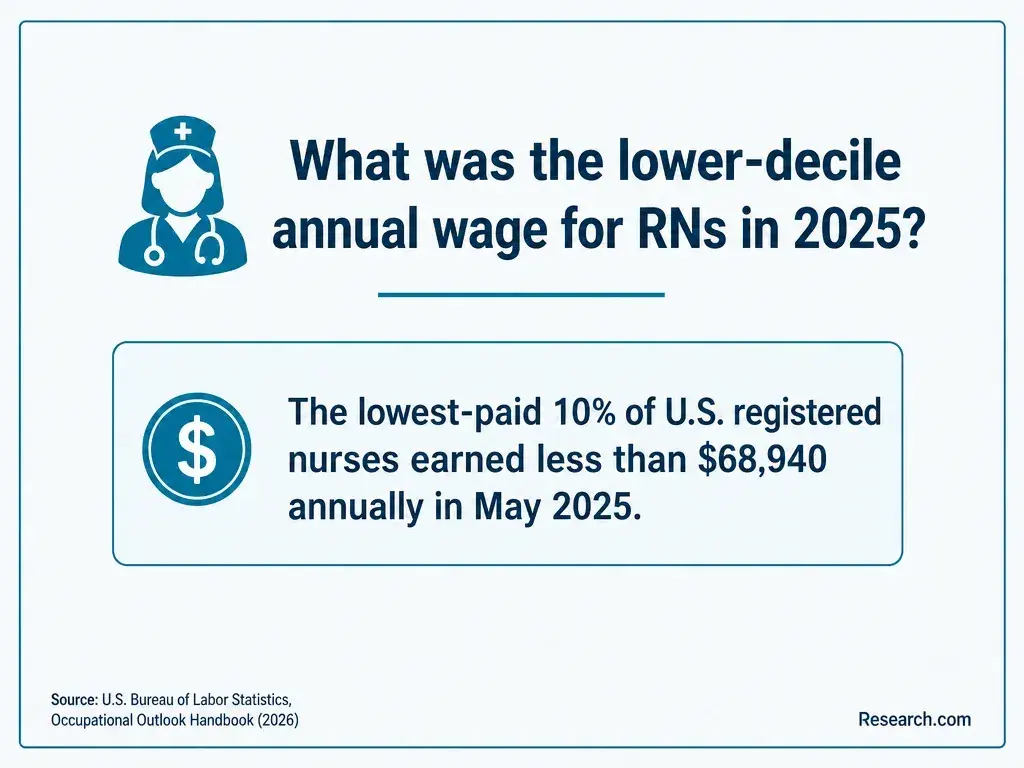
For pay comparisons, use the U.S. Bureau of Labor Statistics' registered nurse occupation figures alongside local job postings and actual offers. An occupation-wide RN median includes nurses with varied experience, settings, and education; it is not the expected starting salary for an LPN-to-BSN graduate. Compare any likely earnings change with the program's full cost and the wages you may forgo while studying.
Advanced-practice roles require additional education and credentials after RN preparation. For example, time-efficient PMHNP certificate pathways address eligible graduate-prepared nurses, not newly graduated LPN-to-BSN students seeking their first RN job.
How Should Students Evaluate LPN-to-BSN Programs and Reported Outcomes?
Compare programs using the same entry point, time window, and outcome definition. Before paying a deposit, request answers in writing to these questions:
- How many LPN/LVN students entered the track in each recent cohort, and how many graduated on time or later?
- For those graduates, how many took the NCLEX-RN for the first time, how many passed, and which reporting years do the figures cover?
- Which of my credits apply to the nursing major, and what term-by-term sequence, clinical schedule, and total estimated cost follow from that evaluation?
- What is the exact track's accreditation and board-approval status, and does it meet educational requirements for the state where I intend to seek initial RN licensure?
Give greater weight to documented eligibility, feasible scheduling, and clearly defined cohort results than to a single headline pass rate. If your prior education or goal differs from an LPN-to-BSN applicant's - for example, you hold a non-nursing degree and no nursing license - comparing nursing degrees for non-nursing graduates is more relevant than assuming LPN advanced standing applies. If two schools cannot provide comparable outcomes, compare what they can document and state the remaining uncertainty rather than treating missing data as success or failure.
Other Things You Should Know About Nursing
Often, but feasibility depends on clinical shifts, labs, coursework, and your employer's scheduling flexibility. Ask for an actual term schedule before committing to work hours.
A first-attempt failure does not itself mean you cannot retest. Follow the applicable board's eligibility rules and the examination administrator's retake procedures; you cannot practice as an RN without a valid license.
It may. Ask about reentry deadlines, course availability, repeat requirements, and whether clinical placement must be arranged again. Get the policy for your entering cohort in writing.
Yes. Keep transcripts, course descriptions, license information, and any documentation the receiving school requests. Those records support review, but the program decides what prior learning satisfies its requirements.
- NCLEX Pass Rates - California Board of Registered Nursing https://www.rn.ca.gov/education/passrates.shtml
- Use The Data - National Center for Education Statistics (NCES) https://nces.ed.gov/ipeds/use-the-data
- Key Differences Between Regional and National Accreditation of Nursing Schools | Saint Joseph's College of Maine https://studyonline.sjcme.edu/blog/key-differences-between-regional-and-national-accreditation-nursing-schools
- LPN to RN Outcomes | Labouré College of Healthcare https://www.laboure.edu/lpn-to-rn-outcomes
- Nursing - Program Outcome Data | academics.ysu.edu https://academics.ysu.edu/bitonte-college-of-health-and-human-services/nursing-program-outcome-data
- LPN to BSN Program | Online https://online.uark.edu/programs/licensed-practical-nurse-bachelor-science-nursing.php
- Nursing, LPN to BSN Bridge Program | gsu.edu https://www.gsu.edu/program/nursing-lpn-to-bsn-bridge-program/
- The Impact of Education on Nursing Practice | aacnnursing.org https://www.aacnnursing.org/news-data/fact-sheets/impact-of-education-on-nursing-practice