2027 Choosing an Online MS in Psychology - Forensic Psychology for a Future Research Coordinator Position: Prerequisites to Compare
Audited and Verified:
Our Editorial and Data Verification Process
Research.com uses government datasets, official education statistics and primary institutional information to support its career and degree guides. Our review process checks factual accuracy, occupational definitions, source dates and the requirements associated with the credentials discussed.
How This Article Was Fact-Checked
Our editorial team verifies salary estimates, employment projections, education requirements and program information against original data providers and official organizations. Salary figures are checked against the relevant occupational definitions and reporting periods. Information about licensure, accreditation and required in-person training is reviewed separately.
Fact-checked and verified on:

Co-Founder and Chief Data Scientist
A forensic psychology master's can sound like a direct route to coordinating justice-related research, but the concentration name tells you little about the methods training or project experience employers will see.
If you are considering an online MS in psychology, the crucial comparison is between what you already know, what each program requires for admission, and what it lets you demonstrate before graduation.
This guide identifies the prerequisites worth checking, the research opportunities that matter most, and the circumstances in which targeted training or research employment may be a better investment.
Key Things You Should Know
- Compare three areas separately: admission prerequisites, research-methods preparation, and opportunities to coordinate an actual project. Meeting the first does not establish the other two.
- Prioritize statistics, research design, ethical data handling, and supervised project work over the forensic concentration label when your goal is research coordination.
- No forensic psychology MS automatically confers clinical licensure or a research coordinator job; verify each program's required credits, total charges, scheduling, and research access before enrolling.
What Is an Online MS in Psychology-Forensic Psychology Degree?
It is a graduate psychology degree with coursework focused on behavior and research in legal or justice settings. Depending on the school, forensic psychology may be a formal concentration within an MS, the degree's named field, or simply a selection of electives. Those distinctions affect what appears on your transcript, but none establishes the depth of research training.
For a future research coordinator, the strongest fit is a program that connects psychological science to feasible questions about courts, corrections, victim services, or related systems and provides substantial methods work.
A research coordinator typically helps organize a study's approvals, recruitment, records, timelines, and communication; the job is not forensic evaluation or criminal investigation.
If you do not yet hold a bachelor's degree, establish that foundation first. Faster forensic psychology bachelor's degree pathways may be worth comparing, but an accelerated schedule is useful only if it leaves room for statistics and research experience.
What Prerequisites Do Online Forensic Psychology Master's Programs Require?
There is no universal prerequisite list. Programs may admit graduates from psychology, criminal justice, sociology, public health, or other fields, while differing on required psychology coursework, GPA, statistics, research methods, references, and entrance tests.
An applicant can be eligible without yet having the quantitative preparation that makes research-focused graduate work manageable.
The comparison below separates formal admission rules from preparation that may make you a stronger candidate for research coordination. Confirm each requirement in the catalog for your intended entry term:
| Background area | Check for admission | Check for research readiness |
| Undergraduate degree | Accepted majors and degree equivalencies | Evidence of social-science or justice-system research exposure |
| Psychology coursework | Required introductory or advanced courses and permitted substitutions | Ability to connect theory and measurement to a research question |
| Quantitative coursework | Whether statistics or research methods must be completed before enrollment | Experience interpreting analyses, documenting data, and explaining limitations |
| Applications | Published GPA, references, essay, test, and deadline policies | A clear account of your role in a project, not merely an interest in forensics |
Ask admissions staff whether missing courses can be completed before entry, taken conditionally, or waived with documented equivalent work. Get the answer in writing. If you are finishing a bachelor's elsewhere, psychology program transfer policies may affect how quickly you can complete your undergraduate preparation; only the receiving school can determine how a course applies to its degree.
Is an Online Forensic Psychology Master's Degree Accredited and Licensure-Eligible?
First, verify the university's institutional accreditation through the accreditor or the US Department of Education's accreditation records, then confirm that the specific online degree is offered by that institution. Institutional accreditation is important, but it does not prove that a particular concentration has research placements or meets a professional licensing board's rules.
Do not expect APA accreditation of a general, nonclinical forensic psychology MS: APA accreditation applies to specified professional psychology training programs and internships, not to every psychology degree.
Likewise, an MS with courses on mental disorders or assessment does not itself authorize psychotherapy, diagnosis, independent forensic assessment, expert testimony, or use of a protected psychologist title. If licensure is your actual goal, obtain the intended state board's educational requirements before applying.
Accreditation questions also arise earlier in the education pathway. Guides to online undergraduate addiction psychology program comparisons can help illustrate why a school's accreditation, a program's subject matter, and eligibility for a regulated role must be checked separately; an undergraduate concentration is not a substitute for a qualifying professional credential.
Online study can reduce relocation and commuting, but it does not necessarily provide flexible research hours. Live seminars, group analyses, faculty meetings, approved field sites, and occasional campus visits may still occur at fixed times.
Campus study may make it easier to join an established lab; a strong online program can be competitive for your goal if it offers comparable supervision and realistic access to projects or approved datasets.
Compare the formats by asking who assigns research supervisors, how often teams meet, whether remote students can participate in ongoing studies, and who arranges any required site experience.
If you work in a court, agency, or nonprofit, ask whether an existing job can support an approved nonclinical project; employment alone does not guarantee academic credit or permission to use agency records.
The questions used when comparing schools for an online psychology major, especially scheduling, advising, and access to faculty, remain useful, but a prospective graduate student should demand more specific answers about research supervision.
For a research coordinator, prioritize research design, statistics, psychological measurement, research ethics, and scientific writing. Forensic courses are most useful when they require students to assess evidence and the limits of measures in legal or justice settings, rather than only survey prominent cases or theories.
Course titles alone cannot show whether you will practice the work. Look for assignments involving a protocol, codebook, data-quality checks, literature synthesis, or a clearly documented analysis. A thesis or supervised capstone can provide evidence of these skills if you have appropriate mentorship and lawful data access.
When a project involves people or restricted records, determine what institutional review, site authorization, consent, and data-use controls are required before collecting or examining information.
Topic knowledge should follow the research setting. For example, studying substance-use services in corrections may call for familiarity with recovery support career planning so that a project distinguishes service roles from clinical treatment. That knowledge improves study design; it does not qualify a student to provide counseling.
Completion time depends on required credits, course availability, enrollment pace, and whether a thesis, capstone, or placement can be completed on schedule.
Published tuition may omit required fees, software, travel, continuation enrollment, and costs associated with unpaid project work. Compare a written, individualized cost and completion estimate rather than a headline tuition rate or advertised fastest finish.
Request the credit requirement and current per-credit or per-term charges, then ask which courses run each term and whether changing to part-time study affects aid. If you already work in a justice or community setting, check employer education assistance and project-approval rules before counting on either to reduce costs.
Scholarships aimed at another credential should not be treated as MS funding. For example, scholarship options for online addiction counseling undergraduates concern a different degree level; ask each graduate program what aid, if any, is actually available to its students.
It can, if the program helps you demonstrate the work employers request. Research coordinators may maintain study schedules, communicate with sites and participants, monitor data quality, prepare documentation for oversight, and help researchers report results.
Requirements vary substantially by employer: some roles accept a bachelor's degree plus relevant experience, while others favor graduate methods training or experience in a particular research setting.
Compare several postings from the employers you hope to approach. If they emphasize project administration, databases, and participant coordination more than graduate specialization, a research assistant position plus targeted methods training may be the shorter route.
If they require independent study planning or advanced analysis, a methods-intensive MS with supervised work may offer more value than a concentration with limited research access.
A different goal requires a different degree comparison. Someone seeking to provide therapy should evaluate a qualifying professional program rather than assume this MS serves that purpose; choosing a shorter clinical mental health counseling master's involves licensure and supervised-training questions distinct from research coordination.
Potential nonclinical directions include research assistant or coordinator roles, program evaluation, victim-services program support, corrections-related research support, and justice-agency administration.
The best fit depends on duties, prior experience, data skills, hiring rules, and any required background screening, not the degree title alone. Public-sector positions may also use fixed job classifications that determine the education and experience needed for appointment.
Read job descriptions carefully: "forensic" can describe a research setting without granting investigative, legal, or clinical authority. If compensation is a major factor, comparisons of higher-paying career paths after forensic psychology graduate study can suggest occupations to investigate, but confirm each role's actual credentials before treating it as an accessible outcome.
There is no reliable single salary or growth rate for "forensic psychology MS graduates." A research coordinator is an employer-defined title spanning different occupations and settings.
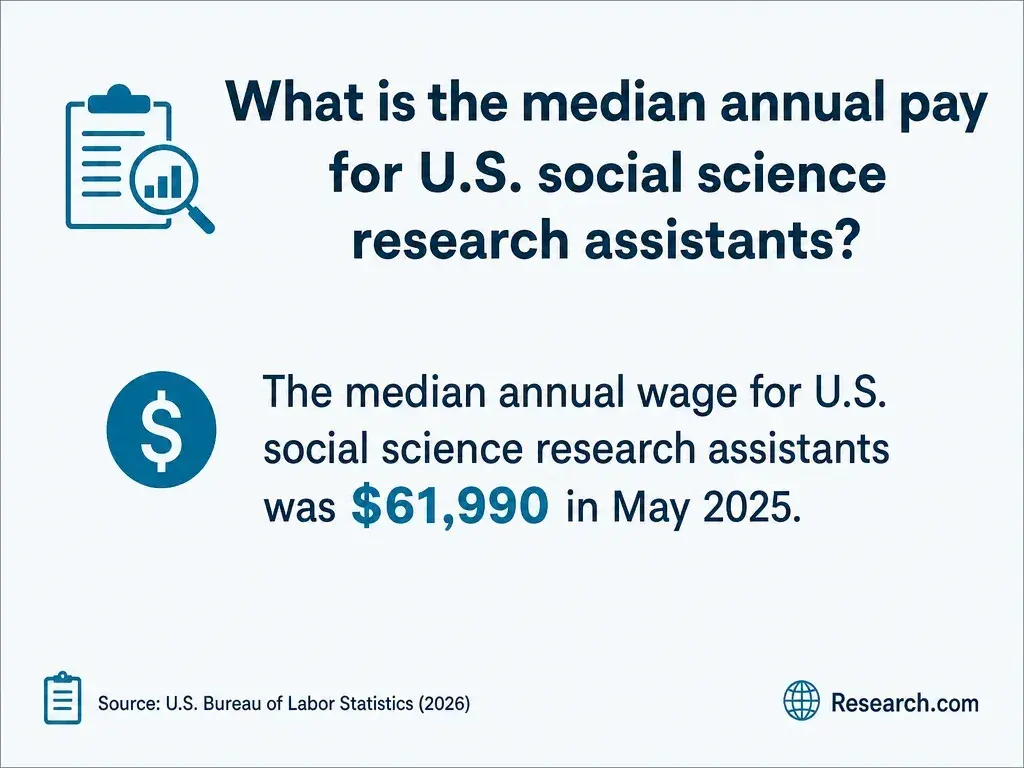
US Bureau of Labor Statistics wage data for social science research assistants may provide context for research-support work, but it is not a graduate salary estimate; psychologist wage data generally describes a regulated occupation with substantially different qualifications.
For a useful local comparison, collect posted pay ranges for research coordinator and assistant jobs in your target agencies, check each posting's degree and experience requirements, and compare those ranges with the program's full cost and the earnings you would give up while studying. Do not apply an occupational growth projection to a narrow forensic research job unless the occupation genuinely matches its duties.
Salary discussions for another profession need the same caution. Clinical counseling master's completion time and employment outlook concerns a distinct, potentially licensure-oriented pathway, not the expected pay or outlook for forensic research coordinators.
How Can You Choose a Reputable Online Forensic Psychology Program?
Start with your target job postings and identify the skills you cannot already demonstrate. Then request each program's current catalog, course rotation, total-cost estimate, and written explanation of how online students access research supervision.
A reputable choice is one whose documented opportunities address your gaps, not simply one with an appealing specialization name.
Before committing, use these questions to test whether the program is feasible for your situation:
- Which psychology and quantitative courses are mandatory before admission, and which alternatives or waivers are formally accepted?
- What supervised research work can an online student actually complete, and who approves its site, data access, and deliverables?
- Which meetings, residencies, or placements have fixed times or locations, and what happens if a project is delayed?
- What are the required credits, all expected charges, and published outcomes for students pursuing research roles?
If the answers point to limited research access and high cost, compare a research assistant role with targeted statistics or methods study instead.
For someone still choosing an undergraduate route, undergraduate substance use counseling study on a budget is an example of a different cost-and-career decision; it should not be mistaken for a cheaper equivalent to graduate forensic research preparation.
Other Things You Should Know About Psychology
Often, yes, if the program accepts professional references. A supervisor who can describe your data handling, writing, reliability, or project coordination may offer stronger evidence than an academic contact who barely knows your work.
It can help with a specific skill gap, but it rarely substitutes for understanding study design and statistics. Match training to the tools in your target job postings and keep an example of work you are permitted to share.
Only with the organization's permission and appropriate protection of confidential information. A methods summary or blank template may demonstrate your contribution without exposing participant or agency records.
Check whether each program has a course-recency rule. Even if the credit remains acceptable, a refresher may help you interpret analyses and keep up with graduate methods coursework.
- Institutional Review Board (IRB) Written Procedures | hhs.gov https://www.hhs.gov/ohrp/regulations-and-policy/requests-for-comments/guidance-for-institutions-and-irbs/index.html
- Program Eligibility, Written Arrangements, and Distance Education | 2024-2025 Federal Student Aid Handbook https://fsapartners.ed.gov/knowledge-center/fsa-handbook/2024-2025/vol2/ch2-program-eligibility-written-arrangements-and-distance-education
- Institutional Review Boards: Purpose and Challenges - PMC https://pmc.ncbi.nlm.nih.gov/articles/PMC4631034/
- Clinical Forensic Psychology Research | CoAS | Goodwin College of Professional Studies https://drexel.edu/coas/academics/departments-centers/psychology/research/forensic-psychology/
- Institutional Review Regarding Human Subjects Research | columbia.edu https://www.gsas.columbia.edu/content/institutional-review-regarding-human-subjects-research
- Online Master's Degree in Forensic Psychology | Monroe University https://www.monroeu.edu/academics/king-graduate-school/online-masters-degree-forensic-psychology
- MS in Forensic Psychology | Online Master's Degree | Capella University https://www.capella.edu/online-psychology-degrees/ms-clinical-psychology-program/masters-forensic-psychology/
- Clinical Research Coordinator: Salary, Job Description and Requirements - Campus Insider https://insider.augusta.edu/clinical-research-coordinator-salary/
- Forensic Psychology | fit.edu https://www.fit.edu/psychology/academics-and-learning/clinical-psychology/advanced-emphasis-coursework/forensic-psychology/