2027 Choosing an Online BA in Psychology - Mental Health Around Captioning and Recorded Lecture Needs
Audited and Verified:
Our Editorial and Data Verification Process
Research.com uses government datasets, official education statistics and primary institutional information to support its career and degree guides. Our review process checks factual accuracy, occupational definitions, source dates and the requirements associated with the credentials discussed.
How This Article Was Fact-Checked
Our editorial team verifies salary estimates, employment projections, education requirements and program information against original data providers and official organizations. Salary figures are checked against the relevant occupational definitions and reporting periods. Information about licensure, accreditation and required in-person training is reviewed separately.
Fact-checked and verified on:

Co-Founder and Chief Data Scientist
An online psychology program may advertise flexible lectures, yet a student can still encounter missing captions, recordings that expire before exams, or required live meetings. Those details matter when you rely on accessible video to study mental-health topics or balance classes with work and caregiving.
This guide explains what to verify about lecture access, academic quality, cost, and career preparation before choosing an online BA in psychology. It will help you compare programs on the learning conditions you need, not just the word "online" in a brochure.
Key Things You Should Know
- Ask whether all required lecture content is captioned, whether captions are corrected for psychology terminology, and how long recordings remain available.
- Online does not necessarily mean asynchronous: live discussions, exams, group work, or placements may still require scheduled attendance.
- A psychology BA commonly requires about 120 semester credits, but its mental-health courses do not, by themselves, qualify graduates to diagnose or provide therapy.
What Is an Online BA in Psychology With Accessible Lecture Options?
An online Bachelor of Arts in psychology is an undergraduate degree covering psychological science alongside general education and electives. "Accessible lecture options" describes how students can use instructional content; it is not a separate degree or proof that every course meets a particular accessibility standard.
For this decision, distinguish captioned video from recorded video. Captions display spoken content and relevant audio information. A recording lets you replay a lecture later. A program may offer one without the other, and neither feature alone makes a course fully accessible. Slides, readings, assessments, and the learning platform also matter.
Some programs include mental-health or abnormal-psychology courses; others offer a formally named concentration. Confirm which appears on the degree or transcript rather than assuming an elective creates a credential.
If your goal is eventual therapy practice, compare the BA as undergraduate preparation with short counseling master's formats and career planning; they serve different educational purposes.
How Do Captioned and Recorded Lectures Support Online Psychology Students?
Accurate captions can make discussions of diagnoses, research methods, and unfamiliar terminology easier to follow.
Recordings support review before statistics exams, let students pause complex explanations, and help those whose work or caregiving schedules conflict with a live lecture. They are study tools, not substitutes for accessible assessments or opportunities to ask questions.
The distinctions below help you test a program's advertised flexibility against what happens in a required course.
| Feature to verify | Why it changes the learning experience |
| Caption accuracy and correction process | Automatic captions may misstate technical terms; students need a way to report consequential errors. |
| Recording coverage and retention | A replayable lecture helps only if required sessions are recorded and remain available when needed. |
| Live participation rules | A recording may not replace attendance, discussion, or an assessed presentation. |
| Access to course materials | Readable slides, transcripts where available, and accessible assignments complement video access. |
Request a sample lecture from a required psychology course, not just a promotional demonstration. Ask whether guest lectures, student presentations, and live Q&A receive the same treatment.
If considering an accelerated schedule, compare it with fast-paced BA and BS forensic psychology pathways: shorter courses can leave less time to resolve a captioning problem before an assignment is due.
Is an Online Psychology Degree Accredited and Valid for Career Preparation?
Check the institution's accreditation status through its accreditor and the U.S. Department of Education's recognized-accreditor information, then confirm that the online BA is awarded by that institution.
Institutional accreditation is important for matters such as academic oversight and potential federal-aid eligibility. It does not certify that a particular lecture is captioned or that the degree qualifies a graduate for clinical licensure.
Do not expect APA accreditation of a general undergraduate psychology BA; APA accreditation applies to specified professional psychology training at other levels. Professional programs have different recognition and licensing considerations. For example, clinical mental health counseling course pace and accreditation involve questions distinct from those for a psychology major.
For career preparation, examine what the BA actually teaches and assesses: research literacy, statistics, ethical reasoning, writing, and understanding of mental-health service systems. Ask for the current catalog and a degree map for your entry term. Accreditation is a starting check, not evidence that a program's graduates obtain a particular job.
Most psychology majors combine introductory psychology with statistics, research methods, and courses on subjects such as development, cognition, social behavior, and biological or behavioral foundations.
Requirements and sequencing vary. A mental-health emphasis may add psychopathology, health psychology, addiction, or community-services electives, but studying these topics is not clinical training.
Lecture access matters especially in methods and statistics: a caption error in a technical explanation can change its meaning. Look beyond videos to accessible data demonstrations, software instructions, and feedback. If a capstone or research project is required, ask how students meet faculty, obtain approved data, and present their work online.
A BA elective in forensic or mental-health psychology should not be mistaken for graduate specialization. Even under-two-year forensic psychology graduate program options must be evaluated on their own curriculum and intended outcomes; neither an undergraduate elective nor a graduate program's title establishes clinical authority.
First-year applicants typically submit evidence of secondary-school completion and the materials specified by the institution. Transfer applicants generally provide transcripts from prior colleges. Test policies, minimum grades, and whether admission to the university also grants admission to the psychology major depend on the school.
If you have prior coursework, ask for a written degree audit showing not only accepted credits but which ones satisfy general education, statistics, research methods, major, and residency requirements. A course can transfer as elective credit without replacing a required psychology course. For a closer look at that distinction, see using previous coursework toward a psychology degree.
Before applying, ask whether the courses you still need are offered online at a workable frequency. A generous credit evaluation provides little time advantage if a required methods course is unavailable when you need it.
A bachelor's degree commonly totals about 120 semester credits and is often planned over four years of full-time study. Your actual timeline depends on accepted credits that apply to requirements, course sequencing, enrollment pace, and any residency or experiential requirement. Online delivery does not remove those requirements.
Compare a written estimate of remaining credits and required terms with the school's per-credit or per-term tuition, mandatory fees, technology costs, and any travel or placement expenses. Federal aid eligibility depends on the institution and your circumstances.
Do not assume that part-time study or an accelerated calendar has the same aid implications as full-time enrollment. A guide to choosing a cost-conscious psychology degree program can help frame the comparison, but request a current, individualized estimate from each school.
For students balancing employment or care responsibilities, the cheapest advertised credit price may not yield the lowest practical cost. An inflexible live-session schedule can mean reduced work hours, while an extra term can add fees. Compare the schedule and the full remaining degree plan together.
A psychology BA can support applications for nonclinical work in human services, community outreach, intake and referral, research support, and organizational or education settings.
Actual eligibility depends on the job description, experience, location, and any required credential. Mental-health coursework may help you understand service systems and communicate respectfully, but employers may also require experience with documentation, data, or client-facing work.
For example, an intake or service-coordination role may involve explaining available services, maintaining records, and referring concerns to qualified professionals, not diagnosing a client. A research-support role may involve literature searches, approved data handling, and scheduling participants rather than independent psychological assessment.
Compare job postings for your target role before choosing electives. An approved internship, research assistantship, or relevant employment can supply evidence of skills that a course title alone cannot. For a specialized adjacent field, graduate forensic psychology job options and qualifications illustrate why duties and employer requirements matter more than a psychology label.
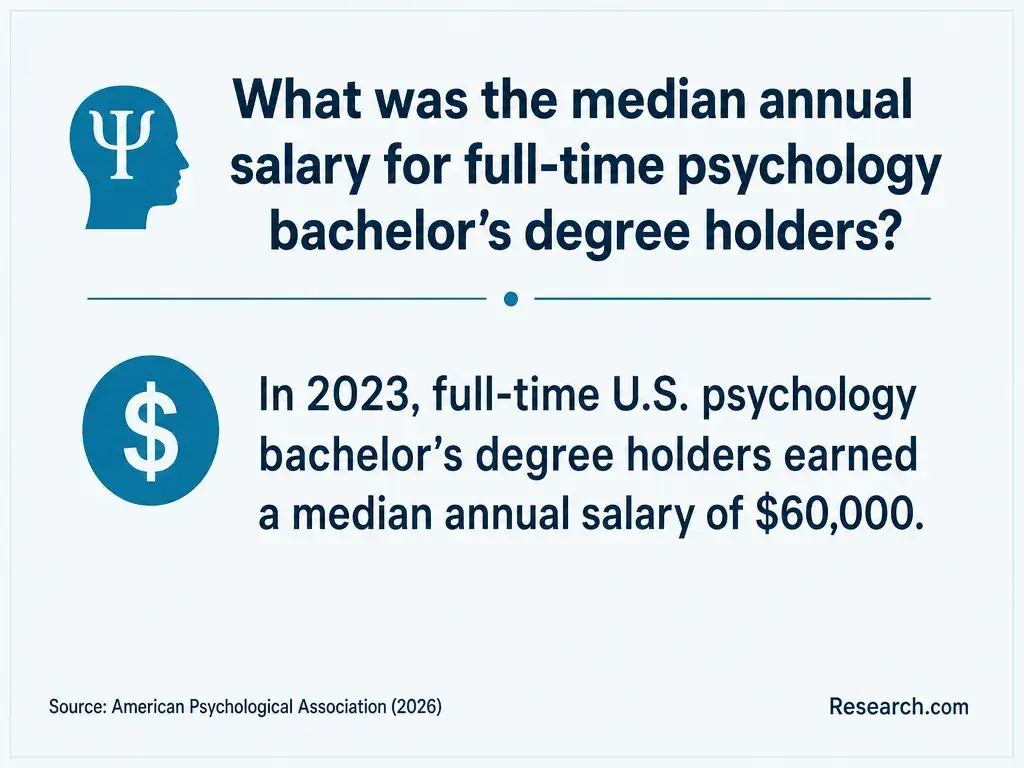
There is no single reliable "psychology BA salary." Pay follows the occupation and role, location, employer, and experience, not the major alone. A student entering a human-services support job should not use the wage for a licensed psychologist as an earnings estimate.
For a defensible comparison, select two or three jobs you would actually pursue and check their current U.S. Bureau of Labor Statistics Occupational Outlook Handbook profiles for occupation-wide median pay, typical entry education, and projected employment change.
Then compare local postings and their required credentials. An occupational median includes workers with different experience levels; it is not an offer to a new graduate.
If additional study is under consideration, weigh its cost and time against the particular role it is meant to unlock. Faster pathways through graduate psychology coursework may reduce time in school, but a general psychology master's degree does not automatically change licensure eligibility or produce a predictable salary increase.
A psychology BA, including one with a mental-health concentration, does not by itself authorize psychotherapy, diagnosis, independent psychological assessment, or use of a protected clinical title.
It can provide academic preparation for later study, but counseling, social work, psychology, and other regulated professions have distinct educational, supervised-practice, examination, and state-specific rules.
If your goal is to become a therapist, identify the exact license and state first. Compare qualifying graduate programs against that board's rules, including any applicable program recognition and placement requirements.
Budget for the full route rather than the BA alone; affordability checks for online counseling study are relevant only after confirming that a program fits the intended credential.
If your goal is nonclinical support work instead, a BA may be useful, but a shorter human-services qualification, employer training, or a state-recognized support credential could be more direct. Check the target employer's requirements before committing to another degree.
How Do You Choose the Best Online Psychology Program?
The best fit is the accredited program whose required courses are usable in your circumstances and whose remaining cost and curriculum support your goal. Ask each school for written answers about a course you would actually take, not a general assurance that its platform is accessible.
Use this sequence to compare finalists and uncover commitments that a program webpage may omit:
- Request a sample required-course recording and check captions for accuracy, speaker identification, and technical terms.
- Confirm which lectures are recorded, when captions appear, how long recordings remain available, and what happens if a recording or caption file fails.
- Ask about required live attendance, timed exams, group meetings, campus visits, and any placement or capstone schedule.
- Obtain a written degree audit and estimate of remaining tuition and fees; verify institutional accreditation and the current catalog requirements.
- Contact accessibility services about the process for arranging accommodations, without assuming an advertised captioning feature replaces an individualized review.
Choose an adjacent program instead if it better matches the work you want to do. For instance, someone focused specifically on a qualifying addiction-counseling route should compare state credential rules and program content, then consider comparing grants for undergraduate addiction counseling study rather than assuming a general psychology BA is the most direct or affordable option.
Other Things You Should Know About Psychology Programs
That depends on the platform, copyright rules, and course policy. Ask whether downloads are permitted and what offline alternative is available if your internet access is unreliable.
Not always. A transcript can help with searching and review, while synchronized captions connect words to the video as it plays. Ask which formats a course provides.
They may. Ask how the school notifies participants, handles recording access, and offers participation options when a student has a privacy concern.
Raise the issue with the instructor and accessibility office. Captions convey audio; meaningful charts, demonstrations, and other visual information may need a separate accessible explanation.
- ADA Requirements: Testing Accommodations https://www.ada.gov/resources/testing-accommodations/
- Disability Discrimination: Technology Accessibility | ed.gov http://www.ed.gov/laws-and-policy/civil-rights-laws/disability-discrimination/disability-discrimination-key-issues/disability-discrimination-technology-accessibility
- Effects of captions, transcripts and reminders on learning and perceptions of lecture capture - PMC https://pmc.ncbi.nlm.nih.gov/articles/PMC9038223/
- Video Captioning FAQ | Disability Resource Center https://drc.calpoly.edu/captioning-faq
- Providing Accommodations in Online Courses | fsu.edu https://odl.fsu.edu/providing-accommodations-online-courses
- Ensuring accessibility of video and audio in UW courses | Trends and Issues in Higher Ed https://www.washington.edu/accessibility/academic-course-content-action-team/video-audio-report/
- What's the Difference Between Asynchronous and Synchronous Learning? | Ohio State Online https://online.osu.edu/content-hub/blogs/whats-the-difference-between-asynchronous-and-synchronous-learning/