2027 Online BA in Psychology - Mental Health After an AAS in Emergency Medical Services: Compare Transfer Credit and Remaining Coursework
Audited and Verified:
Our Editorial and Data Verification Process
Research.com uses government datasets, official education statistics and primary institutional information to support its career and degree guides. Our review process checks factual accuracy, occupational definitions, source dates and the requirements associated with the credentials discussed.
How This Article Was Fact-Checked
Our editorial team verifies salary estimates, employment projections, education requirements and program information against original data providers and official organizations. Salary figures are checked against the relevant occupational definitions and reporting periods. Information about licensure, accreditation and required in-person training is reviewed separately.
Fact-checked and verified on:

Co-Founder and Chief Data Scientist
An associate of applied science (AAS) in emergency medical services gives you experience with people in crisis, but it may not fit neatly into a psychology bachelor's degree. Some EMS courses may transfer as electives while leaving psychology prerequisites and general education unfinished. This guide is for EMS graduates comparing online BA programs with a mental-health focus. It shows how to read a transfer evaluation, estimate the coursework and cost still ahead, and decide whether the degree supports your intended nonclinical role or a later professional degree.
Key Things You Should Know
- An EMS AAS does not automatically fulfill the first half of a psychology BA: accepted credits may count only as electives, not as general education or major requirements.
- Use an illustrative 120-credit BA carefully: even if 60 AAS credits apply toward graduation, the remaining 60 credits must still include every unmet prerequisite, major, and residency requirement.
- A mental-health focus can build relevant knowledge for support work or further study, but a psychology BA does not authorize diagnosis, psychotherapy, or independent clinical practice.
What Is an Online BA in Psychology After an EMS AAS?
It is a psychology bachelor of arts completed after an EMS-focused applied associate degree, with some prior coursework potentially applied toward graduation. "Mental health" might describe a formal concentration, a set of electives, or simply the student's career goal; check the degree catalog for the actual designation. Online delivery describes where coursework is taught, not whether every class, exam, or applied experience can be completed on your own schedule.
EMS experience can inform your study of stress, behavior, health, and service systems. It does not replace training in psychological research or confer clinical authority. As you use an online psychology degree selection guide, compare programs by the credits they apply to your degree - not just the size of the transfer-credit allowance they advertise.
How Many EMS AAS Credits Transfer to an Online Psychology BA?
There is no dependable number until the receiving institution evaluates your record. A school may accept an EMS course for college credit yet apply it only to a free-elective slot. Another may award no credit if the course lacks an academic equivalent or exceeds an applicable limit. Admission, credit acceptance, satisfaction of a requirement, and permission to graduate are separate decisions.
The comparison below shows why the placement of each credit matters as much as the total accepted.
| Prior EMS AAS work | Possible placement | Question for the evaluator |
| English, mathematics, or other academic courses | General education or electives | Does the course satisfy a specific BA requirement? |
| Anatomy, physiology, or medical terminology | Science requirement or electives | Does the BA require a particular laboratory or science sequence? |
| Paramedic and clinical EMS courses | Applied-credit block or electives, if permitted | Is there a limit on technical or occupational credit? |
| Psychology or statistics | Major, prerequisite, general education, or electives | Has the psychology department approved equivalency, including course level and content? |
For an illustration - not a prediction - if a BA requires 120 credits and 60 AAS credits apply toward that total, 60 credits remain by arithmetic. You could still face a difficult schedule if most accepted credits are electives and the remaining psychology courses have prerequisites. See applying associate-level credits to psychology study for additional transfer questions, then rely on the receiving school's written evaluation for your own result.
What Coursework Remains After Transferring an EMS AAS?
Usually, the largest gaps are in psychology-major courses and any general education the applied degree did not cover. Your degree audit should identify requirements still open, not merely report a remaining-credit total. A prior statistics course, for example, may transfer as mathematics credit without satisfying the psychology major's statistics requirement.
To compare offers, ask each institution for a term-by-term completion map. These checks expose delays that a transfer-credit total can hide:
- Match every accepted course to a named degree requirement or elective slot in the written audit.
- Confirm introductory psychology, statistics, and research-methods equivalencies with the department that controls the major.
- Check prerequisites, course rotation, minimum upper-division credits, and credits that must be earned at the institution.
- Request a written substitution review or transfer appeal for courses whose documented content appears to meet a requirement.
If your goal is specifically substance-use-disorder counseling, compare this psychology curriculum with degrees in addiction counseling. Similar-looking mental-health electives may not meet a state credential's specified coursework or supervised-experience rules.
Verify the institution's recognized accreditation and its current status through the accreditor and school. Accreditation supports a baseline review of the institution; it does not guarantee that your EMS credits will transfer, meet major requirements, or qualify you for a future license. The American Psychological Association does not accredit general undergraduate psychology BA programs.
A transfer-friendly program provides a course-level evaluation, a usable degree audit, clear appeal and substitution procedures, and access to required courses at a workable pace. Ask whether its AAS policy differs from its policy for a transfer-oriented associate degree. If you are also comparing accelerated MS psychology options for later study, verify those programs' admission prerequisites separately; BA accreditation and completion do not establish graduate eligibility.
Requirements vary by institution. Typically, a transfer applicant submits an application and official transcripts from every college attended; a school may also evaluate prior GPA, transferable-credit minimums, and whether admission to the psychology major has separate conditions. EMS certification or work experience can strengthen the context of an application but does not replace required academic records.
Gather your AAS transcript, course descriptions or syllabi for disputed equivalencies, and documentation of any additional college-level study. Ask admissions which requirements govern entry, then ask the registrar or transfer-credit office for the official credit evaluation and the psychology department about major substitutions. Do not plan around an informal estimate. A bachelor's degree is also generally the starting academic credential for master's admission: twelve-month forensic psychology graduate study pathways, for example, should not be treated as substitutes for finishing the BA.
Both depend on the approved completion plan, not the AAS title. Divide required remaining credits by a realistic per-term course load, then account for prerequisites and courses offered only in certain terms. EMS shift work may make a slower pace more sustainable, especially during statistics or research methods.
For each school, calculate the cost of the courses you must actually take: tuition at the applicable rate, mandatory fees, materials, technology charges, and any required travel or placement expenses. Compare that total with the time you may have to reduce paid shifts. Financial aid and employer assistance depend on eligibility and policy; neither should be assumed. A guide to planning a budget for an online psychology degree can help organize the comparison, but the school's current charges and your final audit determine your estimate.
Expect psychology foundations alongside statistics, research methods, and advanced work specified by the major. Depending on the catalog, courses may cover development, social behavior, cognition, biological psychology, and psychological disorders. A mental-health focus may add electives on addiction, health, or community services. Reading about disorders or assessment is academic preparation, not permission to diagnose or administer restricted tests.
Choose electives around the next step. An EMS graduate interested in crisis-service coordination may value developmental psychology, health psychology, and program evaluation; someone considering graduate research should protect room for stronger methods training. If legal-system work is the goal, comparing forensic psychology curricula and career fit is more useful than assuming a forensic elective confers investigative or clinical authority.
Online study can reduce commuting around EMS shifts, but "online" may still include scheduled meetings, proctored exams, group work, or locally arranged experiences. Campus study may make it easier to build faculty relationships and participate in research, though travel and fixed class times can be costly. Neither format automatically offers a clinical placement.
Request sample course schedules and ask how remote students obtain research mentorship, advising, and approved applied experiences. If your eventual goal is licensed counseling rather than nonclinical support work, compare the subsequent qualifying degree and its fieldwork obligations - not just the BA format. Mental health counseling tuition, fees, and financial aid will be a separate decision from the cost of finishing this psychology BA.
Your EMS background and a psychology BA may be relevant to nonclinical crisis-service coordination, behavioral-health intake, community outreach, case-support work, or research and program-support roles. Employers set their own experience requirements; some positions require additional training, a specific credential, or supervised work. In these roles, your useful evidence may include accurate documentation, respectful communication under pressure, referrals, and an understanding of confidentiality and scope.
Do not equate an EMS response role or psychology coursework with authorization to provide psychotherapy. If addiction services interest you, use an addiction recovery employment guide to distinguish recovery-support and coordination jobs from state-regulated counseling roles, then check the rules for the state and job you intend to pursue.
What Salary and Job Outlook Can Psychology Graduates Expect?
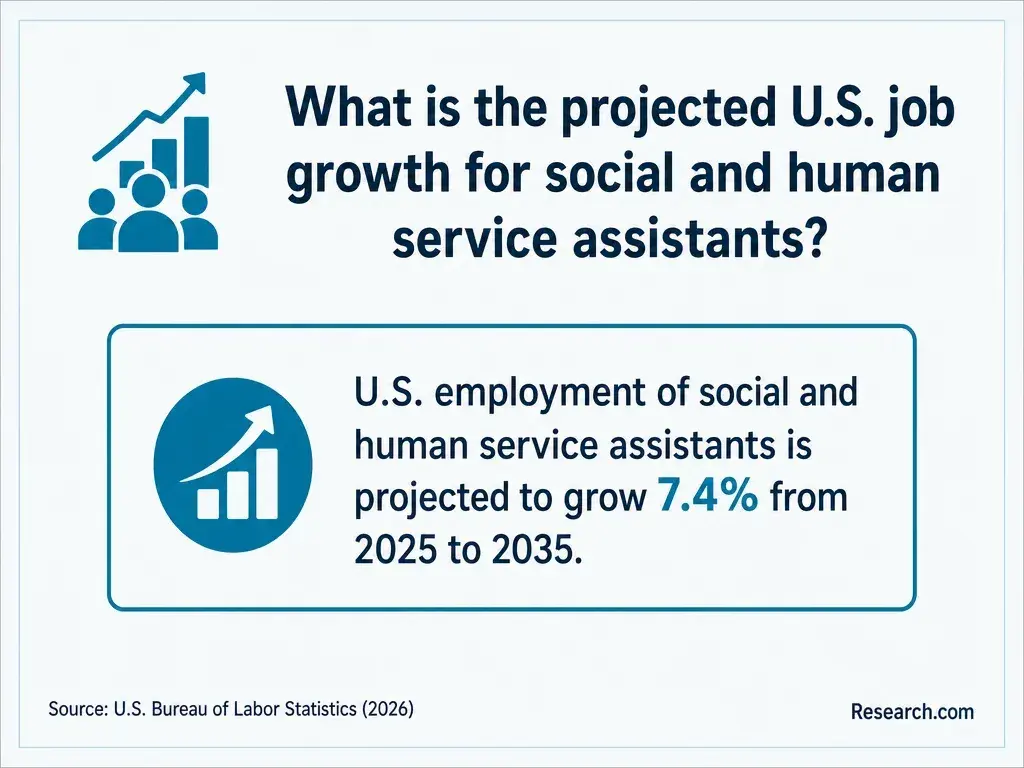
There is no single salary or growth rate for "psychology BA graduates." The U.S. Bureau of Labor Statistics reports pay and projected employment by occupation, not by this particular transfer pathway. Its social and human service assistant category can provide context for some support roles, but its occupational median is not an offer to a new graduate or a measure of what an EMS-to-psychology BA adds to earnings. A licensed mental-health counselor is a different comparison because that occupation generally requires further qualifying education and state licensure.
Before assigning a return to the degree, compare local job postings you could realistically qualify for with your EMS experience alone against those requiring a bachelor's degree. Include remaining tuition and lost shifts in that assessment. If addiction counseling is the specific target, substance abuse counseling bachelor's affordability and duration may offer a more relevant education-cost comparison than a broad psychology salary claim.
Other Things You Should Know About Psychology
Not automatically. The psychology department must approve the site, learning objectives, supervision, and duties under its internship policy. Past clinical hours may not satisfy a requirement for a new, supervised academic experience.
That depends on your work plans and the certification's renewal rules. Keeping it may preserve employment options during school, but budget for continuing education and renewal obligations.
Do not use identifiable patient information or assume that removing names makes its use permissible. Obtain course and employer guidance before proposing any project involving workplace records, observations, or participants.
Possibly. Compare BSW and psychology BA transfer audits, then check the entry and advanced-standing rules of the MSW programs you might pursue. A psychology BA does not itself confer social-work licensure or guarantee an advanced-standing MSW route.
- Cost of Attendance (Budget) | 2025-2026 Federal Student Aid Handbook https://fsapartners.ed.gov/knowledge-center/fsa-handbook/2025-2026/vol3/ch2-cost-attendance-budget
- .14 Evaluation and Review Process for Transfer of Courses and Credits. | Library of Maryland Regulations https://regs.maryland.gov/us/md/exec/comar/13B.06.02.14
- Transfer and Test-Based Credit Policies | Stony Brook University https://www.stonybrook.edu/undergraduate-admissions/transfer/transfer-credit.html
- Online Bachelor of Arts in Psychology | UML GPS https://gps.uml.edu/degrees/undergrad/online-bachelors-psychology-degree.cfm
- Psychology Curriculum | charlotte.edu https://psych.charlotte.edu/undergraduate-program/psychology-courses/
- Transfer Credit | Department of Psychology https://psychology.columbia.edu/content/transfer-credit
- Major in Psychology | Elmhurst University https://www.elmhurst.edu/academics/departments/psychology/programs/psychology-major/