2027 Online BA in Psychology - Mental Health: How to Evaluate Practical Training Without a Clinical Practicum
Audited and Verified:
Our Editorial and Data Verification Process
Research.com uses government datasets, official education statistics and primary institutional information to support its career and degree guides. Our review process checks factual accuracy, occupational definitions, source dates and the requirements associated with the credentials discussed.
How This Article Was Fact-Checked
Our editorial team verifies salary estimates, employment projections, education requirements and program information against original data providers and official organizations. Salary figures are checked against the relevant occupational definitions and reporting periods. Information about licensure, accreditation and required in-person training is reviewed separately.
Fact-checked and verified on:

Co-Founder and Chief Data Scientist
An online psychology BA can teach you about mental health without placing you in a clinical practicum. That distinction matters if you want experience you can describe to employers or use to prepare for graduate study.
This guide is for prospective and returning undergraduates comparing programs, especially those interested in community mental-health work. It shows how to judge supervised projects, internships, research, and online scheduling - and when the absence of a practicum is a limitation rather than a flaw.
Key Things You Should Know
- Judge practical training by its assigned tasks, qualified supervision, feedback, and documented work - not by whether a program calls an experience "hands-on."
- A nonclinical internship, research project, or capstone can build useful skills, but it does not substitute for a clinical practicum or qualify a BA graduate to provide therapy.
- Before enrolling, obtain the current degree plan and written answers about placement availability, site approval, scheduling, costs, and what happens if you cannot secure a site.
What Is an Online BA in Psychology Focused on Mental Health?
It is an undergraduate psychology degree that pairs broad study of behavior and psychological science with courses about mental health, such as psychopathology, development, prevention, or service systems. "Mental health" might be an official concentration, a set of electives, or simply a program description. Check the catalog to see which it is; the label alone does not establish a distinct credential or clinical training.
The degree may fit someone seeking a foundation for nonclinical support work or later graduate study. If substance-use services are your main interest, compare its required courses and applied opportunities with bachelor's study in addiction psychology online. Neither focus, by itself, qualifies you to deliver treatment.
How Can You Evaluate Practical Training Without a Clinical Practicum?
Start with the work a student actually performs. A clinical practicum is supervised preparation for clinical responsibilities within an appropriate professional program. An undergraduate BA without one can still offer substantial nonclinical learning, but reading case examples or watching recorded demonstrations is not the same as carrying out a supervised task.
The comparison below separates common experiences by the evidence they can produce and the limits you should recognize. Availability and requirements depend on the particular program.
| Experience | Potential evidence of learning | Important limit |
| Community-agency internship | Supervised outreach, resource navigation, administrative intake support, or service coordination | Client contact does not make the placement clinical training |
| Research assistantship | Literature searches, approved data handling, coding, or research summaries | Access to research positions and participant data is not automatic |
| Applied capstone | An evidence review, referral-resource guide, or proposed program-evaluation plan | A proposed deliverable is not proof that an agency adopted or tested it |
| Course simulations | Practice communicating, documenting, and responding to scenarios with feedback | Simulations do not establish competence with actual clients |
Use the same verification process for each program. Request the course syllabus or placement handbook rather than relying on an "experiential learning" description; comparing online psychology degree curricula is a starting point, not a substitute for those documents.
Ask the program coordinator for specific answers to these questions before committing:
- Which experience is required, optional, or competitively assigned, and which students can access it online?
- Who approves the site and supervises the work, how often does feedback occur, and what tasks are prohibited?
- What must the student submit for assessment, and may a current job or volunteer position count after approval?
- Are meetings or site hours scheduled during business hours, and what travel, screening, or unpaid-work costs apply?
- What alternative is available if a suitable site cannot be secured by the required term?
A strong option gives students defined responsibilities, oversight, a usable work sample, and a feasible path to completion. For agency or research work, confirm permissions for data access, confidentiality, consent, and any required institutional review before beginning. A portfolio should omit identifiable client information; removing names alone may not make sensitive material safe to share.
Does an Online Psychology Bachelor's Degree Lead to Mental Health Licensure?
No: a psychology BA, whether online or on campus, does not by itself license someone to diagnose conditions, provide psychotherapy, or practice independently as a psychologist. Studying disorders or counseling theories is not professional clinical preparation. Requirements differ by occupation and state, and some support roles have separate certification or registration rules.
If your goal is licensed counseling, investigate qualifying graduate education, supervised practice, examinations, and your state board's rules before choosing the BA. Clinical mental health master's programs by study pace can help frame a later comparison, but a shorter advertised schedule does not remove placement or licensing requirements. If your immediate goal is nonclinical outreach or coordination, judge the BA against those job duties instead of expecting it to provide a clinical pathway on its own.
Confirm that the degree-granting institution holds recognized institutional accreditation and that it covers the school offering the online BA. Check the institution named on the degree, the accreditor's current record, and the school's catalog for your intended entry term. Accreditation supports institutional quality review; it does not verify that a particular internship is available or that the BA meets a licensing board's requirements.
Do not reject an otherwise suitable BA because it lacks APA program accreditation: APA accreditation applies to specified professional psychology programs and training, not general psychology bachelor's degrees. The same scope check matters when comparing accredited forensic psychology degree programs; a degree's subject and an institution's accreditation must not be mistaken for a professional credential.
Look for a foundation in research methods and statistics alongside developmental, social, biological, and abnormal psychology. For practical nonclinical work, courses addressing cultural responsiveness, research ethics, community mental-health systems, and substance use can be more useful than a long menu of disorder-focused electives with no opportunity to apply or evaluate evidence.
Read course descriptions for what students do: assess the quality of research, write an evidence brief, examine referral systems, or plan an ethically appropriate evaluation. A course titled "assessment" or "counseling" may teach concepts without authorizing students to administer restricted tests or counsel clients. If your target is substance-use counseling rather than general mental-health support, online colleges offering addiction counseling study may provide a more relevant comparison - but verify the target state's credential requirements separately.
Online lectures can cover the same academic subjects as campus courses, but access to people, sites, and feedback may differ. Campus students may find it easier to visit a lab or community partner; online students may be able to complete a locally approved internship without relocating. Neither format guarantees a placement or regular faculty mentorship.
For a working student or parent, check live-meeting times, group-project obligations, placement hours, and required campus visits. "Asynchronous" may describe lectures while supervision meetings or agency work remain scheduled. If graduate study is likely, compare the full cost of the next credential as well: psychology graduate study on a budget is relevant only if that degree advances your specific career goal. A low-cost online BA is less useful if its schedule makes the experience you need impossible to complete.
Requirements vary by school and by whether you are entering as a first-year or transfer student. Confirm the institution's application, prior-school transcript, and any major-entry requirements directly with admissions. A school may admit you before deciding which previous courses fulfill psychology requirements.
Returning students should request a written degree audit showing where accepted credits apply - not just a total of accepted credits. Check statistics and research-methods equivalencies, course sequence, residency requirements, and when remaining courses are offered. Psychology program transfer policies provide comparison context, but only the receiving institution can approve your individual coursework and projected path to graduation.
Time to completion depends on approved transfer credits, course availability, enrollment pace, and whether an internship or capstone has prerequisites. Ask for a term-by-term plan based on your transcript. An advertised accelerated format does not guarantee that required courses or an approved site will be available when you need them.
Compare a written estimate of remaining tuition and mandatory fees with books, technology, background checks, travel, and any unpaid placement hours. Include the cost of changing work hours if practical training requires daytime availability. If the BA is preparation for graduate school, compare that later expense separately; one-year forensic psychology graduate tuition comparisons illustrate why a short advertised graduate timeline should not be confused with the total cost of a professional pathway. A forensic psychology master's also should not be assumed to meet mental-health licensure requirements.
A BA may support applications for nonclinical positions such as behavioral-health program assistant, community outreach worker, intake coordinator, research assistant, or human-services support worker. Duties can include organizing referrals, communicating with participants, maintaining records, and helping evaluate services. Job titles alone are unreliable: employers set experience requirements, and states may regulate particular duties or titles.
The table links possible roles to practical evidence worth seeking during the BA. It describes preparation, not guaranteed job eligibility.
| Target role | Relevant evidence from study or experience | Qualification to verify |
| Intake or program coordinator | Supervised documentation, resource navigation, and respectful communication | Employer's experience and confidentiality requirements |
| Research assistant | Methods coursework, approved data work, and a clear research writing sample | Required software, methods, and research experience |
| Recovery-support worker | Knowledge of support boundaries, referrals, and recovery resources | State or employer rules for peer or addiction-related credentials |
If recovery services are the goal, compare actual postings with jobs supporting addiction recovery. Someone with relevant community or administrative experience may need targeted training and supervised work more urgently than another degree; someone seeking to provide treatment needs to investigate the applicable professional credential instead.
What Are the Salary and Job Outlook for Psychology Graduates?
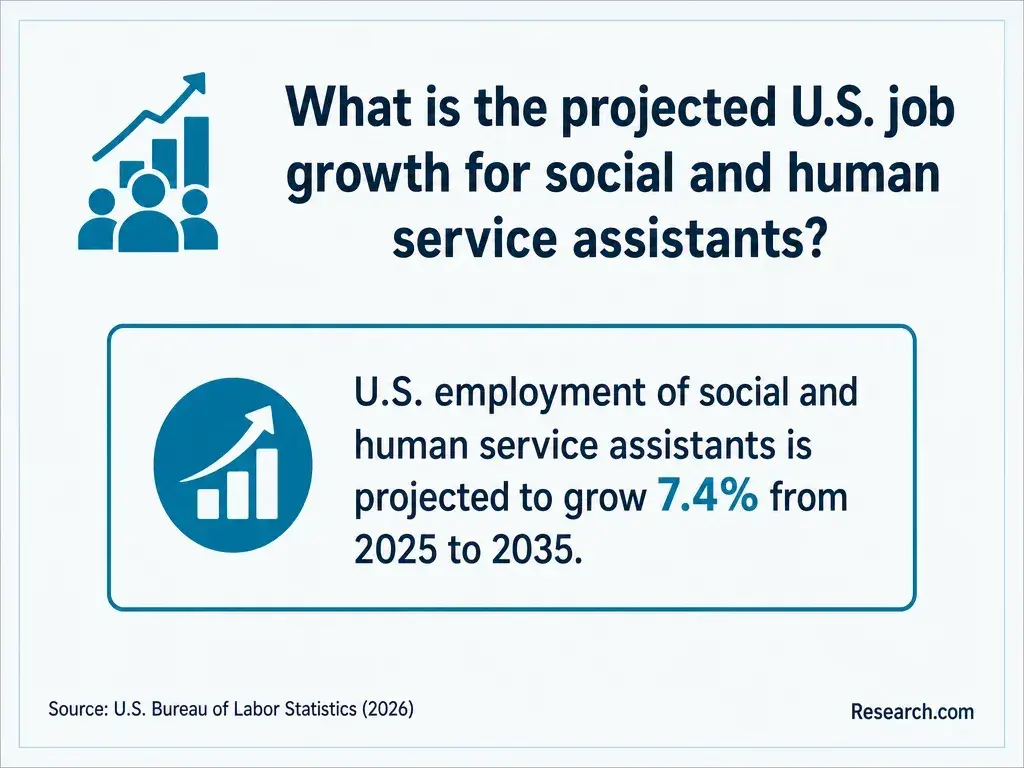
There is no single salary or job-growth figure for "psychology BA graduates." The US Bureau of Labor Statistics reports wages and projections by occupation, not by undergraduate major. Its social and human service assistants category can provide context for some support positions, but it also includes workers with different education and experience. Research-assistant and program-coordination jobs may fall under other occupational categories.
For a useful comparison, identify the duties and qualifications in local postings, then consult the matching BLS occupation's latest wage reference year and projection period. Do not treat an occupation-wide median as a likely starting offer. Higher-paying licensed or specialized careers involve different qualifications; higher-paying career paths after forensic psychology graduate study, for example, should not be counted as outcomes of an undergraduate mental-health BA. The better financial question is whether the program provides affordable, accessible evidence of the skills your target entry-level jobs require.
Other Things You Should Know About Psychology
Possibly, but ask whether the program permits student-proposed sites, who approves them, and when approval must occur. A willing agency does not automatically satisfy academic requirements.
Only if the program permits it and approves the duties, supervision, and assessment plan. Existing employment is not an automatic substitute for a required experience.
Yes. A permitted sample can clarify the expected quality and scope of work. Do not expect access to confidential client records or another student's restricted research data.
It may still fit a goal focused on academic prerequisites. If supervised, demonstrable experience is central to your goal, compare another program or secure suitable experience outside the degree before deciding.
- Information Related to Mental and Behavioral Health, including Opioid Overdose | HHS.gov https://www.hhs.gov/hipaa/for-professionals/special-topics/mental-health/index.html
- Accreditation in the U.S. | ed.gov http://www.ed.gov/laws-and-policy/higher-education-laws-and-policy/college-accreditation/accreditation-in-the-us
- Community Supervision Internship and Volunteer Opportunities | NC DAC https://www.dac.nc.gov/divisions-and-sections/community-supervision/community-supervision-internship-and-volunteer-opportunities
- Section C: Consent, Due Process, & Confidentiality | ucla.edu https://smhp.psych.ucla.edu/conted2/part12c.htm
- General Community Outreach & Services - Field Study https://fieldstudy.soceco.uci.edu/pages/traditional-field-study-catalog-general-community-outreach-services
- Ready for practicum? | apa.org https://www.apa.org/gradpsych/2015/01/practicum