2027 Cheapest Accredited Online Chemistry Degree Programs That Accept FAFSA

Co-Founder and Chief Data Scientist
Finding a cheap online chemistry degree is harder than finding a cheap online business or psychology program because chemistry requires lab science, specialized faculty, and strict accreditation standards. It matters because College Board reported average published tuition and fees of $11,610 at public four-year in-state colleges and $43,350 at private nonprofit colleges for 2024-25.
This guide is for students who need an accredited, FAFSA-eligible chemistry degree without overborrowing. You will learn which options are likely lowest-cost, how aid changes the real price, and how to compare value beyond tuition.
Key Things You Should Know
- The cheapest FAFSA-eligible online chemistry degrees are usually public university programs, but the lowest published tuition is not always the lowest net cost after grants, transfer credits, fees, and residency rules.
- Federal Pell Grants can provide up to $7,395 for eligible undergraduate students in the 2024-25 award year, but FAFSA participation does not mean every student receives grants or that the full chemistry degree will be covered.
- Online chemistry degrees are less common than many online science degrees because lab courses may require kits, proctored exams, campus visits, or approved local lab arrangements, so students should verify format and total completion cost before enrolling.
Which Are the Cheapest Accredited Online Chemistry Degree Programs That Accept FAFSA?
The cheapest accredited online chemistry degree programs that accept FAFSA are typically offered by regionally accredited public universities that participate in Title IV federal student aid. The main challenge is that true online chemistry bachelor's degrees are rare; many schools offer online science courses, but not a full chemistry major that can be completed mostly or fully at a distance.
The table below focuses on accredited U.S. institutions with online chemistry degree options and federal student aid participation. Tuition figures are based on published undergraduate online tuition ranges available from current institutional pricing and should be verified directly with the school because residency, fees, course level, and lab requirements can change the final cost.
| School | Online chemistry degree option | Institutional accreditation | FAFSA participation | Published online tuition snapshot | Best-fit student |
| University of North Dakota | BS in Chemistry | Higher Learning Commission | Yes | About $400 per credit before fees | Students who want a chemistry-focused bachelor's from a public university and can manage lab requirements |
| Oregon State University Ecampus | BS in Chemistry | Northwest Commission on Colleges and Universities | Yes | About $375 per quarter credit before fees | Students who want strong online science infrastructure and are comfortable with the quarter-credit system |
| Arizona State University Online | BA in Chemistry | Higher Learning Commission | Yes | Often published in a range of about $563 to $661 per credit before fees | Students who need a flexible online chemistry pathway and may value ASU's large online student support system |
For many students, the practical "cheapest" choice will be the program that accepts the most previous credits and offers the best aid package, not simply the lowest advertised per-credit rate. A student with 60 transferable credits may pay less at a higher-tuition university than a student starting from zero credits at a lower-tuition option.
Students who are open to a broader science pathway may also compare chemistry with a biology degree online, especially if their goal is healthcare prerequisites, laboratory support work, environmental science, or graduate school preparation rather than a chemistry-specific job title.
How Does FAFSA Eligibility Work for Online Chemistry Degree Programs?
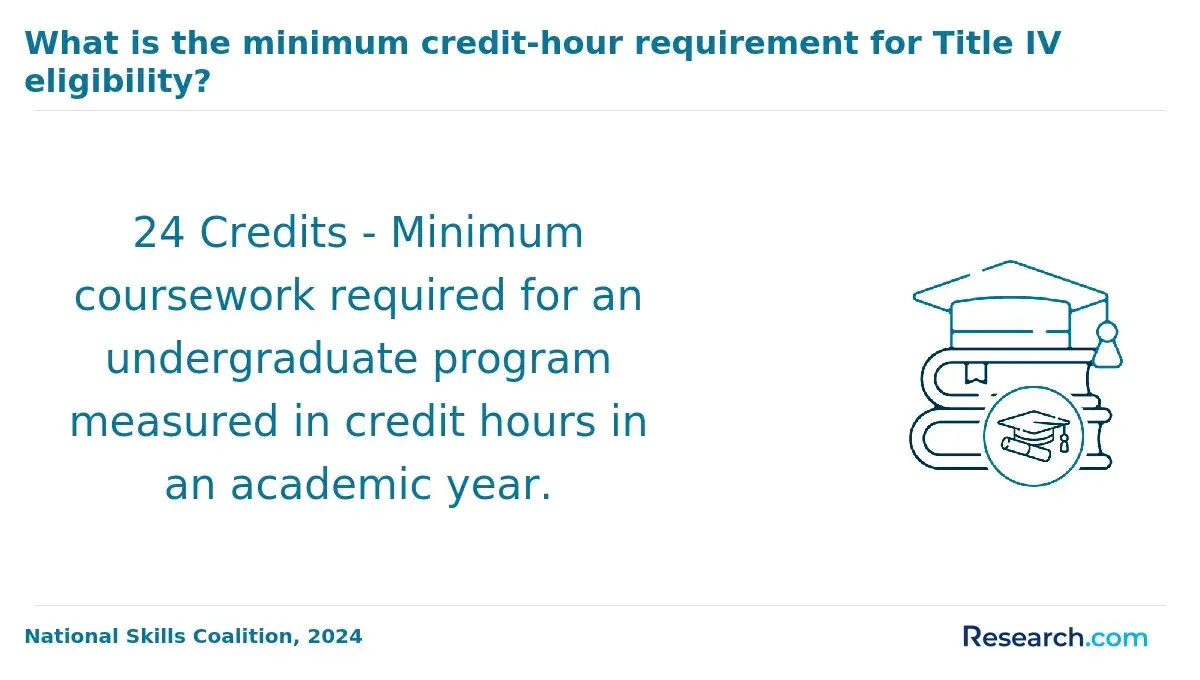
FAFSA eligibility means the institution participates in federal student aid programs and the student's program is eligible for Title IV aid. It does not mean the student automatically receives a Pell Grant, scholarships, or enough aid to cover the full degree.
For online chemistry students, eligibility depends on several layers: the school, the degree program, the student's enrollment status, and the student's own federal aid profile. Before applying, students should confirm each of the following because one weak point can change the aid calculation:
- Confirm that the institution is accredited by a U.S. Department of Education-recognized accreditor and participates in federal student aid.
- Ask whether the specific online chemistry degree, not just the school, is eligible for federal aid.
- Check whether lab courses, summer terms, internships, or campus intensives are included in the same aid-eligible program cost.
- Confirm minimum enrollment requirements because half-time or full-time status can affect aid amounts and loan eligibility.
- Review satisfactory academic progress rules, since low completion rates, withdrawals, or repeated courses can reduce future aid eligibility.
A common mistake is assuming that "accepts FAFSA" means "affordable for everyone." FAFSA is an application system, not a discount program. It determines eligibility for federal grants, loans, and work-study, while the school decides institutional aid and applies its own cost of attendance rules.
How Much Does an Online Chemistry Degree Cost After Financial Aid?
The cost after financial aid is the net price: tuition and required costs minus grants, scholarships, and other non-repayable aid. Loans can help cover a balance, but they do not reduce the price of the degree because they must generally be repaid with interest.
The following comparison shows why two students in the same online chemistry program can face very different out-of-pocket costs. It uses the federal Pell Grant maximum of $7,395 for the 2024-25 award year as a reference point, but actual awards depend on FAFSA results, enrollment intensity, and annual federal rules.
| Cost factor | What it includes | Why it matters for chemistry students |
| Tuition | Per-credit charges multiplied by required credits | Chemistry degrees often require a structured science sequence, so retaking prerequisites can add cost |
| Mandatory fees | Online fees, technology fees, lab fees, proctoring, and registration charges | Lab-based online courses may cost more than standard lecture courses |
| Books and materials | Textbooks, access codes, lab kits, safety supplies, and software | Some chemistry courses require specialized materials that are not included in tuition |
| Travel or residency costs | Campus labs, local lab arrangements, lodging, or transportation if required | A low online tuition rate can become less affordable if repeated campus visits are required |
| Grants and scholarships | Pell Grants, state grants, institutional grants, and private scholarships | These reduce net cost and are more valuable than loans when comparing affordability |
To estimate your likely cost, build a completion budget rather than looking only at one semester. Include all remaining credits, expected aid for each year, fees, lab costs, and the number of terms needed to graduate.
Follow these steps:
- Ask the school for a written cost estimate based on your transfer evaluation, not just the standard four-year degree plan.
- Separate grants and scholarships from loans so you can see the true discount versus the amount you may borrow.
- Calculate the cost of required chemistry labs, including kits, proctoring, travel, or campus intensive fees.
- Compare annual aid renewal rules so you know whether a scholarship can continue after the first year.
The best value is not always the lowest tuition. For an online chemistry degree, value comes from a combination of net price, accreditation, transfer acceptance, course availability, lab access, student support, and alignment with your career or graduate school goal.
A lower-cost program may be the best choice if it has transparent tuition, predictable course sequencing, and enough upper-division chemistry courses online to let you graduate on time. A more expensive program may be worth considering if it accepts more transfer credits, offers stronger advising, or reduces the risk of delayed graduation.
| Value factor | Lower-cost program advantage | When a higher-cost program may be better |
| Transfer credits | Can sharply reduce total tuition if many credits apply | Worth paying more per credit if the school accepts significantly more completed coursework |
| Lab access | Online or local lab options can reduce travel costs | Campus labs may be valuable for students planning research-heavy graduate study |
| Program fit | BA options may be flexible and cost-effective | BS options may better support chemistry-intensive careers or graduate prerequisites |
| Course availability | Predictable online scheduling helps students graduate sooner | A larger online university may offer more frequent science course rotations |
| Student support | Lean programs may cost less overall | Extra advising, tutoring, and career services may reduce withdrawal or repeat-course risk |
Students should avoid choosing a program based primarily on low cost if they need a very specific outcome, such as ACS-aligned preparation, pre-pharmacy prerequisites, graduate chemistry admission, or employer-required laboratory competencies.
The cheapest online chemistry degree is only worth considering if the institution is properly accredited. In the U.S., students should first look for institutional accreditation from a recognized accreditor because this is tied to federal aid eligibility, transferability, graduate school recognition, and employer acceptance.
Chemistry also has a program-quality layer. Some chemistry degrees may be approved or certified by the American Chemical Society, while others are accredited institutionally but not ACS-certified.
ACS certification is not required for every chemistry career, but it can matter for students targeting research roles, graduate chemistry programs, or employers that prefer a traditional chemistry curriculum.
Use this accreditation check before committing to any low-cost online chemistry program:
- Search the institution in the U.S. Department of Education-recognized accreditation database or confirm accreditation through the school's official accreditation page.
- Confirm that the online chemistry degree is offered by the accredited institution, not by an unaccredited third-party provider.
- Ask whether the degree title on the transcript will match the advertised online chemistry program.
- Ask whether the program is ACS-certified, ACS-aligned, or neither, and decide whether that matters for your intended career path.
- Verify whether credits from the program are commonly accepted by graduate schools, professional schools, or licensing-related prerequisite evaluators.
Red flags include unclear accreditation language, pressure to enroll quickly, vague lab requirements, unusually short bachelor's timelines without a transfer-credit explanation, and promises of guaranteed jobs or guaranteed financial aid.
FAFSA can connect eligible online chemistry students with federal grants, federal loans, and work-study, depending on the student's status and the school's aid policies. Undergraduate students with financial need may qualify for Pell Grants, while graduate students generally rely more heavily on federal loans unless institutional or employer aid is available.
The main federal aid types differ in how they affect affordability. Grants reduce the net price, while loans increase access but add repayment obligations after leaving school. Consider the following:
- Federal Pell Grant: Need-based grant aid for eligible undergraduates that does not usually need to be repaid.
- Federal Supplemental Educational Opportunity Grant: Campus-based aid for students with exceptional financial need, available only at participating schools with limited funds.
- Federal Direct Subsidized Loan: Undergraduate loan based on financial need, with the federal government generally paying interest during eligible in-school periods.
- Federal Direct Unsubsidized Loan: Loan available to undergraduate and graduate students, with interest accruing while in school.
- Federal Work-Study: Part-time employment aid, if offered by the school and suitable for the student's schedule.
Students planning healthcare-related chemistry pathways should be especially careful with borrowing because additional degrees may be needed. Someone considering pharmacy, for instance, may later compare bachelor's costs with the cost of the cheapest online pharmacy school options before deciding how much undergraduate debt is reasonable.
Transfer credits can be the biggest cost reducer in an online chemistry degree because they reduce the number of credits you must pay for at the degree-granting university. This is especially important in chemistry, where general education, math, biology, physics, and introductory chemistry courses can often be completed at a lower-cost community college before transfer.
However, not all transfer credits save money equally. A course may transfer as an elective but fail to satisfy a chemistry major requirement, which means the student still has to retake the needed course.
| Transfer scenario | Potential savings | Main risk |
| Associate degree completed before transfer | Can reduce remaining credits substantially if the school has a clear pathway | Science prerequisites may not align with the chemistry major sequence |
| Community college general education courses | Often lowers cost for non-major requirements | Some universities limit how many lower-division credits apply |
| Previous STEM coursework | Can reduce math and science course load | Older lab courses may expire or fail to meet current prerequisites |
| Credit for exams or military training | May reduce elective or general education requirements | Usually less useful for upper-division chemistry requirements |
Before enrolling, ask for an official or near-official transfer evaluation. Then compare schools based on the cost of the credits you still need, not the credits you already have. Implement these strategies:
- Request a degree audit showing exactly which requirements your credits satisfy.
- Identify remaining lab science courses and ask whether they are available online every year.
- Check grade minimums for chemistry, calculus, biology, and physics transfer courses.
- Ask whether upper-division chemistry credits must be completed at the degree-granting institution.
- Recalculate total cost after transfer, including fees and aid, before accepting admission.
A low-cost FAFSA-eligible online chemistry degree is most useful for students who need flexibility, recognized accreditation, and access to federal aid while preparing for chemistry-related careers or graduate study. It can be a strong fit for working adults, military-affiliated students, rural students, parents, and transfer students who already completed lower-division science courses.
It may be less ideal for students who need intensive in-person lab experience, undergraduate research access, or a highly structured pre-professional environment. Chemistry is hands-on, and some career paths value laboratory experience as much as the degree itself.
Consider the following:
- Best fit: Students with previous college credits, strong self-discipline, and a clear plan for lab requirements.
- Possible fit: Students seeking pre-health prerequisites who verify that the online lab courses will be accepted by their target graduate or professional schools.
- Riskier fit: Students starting from zero credits who need frequent in-person tutoring, research mentorship, or highly supervised lab training.
- Usually not the best fit: Students choosing chemistry only because it is available online, without interest in math-heavy science coursework.
Students who mainly want a faster entry into patient-facing work may find that a chemistry degree is not the quickest or cheapest route. In that case, comparing science degrees with fasttrack medical training options can clarify whether a shorter credential better matches the student's timeline.
Career ROI depends on how much you pay, how much you borrow, how long it takes to finish, and whether the degree supports your target job or next academic step. A chemistry degree can lead to roles in laboratories, quality control, environmental testing, pharmaceuticals, materials science, education support, regulatory work, and graduate study, but many higher-level chemistry roles may require a master's or doctorate.
The U.S. Bureau of Labor Statistics reported a May 2024 median annual wage of about $87,180 for chemists and materials scientists. That figure is useful as a labor-market benchmark, but it is not a promise for new graduates because entry-level pay, location, industry, lab experience, and graduate education can make a major difference.
| Career or education goal | Degree value consideration | Cost caution |
| Entry-level laboratory technician or quality control role | A bachelor's degree plus lab coursework may help meet job requirements | High debt can reduce ROI if starting pay is modest |
| Graduate chemistry or materials science study | A strong BS curriculum, lab depth, and faculty references matter | The cheapest BA may not provide the best preparation for research-heavy programs |
| Pre-health pathway | Chemistry coursework can satisfy prerequisites for several professional routes | Professional school costs should be included in long-term borrowing plans |
| Healthcare management or operations | Chemistry may provide scientific credibility but may not be the most direct route | A business-oriented healthcare degree may produce a clearer pathway for non-lab roles |
If your long-term goal is healthcare leadership rather than laboratory science, compare the chemistry path with an online masters healthcare management pathway before committing to a science-heavy undergraduate plan. The best ROI comes from matching the degree to the actual role you want, not simply choosing the cheapest accredited option.
How Should Students Choose the Cheapest FAFSA-Eligible Online Chemistry Degree?
Students should choose the cheapest FAFSA-eligible online chemistry degree by comparing total completion cost, not just tuition. The right program should be accredited, aid-eligible, realistic to complete online, aligned with career goals, and transparent about labs, fees, transfer credits, and financial aid renewal.
A practical selection process can prevent the most expensive mistakes: enrolling before transfer credits are evaluated, assuming grants will cover the balance, overlooking lab costs, or choosing a program that does not meet graduate school expectations.
Follow these steps:
- Start with accredited public and private nonprofit universities that clearly list an online chemistry degree, not just individual online chemistry courses.
- Confirm FAFSA participation and ask whether the specific online chemistry program is Title IV-eligible.
- Request a transfer evaluation before comparing total cost across schools.
- Ask for a written estimate of tuition, fees, lab costs, technology fees, books, and any campus or travel requirements.
- Compare grant and scholarship aid separately from federal loans so you know your likely debt.
- Check whether the degree is a BA or BS and whether it supports your intended job, graduate program, or professional school prerequisites.
- Ask how often upper-division chemistry courses are offered online so delayed scheduling does not add extra semesters.
- Review student support, tutoring, advising, and career services because repeating chemistry courses can erase tuition savings.
The cheapest program makes sense when it is accredited, affordable after aid, compatible with your transfer credits, and strong enough for your next step. If your goal is healthcare operations rather than laboratory science, it may be smarter to compare chemistry with an affordable healthcare administration course path before enrolling.
Other Things You Should Know About Chemistry Programs
Sometimes. Some programs use lab kits, simulations, remote labs, approved local facilities, or short campus residencies. Always ask how each required lab is completed before enrolling because lab format can affect cost, scheduling, and graduate school acceptance.
To qualify for FAFSA in 2027, students must demonstrate financial need, have a high school diploma or GED, and enroll in an accredited online chemistry degree program as a regular student. Registration with Selective Service may be required for males aged 18-25.
A BS is often better for students who want chemistry-intensive lab roles, research preparation, or graduate chemistry study. A BA may be more flexible for pre-health, teaching-related, interdisciplinary, or career-changing students.
Possibly, but requirements vary by professional school. Before enrolling, ask target schools whether they accept online lecture and lab science courses, especially for general chemistry, organic chemistry, biology, and physics.
- 2025 Most Affordable Online Colleges & Degrees https://www.onlineu.com/most-affordable-colleges
- Financial Aid For Online Colleges https://www.affordablecollegesonline.org/financial-aid/financial-aid-for-online-colleges/
- Undergraduate Online Financial Aid | Bushnell University https://www.bushnell.edu/financial-aid/undergraduate-online/
- 9 Online Schools That Accept FAFSA (and How to Get Financial Aid) https://www.studentloanplanner.com/financial-aid-online-colleges/
- Grants and Scholarships - North Central State College https://ncstatecollege.edu/admissions-and-aid/financial-aid/grants-and-scholarships/