2027 Accredited Online Chemistry Degree Programs That Accept the Most Transfer Credits

Co-Founder and Chief Data Scientist
Choosing an online chemistry degree is harder when you already have college credits and do not want to repeat expensive coursework. The stakes are real. College Board's 2024 pricing data shows average published tuition and fees at public four-year colleges reached $11,610 for in-state students, making every accepted credit matter.
This guide is for transfer students, adult learners, military learners, and associate degree holders. You will learn which accredited online chemistry-related programs are most transfer-friendly, how credits are evaluated, and how to estimate the time, cost, and career value of each option.
Key Things You Should Know
- The most transfer-friendly accredited online chemistry and biochemistry bachelor's options commonly allow up to about 90 semester credits, but the credits must still fit general education, major, lab, upper-division, and residency requirements.
- A high transfer-credit cap is not the same as high transfer efficiency; the best program is the one that applies your prior credits to required degree categories rather than only free electives.
- For chemistry-related careers, transfer savings should be weighed against lab quality, accreditation, graduate or professional school prerequisites, and labor-market value; BLS information updated in 2024 projects faster-than-average growth for chemists and materials scientists from 2023 to 2033.
Which Accredited Online Chemistry Degree Programs Accept the Most Transfer Credits?
The accredited online chemistry-degree market is smaller than many online majors because chemistry requires lab work, sequencing, and hands-on skill development.
The most transfer-friendly options are usually bachelor's programs in chemistry, biochemistry, or closely related chemistry-heavy fields that allow a large block of previous college credits while still requiring upper-division science courses through the degree-granting institution.
The table below compares programs with clear online delivery and transfer-friendly structures. Maximum transfer credit is not a promise; each school must evaluate your transcripts, course level, grade, accreditation source, lab equivalency, and fit with the degree plan.
| Institution | Online degree type | Accreditation status to verify | Potential transfer-credit ceiling | Key residency or completion rule | Best fit |
| Oregon State University Ecampus | B.S. or B.A. in Chemistry | Institutionally accredited; students should verify current institutional and program details before applying | Up to 135 quarter credits may apply in a 180-quarter-credit degree, roughly comparable to 90 semester credits | Requires a defined amount of OSU coursework, including upper-division and major-related requirements | Students who want a true online chemistry degree with substantial lab-science coursework |
| Arizona State University Online | B.S. in Biochemistry or related chemistry-intensive pathway | Institutionally accredited; students should verify current degree and lab requirements | Often up to 90 semester credits toward a 120-credit bachelor's degree, subject to evaluation | Typically requires at least 30 credits through ASU and completion of required major courses | Students with prior science, math, or general education credits who want a chemistry-adjacent degree |
| Florida International University Online | B.A. in Chemistry, where available online | Institutionally accredited; students should confirm current online availability and chemistry requirements | Often up to 90 semester credits may be considered toward a 120-credit degree | Usually requires final institutional credits and major-specific coursework through FIU | Florida transfer students and students with lower-division general education already completed |
The practical takeaway is that students with 60 to 90 transferable semester credits should not simply choose the school advertising the largest cap. They should request a degree audit that shows how many credits satisfy the chemistry major, how many satisfy general education, and how many fall into electives.
Students who are open to a related life-science route may also compare a biology degree online, especially if their previous coursework is stronger in biology than chemistry.
How Do Online Chemistry Degree Programs Evaluate Transfer Credits?
Online chemistry programs usually evaluate transfer credits in two layers: first, whether the credits are college-level and from an acceptable institution; second, whether they satisfy specific degree requirements. Chemistry is stricter than many majors because general chemistry, organic chemistry, analytical chemistry, physical chemistry, and lab courses often build on one another in a required order.
Most schools use a process like the one below. Following these steps before enrolling can prevent one of the costliest mistakes: assuming that accepted credits will automatically reduce the number of required chemistry courses.
- Submit official transcripts from every college, university, military training provider, testing agency, or prior-learning source you want evaluated.
- Ask whether the school performs an unofficial pre-evaluation before admission or only an official evaluation after acceptance.
- Provide syllabi, lab descriptions, course catalogs, and learning outcomes for older or specialized science courses.
- Confirm minimum grade rules, because chemistry major courses may require higher grades than general electives.
- Ask whether each accepted course applies to general education, the chemistry major, prerequisites, upper-division requirements, or electives.
- Request a remaining-degree plan that lists every course still required, not just the total number of credits accepted.
Course age can matter. Some schools are flexible with English, humanities, or social science credits but review older lab science, math, and technology courses more carefully because equipment, safety standards, instrumentation, and computational tools change over time.
How Can Transfer Credits Shorten an Online Chemistry Degree?
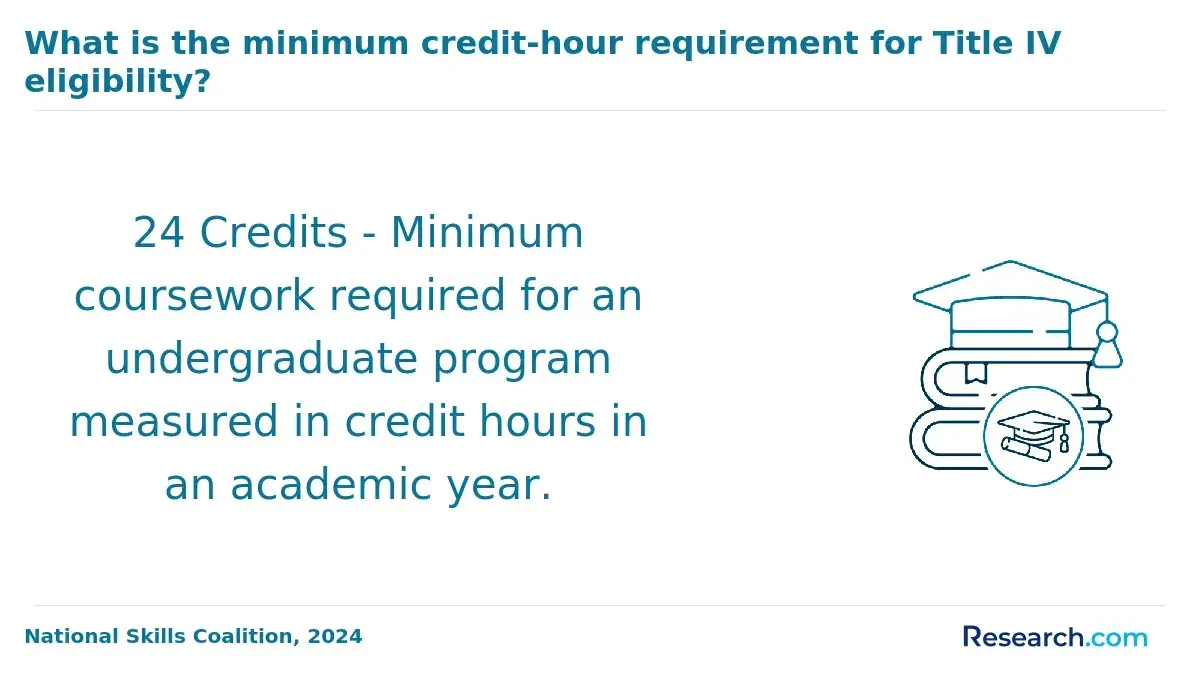
A standard U.S. bachelor's degree commonly requires about 120 semester credits. Transfer credits shorten the degree only when they replace required coursework; credits that enter as unused electives may increase your transcript total without moving you much closer to graduation.
The table below uses a 120-credit bachelor's structure to show how transfer credits can affect completion time. Actual timelines vary because chemistry courses often have prerequisites and labs that may not be offered every term.
| Accepted transfer credits | Credits remaining in a 120-credit degree | Approximate full-time pace at 15 credits per term | Approximate part-time pace at 6 credits per term | Main caution |
| 0 credits | 120 credits | About 8 terms | About 20 terms | Longest and usually most expensive route |
| 30 credits | 90 credits | About 6 terms | About 15 terms | May still require the full chemistry sequence |
| 60 credits | 60 credits | About 4 terms | About 10 terms | Works best when general education is complete |
| 90 credits | 30 credits | About 2 terms | About 5 terms | Only realistic if major, upper-division, and residency rules are satisfied |
The most efficient path is often not the shortest advertised path. For example, a student with many unrelated electives may still need two or more years of sequenced chemistry courses, while a student with an associate degree in science may move faster because prerequisites and general education are already aligned.
If your main goal is rapid entry into patient-facing healthcare rather than chemistry careers, a fasttrack medical pathway may be worth comparing before committing to a lab-heavy bachelor's route.
Transfer credits can reduce tuition by lowering the number of credits you must take at the new institution. The savings depend on the school's per-credit tuition, fees, residency rules, lab fees, online course fees, and whether transfer credits replace required courses or only electives.
College Board's 2024 Trends in College Pricing and Student Aid reported average published tuition and fees of $11,610 for in-state students at public four-year institutions for the 2024-25 academic year. For transfer students, that figure highlights why applying even one semester of prior credits can materially change the degree's total cost.
The table below shows how to think about tuition reduction using a simple per-credit formula. It is not a school quote; students should replace the example rate with the exact per-credit tuition and mandatory fees from each program.
| Transfer scenario | Credits not taken at new school | Example calculation at $500 per credit | What to verify |
| One semester transferred | 15 credits | $7,500 in avoided tuition charges | Whether those credits satisfy required categories |
| One academic year transferred | 30 credits | $15,000 in avoided tuition charges | Whether lab and major prerequisites remain |
| Associate degree block transferred | 60 credits | $30,000 in avoided tuition charges | Whether upper-division chemistry still requires multiple terms |
| Maximum transfer pathway | 90 credits | $45,000 in avoided tuition charges | Whether residency, capstone, and major rules allow a true 30-credit finish |
Cost comparisons should also include financial aid timing. The maximum Federal Pell Grant for the 2024-25 award year is $7,395, but eligibility depends on federal rules, enrollment intensity, cost of attendance, and personal financial circumstances. A transfer-friendly program may reduce borrowing, but a student should still compare net price after grants, scholarships, employer assistance, and required lab costs.
Yes, but chemistry programs tend to be more selective with nontraditional credit than with previous accredited college coursework. Military training, CLEP, AP, IB, ACE-recommended training, employer education, and portfolio-based prior learning may satisfy general education or elective requirements, but they are less likely to replace upper-division chemistry labs unless the school can verify equivalent learning outcomes.
Students with nontraditional credit should separate "credit accepted by the university" from "credit accepted by the chemistry department." These questions help clarify the difference before enrollment:
- Will ACE, military, CLEP, AP, IB, or portfolio credit apply to the chemistry major, or only to electives and general education?
- Does the program accept exam credit for prerequisite science or math courses required before organic chemistry, biochemistry, or physical chemistry?
- Are lab components required in person, through approved kits, through partner sites, or through intensive campus sessions?
- Is there a maximum number of alternative credits that can count toward the degree?
- Will graduate schools, medical schools, pharmacy schools, or employers accept the same credits for their prerequisites?
Students considering chemistry as a pre-pharmacy route should be especially careful because professional programs may have their own prerequisite rules. If pharmacy is the long-term goal, comparing the total pathway cost, including prerequisite completion and professional tuition, can make a resource on the cheapest online pharmacy school useful alongside chemistry transfer planning.
The best-transfering credits are usually recent, credit-bearing courses from institutionally accredited colleges that match the receiving program's curriculum. In chemistry degrees, the strongest credits tend to be lower-division general education, college algebra or calculus, statistics, physics, biology, general chemistry with lab, and sometimes organic chemistry with lab.
The table below summarizes how different prior credits usually perform in a transfer evaluation. It is a planning guide, not a substitute for an official degree audit.
| Previous credit type | Typical transfer strength | Why it may transfer well or poorly | Best student action |
| Completed associate degree from a partner community college | Strong for general education | Articulation agreements may satisfy broad lower-division requirements | Ask whether the associate degree transfers as a block or course by course |
| General chemistry with lab | Strong if recent and equivalent | Directly supports the chemistry sequence | Provide lab hours, textbook, topics, and safety coverage |
| Organic chemistry with lab | Moderate to strong | Departments may scrutinize rigor and lab equivalency | Submit a syllabus and ask whether it satisfies the major requirement |
| Older science courses | Variable | Some schools review age, lab methods, instrumentation, and prerequisite relevance | Ask about expiration or recency policies before applying |
| Unrelated electives | Weak to moderate | May count toward total credits but not toward major progress | Check whether electives are still needed in the degree plan |
| Developmental or remedial courses | Usually weak | Often not considered college-level degree credit | Do not count these when estimating remaining credits |
A common red flag is a transcript with many credits but few prerequisites. If most previous courses are unrelated electives, a chemistry degree may still take considerable time because lab science sequences cannot always be compressed.
Transfer agreements can make online chemistry degree completion more predictable. These agreements may include statewide articulation policies, community college transfer pathways, guaranteed-transfer course maps, reverse-transfer arrangements, or institution-to-institution equivalency databases.
The main advantage is transparency. Instead of waiting for a case-by-case evaluation, students can often see in advance which courses satisfy general education, math, science prerequisites, and lower-division major requirements. This is especially valuable for chemistry because a missing prerequisite can delay multiple later courses.
Before relying on an agreement, students should confirm the exact catalog year, GPA requirements, grade minimums, residency rules, and whether the agreement applies to fully online students. Some agreements are designed for in-state public institutions, while others apply only to specific associate degree tracks or partner colleges.
Transfer agreements are strongest when they produce a term-by-term completion plan. If an agreement only states that credits "may transfer," students should still request a degree audit showing remaining courses, expected sequence, lab format, and projected graduation term.
The most important transfer policies are not always the most visible ones on an admissions page. Students should compare the policies that determine whether prior credits reduce required coursework, not just whether they appear on the transcript.
Use the following checklist when speaking with admissions, the registrar, academic advising, and the chemistry department. The goal is to identify the program that accepts the most useful credits, not simply the most total credits.
- Maximum transfer-credit limit: Ask for the total cap and whether separate caps apply to two-year college, four-year college, exam, military, or prior-learning credits.
- Residency requirement: Confirm the minimum number of credits that must be completed through the new institution.
- Major-credit requirement: Ask how many chemistry major credits must be completed at the school even if similar courses were taken elsewhere.
- Upper-division requirement: Confirm whether transferred lower-division courses can satisfy upper-division expectations.
- Lab requirement: Ask whether previous labs, online labs, hybrid labs, or in-person labs meet the degree standard.
- Minimum grade rule: Check whether chemistry, math, and prerequisite courses require a C, C+, B-, or other minimum.
- Course age rule: Ask whether science or math credits expire or require department review after a certain period.
- Elective overflow: Ask how many accepted credits would be unused because the degree has limited elective space.
- Professional school alignment: Confirm whether transferred credits meet prerequisites for medical, pharmacy, dental, graduate, or teacher-preparation programs if those are your goals.
Students should be cautious if a school will not show how transfer credits apply before enrollment. A generous headline policy is less valuable than a transparent degree plan showing remaining cost, time, prerequisites, and graduation requirements.
Transfer-friendly online chemistry programs are most valuable for students who already have college-level credits that match the degree structure. The strongest candidates usually have an associate degree in science, completed general education, recent chemistry and math prerequisites, military or professional training that can cover electives, or previous enrollment in a STEM major.
These students often benefit most because their prior work can replace foundational requirements while they focus on upper-division chemistry, biochemistry, research methods, instrumentation, or capstone work. The degree may support roles in laboratories, quality control, environmental testing, biotechnology, education-related pathways, or preparation for graduate and professional study.
Students should also consider labor-market fit. BLS information updated in 2024 projects faster-than-average employment growth for chemists and materials scientists from 2023 to 2033, but opportunities vary by industry, location, lab experience, and whether a student continues to graduate school. A transfer-friendly degree can improve ROI by reducing tuition and time, but career outcomes still depend on skills, internships, lab competence, and the credibility of the program.
Not every student should choose chemistry just because many credits transfer. If your long-term goal is healthcare administration, operations, policy, or leadership rather than lab science, an online masters healthcare management pathway may align better after a bachelor's degree.
How Should Students Choose an Online Chemistry Degree Based on Transfer Efficiency?
The best way to choose is to compare programs by transfer efficiency: the number of prior credits that actually reduce required credits, cost, and time to graduation. A program that accepts 75 useful credits can be better than one that accepts 90 credits but leaves you with the same chemistry sequence and residency burden.
Follow this decision process before committing to a program:
- Create a transcript inventory with course names, credits, grades, lab components, course dates, and institution names.
- Shortlist only institutionally accredited online chemistry, biochemistry, or chemistry-related programs that fit your career goal.
- Request a written transfer evaluation or preliminary degree audit from each school.
- Separate credits into categories: general education, major requirements, prerequisites, upper-division requirements, electives, and unused credits.
- Calculate credits remaining, required terms, lab scheduling constraints, tuition, fees, books, technology costs, and possible travel for labs.
- Ask whether the degree supports your next step, such as employment, graduate school, pharmacy school, teaching preparation, or professional certification.
- Choose the program with the best combination of useful accepted credits, transparent remaining requirements, affordable net price, lab quality, and career relevance.
Students should also compare alternatives honestly. If a chemistry degree is mainly a stepping stone into healthcare management, public health administration, or non-lab healthcare leadership, a healthcare administration course or degree pathway may offer a more direct return on time and tuition.
The strongest transfer decision is evidence-based. Do not enroll based only on a maximum-credit claim, a fast-completion promise, or a low advertised tuition rate. Enroll when you have a written plan showing which credits count, what remains, how long it will take, and why the degree supports your next career or education move.
Other Things You Should Know About Chemistry Degrees
They may be, but acceptance depends on the employer, graduate program, professional school, and lab format. Students planning graduate study or professional school should ask whether online, hybrid, home-kit, or intensive in-person labs satisfy prerequisite expectations.
No, ACS approval is not required for every chemistry-related career or graduate pathway. However, ACS-approved programs may be preferred for some research-intensive, graduate, or traditional chemistry career goals, so students should compare this factor with transfer savings.
Possibly, but teacher certification is controlled by state rules and usually requires approved educator preparation, exams, background checks, and student teaching. A chemistry degree alone may not be enough for licensure.
Many universities do not label the diploma as online, but policies vary. Students who are concerned should ask the registrar exactly how the diploma and transcript identify the campus, program, and delivery format.
- Program Transfer Search https://search.ontransfer.ca/
- Best Online Schools for Transferring Credits [2026 Guide] https://www.straighterline.com/blog/transfer-best-online-schools-for-transferring-credits
- Top Online Schools That Accept Transfer Credits https://www.edvisorly.com/student-guides/online-schools-that-accept-transfer-credits
- Choosing an Online School as a Transfer Student | OEDb.org https://www.oedb.org/advice/choosing-an-online-school-for-transfer-students/
- Community college transfer processes discourage degree completion https://journalistsresource.org/education/community-college-transfer-bachelors-degree-barriers-research/
- Online Science Courses with Lab that Transfer: A Helpful Guide - Prereqcourses https://www.prereqcourses.com/online-science-courses/
- Transferology https://www.transferology.com/