2027 CEN vs TCRN: Emergency Nursing and Trauma Certification Compared
Audited and Verified:
Our Editorial and Data Verification Process
Research.com uses government datasets, official education statistics and primary institutional information to support its career and degree guides. Our review process checks factual accuracy, occupational definitions, source dates and the requirements associated with the credentials discussed.
How This Article Was Fact-Checked
Our editorial team verifies salary estimates, employment projections, education requirements and program information against original data providers and official organizations. Salary figures are checked against the relevant occupational definitions and reporting periods. Information about licensure, accreditation and required in-person training is reviewed separately.
Fact-checked and verified on:

Co-Founder and Chief Data Scientist
Choosing between Certified Emergency Nurse (CEN) and Trauma Certified Registered Nurse (TCRN) depends less on which credential sounds more impressive than on the patients you care for and the work you want to do next. Both are specialty certifications for registered nurses, but they assess different bodies of knowledge.
For emergency and trauma nurses considering an exam, this comparison explains the requirements, preparation, costs, and career trade-offs so you can choose a credential that fits your practice rather than pay for the wrong test.
Key Things You Should Know
- Choose CEN for broad emergency nursing practice; choose TCRN for care across the trauma continuum, including injury management beyond the emergency department.
- Both credentials are awarded by the Board of Certification for Emergency Nursing (BCEN). Neither replaces an RN license, employer orientation, or demonstrated clinical competence.
- BCEN recommends relevant practice experience, commonly at least two years, but its recommendation is not the same as a mandatory experience requirement; confirm the current handbook before applying.
What are the differences between CEN and TCRN certification?
BCEN awards both certifications. CEN tests the breadth of emergency nursing, while TCRN concentrates on injured patients and the systems that support their care. This comparison shows why the credentials can complement one another without being interchangeable.
| Comparison | CEN | TCRN |
| Primary focus | Patients with emergency conditions across ages and body systems | Patients with traumatic injury across the continuum of care |
| Natural practice fit | General emergency department nursing | Trauma-focused ED, resuscitation, inpatient, or trauma-program practice |
| Knowledge beyond the overlap | Nontraumatic medical, behavioral, obstetric, and other emergencies | Injury prevention, trauma systems, rehabilitation, and recovery |
Both exams assess trauma-related judgment, but passing one does not award the other credential. Neither certification grants a new scope of practice.
RNs with an associate's degree can check out this guide to RN-to-BSN programs with no clinicals to explore bachelor's degree completion.
Which certification is better for emergency or trauma nursing?
CEN is generally the better first choice for an RN whose shifts span the full emergency department caseload. It aligns with work that may move from respiratory distress to stroke, psychiatric emergencies, pediatric illness, and injury. TCRN is generally the closer fit when trauma is a sustained part of the nurse's role - particularly when that work extends into intensive care, inpatient care, coordination, or injury prevention.
An ED nurse at a trauma center may benefit from either or both. The deciding question is which knowledge gaps matter most in the current job and the next desired role. A trauma assignment alone does not make TCRN necessary, and CEN does not imply that every holder is prepared for every trauma-team responsibility.
RNs or NPs with a master's degree who plan to pursue an even more advanced education can check out DNP programs with accessible admission requirements.
What are the eligibility requirements for CEN and TCRN exams?
BCEN's central eligibility requirement for each exam is an active, unrestricted RN license or nursing certificate equivalent to an RN license in the applicant's country. BCEN recommends relevant practice experience - typically two years in emergency nursing for CEN or trauma nursing for TCRN - but does not make that recommendation a universal prerequisite. Candidates should check the current BCEN candidate handbook for license documentation, application rules, and any circumstances affecting their eligibility.
These are postlicensure specialty certifications, not routes to initial RN licensure. An ADN- or BSN-prepared RN can evaluate eligibility on the same licensing basis; a nursing student who has not yet obtained the required license cannot use either exam to bypass licensure.
Comparing shorter routes to a DNP degree may be a good move for those with a later career goal.
The CEN blueprint covers emergency presentations across patient populations and clinical systems, including medical and traumatic emergencies. The TCRN blueprint organizes knowledge around traumatic injury, from initial assessment and resuscitation through continuing care and recovery, alongside trauma-system considerations. Consult BCEN's current content outline for each exam before choosing study materials: the outlines, not a colleague's recollection of test questions, define what to prepare.
A practical way to separate them is to consider where your unfamiliar cases arise. If the challenge is managing the ED's nontrauma breadth, CEN addresses that gap more directly. If it is understanding how injured patients progress beyond initial stabilization, TCRN may be more useful.
An MSN-prepared nurse who is planning to specialize in family nurse practice should look into family NP certificate options for MSN-prepared nurses.
Neither credential requires a particular nursing degree level beyond the education needed to obtain the qualifying RN license. The strongest preparation combines relevant patient-care experience, feedback from experienced colleagues, and study against the current exam blueprint. For a newer ED nurse, supervised orientation and unit competency checks should take priority over collecting credentials; an exam pass cannot validate hands-on performance in a specific workplace.
A nurse considering BSN completion options for experienced RNs should treat that academic decision separately from CEN or TCRN preparation. A BSN may serve an employer or long-term education goal, but it is not a substitute for specialty experience or an exam requirement for these credentials.
BCEN sets the exam fees, and the amount payable can depend on the credential, applicable membership discount, and whether the application is for an initial test or retest. Fees change, so check BCEN's current fee schedule and discount terms before budgeting rather than relying on an older quoted price.
Compare the total cost of attempting each credential, not just its application fee: include review materials, practice exams, travel if applicable, and time away from work. Ask whether your employer reimburses the exam only after a passing result, covers a retest, or offers a certification differential. Those policies can change which option is financially sensible.
Doing short-format FNP program comparisons is a good way to get started for RNs who plan to become family nurse practitioners in the future.
Neither exam has a universally easier reputation that should drive the decision. Difficulty depends on the distance between BCEN's blueprint and your daily practice: a trauma-intensive nurse may need more preparation for CEN's nontrauma emergencies, while a general ED nurse may need more work on TCRN's care-continuum and trauma-system topics.
Start with the relevant official content outline, mark domains you rarely encounter, and use practice questions to identify reasoning gaps rather than memorize answers. Then schedule focused review around those gaps. Treat any published pass rate as a description of a particular group of test-takers - not a prediction of your result.
RNs who plan to become nurse practitioners and specialize in the field of psychiatry can look into shorter MSN route to psychiatric NP preparation.
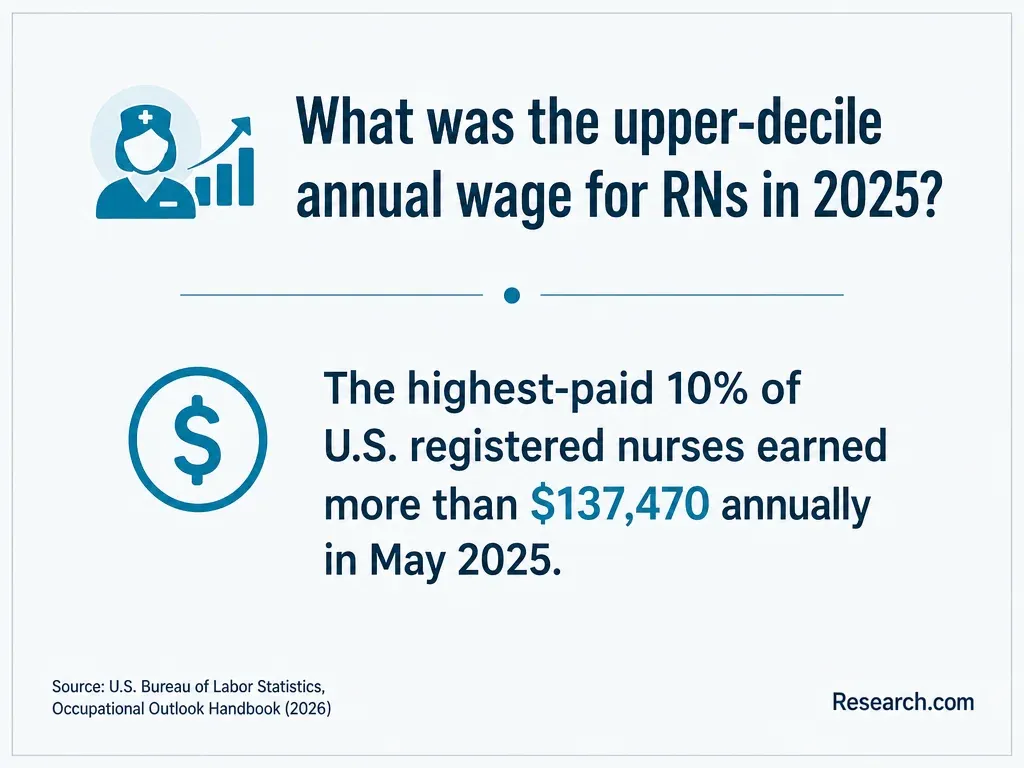
Neither certification guarantees a raise. Compensation depends on the employer's pay policy, location, role, shift, experience, and bargaining arrangements. Broad registered-nurse wage statistics cannot isolate a CEN or TCRN pay premium, and they should not be read as the expected salary for either credential.
For a useful return-on-cost estimate, ask your employer or prospective employer whether the specific credential earns a differential, qualifies for reimbursement, or satisfies a stated hiring preference. Compare that documented benefit with exam and renewal expenses. A credential may still be worthwhile for professional development when no direct pay increase is offered.
Looking into BSN-to-MSN tuition and fee considerations allows nurses who want to pursue advanced studies to prepare financially.
CEN commonly aligns with emergency department RN positions, while TCRN can align with trauma-focused ED, trauma ICU, inpatient trauma, and trauma-program roles. Experienced nurses may also apply specialty knowledge in education, quality improvement, or injury-prevention work. Job titles and requirements differ by employer: a trauma coordinator position, for example, may call for substantial clinical and program experience in addition to certification.
For an early-career nurse, the more realistic sequence is to secure an appropriate RN position, complete specialty orientation, build competence, and then pursue the credential that supports a defined role. Neither exam alone qualifies an RN for a new unit, management position, or advanced practice role.
RNs who plan to pursue an MSN and specialize as a psychiatric NP can explore lower-tuition psychiatric nursing graduate programs.
How should nurses choose between CEN and TCRN certification?
Use your actual case mix and next job - not the perceived prestige of an acronym - to make the choice. A nurse who primarily handles undifferentiated emergency patients will usually get broader alignment from CEN. A nurse whose work follows injured patients through multiple phases of care will usually get closer alignment from TCRN.
Before applying, take three concrete steps: compare both current BCEN blueprints with your practice; check job postings and your employer's written certification policy; and confirm current eligibility, fees, and renewal requirements with BCEN. If neither blueprint addresses your most important development need, targeted orientation or continuing education may be a better first investment. Some nurses eventually earn both, but there is no need to pay for both merely because their work includes trauma.
Planning to advance into an NP role? Explore lower-cost options for future nurse practitioners to address educational expenses.
Other Things You Should Know About Nursing
Yes. Nurses who hold an active credential may use its designation according to BCEN's credential-use rules and their employer's style policy.
No. The Trauma Nursing Core Course (TNCC) is an educational course; TCRN is a BCEN specialty certification earned by passing its exam. Completing a course does not automatically award TCRN.
Yes. Both require periodic renewal. Review BCEN's current renewal handbook for deadlines and available renewal methods before planning continuing education or a retest.
Yes. An eligible RN can pursue and maintain both credentials, provided they meet each credential's separate examination and renewal requirements.
- Continuing Education Certificate in Trauma Skills Among Emergency Nurses: A National Sample Survey Analysis - PMC https://pmc.ncbi.nlm.nih.gov/articles/PMC12373357/
- Trauma Nurse Career Guide for Emergency Care | American College of Education https://ace.edu/student-success/career-guides/trauma-nurse/
- How to Become a Trauma Nurse | denvercollegeofnursing.edu https://www.denvercollegeofnursing.edu/blog/nursing/how-to-become-a-trauma-nurse.html
- The TCRN Certification Process | The Board of Certification for Emergency Nursing https://bcen.org/tcrn/the-certification-process/
- BCEN Certification Guide: CEN, TCRN, CFRN, CTRN & More | RegisteredNursing.org https://www.registerednursing.org/articles/bcen-certification-nursing-2026-10-12/
- Who Should Take the BCEN CEN? Eligibility, Careers, Salary, and Next Steps - Pocket Prep https://www.pocketprep.com/posts/who-should-take-the-bcen-cen-eligibility-careers-salary-and-next-steps/
- CEN Certification: Steps, Cost and Timeline | Cross Country https://www.crosscountry.com/blog/how-to-become-a-certified-er-rn-cen