2027 BS in Business Administration and Finance: Which Prior College Courses Could Count Toward the Focus?
Audited and Verified:
Our Editorial and Data Verification Process
Research.com uses government datasets, official education statistics and primary institutional information to support its career and degree guides. Our review process checks factual accuracy, occupational definitions, source dates and the requirements associated with the credentials discussed.
How This Article Was Fact-Checked
Our editorial team verifies salary estimates, employment projections, education requirements and program information against original data providers and official organizations. Salary figures are checked against the relevant occupational definitions and reporting periods. Information about licensure, accreditation and required in-person training is reviewed separately.
Fact-checked and verified on:

Co-Founder and Chief Data Scientist
Prior coursework can shorten the path to a BS in Business Administration with a finance focus - but only if it fulfills requirements in the new program. An accepted economics course might satisfy a finance prerequisite, while another course with the same name might count only as an elective.
For transfer and returning students, that difference affects scheduling, cost, and graduation plans. This guide shows which courses are promising, how colleges evaluate them, and what to request before deciding where to enroll.
Key Things You Should Know
- Accounting, economics, statistics, mathematics, and introductory business courses are strong candidates for transfer, but finance-focus requirements depend on the receiving school's curriculum.
- Credits accepted by a college do not necessarily satisfy its business core, finance focus, prerequisites, or graduation residency requirement.
- A bachelor's degree commonly requires about 120 semester credits; the useful figure for planning is the number of requirements left after an official degree audit, not the number of credits accepted.
Which prior college courses could count toward a BS in Business Administration and Finance?
Prior courses may apply to general education, the business core, finance prerequisites, finance-focus courses, or open electives. A "finance focus" is not a standardized credential: one college may offer a formal concentration, while another offers finance electives within a general business degree. Check the exact degree requirements before assuming that a transferred finance course counts toward the focus.
The following examples show where common coursework might land in a degree audit. They are possibilities, not transfer guarantees.
| Prior coursework | Possible application | Key question |
| Writing, humanities, natural science | General education or electives | Does it match a specific general education category? |
| Introductory accounting, economics, statistics | Business core or finance prerequisites | Does the content meet the required course's learning outcomes? |
| Management, marketing, business law | Business core or electives | Is a particular upper-division version required? |
| Corporate finance, investments, financial modeling | Finance focus or electives | Does the program accept transferred upper-division finance work for the focus? |
Students whose previous courses are mainly in another business function should compare where those credits would apply, rather than assume finance is the quickest route. For example, credit mapping for online project management programs illustrates why the same transcript can produce a different completion plan in an adjacent major.
How does a college evaluate previous coursework for finance degree credit?
The receiving institution decides what credit to award and where it applies. Evaluators typically review the sending institution, course level, credit hours, grade, subject matter, and match with the current catalog. A transfer office or registrar may award credit first; the business department may then decide whether a course satisfies a particular major or finance-focus requirement.
Course titles alone are weak evidence. A course called "Business Finance" could cover introductory financial management at one college and a different set of topics at another. A syllabus can help an evaluator compare topics, assignments, and prerequisites. Schools may also set minimum grades, limit older coursework in changing subjects, or require certain upper-division courses to be completed in residence.
When comparing institutions through a US online business college selection guide, treat published transfer policies as a starting point. Ask each prospective college for a transcript-based evaluation under the catalog that would govern your enrollment.
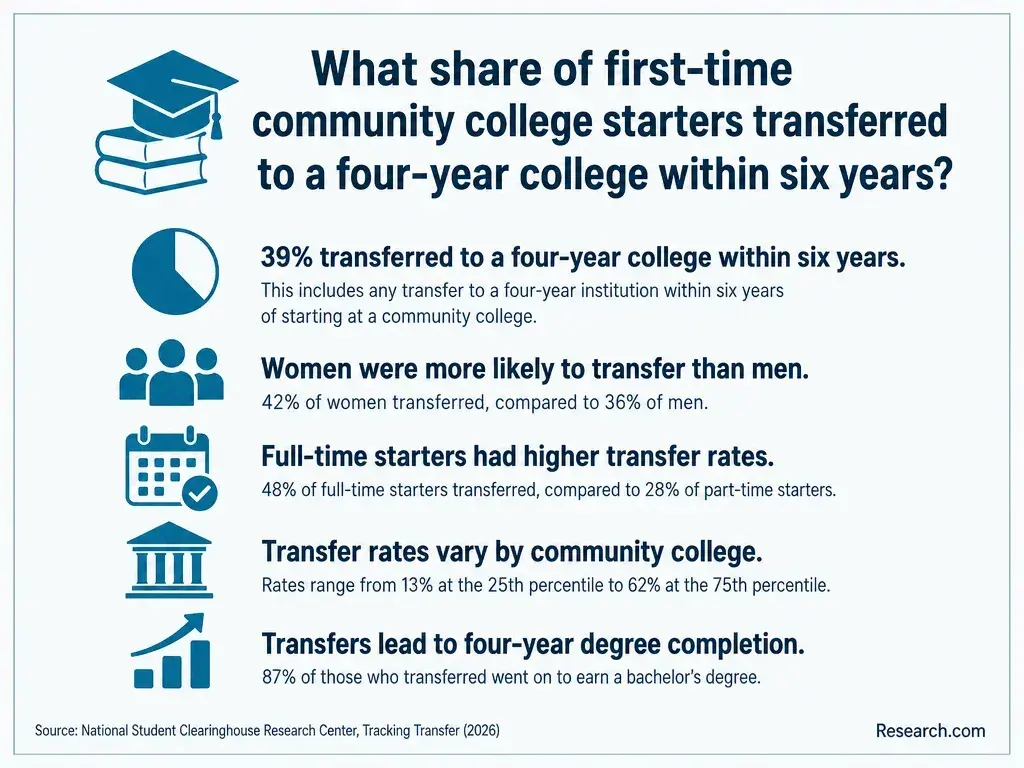
What business courses commonly transfer into a finance degree program?
Introductory management, marketing, business communication, business law, information systems, and operations courses may satisfy a shared business core. Their usefulness depends on the program's required course list: an accepted operations course does not automatically replace corporate finance or a finance elective.
Upper-division business courses need closer review. A college may accept the credits but require its own strategy capstone, research-intensive course, or designated finance sequence. If much of your prior work is in operations or logistics, compare the remaining finance requirements with those in another pathway, such as fast-track online supply chain bachelor's options. The better fit is the program that applies more relevant credits to required coursework, not simply the one that accepts more credits overall.
Often, yes. Previous writing, communication, mathematics, science, social science, and humanities courses may fulfill general education categories even when they have no direct finance content. Completing those categories can create room in a future schedule for sequenced accounting and finance courses.
The details matter. A college might require a laboratory science, a writing-intensive course, or a particular quantitative course rather than any elective in that subject. An associate degree may meet a general education block under an applicable transfer agreement, but that does not necessarily complete business prerequisites or finance-focus requirements. Students comparing a different completion route can compare completion times for organizational leadership degrees; they should check how the same general education transcript applies to each program before relying on an advertised timeline.
Yes, when their content and level match the receiving program's requirements. Financial and managerial accounting commonly underpin finance study; microeconomics and macroeconomics may be required in the business core; and algebra, calculus, statistics, or business quantitative methods may meet mathematical or analytical requirements. These subjects are not interchangeable. Statistics may prepare a student for financial analysis without replacing a required calculus course, and financial accounting does not substitute for corporate finance merely because both involve financial statements.
Check prerequisite chains before registering. If a required finance course follows accounting and statistics, an unresolved equivalency can delay access to it even when plenty of other credits transfer. Students considering a different quantitative business field can review affordable supply chain programs and salary outlook, but should compare required courses and costs rather than assume that a different specialization avoids quantitative work.
Institutional accreditation is one factor colleges use when assessing prior study, but it does not guarantee that a particular course will transfer or fulfill a requirement. Business-school accreditation through AACSB, ACBSP, or IACBE has a different scope. A receiving college may consider it when reviewing business coursework, yet its own equivalency, grade, and residency policies still control the decision.
Verify both the sending and receiving institutions' accreditation status and, if a school cites business accreditation, whether it covers the relevant unit or program. Then ask for the actual course evaluation. This matters when comparing programs on price: online project management degrees with lower tuition may offer a useful cost comparison, but neither a lower advertised price nor an accreditation label tells you how your finance-related credits will apply.
Start with the receiving college's instructions. Official transcripts are commonly required for a final evaluation, while an unofficial transcript may support an initial estimate. Detailed materials become especially valuable when a course title does not clearly establish equivalence.
Prepare the following materials so the transfer office and business department can review disputed or unfamiliar courses efficiently:
- Transcripts from every college attended, including institutions where you completed only a few courses.
- Catalog descriptions and syllabi for accounting, economics, mathematics, and upper-division business or finance courses needing a specific equivalency.
- Documentation of an associate degree, approved transfer agreement, or other prior learning if you want it evaluated under a separate policy.
- A copy of the intended program's requirements with the courses you believe might satisfy them identified.
If your transcript is strongest in a field other than finance, collect the same documents before comparing alternatives such as human resources degree costs and options. A meaningful cost comparison depends on the courses each school says you would still need to take.
There is no universal transfer maximum. A college may separately limit total transfer credits, credits from a two-year institution, upper-division credits accepted from elsewhere, and the share of the major or finance focus completed outside the institution. It may also require a minimum number of credits completed in residence. These rules can make a large accepted-credit total less useful than it first appears.
Ask for two figures: credits accepted and credits that reduce your remaining requirements. Then check whether prerequisite sequencing or infrequently offered courses add terms to the plan. Listings of online business bachelor's degrees with shorter timelines can help identify programs to investigate, but your own evaluated transcript - not another student's pace - determines a realistic completion schedule.
They can, especially when both formats follow the same institution's catalog and degree requirements. Do not assume they do. An online completion track may use a different course sequence, restrict enrollment in certain finance electives, or have separate rules for students entering with an associate degree. A campus program may offer an equivalent course more frequently - or the reverse.
Request an evaluation for the specific format and program you intend to enter. Also check whether required finance courses, exams, and group work fit your schedule. Business degree programs designed for faster progress are worth comparing only after you confirm both credit applicability and when your remaining courses are actually offered.
How can students confirm which transferred courses fulfill degree requirements?
Use the official degree audit for your intended BS in Business Administration and finance focus. It should show where each accepted course applies and what remains in general education, the business core, prerequisites, finance requirements, electives, and residency. Compare it with the applicable catalog and have an adviser confirm the sequence of remaining courses.
Before committing to a program or registering for a course you think may be redundant, take these steps:
- Ask the registrar or transfer office which evaluations are final and which are provisional.
- Ask the business department to review courses listed as electives that appear to match required business or finance coursework; submit syllabi and request a written decision.
- Confirm any approved substitution or appeal is recorded in the degree audit, not merely discussed in an email.
- Review the remaining course schedule and ask the financial-aid office how your planned enrollment affects aid eligibility.
For students balancing a job with degree completion, business administration programs for advancement while working provide another comparison point. The deciding evidence remains a written audit and a feasible schedule for the requirements you personally have left.
Other Things You Should Know About Business Administration
Possibly. Ask whether the college accepts pass/fail transfer work and whether it allows that grading basis for the specific requirement. A course accepted as an elective may still be ineligible for a finance prerequisite.
It may, if the receiving college awards credit for your exam result and applies it to a degree requirement. Request an exam-credit evaluation separately from your college-course evaluation.
They may. Before enrolling elsewhere, obtain written preapproval for the course and confirm the required grade, credit hours, and transcript deadline.
Some colleges waive or recognize general education requirements for second-degree students; others review them individually. A prior degree does not automatically satisfy business-core or finance-focus requirements.
- Accreditation in the U.S. | ed.gov http://www.ed.gov/laws-and-policy/higher-education-laws-and-policy/college-accreditation/accreditation-in-the-us
- CSU Policy: Transfer Policies https://policylibrary.colostate.edu/policy.aspx
- Types of Accounting Degrees You Can Specialize In | Edison State Community College https://www.edisonohio.edu/blog/types-of-accounting-degrees-you-can-specialize-in
- University Undergraduate Graduation Requirements | asu.edu https://catalog.asu.edu/undergraduatereq
- Transfer Credit | University of Alabama - UA Academic Catalog https://catalog.ua.edu/undergraduate/about/academic-regulations/policies/transfer-credit/
- Transfer credit policies - Office of Admissions https://admit.washington.edu/apply/transfer/policies/
- Transfer Credit Policies and Procedures | Prince George's Community College https://www.pgcc.edu/hs/transfer-credit-policies-and-procedures/
- Transfer Credit Policy - Hunter College Catalog - CUNY https://hunter-undergraduate.catalog.cuny.edu/admissions/transfer-advanced-standing-admission
- Undergraduate Transfer Credit Policy | nyu.edu https://www.nyu.edu/about/policies-guidelines-compliance/policies-and-guidelines/UndergraduateTransferCreditPolicy.html
- Program Requirements | Undergraduate BBA | Finance | Stetson-Hatcher School of Business https://business.mercer.edu/programs/undergraduate-bba/finance/program-requirements/