2027 Best Online Professional Certificates for Parents

Co-Founder and Chief Data Scientist
Parents choosing an online professional certificate need training that fits school pickups, work shifts, and a realistic career goal, not simply the shortest course. The U.S. Bureau of Labor Statistics projects healthcare support occupations to grow faster than average from 2024 to 2034, while employers continue to value job-ready digital and technical skills.
This guide explains which certificate types work best for busy parents, what they cost, when licensing matters, and how to compare flexible programs without overpaying or choosing a credential employers do not recognize.
Key Things You Should Know
- Choose a certificate only after matching it to a target role: a short noncredit professional certificate can build skills, while credit-bearing healthcare, legal, and trade certificates may be needed for structured career pathways or later degree study.
- Flexibility matters as much as duration for parents. Look for asynchronous coursework, predictable deadlines, recorded sessions, part-time pacing, and disclosed requirements for labs, clinical placements, internships, or proctored exams.
- Use occupational data carefully. For example, the May 2024 median annual wage for medical assistants was $44,200, but a certificate alone does not guarantee employment, certification eligibility, or that wage level.
Top 10 Best Online Professional Certificates for Parents
Popular Trade School Programs
Online trade-related certificates are strongest for theory, estimating, safety, code awareness, customer service, and business operations. Common options include HVAC fundamentals, electrical theory, construction management, welding technology, automotive service basics, and plumbing coursework.
Parents should verify how hands-on competencies are taught: most skilled trades require in-person labs, employer training, apprenticeships, or supervised field hours. Choose a fully online option for advancement or pre-apprenticeship knowledge; choose a hybrid program when the goal requires demonstrated practical skills, state registration, or an employer-recognized apprenticeship.
Healthcare Programs
Healthcare certificates can include medical billing and coding, medical assisting, pharmacy technician training, health information technology, dental assisting, and patient care support. Billing and coding programs are often well suited to online study, although employers may prefer applicants who earn a separate industry certification.
Medical assisting, dental assisting, and patient-care programs commonly require clinical experiences that cannot be completed solely online. Before enrolling, parents should confirm whether the curriculum meets state rules, whether local clinical placement support is available, and whether graduates are eligible for the certification examination they intend to take.
Criminal Justice / Law Programs
Online certificates in criminal justice, legal studies, paralegal studies, cybersecurity foundations, and victim advocacy can suit parents seeking introductory knowledge or advancement in related administrative roles. A paralegal certificate may be useful for applicants who already hold a degree or have legal-office experience, but requirements vary by employer and state. It does not authorize someone to practice law.
Programs involving law enforcement, corrections, or investigations may include background checks, physical requirements, field training, or agency-specific hiring standards that an online certificate cannot replace.
Arts & Design Programs
Parents seeking portfolio-based work can consider online certificates in graphic design, UX design, digital marketing design, photography, animation, web design, or social media content production. These programs are usually more valuable when they result in a polished portfolio, current software skills, and feedback from working professionals.
A certificate can help career changers demonstrate focused training, but it is not a substitute for a portfolio or client experience. Compare software costs, project ownership rights, instructor feedback, and whether live critiques are required at fixed times.
What types of online professional certificates are best suited for busy parents?
The best online professional certificates for busy parents are usually short, career-specific programs with asynchronous learning, weekly rather than daily deadlines, and a clear connection to a job task. They may be offered by colleges, universities, professional associations, technology companies, or established learning platforms.
A professional certificate generally verifies completion of training; it is different from a professional certification, which is usually awarded by a certifying body after an exam and sometimes experience requirements.
The comparison below helps parents identify the format that fits their time and career objective.
| Option | Best fit for parents | Important trade-off |
| Noncredit professional certificate | Career exploration, digital skills, project-based learning | Usually does not transfer as college credit |
| College certificate | Entry-level career training or future degree progression | May have set terms, tuition, and admissions steps |
| Industry certification preparation | Roles with recognized examinations, such as IT or coding | Training completion and certification are separate milestones |
| Hybrid clinical or technical certificate | Regulated or hands-on career paths | Requires in-person labs, placements, or scheduled assessments |
Parents with only a few hours a week should favor self-paced or lightly structured training. Parents pursuing patient-facing healthcare, skilled trades, or other regulated work should expect less scheduling freedom because supervised practice is often essential.
For a longer academic pathway after a certificate, compare fast track degrees only after confirming that the certificate carries transferable academic credit.
How do online professional certificates for parents compare to campus-based programs?
Online certificates can reduce commuting and make it easier to study after children are asleep, but campus-based programs can be better when a field depends on equipment, live coaching, clinical practice, or local employer relationships. The meaningful comparison is not online versus campus in general; it is whether the delivery method lets a parent complete every required competency.
This table highlights the practical differences parents should weigh before choosing a format.
| Factor | Online format | Campus or hybrid format |
| Scheduling | Often asynchronous, with flexible study blocks | Usually fixed meeting times and travel |
| Hands-on learning | Best for software, business, theory, and digital portfolios | Better for labs, tools, simulations, and clinical skills |
| Networking | May require deliberate virtual networking | Can offer direct local peer and employer contact |
| Total time burden | Lower travel burden, but independent study is substantial | Travel adds time, while live support may improve accountability |
Do not assume "online" means self-paced. Some programs require live attendance, group work, remote proctoring, or local placements.
Parents who need a structured route to a degree may also compare online certificates with the easiest masters options, but a graduate degree is appropriate only when the intended occupation truly benefits from advanced academic study.
What accreditation and licensing requirements should parent-focused certificate programs meet?
Accreditation matters most when a certificate is issued by a college, leads toward academic credit, supports eligibility for financial aid, or prepares students for a regulated occupation.
Institutional accreditation applies to colleges as a whole; programmatic accreditation evaluates certain professional programs. Neither automatically applies to every short, noncredit professional certificate.
Parents should verify the following before paying an enrollment deposit:
- Confirm the college's institutional accreditation through the U.S. Department of Education or Council for Higher Education Accreditation databases when selecting a credit-bearing academic program.
- Check the relevant state licensing board or certification organization for curriculum, clinical-hour, examination, and background-check rules for regulated roles.
- Ask whether the program itself is accredited, approved, or merely designed to prepare students for an external certification exam.
- Get written confirmation that online students can complete required labs, internships, clinical placements, or supervised fieldwork in their state.
A major red flag is a school that promises licensure without naming the licensing board or explaining state-specific restrictions. Licensing rules can change, and an otherwise reputable online program may not meet requirements where a parent lives.
What admission requirements and prerequisites do online certificates for parents typically have?
Admissions requirements vary sharply by credential type. Short professional certificates from third-party providers may require only an account, payment, and basic computer access.
College certificates may require a high school diploma or equivalent, placement testing, prerequisite courses, immunizations for healthcare training, or a background check before placement. Advanced certificates can require previous college coursework, a degree, or professional experience.
Before applying, parents should collect the details that affect both eligibility and family scheduling:
- Identify whether the credential is noncredit, undergraduate credit-bearing, graduate-level, or preparation for an external certification.
- Review prerequisite courses and determine whether prior learning, transfer credit, or work experience can satisfy them.
- Ask about technology, software, identity-verification, and remote-proctoring requirements before the first class begins.
- For programs with placements, confirm the geographic radius, daytime availability, transportation expectations, and who secures the site.
A low-barrier admission process can be helpful for career exploration, but it is not evidence of quality. The more important question is whether the program's curriculum and outcomes align with the employer, certification body, or licensing pathway a parent actually needs.
How long do parent-focused online certificate programs take, and what do they cost?
Parent-focused online certificates can range from a single course completed in weeks to college certificates spanning several terms.
Completion time depends on the program's credit load, course sequence, clinical requirements, and whether the parent studies part time. A "six-month" certificate can take longer when a learner pauses for family needs or waits for a required placement.
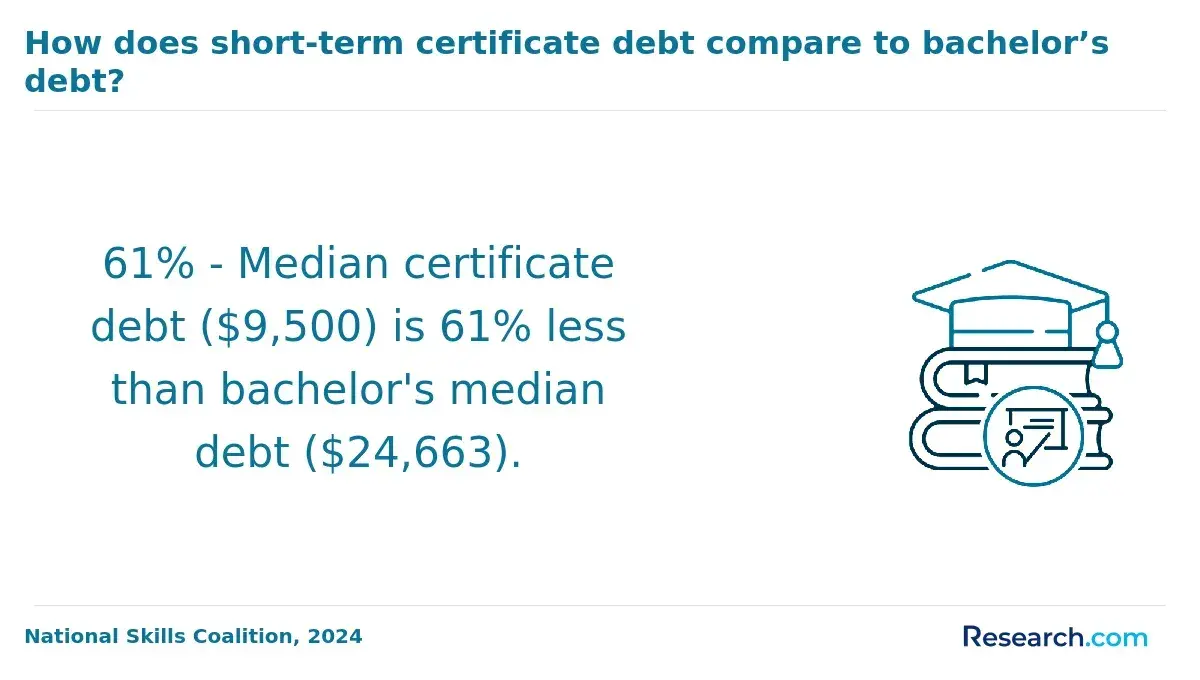
Costs should be compared as total out-of-pocket expense, not advertised tuition alone.
| Cost factor | Why parents should check it |
| Tuition or subscription | May be charged per course, per credit, per month, or as one package |
| Exam fees | External certification examinations are commonly separate from training tuition |
| Materials and software | Design, IT, trade, and healthcare programs can require specialized tools |
| Clinical, lab, or background costs | Hybrid programs may require travel, screenings, uniforms, or liability coverage |
| Childcare and lost work time | Required live sessions and placements can create the largest practical expense |
Ask for a written estimate that includes every mandatory fee and the refund policy. Credit-bearing college certificates may have different aid eligibility than noncredit programs; confirm with the institution rather than assuming federal aid, employer reimbursement, or payment plans apply.
Parents aiming for a high-return field should compare training costs with realistic local openings and the highest paying jobs, not with promotional salary claims.
What curriculum and courses do top online certificates for parents usually include?
Top online professional certificates teach a defined set of job-relevant competencies rather than offering a loose collection of introductory classes. The curriculum should explain what learners will be able to do, how that ability is assessed, and whether the work produces evidence for employers, such as a portfolio, case study, simulation result, or supervised evaluation.
Although subjects differ, strong programs commonly combine technical content with workplace skills:
- Foundational concepts, terminology, ethics, privacy, safety, or compliance rules relevant to the field.
- Applied tools, software, workflows, documentation, and problem-solving activities that mirror entry-level tasks.
- Communication, customer service, teamwork, and project-management practices needed in remote and hybrid workplaces.
- Career preparation, such as portfolio development, résumé feedback, interview practice, or certification-exam preparation when relevant.
AI literacy is increasingly useful in office, design, technology, and marketing work, but a credible curriculum teaches verification, privacy, copyright awareness, and human judgment, not just prompt writing. Parents should avoid programs that market AI as a substitute for foundational job skills.
What careers and job roles can parents pursue after earning these certificates?
Career outcomes depend on the specific credential, prior experience, local hiring conditions, and any separate licensing or certification rules. A certificate can strengthen an application, demonstrate current skills, or help a parent transition into an adjacent role; it does not independently create a job opening.
The following examples show how certificate pathways commonly connect to work.
| Certificate focus | Possible job targets | Common next step |
| IT support or data tools | Help desk specialist, technical support representative, junior data-support role | Build projects and pursue a relevant industry certification |
| Medical billing and coding | Billing specialist, coding support worker, revenue-cycle assistant | Meet employer requirements or sit for a recognized certification exam |
| Digital design or marketing | Content coordinator, junior designer, marketing assistant | Create a portfolio and gain freelance or internship experience |
| Legal studies | Legal assistant, intake coordinator, administrative support worker | Develop law-office experience; meet employer-specific paralegal expectations |
Parents returning after a career break can improve results by targeting roles adjacent to their previous experience, then using the certificate to show updated tools or industry knowledge. People with records should also review employer screening practices and college degrees for felons before committing to a program tied to occupations with background restrictions.
What salary ranges and job outlook can certificate-holding parents realistically expect?
Salary and outlook should be evaluated by occupation, not advertised as a return guaranteed by a certificate. The U.S. Bureau of Labor Statistics reported a May 2024 median annual wage of $44,200 for medical assistants. That figure describes workers in the occupation across experience levels and locations; it does not mean every certificate holder qualifies for the role or earns that amount.
Use wage data as a screening tool: compare the local job description, required credentials, schedule, and likely entry point with the full cost of training. Healthcare support roles may offer accessible entry paths but can require daytime clinical work. Technology and design roles can offer remote-friendly work, but portfolios and experience often matter more than completion certificates alone.
A realistic return-on-investment review includes tuition, exam fees, childcare, lost work hours, expected entry-level opportunities, and the possibility that additional training will be needed. Be cautious of providers that cite unusually high salary figures without identifying the occupation, geographic area, sample size, or whether outcomes were independently verified.
How can parents choose a reputable, flexible online certificate program that fits their goals?
A reputable, flexible program should make its credential type, workload, instructor support, assessment method, total costs, and career limitations easy to understand before enrollment. The best choice is usually the least expensive program that meets the actual requirement for the parent's target role, not necessarily the fastest or most heavily advertised option.
Use this decision process to narrow choices without sacrificing family stability:
- Choose one target job and collect several current local job postings to identify required skills, licenses, certifications, and schedule expectations.
- Decide whether a noncredit skills certificate, credit-bearing college certificate, external certification, apprenticeship, or degree is the correct pathway.
- Compare weekly workload, live-session times, placement obligations, course access length, and withdrawal rules against your childcare and work calendar.
- Verify recognition with the relevant employer, licensing board, certification organization, or college registrar before enrolling.
- Calculate the full cost, including examinations, equipment, transportation, childcare, and the time needed for unpaid placement hours.
Common mistakes include selecting a program because it is self-paced without checking deadlines, assuming all certificates transfer into degrees, and paying for exam preparation that does not include exam eligibility. Request answers in writing, save the curriculum and policy pages, and avoid providers that promise jobs, licenses, or salaries they cannot control.
Other Things You Should Know About the Best Online Professional Certificates
They can be worthwhile when they teach skills requested in a specific target role and fit a parent's available time. They are less useful when the occupation requires a degree, license, apprenticeship, or extensive hands-on experience that the online program does not provide.
Many business, technology, design, and administrative certificates can be completed online. Healthcare, trade, and other regulated pathways may require in-person labs, clinical placements, internships, examinations, or background checks.
Sometimes, but not automatically. Completion of a training certificate is different from earning a professional certification. Check the certification organization's current eligibility rules, including education, examination, and work-experience requirements.
Choose a certificate for focused, shorter-term skill building or an entry pathway with clear employer value. Choose a degree when job postings, licensure rules, advancement goals, or long-term career plans require broader academic preparation.
References
- 7 in-demand certifications in 2025 | edX https://www.edx.org/resources/in-demand-professional-certifications
- Education & Training https://cca.childcaregroup.org/Home/EducationAndTraining
- Early Childhood Professional Development | CCRC https://www.ccrcca.org/about/noteworthy-news/item/early-childhood-professional-development/
- Best Online High Schools for Working Adults in 2026 - Excel High School https://www.excelhighschool.com/blog/best-online-high-schools-for-working-adults-in-2026/
- How People Pay for College [2026]: Financing Statistics https://educationdata.org/how-do-people-pay-for-college
- 10 Certifications That Make You a Strong Candidate - United Staffing Solutions https://www.unitedstaffingsolutions.net/2025/12/11/10-certifications-that-make-you-a-strong-candidate/