2027 Best Career Training Programs With Conditional Admission

Co-Founder and Chief Data Scientist
Choosing career training can be difficult when you do not meet every standard admission requirement today. Conditional admission may let eligible applicants start with academic, attendance, language, or prerequisite conditions instead of being denied outright. This matters in a labor market where the U.S. Bureau of Labor Statistics projects healthcare occupations to grow much faster than average from 2024 to 2034.
This guide helps prospective students compare practical programs, evaluate conditional offers, understand licensing limits, and choose training that matches a specific job goal.
Key Things You Should Know
- Conditional admission is not guaranteed entry: students usually must meet written requirements such as prerequisite completion, minimum grades, tutoring, attendance, or placement-test benchmarks within a set period.
- Short career programs can lead to a school certificate, diploma, or associate degree, but these are different from professional certifications and state licenses; verify which credential an employer or licensing board actually requires.
- Costs and timelines vary widely: a short noncredit course may take weeks, while credit-bearing certificates and associate degrees often take months or about two years; include equipment, exams, clinical fees, and lost work time in your comparison.
Top 10 Best Career Training Programs With Conditional Admission
Popular Trade School Programs
Trade schools commonly offer certificates, diplomas, and associate degrees in welding, HVAC/R, electrical technology, plumbing, automotive service, diesel technology, machining, and construction. Certificates suit learners seeking focused entry-level skills; associate degrees usually add general education and broader technical coursework. Many programs require campus labs, safety training, and hands-on assessments even when theory is online. Conditional admission can fit applicants who need developmental math or a prerequisite, but apprenticeships and state rules may be better for electricians, plumbers, and other regulated trades.
Healthcare Programs
Healthcare training includes certificates for medical assisting, pharmacy technology, dental assisting, practical nursing preparation, and phlebotomy, plus associate degrees in registered nursing, radiologic technology, and dental hygiene. Admission may be conditional while students complete anatomy, immunizations, background checks, drug screening, or minimum course grades. Clinical placement is essential and may limit online options. A school certificate does not automatically create practice authority: nursing, radiography, and many allied-health roles require state licensure or eligibility for a separate certification examination.
Criminal Justice / Law Programs
Criminal justice certificates and associate degrees can cover corrections, public safety, security management, police studies, legal studies, or paralegal preparation. Conditional admission may be available for applicants needing writing support, placement remediation, or prerequisite completion. These programs can build useful knowledge for support roles, but they do not guarantee police hiring, law school admission, or legal authority. Paralegal programs are strongest when they explain whether coursework is approved by a recognized professional body and whether local employers prefer a degree, certificate, or prior office experience.
Arts & Design Programs
Arts and design career programs include certificates and associate degrees in graphic design, digital media, web design, animation, photography, interior design, fashion, and game art. Conditional entry can help students who need foundational drawing, software, or portfolio-development coursework. For most creative roles, a polished portfolio and demonstrable technical skills matter as much as the credential. Check whether the program teaches current tools, provides feedback from working professionals, and lets students retain work for a portfolio. Licensure considerations may apply to interior design in some jurisdictions.
What Is Conditional Admission in Career Training Programs?
Conditional admission is a provisional enrollment decision. A school accepts a learner who does not yet meet one or more standard entry requirements, provided the learner completes defined conditions by a deadline. It is most common in credit-bearing community-college, technical-college, and career-school programs, although policies differ substantially.
Conditions may address academic readiness rather than the ability to complete career training. For example, a student may enroll in foundational math alongside an HVAC certificate, complete English-language support before clinical coursework, or earn a required grade in anatomy before moving into a selective healthcare cohort.
Read the offer carefully. It should identify the exact condition, deadline, allowed course load, consequences of not meeting the condition, and whether the program seat is reserved. "Conditional admission" is not the same as open admission, probation, deferred admission, or guaranteed progression into a licensure-track program.
Which Career Training Programs Accept Conditional Admission?
Programs most likely to use conditional admission are those with broad-access entry points but progression standards for advanced labs, clinicals, or cohort courses. The opportunity is useful when the condition is realistic, affordable, and directly connected to the student's career plan.
| Program type | Common conditional pathway | Important limitation |
| Trade certificate or diploma | Developmental math, reading placement, or safety orientation | Lab capacity and apprenticeship eligibility may still restrict progression. |
| Healthcare certificate or associate degree | Prerequisite science grades, entrance assessment, health clearances | Clinical admission may be separate and more selective. |
| Criminal justice or legal studies | Writing support or placement coursework | Employers may impose background, fitness, or other hiring standards. |
| Design or digital media program | Foundation courses or portfolio development | Portfolio quality remains central to many job searches. |
Students seeking an academic path with federal aid options can also compare cheap online colleges that accept FAFSA. Confirm that a particular certificate is eligible for aid before treating FAFSA availability at the institution as program-level eligibility.
What Are the Admission Requirements for Conditional Admission?
Requirements depend on the provider and credential level. A short noncredit workforce course may require only age, identification, and payment, while a credit-bearing associate degree can require an application, placement measures, transcripts, and program-specific prerequisites. Selective healthcare cohorts commonly add compliance requirements before clinical participation.
Before accepting a conditional offer, ask admissions to confirm these details in writing:
- Which standard requirement is waived or deferred, and what must replace it?
- What grade, test score, attendance level, or course completion is needed to remove the condition?
- Can you take career-core courses while completing the condition, or only general education courses?
- What happens to aid, tuition charges, and your program seat if the condition is not met?
- Are background checks, immunizations, tools, uniforms, transportation, or clinical clearances required later?
A common mistake is assuming a general institutional admission letter means admission to a limited-enrollment program. Ask whether you are admitted to the college, the department, and the specific certificate or cohort.
Are Online or Campus Programs Better for Career Training?
Online training is often better for flexible theory coursework, general education, software demonstrations, and learners balancing employment or family responsibilities. Campus or hybrid study is usually better when competence depends on supervised equipment use, clinical practice, shop safety, patient interaction, or immediate instructor feedback.
| Choose mostly online when | Choose campus or hybrid when |
| The program teaches business, legal studies, digital design, or theory-heavy technical content. | The program requires clinical rotations, welding bays, automotive lifts, electrical labs, or similar facilities. |
| You can maintain deadlines independently and have reliable technology. | You need structured practice, live demonstration, or direct performance feedback. |
| The provider clearly identifies online assessments and student support. | Licensing or certification eligibility requires documented hands-on instruction. |
Flexible calendars can reduce the wait to begin, particularly for adults changing careers; compare online colleges with weekly start dates if frequent enrollment points matter. Do not choose convenience over a format that fails to meet clinical, laboratory, or licensing requirements.
How Long Do Career Training Programs Take and Cost?
Completion time and cost depend on whether training is noncredit, credit-bearing, full-time, part-time, online, or tied to expensive labs and clinicals. A faster program can reduce time away from work, but it may require a heavier weekly workload and may leave less time to build experience or a portfolio.
| Training option | Typical time frame | Cost factors to compare | Best fit |
| Noncredit short course | Weeks to several months | Tuition, supplies, exam fees; federal aid is often unavailable. | Targeted skill updates or employer-required training. |
| Certificate or diploma | Several months to about one year | Tuition, tools, uniforms, labs, certification exams, transportation. | Focused entry-level technical preparation. |
| Associate degree | About two years full-time | Credit tuition, fees, general education, clinical or lab costs. | Roles needing broader coursework or degree-level preparation. |
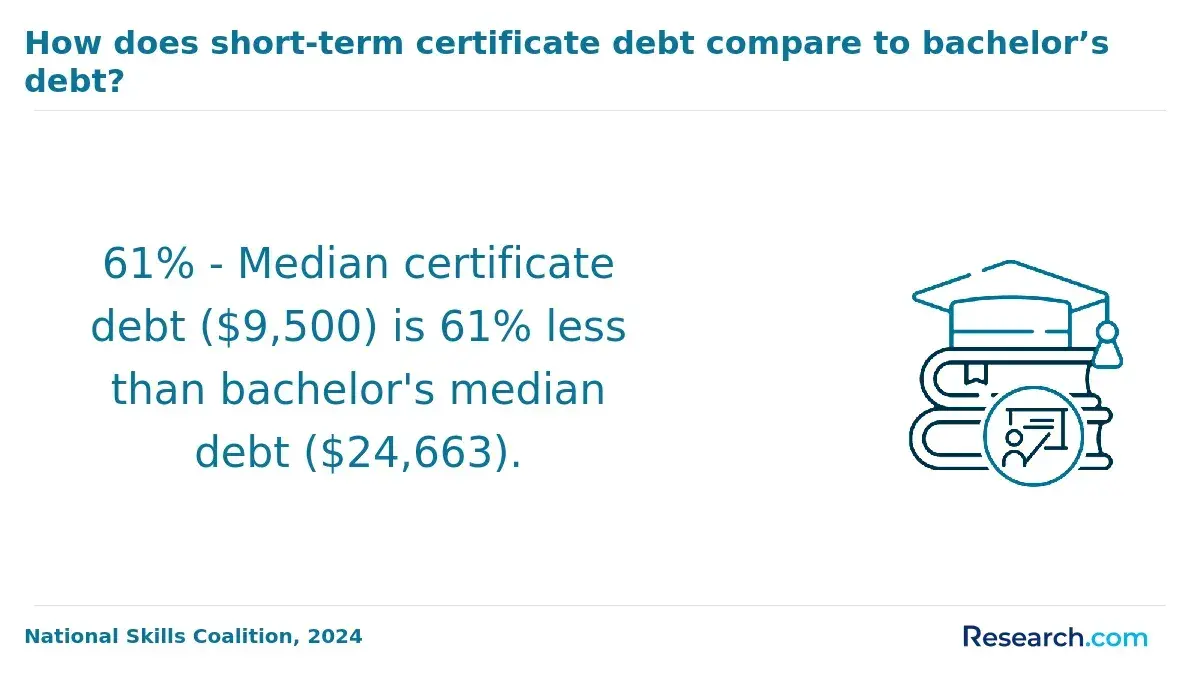
The National Center for Education Statistics reported that average published tuition and fees at public two-year institutions were $4,050 for the 2024-25 academic year. That is a national sticker-price benchmark, not a program total: high-cost equipment, repeat-course policies, and living expenses can materially change affordability.
Military-connected learners should compare institutional support, credit for prior learning, and schedule policies through options such as an online college for military. Ask each school for a written estimate covering every required charge, not tuition alone.
What Certifications or Licenses Do These Programs Require?
Requirements fall into three different categories. A school certificate or diploma confirms completion of an educational program. A professional certification is awarded by a certifying organization after meeting its rules, which may include an exam, education, or work experience. A license is government permission to practice a regulated occupation and is controlled by state law.
Examples include industry certifications for HVAC technicians, automotive technicians, pharmacy technicians, medical assistants, and information-technology workers. Healthcare roles such as practical nurse, registered nurse, radiologic technologist, and dental hygienist may require state licensure after graduating from an approved program and passing required examinations.
Verify four points before enrolling: whether the program meets eligibility rules for the exam or license, whether required supervised hours are included, whether approval applies in your state, and whether exam fees are included. Never rely on a school's broad claim that a program is "certification ready" without checking the named credential and licensing board.
What Courses and Skills Do Career Training Programs Teach?
Effective career training combines occupation-specific knowledge with practical performance skills and employability habits. Conditional students should pay special attention to foundational courses because these often determine whether they can advance into technical, clinical, or capstone work.
Coursework varies by field, but strong programs generally develop the following skill groups:
- Technical knowledge, such as electrical theory, anatomy, legal procedures, drafting, coding, or design software.
- Hands-on performance through labs, simulations, shop projects, clinical practice, or portfolio assignments.
- Safety, ethics, documentation, privacy, and regulatory awareness relevant to the occupation.
- Communication, teamwork, scheduling, customer service, and problem-solving skills employers use across roles.
- Job-search evidence, including resumes, mock interviews, portfolios, project records, or credential-exam preparation.
Ask to see a current course sequence and list of required tools or software. Programs that teach outdated platforms, offer little supervised practice, or cannot explain how skills are assessed deserve closer scrutiny.
What Jobs Can You Get After Career Training?
Career training can support entry-level work, advancement in a current field, or preparation for a later degree. It is not a universal substitute for an apprenticeship, bachelor's degree, license, or employer-specific experience requirement. Match the credential to the actual job posting, not just a broad occupational title.
| Training area | Possible entry-level roles | Career-outcome caution |
| Skilled trades | Helper, installer trainee, maintenance technician, shop technician | Some trades require apprenticeship progression or state licensing. |
| Healthcare | Medical assistant, phlebotomy technician, dental assistant, patient-support roles | Role eligibility can depend on state rules, certification, and clinical training. |
| Criminal justice / law | Security officer, corrections support, records clerk, legal assistant | Public-safety employers may apply background and fitness standards. |
| Arts and design | Junior designer, production artist, content assistant, freelance creative support | A portfolio, client work, and software proficiency strongly affect opportunities. |
The BLS reported a 2024 median annual wage of $62,610 for all occupations, a useful benchmark rather than an outcome promise for any program graduate. Explore education levels associated with the highest paying jobs before assuming that the shortest credential produces the strongest long-term earnings path.
How Do You Choose an Accredited Career Training Program?
Accreditation matters most when it affects federal aid, transfer credit, employer confidence, professional certification eligibility, or licensure. Institutional accreditation evaluates the school; programmatic accreditation evaluates a particular program. Neither label alone proves that a program is affordable, high quality, or right for a specific job.
Use this process to compare programs before paying an enrollment deposit:
- Identify the exact job, state, and employer type you are targeting.
- Check job postings and the relevant state licensing board for required education, exams, experience, and background standards.
- Confirm the school's institutional accreditation and, where relevant, the program's specialized approval directly with the accreditor or licensing authority.
- Request the full cost of attendance, completion timeline, course schedule, refund policy, and required materials in writing.
- Ask whether the credential is credit-bearing, transferable, stackable into a degree, or strictly noncredit.
- Compare retention, completion, licensure-exam eligibility, and job-placement disclosures carefully, including how each school defines placement.
Red flags include pressure to sign immediately, vague statements about licensing, missing lab or clinical details, unitemized fees, and claims of guaranteed employment. A conditionally admitted student should also verify whether support services are included and whether the condition can delay access to core courses.
Other Things You Should Know About
Often, yes. Many trade programs can conditionally admit students who need placement support, foundational math, or documentation. However, access to advanced labs, apprenticeships, and specialty coursework may depend on completing those conditions.
No. It usually means you are accepted provisionally. You must satisfy stated requirements by a deadline to continue normally or enter the specific career cohort.
It can. Aid eligibility depends on the institution, program eligibility, enrollment status, satisfactory academic progress, and federal or state rules. Confirm aid implications with the financial-aid office before enrolling.
No. A certificate is awarded by a school for completing training. A professional certification is issued by an independent certifying organization or industry body and may require an examination or other eligibility standards.
References
- Your Pathway Success Roadmap: 5 Steps to Strengthen College & Career Readiness This Year https://edsystemsniu.org/your-pathway-success-roadmap/
- Building a Strong Middle Class Through Career Pathways Programs - Center for American Progress https://www.americanprogress.org/article/building-strong-middle-class-career-pathways-programs/
- Why Employment Outcome Rates Matter | ACI Learning https://www.acitechacademy.com/blog/why-employment-outcome-rates-matter-a-guide-for-students-and-employers/
- Career-Connected Learning in NC SC | Leon Levine Foundation https://www.leonlevinefoundation.org/career-connected-learning/
- Short-term programs bring lasting benefits - when student centered https://www.luminafoundation.org/focus-magazine/spring-2023/short-term-programs-bring-long-lasting-benefits-when-designed-with-students-in-mind/
- Vocational programs and alternative pathways - Institute for Collaborative Education http://www.iceschoolnyc.org/vocational-programs-and-alternative-pathways
- What Does a Conditional Acceptance Letter for College Mean? https://www.quadeducationgroup.com/blog/conditional-acceptance
- Navigating Conditional Admission When the Required Score Isn't Met - oneiroeducation.com https://oneiroeducation.com/navigating-conditional-admission-when-the-required-score-isnt-met/
- Understanding Conditional Admission: A Comprehensive Legal Overview https://legal-resources.uslegalforms.com/c/conditional-admission
- 6 Ways Districts Can Build & Expand High-Impact CCT Programs https://www.elevatek12.com/blog/student-success/impactful-cct-programs/