2027 Choosing a Data Science Master's When Your Employer Is Adopting AI

Co-Founder and Chief Data Scientist
Your employer's move toward AI may create an opportunity to work on data products, but it does not automatically make a data science master's the right next step. If you are considering graduate study while working, the key is to identify the role you want, the skills that role requires, and whether a program gives you a credible way to practice them. This guide helps you decide whether to enroll, what to look for, and when a smaller educational investment may serve you better.
Key Things You Should Know
- Choose a master's for a defined role and skill gap - not simply because your employer has announced an AI initiative. Ask which teams will build models, prepare data, evaluate outputs, and govern their use.
- Look for substantial work in statistics, programming, machine learning, and real projects. AI-branded course titles alone do not establish that depth.
- The U.S. Bureau of Labor Statistics projects 35% growth in data scientist employment from 2025 to 2035. That signals demand for the occupation, not a guaranteed opening or promotion at your employer.
What Is a Data Science Master's Degree's Value During AI Adoption?
A data science master's is most valuable when your employer needs people who can turn an AI proposal into a tested, maintainable solution. That work can involve defining a measurable problem, judging whether the available data is fit for use, comparing a model with a simpler baseline, and explaining failure risks to decision-makers.
Find out what "adopting AI" means at your workplace. An organization buying a writing assistant may need training and governance more urgently than new model developers. One building forecasting, recommendation, or internal retrieval systems may offer more opportunities for statistical modeling and data engineering. If those opportunities exist, favor programs with employer-compatible projects and instruction in evaluating models after deployment. Confirm that your employer would allow you to work with relevant data; access should never be assumed.
Do You Need a Data Science Master's Degree for AI-Related Careers?
Not necessarily. If your near-term goal is to use approved AI tools effectively in your existing job, targeted training and a supervised workplace project may be more appropriate. A master's becomes more compelling if you want to move into a technically demanding role and need sustained study, assessed projects, and a graduate credential.
Start with the work you already do. An analyst may bring business context and reporting skills but need stronger statistical inference and software practices. A software engineer may bring deployment experience but need more preparation in experimental design and modeling. Ask your manager or a target team which responsibilities are realistically open to you and what evidence they would accept for a transfer. Employer adoption alone is not evidence that a degree is required.
How Can You Choose an Accredited Data Science Master's Program?
First, verify the institution's recognized accreditation through the accreditor or a U.S. Department of Education resource. Then assess the program itself: institutional accreditation does not tell you whether its data science curriculum fits your intended work. Check the current catalog, required courses, project rules, faculty expertise, and the support available to working students.
A useful shortlist compares programs against the same questions. Ask admissions and program staff for written answers where a policy or opportunity affects your decision:
- Which required courses teach statistical inference, coding, data management, model evaluation, and responsible use of AI - and which subjects are electives?
- Can working students complete a substantial project with appropriately authorized employer data, or is a public-data alternative available?
- What are the actual schedules, residency requirements, project-support arrangements, and maximum completion periods?
- Which graduate outcomes does the school report, for whom, and with what response rate? Treat missing or narrowly reported outcomes as unknown, not as evidence of success.
Do not let a ranking or an AI-focused program name substitute for these checks. A strong fit depends on the work you want to do and the conditions under which you can finish the degree.
What Do Data Science Master's Programs Teach About AI and Machine Learning?
Relevant programs commonly combine mathematical and statistical foundations with programming, data preparation, machine learning, and applied projects, but course depth varies. For an employer adopting AI, pay particular attention to how students test whether a system works for the intended users - not only how they train or call a model.
The distinctions below help you read a catalog without treating every mention of "AI" as equivalent.
| Curriculum evidence | What it may show | What remains to verify |
| AI appears in a course description | Students encounter the topic | Whether they implement or evaluate any system |
| A dedicated machine learning course | More sustained study of modeling | Prerequisites, assignments, and treatment of uncertainty |
| Advanced elective or applied project | Opportunity to investigate a specific method or use case | Whether it is regularly offered and accessible to part-time students |
| Capstone with evaluation and documentation | Potential evidence of end-to-end practice | Data access, faculty supervision, and permitted project topics |
Ask for recent syllabi or project descriptions. For example, a credible internal AI-assistant project would assess answer quality, unsupported outputs, sensitive-data exposure, and whether the system improves on the existing workflow. If your goal is primarily to develop AI systems rather than analyze organizational data, compare the curriculum with university degree options in artificial intelligence before committing to a data science degree.
Should You Choose an Online or Campus-Based Data Science Master's?
Choose the format you can complete consistently alongside your job. Online study may reduce travel and make continued employment easier, but it can still include live sessions, group work, scheduled exams, or intensive deadlines. Campus study may make in-person collaboration easier but impose commuting or relocation costs.
Ask each program when classes meet, how often projects require real-time teamwork, and whether an internship or campus visit is mandatory. If your employer's AI rollout may change your hours, flexibility and leave policies matter more than the word "online." A working student pursuing a move into a data role can also examine data career pathways supported by online data science study while checking whether a particular program's schedule permits the required project work.
What Are the Admission Requirements for a Data Science Master's?
Requirements vary by program. Review the current admissions page for the required degree, transcripts, application materials, and any stated preparation in programming, calculus, linear algebra, or statistics. Do not assume that professional AI-tool experience fulfills a formal prerequisite, or that a degree outside computer science rules you out.
Compare your transcript and work samples with the stated requirements before applying. If you have gaps, ask whether the program accepts prerequisite courses, offers foundation study, or expects you to prepare independently - and whether that preparation counts toward admission. Applicants considering an AI-focused alternative can compare AI master's bridge options, while confirming each school's current eligibility rules directly.
How Long Does a Data Science Master's Take and Cost?
Completion time depends on credit requirements, course availability, prerequisite work, and whether you study full- or part-time. Published tuition is only one part of the decision. Request a current, individualized estimate for the pace and residency status that apply to you.
These cost categories distinguish the school's quoted price from the amount you may actually need to finance.
| Cost category | Why it matters for a working student |
| Tuition and mandatory fees | Rates may depend on enrollment pace, residency, and program policies. |
| Materials and technology | Software, computing, and equipment costs may not be included in tuition. |
| Travel and time away from work | Campus visits or reduced work hours can change the total cost substantially. |
| Financing costs | Borrowing can increase what you ultimately pay. |
Ask your employer whether tuition assistance applies to this degree, when reimbursement occurs, and whether repayment is required if you leave. Compare offers using total expected cost, not tuition alone. If an AI-focused degree also fits your goal, review affordable graduate-level artificial intelligence study, then verify current rates and fees with each school. A potential raise should not be treated as certain repayment of your investment.
What Careers Can You Pursue With a Data Science Master's Degree?
Potential paths include data scientist, machine learning practitioner, analytics specialist, and roles focused on evaluating or governing AI systems. Titles differ across employers. During an AI rollout, the most realistic first move may be an internal project or transfer that builds on your domain knowledge, rather than an immediate change to a senior technical title.
Match the degree to job descriptions from teams you could plausibly join. If those roles center on experimentation and model evaluation, prioritize statistics and applied machine learning. If they center on production systems, look for stronger software and data-engineering experience. The BLS projects about 24,800 data scientist openings per year, on average, from 2025 to 2035; that is a national occupational estimate, not a forecast for your company. Use data career pathways supported by online data science study to explore adjacent paths only if you have not already used it to assess online study.
What Salary Can You Expect After a Data Science Master's?
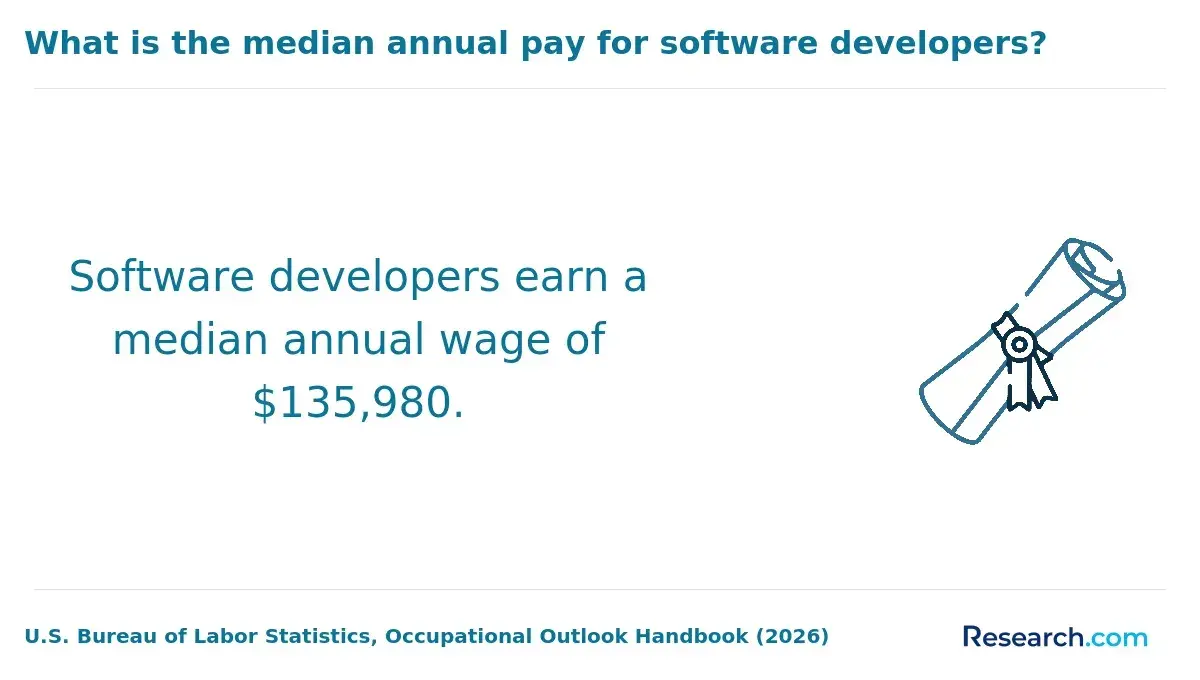
The BLS reports a median annual wage of $120,230 for U.S. data scientists in May 2025. That describes workers in the occupation - not new master's graduates, degree holders specifically, or the raise you can expect. Your pay will depend on your prior experience, role, location, employer, and whether you actually move into a different position.
For a realistic return-on-investment estimate, compare your current compensation with pay for roles you qualify for, then weigh any plausible increase against your full education cost and time commitment. Do not compare your current salary directly with the national occupational median and call the difference a degree benefit. A data science graduate salary guide by industry can help frame further research, but local job postings and an internal compensation conversation will be more relevant to your specific move.
What Certifications and Professional Standards Matter in Data Science?
A certification may help demonstrate familiarity with a tool your employer uses, but it is not a substitute for evaluating data, models, and their effects on people. Before paying for one, check target job descriptions and ask the relevant team whether it values that credential or would prefer a documented project.
Whatever program you choose, look for practice in reproducible analysis, data privacy, security, bias assessment, and clear communication of model limitations. These habits matter especially when an employer moves from experimenting with AI to using it in consequential workflows. If a program emphasizes platform badges but offers little assessed work on evaluation or responsible use, treat that as a curriculum warning sign.
Other Things You Should Know About Data Science
Only with explicit permission from both the employer and the program. Ask about confidentiality, data storage, publication, and who may review the finished work before proposing a topic.
Favor transferable skills such as data preparation, statistical reasoning, evaluation, and documentation. Tool-specific instruction is useful, but a platform change should not erase the value of your coursework.
A conversation can clarify available projects, schedule support, and the skills valued for internal moves. You need not assume that expressing interest creates a promised role.
Use public or appropriately licensed data to demonstrate a comparable problem and method. Explain your decisions and limitations without disclosing proprietary data, prompts, or results.
References
- Partnering with Students to Develop a Capstone for a... - PMC https://pmc.ncbi.nlm.nih.gov/articles/PMC11732519/
- Cost of Attendance (Budget) | 2025-2026 Federal Student Aid Handbook https://fsapartners.ed.gov/knowledge-center/fsa-handbook/2025-2026/vol3/ch2-cost-attendance-budget
- FAQs - Master in Data Science & Analytics https://analytics.georgetown.edu/admissions-tuition/frequently-asked-questions/
- An analysis of the challenges in the adoption of MLOps | sciencedirect.com https://www.sciencedirect.com/science/article/pii/S2444569X24001768
- How AI may reshape career pathways to better jobs | Brookings https://www.brookings.edu/articles/how-ai-may-reshape-career-pathways-to-better-jobs/
- Capstone Project - MS in AI Systems - University of Florida https://msais.eng.ufl.edu/capstone-project/
- MS Data Science & Statistics: FAQ | Binghamton University https://www.binghamton.edu/math/graduate/statistics/faq.html
- From Problem to Solution: Creating Real-World Impact Through the Information & Knowledge Strategy Capstone https://sps.columbia.edu/news/problem-solution-creating-real-world-impact-through-information-knowledge-strategy-capstone
- Business Analytics and AI Masters Program | Stevens Institute of Technology https://www.stevens.edu/program/masters-in-business-analytics-and-artificial-intelligence
- How to Become a Data Scientist | Harvard SEAS https://seas.harvard.edu/news/how-become-data-scientist