2027 Best Bachelor's Completion Programs for Flexible Careers

Co-Founder and Chief Data Scientist
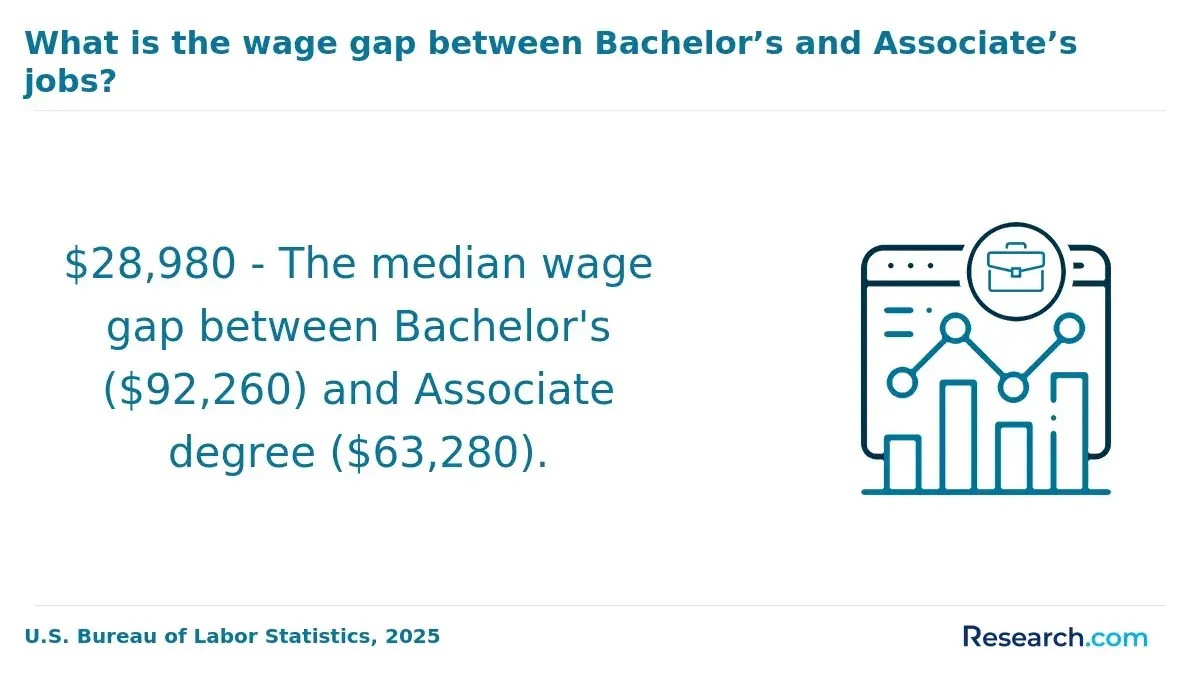
Finishing a bachelor's degree can change both career options and earning power, but the right program depends on your credits, schedule, budget, and target field. BLS 2024 data show workers age 25 and older with a bachelor's degree had median weekly earnings of $1,543, compared with $1,099 for associate degree holders.
This guide is for adults with prior college credit who want a flexible path to completion. You'll learn how programs work, which majors fit in-demand careers, what costs to compare, and how to avoid choosing a program that does not match your goals.
Key Things You Should Know
- Bachelor's completion programs are usually designed for students with about 60 transferable credits, but policies vary widely; the best programs maximize accepted credits, offer adult-friendly schedules, and clearly show remaining degree requirements before enrollment.
- Cost depends more on tuition, transfer credit acceptance, fees, and time to finish than on delivery format alone; College Board 2024-25 data list average published tuition and fees at $11,610 for in-state public four-year colleges and $43,350 for private nonprofit four-year colleges.
- Career fit matters: BLS May 2024 wage data show strong bachelor's-level opportunities in fields such as software development, information security, nursing, business, healthcare management, education, and engineering, but salaries vary by location, experience, licensure, and employer.
Top 10 Best Bachelor's Completion Programs for Flexible Careers
Business Degrees
A business bachelor's completion program is a versatile option for adults who want management, operations, marketing, accounting, finance, or human resources roles. It fits students who have broad transfer credits because many programs accept general education and elective coursework. Choose a concentration if you already know your target role: accounting for CPA-track preparation, analytics for data-heavy work, or management for supervisory advancement. BLS May 2024 data list accountants and auditors at a median annual wage of $81,680, but accounting pathways may require additional credits or licensure depending on the state.
Healthcare Degrees
Healthcare bachelor's completion degrees often focus on healthcare administration, health sciences, public health, or allied health leadership. They work well for medical assistants, technicians, military medics, and associate-degree healthcare workers who want nonclinical advancement. Look for programs that recognize professional credentials, clinical experience, or associate-level health coursework. Healthcare administration can lead toward supervisory, compliance, quality improvement, or operations roles. BLS May 2024 data place medical and health services managers at a median annual wage of $117,960, making this a strong option for students who prefer systems, staffing, budgeting, and policy over direct patient care.
Information Technology Degrees
Information technology completion programs emphasize applied systems, networking, cloud platforms, databases, user support, and enterprise technology operations. They are a practical fit for working adults with help desk, military IT, vendor certifications, or associate-level technical credits. Compared with computer science, IT is often less theory-heavy and more infrastructure-focused. Students should check whether the program includes hands-on labs, cloud tools, cybersecurity basics, and industry-aligned electives. The best flexible IT programs also let students demonstrate skills through projects, portfolios, or prior learning assessment instead of repeating material they already use at work.
Computer Science Degrees
Computer science bachelor's completion degrees are best for students who want software development, systems design, data structures, algorithms, artificial intelligence, or graduate study options. They can be demanding if prior credits do not include calculus, discrete math, or programming fundamentals. Students with unrelated associate degrees should ask for a detailed prerequisite review before committing. BLS May 2024 data list software developers at a median annual wage of $133,080, but employers usually expect evidence of coding ability, version control experience, technical interviews, and completed projects in addition to the degree.
Cybersecurity Degrees
Cybersecurity completion programs prepare students for security operations, risk management, incident response, governance, and network defense roles. They are especially useful for adults with IT support, networking, military, or public-sector experience. Look for courses in secure systems, digital forensics, cloud security, scripting, compliance, and ethical hacking. BLS May 2024 data list information security analysts at a median annual wage of $124,910, reflecting strong demand for security skills. However, entry-level cybersecurity roles can be competitive, so students should combine the degree with labs, internships, certifications, or practical IT experience.
Psychology Degrees
A psychology completion degree is a flexible liberal arts path for students interested in human behavior, research, social services, human resources, case management, sales, or graduate study. It is not usually enough by itself for licensed counseling, therapy, or clinical psychology roles, which typically require graduate education and state licensure. Choose this path if you want broad people-focused skills and may pursue a master's later. Strong programs include statistics, research methods, abnormal psychology, lifespan development, ethics, and applied projects that help translate the degree into workplace-ready communication and analysis skills.
Nursing Degrees
Nursing completion programs most often mean RN-to-BSN pathways for licensed registered nurses who already hold an associate degree or diploma in nursing. These programs are designed for working nurses and usually emphasize leadership, evidence-based practice, community health, care coordination, informatics, and quality improvement. BLS May 2024 data list registered nurses at a median annual wage of $93,600. Students should confirm state authorization, clinical or practicum expectations, employer tuition benefits, and whether the school holds nursing accreditation recognized by employers or graduate nursing programs.
Education Degrees
Education completion programs can support careers in elementary education, special education, early childhood education, instructional design, workforce training, or non-licensure education roles. Licensure-track programs require careful review because student teaching, background checks, exams, and state approval vary. BLS May 2024 data list elementary school teachers, except special education, at a median annual wage of $62,340. If you plan to teach in public schools, choose a program approved for your state. If you want corporate training or education support roles, a non-licensure track may offer more scheduling flexibility.
Criminal Justice Degrees
A criminal justice completion degree can fit adults working in law enforcement, corrections, security, probation support, military service, emergency management, or public administration. It may help with promotion requirements, federal job eligibility, or transition into policy, investigations, or administrative roles. Coursework often covers courts, policing, criminology, ethics, research, homeland security, and constitutional issues. Students should not assume the degree replaces academy training, civil service exams, security clearances, or agency-specific requirements. The strongest programs connect theory to report writing, data analysis, leadership, and community-focused decision-making.
Engineering Degrees
Engineering completion programs are more specialized than many adult-degree pathways because prerequisites, labs, math sequences, and accreditation matter. Options may include engineering technology, industrial engineering, electrical engineering, or applied engineering management. Engineering technology can be more transfer-friendly for students with technical associate degrees, while traditional engineering may require ABET-accredited coursework for certain licensure or employer expectations. BLS May 2024 data list industrial engineers at a median annual wage of $101,140. Before enrolling, confirm lab format, transferability of technical credits, and whether the degree supports your intended engineering role.
What is a bachelor's completion program and who is it best suited for?
A bachelor's completion program is an undergraduate pathway built for students who have already earned college credits but have not finished a bachelor's degree. Instead of starting from zero, you transfer prior coursework, complete upper-division major requirements, and meet the institution's graduation standards.
These programs are best suited for adults who left college with credits, associate degree graduates, military learners, career changers, parents, and workers seeking promotion into roles where a bachelor's degree is preferred or required. They are usually less ideal for students with very few transferable credits, students who need a highly sequenced lab-heavy major, or learners pursuing licensure without confirming state-specific requirements first.
The most important distinction is that "completion" does not mean "easy" or "automatic." A good program shortens the path by honoring previous learning, but you still need to complete the required major, residency credits, and general education gaps.
How do online bachelor's completion programs compare to on-campus options for flexibility?
Online bachelor's completion programs are usually more flexible than campus programs because they reduce commuting, offer asynchronous coursework, and allow students to study around work or caregiving. On-campus programs may be better for students who need in-person labs, direct faculty access, structured routines, or local employer pipelines.
The table below compares the practical differences that matter most for working adults. Use it to decide whether flexibility, structure, hands-on access, or local networking should carry the most weight in your decision.
| Format | Best fit | Main advantage | Trade-off to check |
| Fully online asynchronous | Working adults with unpredictable schedules | Maximum schedule control | Requires strong self-management and reliable technology |
| Online synchronous | Students who want remote access with live interaction | More structure and real-time discussion | Class meeting times may conflict with work shifts |
| Hybrid | Students near campus who need some in-person support | Balances flexibility with face-to-face learning | Travel and campus scheduling may still be required |
| On-campus evening or weekend | Students who learn better in person | Direct access to facilities, peers, and faculty | Less flexible for caregivers, shift workers, or commuters |
Online is not automatically better; it is better when the delivery format matches how you study and when the program provides accessible advising, tutoring, library support, career services, and technical help. Campus-based options can be worth the added time if your field depends on labs, local placements, or cohort-based networking.
What accreditation and institutional quality standards should bachelor's completion programs meet?
Accreditation is the first quality filter for any bachelor's completion program. In the United States, institutional accreditation affects federal financial aid eligibility, credit transfer, employer recognition, and admission to many graduate programs.
The table below summarizes the quality standards to verify before applying. These items help protect you from enrolling in a program that is flexible on paper but weak in recognition, support, or outcomes.
| Quality standard | What to verify | Why it matters |
| Institutional accreditation | The college is accredited by an agency recognized for U.S. higher education quality review | Supports financial aid, transferability, and broad employer acceptance |
| Programmatic accreditation | Required or preferred accreditation exists for fields such as nursing, education, business, engineering, or cybersecurity | May affect licensure, certification eligibility, graduate admission, or employer preference |
| State authorization | The school is authorized to enroll online students in your state | Protects distance learners and may affect complaint processes or clinical placement eligibility |
| Licensure alignment | The curriculum meets requirements in the state where you plan to work | Essential for teaching, nursing, counseling-related paths, and some technical fields |
| Transparent outcomes | The school shares retention, graduation, transfer, and career support information | Helps you judge whether adult students are actually supported through completion |
Common red flags include pressure to enroll immediately, unclear accreditation language, vague transfer-credit estimates, hidden course fees, and promises about guaranteed jobs or salaries. A reputable program should be willing to provide a written degree plan after reviewing your transcripts.
What admission requirements and prior credits do you need for a bachelor's completion program?
Admission requirements vary, but most bachelor's completion programs expect prior college coursework, official transcripts, a minimum GPA, and proof that you meet prerequisite or general education requirements. Some programs require an associate degree, while others admit students with a certain number of transferable credits.
Before applying, ask the school to evaluate every transcript, military record, exam score, professional certification, and prior learning option. Students still building lower-division credits may want to compare community college pathways first; this is where resources on what is the easiest associate degree to get can help clarify which associate-level routes may be more manageable before transferring.
Use this sequence before you commit to a program:
- Request an unofficial transfer evaluation before submitting a deposit.
- Ask which credits apply to the major, not just which credits transfer as electives.
- Confirm the school's residency requirement, which is the minimum number of credits you must complete there.
- Check whether old credits expire for technical, science, nursing, or business-core courses.
- Compare your remaining courses against your work schedule, financial aid limits, and target graduation date.
The biggest mistake is assuming that "90 credits accepted" means you are three-quarters finished. If many credits transfer only as electives, you may still need several semesters of major or prerequisite coursework.
How long do bachelor's completion programs take and what do they typically cost?
Completion time depends on how many credits transfer, how many courses you take per term, whether the program uses accelerated sessions, and whether required courses are offered year-round. A student entering with an associate degree may need roughly 60 additional credits, but the real timeline depends on how those credits apply to the chosen major.
Cost should be evaluated as total degree cost, not just tuition per credit. College Board 2024-25 data show average published tuition and fees of $11,610 for in-state public four-year institutions and $43,350 for private nonprofit four-year institutions, but adult learners may pay more or less depending on online pricing, transfer credits, employer assistance, and fees.
When estimating affordability, include the cost categories below because they can change the final bill:
- Tuition per credit and the number of credits still required after transfer evaluation
- Online, technology, lab, clinical, proctoring, graduation, and student services fees
- Books, software, equipment, background checks, uniforms, or exam preparation materials
- Lost income if you reduce work hours to complete courses faster
- Employer tuition assistance, military benefits, grants, scholarships, and federal aid eligibility
Some adults search for very short pathways, including one year degree programs for seniors, but bachelor's completion timelines should be judged carefully. A one-year finish may be realistic only when many credits transfer cleanly, the student can take a heavy course load, and the major has few sequential requirements.
What majors and career-focused tracks work best for flexible, in-demand bachelor's completion paths?
The best major for a flexible bachelor's completion path is the one that connects your existing credits to a realistic career target. The strongest choices tend to be transfer-friendly, available online, and aligned with industries that value bachelor's-level skills.
Use the comparison below to narrow your options by career goal rather than by major name alone. This helps you avoid choosing a program that sounds broad but does not build the skills employers expect.
| Career goal | Strong completion major | Why it works | What to verify |
| Move into management | Business administration, organizational leadership, healthcare administration | Builds budgeting, supervision, operations, and communication skills | Whether the curriculum includes analytics, leadership projects, or industry-specific electives |
| Enter or advance in technology | Information technology, computer science, cybersecurity | Supports technical roles with portfolio-friendly coursework | Whether labs, coding projects, cloud tools, or security simulations are included |
| Advance in patient care or health operations | RN-to-BSN, health sciences, public health | Recognizes healthcare experience and supports leadership pathways | Whether clinical, practicum, or accreditation requirements match your state and employer |
| Work in people-focused services | Psychology, human services, criminal justice, education | Develops communication, ethics, research, and case-based reasoning | Whether the degree leads to licensure, graduate study, or non-licensed roles |
If you need a faster skills boost before or during degree completion, best online certificate programs can be useful for targeted credentials in areas such as technology, project management, analytics, or healthcare administration. A certificate is not a substitute for a bachelor's degree when the job requires one, but it can strengthen your resume while you finish.
What curriculum, coursework, and learning formats can you expect in bachelor's completion programs?
Bachelor's completion curricula usually combine remaining general education requirements, upper-division major courses, electives, and a capstone or applied project. The learning format may include eight-week terms, competency-based modules, cohort models, evening courses, self-paced work, or traditional semesters.
Most adult-focused programs are built around applied learning. Instead of only taking exams, students may complete case studies, presentations, data projects, simulations, clinical reflections, lesson plans, business plans, lab reports, or portfolios tied to workplace problems.
Before enrolling, review the curriculum for the following features because they affect both workload and career value:
- Clear upper-division course sequence showing when each required class is offered
- Major projects that can become portfolio samples or promotion evidence
- Accessible faculty feedback, tutoring, writing support, and library services for online students
- Reasonable weekly workload expectations for accelerated courses
- Internship, practicum, clinical, or fieldwork rules if your major requires supervised experience
AI and automation are also changing coursework. Strong programs increasingly teach students how to use digital tools ethically, verify outputs, protect data, and apply human judgment in decision-making rather than relying on software alone.
What careers, salaries, and advancement opportunities can a bachelor's completion degree lead to?
A bachelor's completion degree can support entry into bachelor's-preferred roles, promotion into supervisory positions, career changes, graduate school preparation, or licensure pathways when the program is properly aligned. Outcomes depend on the field, local labor market, experience, certifications, and whether the degree meets employer or state requirements.
The table below uses BLS May 2024 median annual wage data for selected U.S. occupations connected to common completion majors. Treat these as labor-market reference points, not salary promises for new graduates.
| Degree area | Related role | Median annual wage | What affects advancement |
| Business | Accountant or auditor | $81,680 | Accounting credits, CPA eligibility, industry experience, analytics skills |
| Healthcare | Medical and health services manager | $117,960 | Clinical or administrative experience, compliance knowledge, leadership record |
| Computer science | Software developer | $133,080 | Portfolio, coding interviews, internships, project depth, technical stack |
| Cybersecurity | Information security analyst | $124,910 | IT experience, labs, certifications, incident response practice, clearance needs |
| Nursing | Registered nurse | $93,600 | Licensure, specialty experience, BSN preference, shift, region, employer type |
| Education | Elementary school teacher | $62,340 | State licensure, district salary schedule, endorsements, graduate credits |
The degree is most valuable when it removes a specific barrier: a promotion requirement, a bachelor's-only job posting, graduate admission, licensure eligibility, or a career transition into a field where your previous experience still counts. It is less compelling when the program is expensive, the major does not connect to your target role, or a shorter credential would meet your immediate goal.
How can working adults choose the right bachelor's completion program for their goals?
Working adults should choose a bachelor's completion program by starting with the career outcome, then working backward to accreditation, transfer credits, schedule, cost, and support. Rankings can be helpful, but they should not replace a personalized degree audit and ROI check.
Follow these steps before enrolling:
- Define the job title, promotion, license, graduate program, or career change you want the degree to support.
- Confirm that the major and concentration match that goal, not just your existing credits.
- Request a written transfer evaluation from at least two schools.
- Calculate total remaining cost using required credits, fees, books, and likely time to finish.
- Ask how online students access advising, tutoring, career services, disability support, and faculty.
- Check whether courses are asynchronous, synchronous, hybrid, accelerated, or competency-based.
- Review graduation requirements, course rotation, capstone rules, and any fieldwork obligations.
- Speak with your employer about tuition assistance, promotion criteria, preferred schools, or required accreditation.
Adults balancing school with caregiving should also compare programs designed for parents and returning learners. Guides to degrees for moms can help identify features such as asynchronous classes, part-time pacing, transfer-friendly policies, and student support that matter when family responsibilities affect study time.
Avoid three common mistakes: choosing the cheapest program without checking transfer fit, choosing the fastest program without checking workload, and choosing the most familiar school without confirming that it supports your intended career. The best program is the one you can finish, afford, and use.
Other Things You Should Know About
Yes, the final credential is typically a bachelor's degree from the institution, not a separate "completion" degree. The difference is the pathway: completion programs are designed for students who already have college credits and need an efficient route to finish remaining requirements.
Many programs are built for students with about 60 transferable credits or an associate degree, but some accept fewer and others allow up to 90 transfer credits. Always request a written transfer evaluation because accepted credits may not all apply to your major.
They can be, especially when the school is properly accredited and the degree matches the role. Employers usually care more about accreditation, relevant skills, experience, licensure, and portfolio evidence than whether courses were completed online or on campus.
The fastest route is to choose a program that accepts the most applicable credits, offers required courses year-round, and matches your existing coursework. Accelerated terms can help, but taking too many courses while working can increase the risk of stopping out.
References
- Do your graduate and online programs offerings match what students actually want? | EAB https://eab.com/resources/blog/adult-education-blog/do-your-graduate-and-online-programs-offerings-match-what-students-actually-want/
- Recent Graduate Outcomes by Field of Study https://opportunitydata.org/grad-labor-explorer.html
- The Best Online Degrees for Working Adults [Complete Guide] https://beal.edu/best-online-degrees-for-working-adults/
- Study in the UK: Admission Requirements for UG and PG Courses https://www.scottiaeducation.com/study-in-the-uk-admission-requirements-for-ug-and-pg-courses/
- In-Person Learning vs. Online Learning: Which Is Right for You? | ACE Blog https://ace.edu/blog/examining-in-person-instruction-from-a-virtual-mindset-what-can-we-improve/
- How does a college degree improve graduates’ employment and earnings potential? - APLU https://www.aplu.org/our-work/4-policy-and-advocacy/publicuvalues/employment-earnings/
- Top 19 Bachelor Degree Programs for Working Adults | NEIT https://www.neit.edu/blog/degrees-for-working-adults
- Course Delivery Formats 101: Synchronous, Asynchronous, and Blended/Hybrid Learning Explained https://www.iacet.org/events/iacet-blog/blog-articles/course-delivery-formats-101-synchronous-asynchronous-and-blended-hybrid-learning-explained/
- Admission Requirements | Undergraduate Admissions + Programs https://www.ualberta.ca/en/admissions/how-to-apply/admission-requirements/index.html
- Tuition Reimbursement Programs [A Guide for HR and Employers] https://compt.io/blog/employee-tuition-reimbursement/