2027 Alternative Certification vs. Accredited Education Degree: Cost and Portability

Co-Founder and Chief Data Scientist
Choosing between alternative teacher certification and an accredited education degree can determine how quickly you enter a classroom, what you pay, and how easily you can move states later. Public-school teachers earned median annual wages from $62,340 for elementary teachers to $64,580 for high school teachers in May 2024.
This guide helps career changers, college students, and aspiring educators compare licensure eligibility, costs, portability, training quality, and long-term advancement before enrolling.
Key Things You Should Know
- Alternative certification is usually faster and may let candidates earn a salary while completing requirements, but it is typically designed for one state and may have narrower interstate portability.
- An accredited education degree generally costs more and takes longer, yet it usually provides broader pedagogical preparation, supervised student teaching, and a clearer route to initial licensure.
- Median May 2024 pay was $62,340 for kindergarten and elementary school teachers and $64,580 for high school teachers. Salary depends far more on state, district, degree level, and contract scale than on the initial pathway alone.
What is the difference between alternative teacher certification and an accredited education degree?
Alternative teacher certification, often called alt cert, is a state-approved route for people who already hold a bachelor's degree outside education and want to become licensed teachers. Candidates commonly complete targeted coursework, pass required exams, teach under a provisional or intern credential, and receive mentoring while working.
An accredited education degree is an associate, bachelor's, master's, or post-baccalaureate program that prepares students in teaching methods, subject knowledge, child development, assessment, special education, and classroom practice. For a traditional undergraduate route, the degree normally includes a state-approved educator-preparation program and culminates in student teaching before initial licensure.
The most important distinction is not simply "certificate versus degree." It is whether the program is approved by the licensing state for the grade level and subject you want to teach. Institutional accreditation, programmatic accreditation, state approval, and licensure eligibility are related but separate concepts.
| Decision factor | Alternative certification | Accredited education degree |
| Typical applicant | Career changer or bachelor's degree holder | First-time college student or educator seeking advanced preparation |
| Primary purpose | Accelerate entry into a state's teacher workforce | Build broad educator preparation and meet degree requirements |
| Classroom entry | May occur while completing the program | Usually follows coursework and supervised student teaching |
| Credential outcome | State certification or eligibility for a license | Academic degree plus potential eligibility for a license |
| Portability | Depends heavily on state rules and completed requirements | Often easier to document, but still subject to each state's rules |
Choose alt cert if you already have a bachelor's degree, can meet your state's subject and testing requirements, and need a faster transition. Choose an education degree if you need an undergraduate degree, want extensive guided practice before taking responsibility for a class, or expect to seek licensure in multiple states.
Which path better meets state teacher licensure requirements: alt cert or education degree?
Neither route automatically qualifies someone to teach everywhere. Public-school teaching is regulated by states, and licensing agencies set their own rules for approved preparation, coursework, clinical experience, background checks, examinations, subject-area preparation, and renewal. A program can be academically reputable but still fail to meet the requirements of the state where you intend to work.
A traditional education degree is often the more straightforward option for initial licensure because the degree program is commonly built around one state's approved standards. However, an alt-cert route can meet the same eventual license standard when it is formally state approved and includes all required assessments, mentoring, and clinical or teaching experience.
Before applying, verify these points directly with the relevant state licensing agency and the program's licensure office:
- Confirm that the program is approved for your intended state, subject, and grade band.
- Ask whether completion leads to an initial, provisional, intern, or full standard license.
- Identify required content, pedagogy, and performance assessments before calculating your timeline.
- Check whether a school district must hire or sponsor you before you can begin the program.
- Determine what is required to convert an initial credential into a renewable professional license.
A common mistake is assuming that institutional accreditation alone creates teacher licensure eligibility. Avoid this by getting a written confirmation of the program's state-approval status and by comparing its published curriculum with the licensing rules for your target state.
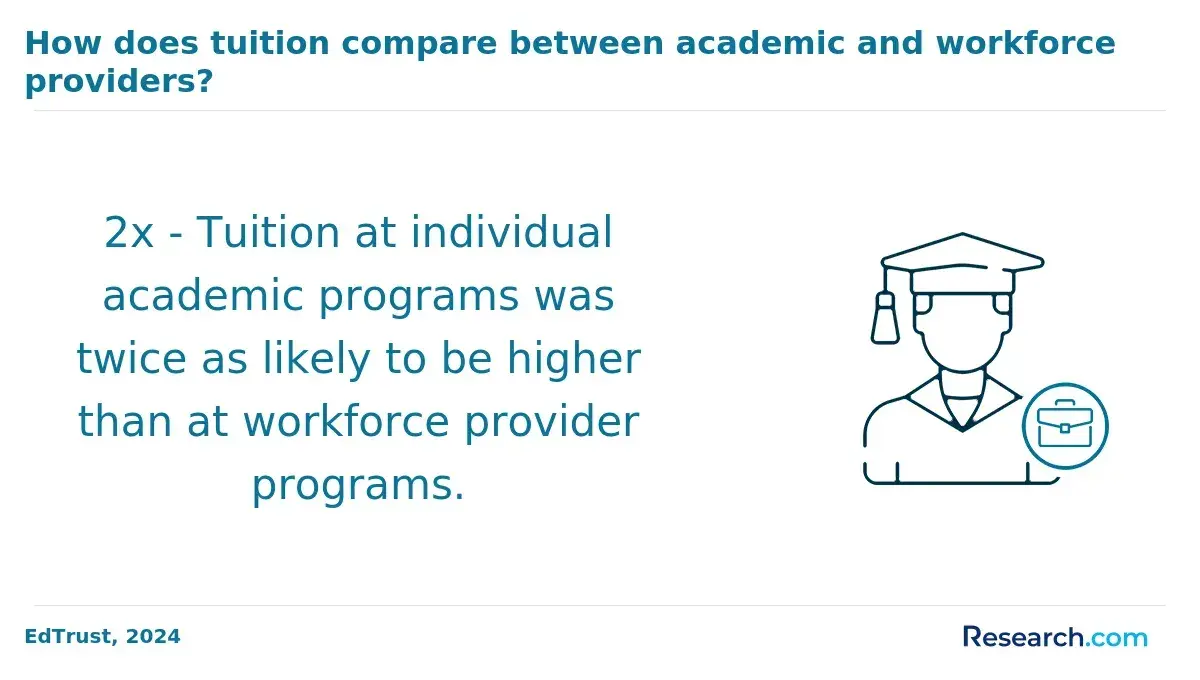
How do costs compare between alternative teacher certification programs and education degrees?
Alternative certification often has the lower upfront price because it focuses on professional preparation rather than a full undergraduate degree. Its true cost, however, can include application fees, fingerprinting, examinations, coursework, background checks, certification fees, unpaid training time, and possible salary reductions under an intern or provisional credential.
An education degree has a higher total tuition commitment because it includes general education and major coursework. For context, average published tuition and fees for full-time undergraduate students at public four-year institutions were $11,610 in the 2022-23 academic year, according to federal education data. That figure is not a final price: grants, residency, housing, transfer credit, and institution type can materially change what a student pays.
| Cost consideration | Alternative certification | Education degree |
| Tuition scope | Usually limited to certification coursework and support services | Includes degree requirements, education major courses, and clinical preparation |
| Ability to earn while training | Often possible after obtaining an eligible teaching placement | Less likely during full-time student teaching |
| Financial aid | Varies by provider and program eligibility | May include federal aid for eligible degree-seeking students |
| Hidden expenses | Tests, licensing, commuting, materials, and unpaid orientation | Tests, licensing, field-placement travel, books, and unpaid student teaching |
| Financial risk | Lower upfront cost can be offset by limited transferability | Higher upfront cost can be offset by transferable credits and degree value |
Compare net cost rather than advertised tuition. Request a written estimate that separates tuition from mandatory fees, testing, licensure, transportation, books, and the cost of any unpaid student-teaching semester. Also ask whether financial aid, employer tuition support, service scholarships, or district residency programs apply to your specific route.
How portable are alternative certifications and education degrees across different U.S. states?
Teacher licenses are not nationally automatic. Many states participate in reciprocity arrangements or review out-of-state credentials, but reciprocity generally means an application pathway rather than a guarantee of an identical license. A receiving state can require additional examinations, state-history coursework, reading instruction, special education training, or proof of recent teaching experience.
An accredited education degree can be easier to evaluate across state lines because transcripts show completed academic and professional coursework, and student-teaching records document clinical practice. Still, the degree itself does not replace a state license. A person with an education degree may need to complete state-specific steps before being hired as a licensed teacher elsewhere.
Alternative credentials can be portable when they lead to a full standard license and include comparable preparation. They are less portable when the candidate holds only an emergency permit, temporary intern license, district-specific authorization, or unfinished program credential.
| Credential status | Likely portability outlook | What to keep |
| Full standard license after alt cert | Potentially transferable, subject to receiving-state review | License history, test scores, transcripts, mentoring and experience records |
| Provisional or intern license | Often limited because it may depend on a sponsoring district or unfinished requirements | Written pathway requirements and completion timeline |
| Education degree with approved preparation | Generally easier to document, but a new license application is still required | Transcripts, student-teaching verification, program-completion recommendation |
| Degree without educator preparation | Usually insufficient by itself for public-school licensure | Course descriptions and plans for additional preparation |
If relocation is likely, favor a program that leads to a full license, has clear clinical-training documentation, and discloses how graduates qualify in other states. Do not choose a route solely because it says "national" or "online"; state approval and final license type matter more than marketing language.
What admission requirements do alternative certification programs and education degrees typically have?
Alternative programs generally require a completed bachelor's degree from an accredited institution. Many also review undergraduate GPA, subject-area credits, writing ability, background clearance, and eligibility to work in a school. Candidates for secondary subjects may need a major or a specified number of credits in the field they plan to teach.
Education bachelor's programs normally require a high school diploma or equivalent, college admission materials, and eventual admission to the educator-preparation major. Requirements commonly become stricter before student teaching, when candidates may need minimum grades in education courses, background clearance, professional dispositions reviews, and passing scores on required exams.
Applicants should distinguish entry admission from teacher-candidate admission. The following comparison clarifies why being accepted by a college does not necessarily mean a student has been admitted to the licensure track.
| Requirement | Alternative certification | Education degree |
| Prior degree | Usually a bachelor's degree is required | Not required for an undergraduate program |
| Subject knowledge | Often evaluated before placement, especially in secondary fields | Built through major and general-education coursework |
| Teaching position | May be required before or soon after enrollment | Usually not required until field placement or student teaching |
| Background clearance | Commonly required before school placement | Commonly required before fieldwork |
| Testing | May be required for admission, licensure, or both | May be required for program progression and licensure |
If academic flexibility is your concern, compare admissions policies carefully rather than assuming education is an easy major. Some students first explore easy degrees to get online, but a teaching license still requires state-specific professional preparation, assessments, and supervised classroom work.
How do online and campus-based options differ for alt cert and education degree programs?
Online delivery can make both pathways more accessible for working adults, rural residents, and career changers. Online coursework may cover learning theory, instructional planning, literacy, assessment, and classroom management asynchronously or in scheduled virtual sessions. It does not eliminate the in-person components required for teaching competence and licensure.
For alt cert candidates, online classes can fit around a paid teaching assignment, but district mentoring, observations, and performance evaluations still occur in schools. For online education degrees, field experiences and student teaching are typically arranged near the student's residence, subject to the program's authorization and the receiving school's willingness to host placements.
| Format factor | Online or hybrid | Campus-based |
| Course scheduling | Often more flexible for employed candidates | May offer more fixed meeting times and local cohort interaction |
| Clinical work | Completed in approved local schools, not fully online | Often coordinated through nearby partner schools |
| Networking | May require deliberate outreach to districts and mentors | Can provide frequent in-person faculty and peer contact |
| Best fit | Working adults with a confirmed local placement plan | Students who value structured support and local field-placement networks |
Ask an online provider whether it is authorized to enroll students in your state, whether it places student teachers or expects you to find a placement, and what happens if a district declines to host you.
For readers weighing broader flexibility beyond teaching, these degrees for remote work can help illustrate how career format and professional licensing can create very different constraints.
What coursework and classroom training are included in each pathway to becoming a teacher?
Both routes should prepare candidates to plan lessons, assess learning, manage classrooms, support diverse learners, work with families, and follow school policies. The depth and sequencing differ. Degree programs generally spread this learning across multiple semesters, while alternative pathways compress essential preparation and integrate it with employment-based practice.
A strong program makes classroom training visible rather than treating it as an afterthought. Before enrolling, ask for the number of observation hours, the length of student teaching or residency, mentor qualifications, evaluation process, and the support available when a classroom problem arises.
| Preparation component | Alternative certification | Education degree |
| Foundations and learning theory | Usually condensed and job-focused | Usually integrated across a broader sequence |
| Methods coursework | Focused on assigned subject and grade level | Includes subject methods plus related education requirements |
| Special populations | May address disability services, multilingual learners, and equity requirements | Often addressed in dedicated and embedded courses |
| Classroom experience | Frequently occurs as teacher of record with mentoring | Usually progresses from observation to supervised student teaching |
| Feedback structure | Mentor, program supervisor, and school administrator may all evaluate | Cooperating teacher and university supervisor commonly evaluate |
Teaching under supervision before becoming the teacher of record can be valuable for candidates who are new to schools. Conversely, a paid residency or intern position can be financially practical for a career changer who already has strong subject expertise and can handle a steep learning curve.
How long does it take to become a licensed teacher through each education pathway?
Time to licensure depends on your starting education, subject area, state rules, testing schedule, and whether you can secure a school placement. A bachelor's degree in education commonly takes about four years of full-time study. An alternative route for someone who already has a bachelor's degree may take roughly one to two years, although the candidate may begin teaching earlier under an intern or provisional credential where state rules permit.
A master's degree in education can be a useful route for degree holders who want deeper preparation or a career change, but it is not always the fastest licensure option. Be cautious when comparing accelerated programs: a short academic term does not remove state-required clinical practice, testing, or application processing.
Readers considering compressed graduate study can review 6 months masters degree online options, then confirm whether any specific program includes the licensure components required in their state.
| Starting point | Common pathway | Typical timing consideration |
| No bachelor's degree | Bachelor's in education with student teaching | Usually a multi-year undergraduate commitment |
| Bachelor's in a teachable subject | State-approved alternative certification | May permit earlier paid classroom entry |
| Bachelor's degree and desire for graduate preparation | Licensure-track master's or post-baccalaureate program | Length varies with prerequisites and clinical placement |
| Out-of-state educator | Reciprocity or additional state requirements | Timing depends on transcript review and required add-ons |
The fastest path is not always the lowest-risk path. Count time for prerequisites, exam retakes, background checks, placement matching, and license processing. If you need an income immediately, prioritize routes that clearly explain when paid employment can begin and what support you receive once it does.
What entry-level teaching roles, salaries, and advancement opportunities follow each pathway?
After meeting state requirements, both pathways can lead to roles such as elementary teacher, middle school teacher, high school teacher, special education teacher, or subject-area teacher.
Assignment eligibility depends on the license endorsement, not merely the name of the program. A candidate prepared for secondary mathematics, for example, may not automatically qualify for elementary general education.
According to the U.S. Bureau of Labor Statistics, the median annual wage for kindergarten and elementary school teachers was $62,340 in May 2024, while high school teachers had a median of $64,580. These national medians are useful benchmarks, not personal salary predictions: public-school pay scales vary by district, years of experience, degree level, union contract, and local cost of living.
| Career stage | Potential roles | What typically supports advancement |
| Initial licensure | Classroom teacher, resident teacher, or teacher of record | Successful evaluations, completed induction, and full licensure |
| Developing teacher | Grade-level lead, department participant, mentor-in-training | Experience, strong instructional practice, and district opportunities |
| Specialized practice | Special education, reading, English learner, instructional technology, or subject specialist | Additional endorsements or graduate coursework where required |
| Leadership | Instructional coach, curriculum specialist, assistant principal, or principal | Advanced degree, leadership credential, and state-specific qualifications |
Labor-market conditions vary sharply by location and endorsement area, so review openings in your intended districts before choosing a specialization. Teachers considering research, college faculty roles, or senior education leadership may later explore PhD programs online, though a doctorate is not required for most K-12 classroom positions.
How can prospective teachers evaluate and choose a reputable alternative or degree program?
The best program is the one that creates a documented, affordable path to the license and job you want in the state where you plan to work. Start with the state licensing agency's requirements, then use each school's materials to verify - not assume - that its curriculum, placement process, and credential outcome match those requirements.
Use the following process to compare programs on total value rather than speed or headline tuition alone:
- Choose your target state, grade band, subject area, and preferred school setting before requesting information.
- Confirm state approval and ask whether the program leads to a full initial license, not only a temporary credential.
- Request a written total-cost estimate that includes tuition, fees, tests, licensing, books, and likely field-placement expenses.
- Ask who secures field placements, how mentoring works, and what support is available if you struggle in the classroom.
- Compare completion requirements, transfer-credit rules, exam expectations, and any obligation to work for a sponsoring district.
- Review published outcomes carefully and ask how the school defines completion, licensure, and employment.
Red flags include vague claims that a program works "in every state," pressure to enroll before reviewing licensure rules, no clear answer about student teaching or mentorship, and promises of guaranteed jobs or salaries.
Another frequent mistake is comparing only tuition. A lower-priced program may cost more overall if it requires unpaid work, does not qualify you for your preferred license, or must be repeated after relocation.
If possible, speak with a current candidate, a recent completer, and a district hiring contact. Their experiences can reveal whether the program's pacing, supervision, and placement relationships are realistic for your financial situation and teaching goals.
Other Things You Should Know About Teaching Programs
Often, yes. Many alternative routes are designed for degree holders in other fields. You may need enough coursework or demonstrated knowledge in the subject you intend to teach, plus required exams, background clearance, and a district placement.
A state-approved alternative route that leads to a standard teaching license can qualify you for many public-school positions. Hiring decisions also depend on your endorsement area, classroom experience, interview, references, and district needs.
No. An education degree can make your preparation easier to document, but every state controls its own license. Moving may require a new application, additional coursework, examinations, or evidence of teaching experience.
You may work in some school roles, such as paraprofessional, substitute, tutor, or after-school staff, depending on local rules. Full-time student teaching is often unpaid and demanding, so many students reduce outside work during that placement.
References
- Traditional vs Alternative Teaching Certification (2021) | Analysis https://www.teachworthy.org/traditional-vs-alternative-teaching-certification/
- Alternative Certification Pricing https://iteach.net/pricing/
- Comparing Alternative Teacher Certification Providers in 2025 https://teach.moreland.edu/alternative-providers
- All About Alternative Teacher Certification - American Board Blog https://www.americanboard.org/blog/all-about-alternative-teacher-certification/
- The Alternative Teacher Certification Sector Outside Higher Education https://www.americanprogress.org/article/the-alternative-teacher-certification-sector-outside-higher-education/