2027 Accredited Online Interdisciplinary Studies Degree Programs That Accept the Most Transfer Credits

Co-Founder and Chief Data Scientist
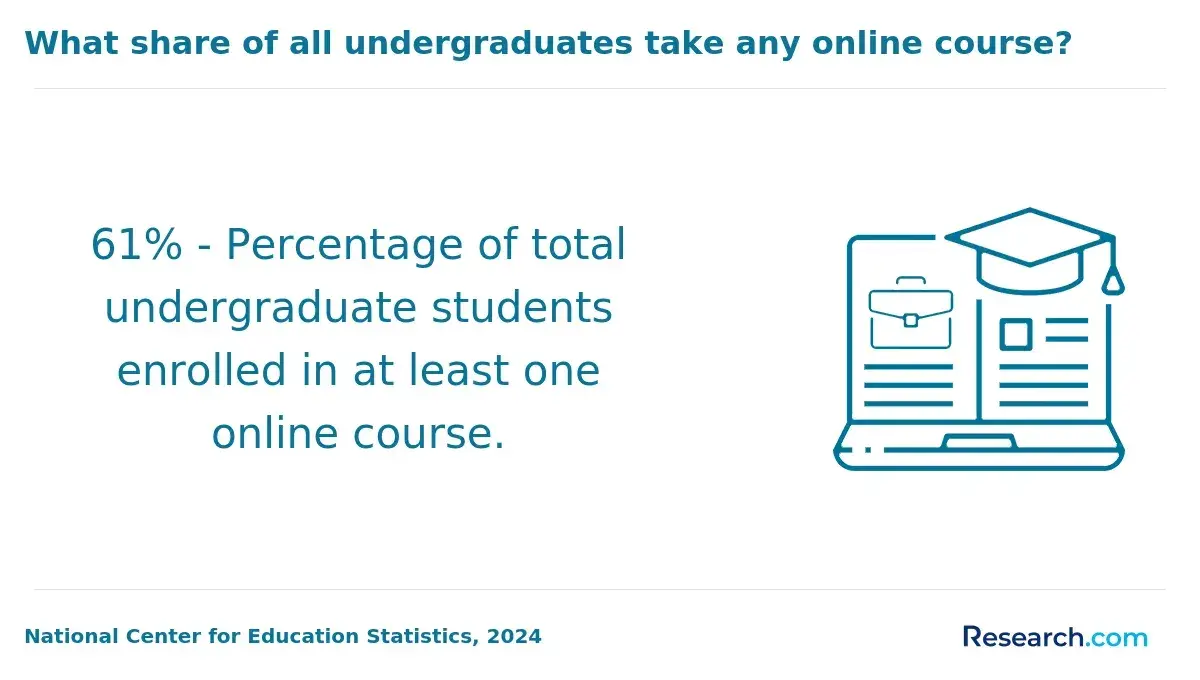
If you have past college credits, the right online interdisciplinary studies degree can turn unfinished coursework into a faster bachelor's completion path. NCES data published in 2024 shows that more than half of U. S. undergraduates took at least one distance education course, making online transfer pathways a mainstream option. This guide is for returning students, associate degree holders, military learners, and adults with mixed credits. You will learn which programs are most transfer-friendly, how credits are evaluated, and how to estimate whether a high-transfer program will actually save you time and money.
Key Things You Should Know
- The most transfer-friendly online interdisciplinary, general studies, liberal studies, and professional studies bachelor's programs may accept up to 90 to 117 transfer credits, but most students still need at least 24 to 30 institutional or residency credits.
- A 120-credit bachelor's degree can be shortened substantially when transfer credits apply to general education, major, concentration, and elective requirements rather than only counting as free electives.
- College Board data published in 2024 lists average published tuition and fees at $11,610 for in-state public four-year students and $43,350 for private nonprofit four-year students, so every accepted credit can meaningfully affect total cost.
Which Accredited Online Interdisciplinary Studies Degree Programs Accept the Most Transfer Credits?
The online programs that accept the most transfer credits are usually degree-completion programs in interdisciplinary studies, liberal studies, general studies, professional studies, multidisciplinary studies, or applied arts and sciences. These degrees are designed for students whose prior credits do not fit neatly into a single traditional major.
The table below compares accredited online bachelor's programs that are commonly considered transfer-friendly for interdisciplinary-style degree completion. Published transfer limits can change, and the real number that matters is the number of credits the school applies to your specific degree plan after an official evaluation.
| School | Online degree pathway | Institutional accreditation | Published or typical maximum transfer-credit potential | Best fit | Important limitation |
| Thomas Edison State University | BA in Liberal Studies | Middle States Commission on Higher Education | Up to about 117 credits, depending on source, level, and degree requirements | Adults with many completed credits from multiple institutions | Students must still satisfy capstone, residency, upper-level, and degree-specific rules |
| Charter Oak State College | BA or BS in General Studies | New England Commission of Higher Education | Up to about 114 credits, depending on the plan of study | Students seeking a highly flexible adult-completion degree | Concentration, cornerstone, capstone, and upper-level requirements can limit usable transfer credits |
| Excelsior University | BS in Liberal Arts | Middle States Commission on Higher Education | Up to about 113 credits, depending on program rules | Learners with college, military, exam, or professional learning credit | Applied transfer credit must meet distribution and major-area expectations |
| Southern New Hampshire University | BA in General Studies | New England Commission of Higher Education | Up to 90 credits | Students wanting structured online terms and broad elective flexibility | At least 30 credits are generally completed through the institution |
| Liberty University | BS in Interdisciplinary Studies | Southern Association of Colleges and Schools Commission on Colleges | Up to 75% of the degree, commonly up to 90 credits for a 120-credit bachelor's | Students combining two or more academic areas into one degree plan | Credits must fit the selected areas of study and university requirements |
| Western Governors University | BS in Multidisciplinary Studies or related flexible pathways | Northwest Commission on Colleges and Universities | Often up to 75% of the program, depending on the degree | Self-paced learners who can demonstrate competency quickly | Transfer is mapped to competency units rather than only course titles |
| University of North Texas | BAAS in Applied Arts and Sciences | Southern Association of Colleges and Schools Commission on Colleges | Often up to 90 credits, subject to degree and residency rules | Students with technical, workforce, military, or applied associate credits | Professional and technical credits may apply differently from academic credits |
| Texas Tech University | BA or BS in University Studies | Southern Association of Colleges and Schools Commission on Colleges | Often up to 90 credits, subject to residency and major rules | Students who want to combine multiple concentrations | Each concentration may have course-level requirements that transfer credits must match |
| Arizona State University Online | BA in Interdisciplinary Studies | Higher Learning Commission | Transfer limits vary; community college and upper-division rules matter | Students who want a large public university online degree with customizable themes | Not all lower-division or community college credits can satisfy upper-division requirements |
| University of Central Florida Online | BA or BS in Interdisciplinary Studies | Southern Association of Colleges and Schools Commission on Colleges | Transfer potential varies by Florida articulation, residency, and degree rules | Florida transfer students and associate degree holders | Students must confirm how credits apply to tracks, minors, and upper-level coursework |
A high maximum transfer-credit limit is useful, but it is not the same as a short path to graduation. A program accepting 90 credits as true degree-applicable credit can be better than one advertising 113 credits but applying many of them only as electives.
How Do Online Interdisciplinary Studies Degree Programs Evaluate Transfer Credits?
Transfer evaluation is the process a school uses to decide whether your prior coursework can count toward its degree. In interdisciplinary studies, this process is especially important because students often bring credits from several majors, institutions, military records, exams, certificates, or unfinished programs.
Most schools begin with official transcripts, then classify each course by accreditation source, grade, subject, level, credit value, and fit within the degree plan. The table below shows the major evaluation factors and why they matter.
| Evaluation factor | What the school checks | Why it affects completion |
| Institutional accreditation | Whether the previous school was regionally or nationally accredited when credits were earned | Credits from recognized institutions are more likely to transfer cleanly |
| Course grade | Whether the course met the minimum grade, often C or higher for many transfer policies | Low grades may be denied or transferred only as elective credit |
| Course equivalency | Whether the course matches a required course, general education category, major area, or elective | Equivalent courses reduce requirements more efficiently than unspecified electives |
| Credit level | Whether credits are lower-division, upper-division, graduate-level, remedial, or vocational | Upper-level requirements often cannot be satisfied by lower-level credits |
| Course age | Whether older coursework is still considered current in fields such as technology, business, or science | Outdated credits may be excluded from major requirements even if they count as electives |
| Documentation | Official transcripts, course descriptions, syllabi, military records, exam scores, or training recommendations | Better documentation can improve the chance of accurate placement |
Students should treat the first transfer estimate as a starting point, not a final answer. The most accurate evaluation usually happens after the school receives all official transcripts and the student declares a degree plan or concentration.
Before applying broadly, gather the documents that transfer evaluators commonly need. This helps prevent delays and reduces the risk of receiving a lower transfer award because of missing information.
- Request official transcripts from every college attended, even if you completed only one course.
- Download course descriptions or syllabi for older, unusual, technical, or major-specific courses.
- Collect CLEP, DSST, AP, IB, military, workforce training, and professional certification records if applicable.
- Ask whether the school provides an unofficial pre-evaluation before you pay enrollment deposits.
- Confirm whether accepted credits satisfy specific requirements or only increase your total elective count.
How Can Transfer Credits Shorten an Online Interdisciplinary Studies Degree?
A standard U.S. bachelor's degree usually requires about 120 semester credits. Transfer credits shorten the degree only when they reduce the credits you still need to take at the new institution.
The table below uses a 120-credit bachelor's structure to show how different transfer-credit amounts can affect remaining credits. Actual timelines vary because online terms, course load, prerequisites, capstones, and course sequencing can slow or accelerate completion.
| Accepted degree-applicable transfer credits | Credits still needed for a 120-credit degree | Approximate completion pace at 12 credits per term | What to check |
| 30 credits | 90 credits | About 8 standard terms | Whether general education is partly complete |
| 60 credits | 60 credits | About 5 standard terms | Whether an associate degree satisfies a block of requirements |
| 75 credits | 45 credits | About 4 standard terms | Whether upper-level coursework is still required |
| 90 credits | 30 credits | About 3 standard terms | Whether the school's residency requirement is exactly 30 credits |
| 105 credits or more | 15 credits or fewer, if permitted | Potentially 1 to 2 terms | Whether capstone, residency, and institutional credit minimums prevent this outcome |
Students often search for fast completion pathways because they want to finish a credential without starting over. If speed is your top priority, compare transfer-friendly programs with options marketed as a best 1 year bachelor degree online, but remember that a one-year timeline usually requires a large number of accepted credits, a manageable course load, and a program structure that offers required classes frequently.
The biggest time-saving mistake is assuming that all accepted credits shorten the degree equally. Thirty elective credits may raise your total credit count, but they may not replace required statistics, writing, upper-level concentration, research, or capstone courses.
How Much Can Transfer Credits Reduce the Cost of an Online Interdisciplinary Studies Degree?
Transfer credits can reduce tuition because students pay for fewer new credits. The impact can be large: College Board data published in 2024 lists average published tuition and fees at $11,610 for in-state public four-year students and $43,350 for private nonprofit four-year students, showing why avoiding repeated credits can materially change the total investment.
The table below explains how to estimate cost reduction without relying only on advertised tuition. Use the school's confirmed per-credit tuition, required fees, and your official transfer evaluation to make the calculation realistic.
| Cost factor | How transfer credits affect it | What students should verify |
| Tuition per credit | Each degree-applicable transferred credit can reduce the number of credits billed by the new school | Whether tuition is charged per credit, per term, or by subscription in competency-based programs |
| Mandatory fees | Some fees remain even when fewer credits are required | Technology, graduation, transcript, assessment, portfolio, and course material fees |
| Residency requirement | Schools may require a minimum number of credits to be completed through them | Whether the residency minimum is 24, 30, or another number of institutional credits |
| Repeated coursework | Courses that do not transfer may need to be retaken | Grade minimums, expired courses, incompatible content, and missing labs |
| Financial aid eligibility | Part-time enrollment or short completion plans can affect aid packaging | Enrollment intensity, satisfactory academic progress, lifetime aid limits, and loan borrowing needs |
A simple cost estimate starts with this formula: remaining credits multiplied by confirmed tuition per credit, plus required fees. Then compare that number across schools after each one provides a transfer evaluation.
Cost comparisons should also account for opportunity cost. Finishing sooner may allow a student to qualify for roles that require a bachelor's degree earlier, but a cheaper program is not automatically the better investment if it does not support the student's career or graduate-school goals.
Can Military, Professional, or Prior Learning Credits Transfer to an Online Interdisciplinary Studies Degree?
Yes, many transfer-friendly interdisciplinary studies programs consider military, professional, exam-based, and prior learning credits. These credits may be especially useful in flexible majors because interdisciplinary programs often have room for applied electives or individualized concentration areas.
The main prior-learning options differ in documentation and reliability. Students should ask each school whether these credits count toward the major, the concentration, general education, or electives.
- Military credit: Schools may evaluate Joint Services Transcript records, Community College of the Air Force coursework, Defense Activity for Non-Traditional Education Support exams, and training recommended for academic credit.
- Credit by examination: CLEP, DSST, AP, and IB scores may satisfy general education or elective requirements when scores meet the institution's policy.
- Professional certification or training: Some schools award credit for evaluated workplace learning, licenses, academy training, corporate training, or industry certifications.
- Portfolio assessment: Adult learners may document college-level learning from work, service, entrepreneurship, or community leadership through a faculty-reviewed portfolio.
Professional credit is helpful, but it does not replace licensure-specific education when a career has strict requirements. For example, students interested in behavior analysis should separately review graduate-level and certification pathways such as BCBA online programs because an interdisciplinary bachelor's degree alone does not meet all credentialing requirements.
A common red flag is a school that heavily promotes prior-learning credit but will not explain how that credit applies to the student's exact degree audit. Ask for a written breakdown before enrolling.
Which Types of Previous College Credits Transfer Best to Online Interdisciplinary Studies Degrees?
The credits that transfer best are usually lower-division general education courses, completed associate degree coursework from accredited colleges, and courses that clearly match degree categories. Credits are less predictable when they are remedial, highly specialized, very old, unaccredited, or tied to occupational training without academic credit recommendations.
The categories below help students predict which credits are likely to be useful before requesting an official evaluation.
- General education credits: English composition, college algebra, statistics, natural science, humanities, social science, and communication courses often transfer well because most bachelor's degrees require them.
- Completed associate degree credits: Associate of Arts and Associate of Science degrees often align better with bachelor's general education blocks than narrow occupational degrees, though applied degrees can still be valuable in BAAS or professional studies programs.
- Upper-level major credits: Junior- and senior-level coursework can be highly valuable when it fits a concentration, but it may be harder to match across institutions.
- Business, technology, administration, education, health, and communication credits: These can fit interdisciplinary themes when the program allows customized academic areas.
- Vocational or technical credits: These transfer best into applied degrees that are designed for workforce learning rather than traditional liberal arts majors.
Students with administrative, business, or workplace-support coursework may also consider whether an earlier credential from an office administration college can roll into a broader bachelor's completion plan in professional studies, applied arts and sciences, or interdisciplinary studies.
The key distinction is transfer acceptance versus degree applicability. A school may accept 70 credits but apply only 48 toward graduation if the remaining credits duplicate courses, exceed elective limits, or fail to match the degree structure.
How Do Transfer Agreements Affect Online Interdisciplinary Studies Degree Completion?
Transfer agreements can make degree completion more predictable because they define how credits move from one school to another. They are especially helpful for students moving from community colleges into public universities or from associate programs into adult-completion bachelor's degrees.
The table below summarizes common agreement types and how they affect transfer efficiency. These agreements do not eliminate every requirement, but they can reduce uncertainty.
| Agreement type | How it works | Why it helps | What can still go wrong |
| Statewide articulation agreement | Public institutions agree to transfer certain general education or associate degree credits | Students may avoid course-by-course disputes for common requirements | Major prerequisites, GPA rules, and upper-level credits may still apply |
| Associate-to-bachelor pathway | A community college and university map a two-year degree into a four-year completion plan | Students can plan courses before transfer and reduce lost credits | Changing majors can break the pathway |
| Block transfer | A completed credential is accepted as a package rather than course by course | General education may be satisfied more efficiently | Program-specific courses may still be required |
| Reverse transfer | Credits earned after transfer are sent back to complete an associate degree | Students can gain an interim credential while pursuing the bachelor's | It does not automatically reduce bachelor's requirements |
| Military or corporate partnership | The school has predefined credit awards or tuition arrangements for specific training | Adult learners may receive faster evaluations | Credits still need to match the selected degree plan |
Transfer agreements are strongest when students follow the mapped curriculum before switching schools. If you already have a mixed transcript, an agreement can still help, but you will need a course-by-course review to see where older or unrelated credits fit.
What Transfer Policies Should Students Compare Before Choosing an Online Interdisciplinary Studies Degree?
Students should compare transfer policies before choosing a school because the advertised maximum transfer-credit number rarely tells the whole story. Two programs may both advertise up to 90 transfer credits, but one may apply more credits to required categories while the other leaves students with extra electives and more required coursework.
Use the following questions when speaking with admissions, advising, or registrar staff. The goal is to get a written, degree-specific answer rather than a general marketing statement.
- What is the maximum number of transfer credits allowed for this specific online interdisciplinary studies degree?
- How many credits must I complete through your institution to meet residency requirements?
- Will my associate degree satisfy general education as a block, or will each course be evaluated separately?
- Which of my credits apply to major, concentration, upper-level, capstone, or elective requirements?
- Do you limit credits from community colleges, nationally accredited schools, military training, exams, or prior learning portfolios?
- Are there grade minimums, course-age limits, lab requirements, or technology-course expiration rules?
- Can I receive an official or near-official transfer evaluation before committing to enrollment?
- How often are required online courses offered, and can I finish without waiting for a specific term?
- Will transfer credits affect my financial aid status, course load, or satisfactory academic progress requirements?
- Can you provide a remaining-course plan with estimated tuition and fees after transfer credits are applied?
Common red flags include refusing to provide a degree audit, describing all prior credits as "likely transferable" without category placement, failing to explain residency rules, or encouraging enrollment before transcripts have been reviewed.
Students should also confirm accreditation. Institutional accreditation affects transferability, financial aid eligibility, graduate admission, and employer recognition, while programmatic accreditation may matter in fields connected to licensure or professional practice.
Which Students Benefit Most From Transfer-Friendly Online Interdisciplinary Studies Degree Programs?
Transfer-friendly online interdisciplinary studies programs are best for students who have useful prior credits but need a flexible structure to finish a bachelor's degree. They are less ideal for students entering fields that require a tightly sequenced major, specific licensure coursework, or a highly technical undergraduate curriculum.
The students below often gain the most from these programs because their past learning can reduce both remaining credits and completion time.
- Students with 60 or more prior credits: A large existing transcript can make a degree-completion program more efficient than starting a new major from the beginning.
- Associate degree holders: An AA, AS, AAS, or applied associate degree may satisfy general education, electives, or professional concentration credits, depending on the receiving school.
- Military and veteran students: Military training and prior college work can fit well in programs that accept evaluated nontraditional learning.
- Adults with mixed majors: Students who changed majors or attended multiple schools can combine credits into one coherent interdisciplinary plan.
- Career changers needing a bachelor's credential: Some employers require any bachelor's degree for advancement, management training, public-sector roles, or internal promotion pathways.
Students should be cautious if their long-term goal requires a specific academic foundation. For example, a learner planning a technical graduate path such as a cyber security masters may need programming, networking, statistics, or systems coursework that a broad interdisciplinary degree may not automatically include.
The career value of an interdisciplinary studies degree depends on how the student shapes it. BLS education data for 2024 shows median weekly earnings of $1,543 for workers with a bachelor's degree, compared with $992 for those with some college but no degree; this does not predict an individual salary, but it shows why finishing an unfinished bachelor's can matter in the labor market.
How Should Students Choose an Online Interdisciplinary Studies Degree Based on Transfer Efficiency?
Students should choose based on transfer efficiency, not just maximum transfer credits. Transfer efficiency means the program applies the greatest number of your credits to requirements that reduce time, tuition, and unnecessary repetition while still supporting your career or graduate-school goal.
A practical selection process starts with your end goal and works backward. Follow these steps before enrolling.
- Define the outcome you need, such as promotion eligibility, graduate-school preparation, military transition, career change, or personal completion.
- Shortlist only institutionally accredited schools that offer online interdisciplinary, liberal studies, general studies, applied studies, or professional studies degrees.
- Request transfer evaluations from multiple schools using the same transcript set.
- Compare the number of credits accepted, the number applied to degree requirements, and the number still required for graduation.
- Calculate total remaining tuition and fees rather than comparing sticker prices.
- Review residency, capstone, upper-level, GPA, course-age, and concentration rules.
- Ask whether required courses are available online every term or only once per year.
- Check whether the degree supports future licensure, certification, or graduate admission plans.
- Choose the program with the best mix of accepted credits, remaining cost, schedule feasibility, academic credibility, and career relevance.
Students aiming for regulated or specialized helping professions should be especially careful. For instance, someone planning an art therapy masters may need psychology, studio art, or prerequisite coursework that should be built into the bachelor's plan rather than left to chance.
The strongest choice is usually not the school with the biggest advertised transfer number. It is the school that gives you the clearest written path from your existing credits to a completed, accredited degree with the fewest unnecessary courses.
Other Things You Should Know About Interdisciplinary Studies
It can be respected when it comes from an institutionally accredited school and the student can explain the focus of the degree. Employers often care about the bachelor's credential, relevant skills, work experience, and how well the program aligns with the role.
Most accredited universities do not mark "online" on the diploma, but policies vary. Ask the school whether the diploma and transcript differ from the campus version before enrolling.
Yes, but admission depends on the graduate program's prerequisites, GPA expectations, accreditation requirements, and required background courses. Students should compare graduate admission requirements before choosing undergraduate concentrations.
They are related but not identical. Interdisciplinary studies usually combines multiple academic fields around a theme, while general studies and liberal studies may offer broader distribution-based degree plans with fewer structured concentration requirements.
References
- The Importance of Understanding Transfer Credit Policies https://www.sophia.org/blog/higher-education/understanding-transfer-credit-policies/
- Transfer Access for All? Depends on Where You Start https://www.nists.org/post/transfer-access-for-all-depends-on-where-you-start
- About - Degree Completion Interdisciplinary Studies | CIIS https://www.ciis.edu/academics/continuing-undergraduate-programs/bachelor-arts-interdisciplinary-studies
- Credit for Prior Learning https://www.nunez.edu/admissions/credit-for-prior-learning
- Top Online Schools That Accept Transfer Credits https://www.edvisorly.com/student-guides/online-schools-that-accept-transfer-credits
- Frequently Asked Questions About TES https://tes-support.collegesource.com/article/349-tes-faqs-list
- College-Level Examination Program (CLEP) Credit https://itransfer.org/other-credit/clep/