2027 A Second BS in Business Administration After a Bachelor's in Political Science: Credits, Cost, and Alternatives
Audited and Verified:
Our Editorial and Data Verification Process
Research.com uses government datasets, official education statistics and primary institutional information to support its career and degree guides. Our review process checks factual accuracy, occupational definitions, source dates and the requirements associated with the credentials discussed.
How This Article Was Fact-Checked
Our editorial team verifies salary estimates, employment projections, education requirements and program information against original data providers and official organizations. Salary figures are checked against the relevant occupational definitions and reporting periods. Information about licensure, accreditation and required in-person training is reviewed separately.
Fact-checked and verified on:

Co-Founder and Chief Data Scientist
A political science graduate considering a second bachelor's in business administration faces a different decision from a first-time college applicant: the issue is not whether prior study counts, but which requirements remain and whether another degree is worth completing.
This guide explains how schools evaluate credits, what drives cost and completion time, and when a certificate, graduate program, or work experience may be a more direct route. It is designed to help you compare actual degree audits against the business role you want - not an advertised completion timeline.
Key Things You Should Know
- A second business bachelor's does not usually require starting college over, but accepted political science credits may not satisfy accounting, finance, or other business-core requirements.
- Many bachelor's programs require approximately 120 semester credits in total; your remaining coursework depends on the school's second-degree, major, and residency rules - not the number on your first transcript alone.
- Choose another bachelor's only if its required business training and recruiting opportunities justify the additional tuition and time compared with targeted courses, experience, or an eligible graduate pathway.
Is a second bachelor's degree in business administration worthwhile after political science?
It can be worthwhile when the jobs you want call for broad, structured undergraduate business preparation and you still need substantial grounding in accounting, finance, operations, and quantitative decision-making. Political science already develops useful strengths in research, persuasive writing, policy analysis, and working with stakeholders. A second degree adds the most value when it closes a demonstrable business-skills gap rather than simply adding another bachelor's credential.
The case is weaker if you already have relevant work experience or need one specific skill to move into an adjacent role. For example, a legislative aide seeking an operations coordinator position may benefit more immediately from budgeting practice, spreadsheet work, and responsibility for a measurable workplace project than from a full second degree. A move into accounting or a technical analytics role, by contrast, may call for more specialized preparation than a general business administration BS provides.
Compare the required courses with actual job postings, then ask whether the school offers internships, career services, and recruiting access to second-degree students. Include the cost of time away from work. If a full degree still fits your goal, examine low-cost shorter business administration programs against your own evaluated remaining requirements; a program's advertised duration may describe a different student.
How many credits are required for a second bachelor's in business administration?
There is no universal second-degree credit requirement. Many US bachelor's degrees total approximately 120 semester credits, but a school may separately require a minimum amount of new coursework, a set number of credits earned there, and completion of every unmet business-major requirement. Your previous bachelor's may fulfill most general education requirements while leaving much of the business core untouched.
Accepted credits are not the same as completed requirements. A school might accept a political theory course as an elective without using it toward accounting, statistics, or a concentration. Even when the total credits on your two transcripts exceed the degree minimum, you cannot graduate until the required categories are satisfied.
Request an official second-degree evaluation that identifies applied general education, business core, concentration, elective, and institutional-residency credits. Ask the adviser to map prerequisite chains and when required courses are offered; a missing introductory accounting course can delay later finance coursework. You can compare accelerated undergraduate programs, but base your timeline on that course-by-course plan rather than on the word "accelerated."
How much does a second business administration bachelor's degree cost?
Without a named institution and a completed credit evaluation, no reliable total price is available. Calculate cost from the courses you must actually take, not from the published price of an entire bachelor's degree. Tuition may be charged per credit or per term, and a shorter calendar schedule does not necessarily reduce the tuition charged for required courses.
The comparison below separates charges from less visible costs so you can request comparable estimates from each school.
| Cost component | What to verify | Why it changes the decision |
| Tuition | Remaining billable credits, tuition basis, and any second-degree rate | Accepted credits save money only when they reduce required enrollment. |
| Additional expenses | Mandatory fees, books, software, proctoring, and campus travel | A lower tuition rate may not mean a lower total bill. |
| Time and financing | Course availability, work hours, aid eligibility, and borrowing terms | Delay or reduced earnings can outweigh a small tuition difference. |
Having a bachelor's generally rules out a new federal Pell Grant for another undergraduate degree, though eligible students may still have access to federal student loans within applicable limits. Ask each financial-aid office for your remaining eligibility and a term-by-term estimate; do not assume a scholarship or employer reimbursement will apply. Application fees are a smaller consideration, but you can compare no-fee college applications while gathering degree audits.
Start with the position or capability you want, then compare routes by required coursework, access to experience, and whether employers ask for another degree. The following options serve different gaps; they are not interchangeable credentials.
| Path | Best fit | Important limitation |
| Targeted courses or certificate | You need skills such as accounting fundamentals, Excel, or marketing analytics for an adjacent role. | May not satisfy jobs that explicitly require a business-related degree or substantial experience. |
| Relevant work or supervised project | You can take on budgeting, operations, or customer-research responsibilities and document the results. | Experience must be credible and relevant; it does not automatically award college credit. |
| Specialized bachelor's | Your target is a distinct function, such as supply chain or accounting, needing deeper coursework. | It may require more prerequisites and offer less breadth than general business. |
| MBA or other graduate program | You meet admission requirements and need graduate-level business study for a defined next step. | Prerequisites, work-experience expectations, and cost vary; it is not a shortcut to entry-level experience. |
For example, a political science graduate moving toward purchasing or logistics should compare the actual operations courses in a general BS with supply chain degree cost and duration comparisons. If the goal is public-agency administration, employer training or public administration study may fit better than a private-sector-focused business curriculum.
Yes, a school may accept credits from your political science degree, particularly for general education or electives. Courses in statistics, economics, mathematics, or research methods might also satisfy business prerequisites, but only if the receiving institution approves their content and credit equivalency. A course with a similar title is not automatically equivalent.
Second-degree policies matter as much as transfer policies. Some schools recognize completion of a prior accredited bachelor's for general education purposes; others review individual courses. The business department may control major substitutions, while the registrar or transfer office records accepted credit. The institution awarding the second degree has final authority over its requirements.
Send official transcripts and, for disputed equivalencies, course descriptions or syllabi. Request a written audit showing both credits accepted and requirements met. Ask about quantitative-course recency, appeals, and residency before depositing or enrolling. For an illustration of why acceptance and graduation rules must be checked separately, review project management bachelor's residency and transfer requirements; obtain the corresponding policies directly from any business administration program you are considering.
A business administration BS commonly combines accounting, economics, finance, marketing, management, operations, business law, statistics or analytics, and a strategy or capstone course. Exact courses and sequencing vary by school. As a political science graduate, you may already have strong writing and policy-analysis preparation, yet still need introductory accounting or quantitative prerequisites before upper-level business classes.
Inspect the catalog for required courses rather than relying on the degree title. A BS in Business Administration and a BBA can cover similar ground, but their math requirements, electives, and available concentrations can differ. An elective in project management is not necessarily a formal concentration or a professional certification.
If you want project coordination work, compare how much applied scheduling, budgeting, and team-based work the business core offers with budget-friendly online project management programs. Ask whether a capstone permits a workplace-based project and what faculty approval and employer permission it requires; a classroom plan should not be presented as an implemented business result.
Schools typically ask second-degree applicants for transcripts from every previous college, proof of the completed bachelor's, and an application. They may also set GPA standards, require introductory courses before entry to the business major, or distinguish admission to the university from admission to its business school. A political science major alone is not a reason to assume ineligibility.
Check what to check before applying for a business administration degree, then confirm the specific school's current rules. Ask admissions whether you apply as a transfer, post-baccalaureate, or second-degree student; ask the business adviser whether accounting, economics, algebra, or statistics must be completed before declaring the major. Finally, ask which evaluation is preliminary and when you will receive an official degree audit. Admission does not guarantee that particular courses will fulfill business requirements.
Neither format is inherently better for someone earning a second degree. Online study may make it easier to keep working, while campus classes may provide more convenient access to local recruiting, faculty, and in-person group work. The deciding issue is whether you can complete the remaining required courses on a workable schedule.
Ask whether online courses have live sessions, proctored exams, scheduled group projects, or campus visits. Check that upper-level business courses are offered online often enough to avoid a delayed final term. For campus programs, compare commuting and class times with work obligations. Both formats can offer useful applied projects, but internship access and career services should be confirmed for second-degree students specifically.
You can explore US business bachelor's fast-track rankings to identify programs to investigate, not to predict your graduation date. Obtain a written remaining-course schedule from each finalist before treating any advertised pace as achievable.
Your strongest entry route usually combines political science skills with evidence that you can perform a specific business task. Research, writing, and stakeholder communication may translate well to market research support, HR coordination, procurement support, or operations and project coordination. Each role also has functional requirements that a degree title alone does not prove.
For HR work, demonstrate careful documentation, communication, and familiarity with employment practices. For operations or project coordination, show a spreadsheet-based budget, schedule, process map, or responsibly documented work project. For market research, pair your research background with data interpretation and presentation skills. Use public or authorized data in any portfolio; do not disclose an employer's confidential records.
Supervisory and management roles generally require evidence of responsibility and results beyond completing coursework. If your goal is leading teams rather than learning the full business core, compare the curriculum and recruiting value of a second BS with online organizational leadership programs for quicker graduation. Neither degree automatically qualifies you to manage staff.
What salaries and job outlook apply to business administration graduates?
There is no single salary or growth rate for a business administration graduate. The US Bureau of Labor Statistics reports figures for occupations, which include workers with different degrees and experience levels - not outcomes promised to new second-degree graduates.
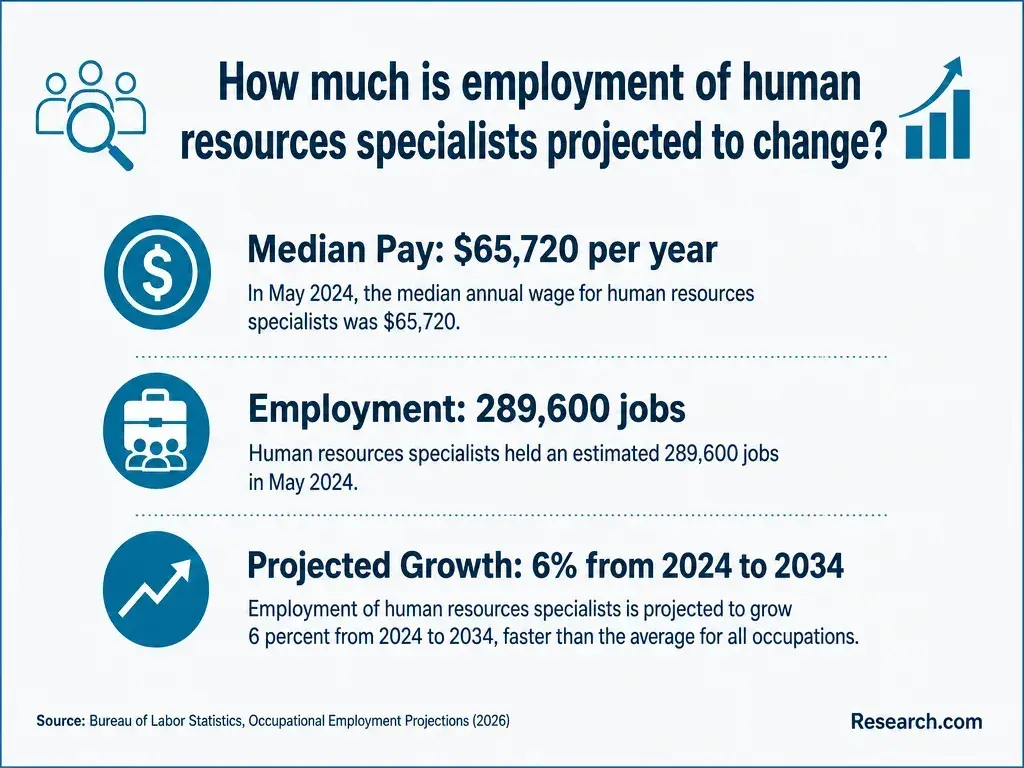
For example, BLS reports a May 2025 median annual wage of $75,940 for human resources specialists and projects 6% employment growth from 2025 to 2035. Those figures can help a political science graduate assess HR as a possible target, but the occupation-wide median is not an entry-level offer; HR-related experience and local hiring conditions matter.
To evaluate the financial return on another degree, compare roles you can plausibly pursue now with roles for which the added coursework or recruiting access would make you more competitive. Weigh that difference against your school-specific net cost, borrowing, and time to completion. For a starting point on program expenses, examine budget-friendly colleges for business administration online, then obtain current charges and your own credit evaluation before making a financial decision.
Other Things You Should Know About Business Administration
No. Your first bachelor's remains a completed credential. A second bachelor's is an additional degree, subject to the awarding school's requirements.
Usually not automatically. Minors are typically awarded under a school's undergraduate degree rules. Ask your original institution whether post-graduation completion is permitted before enrolling in courses for that purpose.
Your original institution's recorded GPA generally remains on its transcript. The new school determines how it calculates transfer and institutional GPAs, so check its transcript policy.
Not necessarily. Many MBA programs consider applicants from other undergraduate majors, though prerequisites and work-experience expectations vary. Check the requirements of programs that match your career goal.
- Fast Facts: Tuition costs of colleges and universities (76) | ed.gov https://nces.ed.gov/fastfacts/display.asp
- Student Eligibility for Pell Grants | ed.gov https://fsapartners.ed.gov/knowledge-center/fsa-handbook/2024-2025/vol7/ch1-student-eligibility-pell-grants
- Types of Financial Aid: Grants, Work-Study, and Loans | studentaid.gov https://studentaid.gov/understand-aid/types
- Plan Your Transfer - UCCS Transfer https://transfer.uccs.edu/plan-your-transfer
- Requirements for a Second Bachelor's Degree | iu.edu https://bulletins.iu.edu/iun/2024-2026/schools/business/undergraduate/policies/second-bachelors.shtml
- University Undergraduate Graduation Requirements | asu.edu https://catalog.asu.edu/undergraduatereq
- For Students: Bachelor's Degree Transfer - Gen Ed @ UMD https://gened.umd.edu/students/transfer-students/students-bachelors-degree-transfer
- SGP 114 Degrees, Graduation, and Commencement | UW Policy Directory https://policy.uw.edu/directory/sgp/sgp-114-degrees-graduation-and-commencement/