2027 A Second BS in Business Administration After a Bachelor's in Legal Studies: Credits, Cost, and Alternatives
Audited and Verified:
Our Editorial and Data Verification Process
Research.com uses government datasets, official education statistics and primary institutional information to support its career and degree guides. Our review process checks factual accuracy, occupational definitions, source dates and the requirements associated with the credentials discussed.
How This Article Was Fact-Checked
Our editorial team verifies salary estimates, employment projections, education requirements and program information against original data providers and official organizations. Salary figures are checked against the relevant occupational definitions and reporting periods. Information about licensure, accreditation and required in-person training is reviewed separately.
Fact-checked and verified on:

Co-Founder and Chief Data Scientist
A bachelor's in legal studies can prepare you for work involving research, contracts, and compliance, but it may leave gaps in accounting, finance, or operations. A second BS in Business Administration could fill those gaps—or require more coursework than your career goal justifies.
If you already hold a legal studies degree, this guide shows how to evaluate the credits you would actually need, estimate the cost, compare learning formats, and decide whether another degree or a narrower option is the better investment.
Key Things You Should Know
- A first bachelor's does not automatically shorten a second one: a business school may accept prior credits while still requiring its business core, upper-level courses, and residency credits.
- Compare the cost of remaining required credits, not the advertised price of a full degree. A completed bachelor's degree generally also changes eligibility for federal Pell Grants.
- A second BS makes the strongest case when a target role calls for substantial business preparation and you need the program's courses or recruiting access; targeted training may be more efficient for one skill gap.
Is a second bachelor's in business administration worthwhile after legal studies?
Start with the job you want, not the degree name. Legal studies can contribute document analysis, regulatory awareness, writing, and careful interpretation of rules. Those skills may already support a move into compliance operations, contract administration, or an entry-level business role. A second bachelor's is more defensible if the roles you are targeting consistently call for accounting, quantitative analysis, finance, operations, or a business degree—and you lack both that preparation and a practical way to demonstrate it.
A BS in Business Administration is a broad undergraduate credential, not a substitute for experience. For someone seeking an HR role, for example, compare its general business core with what to expect from an HR degree. The specialized route may offer more relevant coursework; the broader BS may fit better if you are still choosing among business functions. Neither degree by itself qualifies you for a management position.
Ask employers about the qualifications for your next role. If your legal studies degree already satisfies their bachelor's requirement and your gap is a specific tool or process, another full undergraduate degree may have limited value.
How many credits are required for a second bachelor's degree in business administration?
Many US bachelor's degrees are built around roughly 120 semester credits, but that is not the number a second-degree student should assume they must take. The relevant number is the credits remaining after the institution applies prior work to its current degree requirements. Schools set their own minimum new-credit, major-credit, upper-level, and residency rules; some second-degree policies also limit which general education requirements can be waived.
The distinction is between accepted credits and applicable credits. A school could accept a legal studies course as an elective without letting it replace managerial accounting or a required business-law course. A missing prerequisite can also delay a later course even when the total remaining-credit count looks small.
Request a written second-degree evaluation and term-by-term plan before treating a completion estimate as reliable. When reviewing ranked online business bachelor's completion routes, check whether their advertised timelines apply to students who already hold a bachelor's and whether every remaining required course is offered when you need it.
How much does a second business administration bachelor's degree cost?
There is no useful national price for this particular second degree: the bill depends on the school's charges and your approved degree audit. The comparison below separates charges from the factors that determine how much you will ultimately pay:
| Cost component | What to verify |
| Tuition | Rate per credit, course, or term; charges for upper-level and online courses; and the number of required credits remaining |
| Additional expenses | Mandatory fees, books, software, proctoring, travel, and any required campus visits |
| Time and financing | Course availability, time away from paid work, loan eligibility and interest, and the timing of employer reimbursement |
For a per-credit program, multiply the approved remaining credits by the applicable tuition rate, then add fees and other required expenses. For a flat-rate term, estimate how many terms the actual course sequence requires. Compare those totals—not just advertised tuition—when considering low-cost online business degree programs.
Students who have already earned a bachelor's are generally ineligible for federal Pell Grants, though other aid or employer benefits may be available. Ask the financial aid office about your individual loan eligibility and limits, and ask your employer whether a second bachelor's qualifies for reimbursement before counting on either source.
First confirm that the institution accepts second-bachelor's applicants; some schools restrict or do not offer that route. Admission to the university may also be separate from admission to its business major. Programs commonly request official transcripts from previous colleges, while GPA standards, prerequisite courses, application materials, and deadlines vary.
Your legal studies background does not itself bar business study. The practical questions are whether you have the program's required mathematics or statistics preparation, whether introductory accounting or economics must be completed before upper-level courses, and whether a second-degree applicant can take outstanding prerequisites after admission. For a closer look at possible course requirements, see online guides on the prerequisites for a business administration degree; the school's current catalog controls your application. Before paying to apply, ask admissions which second-degree rules apply and request any available preliminary transcript review.
Business law, contracts, ethics, economics, statistics, mathematics, communication, and general education courses are worth reviewing for equivalency. Their titles alone do not establish a match: the receiving school may examine the syllabus, credit hours, level, grade, and course content. Legal research or constitutional law may transfer as electives rather than satisfy a business-core requirement.
The most useful document is a degree audit showing where each accepted course lands: general education, business core, concentration, elective, or unused credit. If an apparently equivalent course lands only as an elective, submit its syllabus and ask the transfer office or business department about a formal review or substitution. A reader considering a more specialized path can also evaluate using existing credits in a human resources degree, then compare both schools' official evaluations rather than assuming the larger transfer total produces the shorter degree.
A typical business core introduces financial and managerial accounting, economics, finance, marketing, management, operations, statistics or analytics, and strategy. Your legal studies courses may overlap with business law or ethics, but they are less likely to replace courses that teach financial statements, budgeting, or quantitative business decisions. The exact BS curriculum—and any official concentration—depends on the institution.
Look beyond course titles to prerequisites and applied work. Accounting may precede finance; statistics may precede analytics. A capstone or internship may require an approved project, supervision, or access to business information that your current legal studies-related job cannot automatically provide. Choose electives around a documented skill gap rather than assuming an informal cluster appears as a concentration on your transcript.
Meanwhile, if application charges matter, you can explore fee-free online university applications, but confirm that the waiver covers your applicant category.
Choose the format that lets you complete the remaining required courses on a workable schedule. Online delivery can reduce travel, but it may still include live meetings, timed exams, group presentations, fixed deadlines, or an internship. Campus study may offer easier access to local recruiting and in-person projects, but commuting and daytime sections can make completion harder while working.
For each shortlisted program, ask for a sample schedule of the courses in your second-degree audit—not only a general description of flexibility. Check course rotation, part-time enrollment, required visits, assessment rules, and career services available to online students. National online business program rankings can help generate a shortlist, but your audit, schedule, and total cost should determine fit.
If you already meet a role's degree requirement, match the alternative to the missing qualification. A course or certificate in accounting, spreadsheets, analytics, or project coordination can address a narrow skill gap. Supervised work, an internal assignment, or a permitted portfolio project can provide evidence that you can apply that skill. An MBA may be worth comparing if your goal requires graduate-level business study, but its admissions expectations, cost, and curriculum differ from those of a second undergraduate degree.
A specialized bachelor's may make more sense than general business for a substantial switch into a defined function. For example, compare lower-cost colleges for project management majors with a general business program only if project-focused roles are your goal. Check both programs' credit evaluations: changing the major could change how many of your legal studies credits apply.
Legal studies plus business coursework can be relevant to contract administration, compliance operations, HR, procurement, and project coordination. Your entry point depends on the work you have already done. Someone who has handled vendor documents or regulated processes may be able to build on that experience; someone switching into finance or supply chain may need more function-specific coursework and supervised experience.
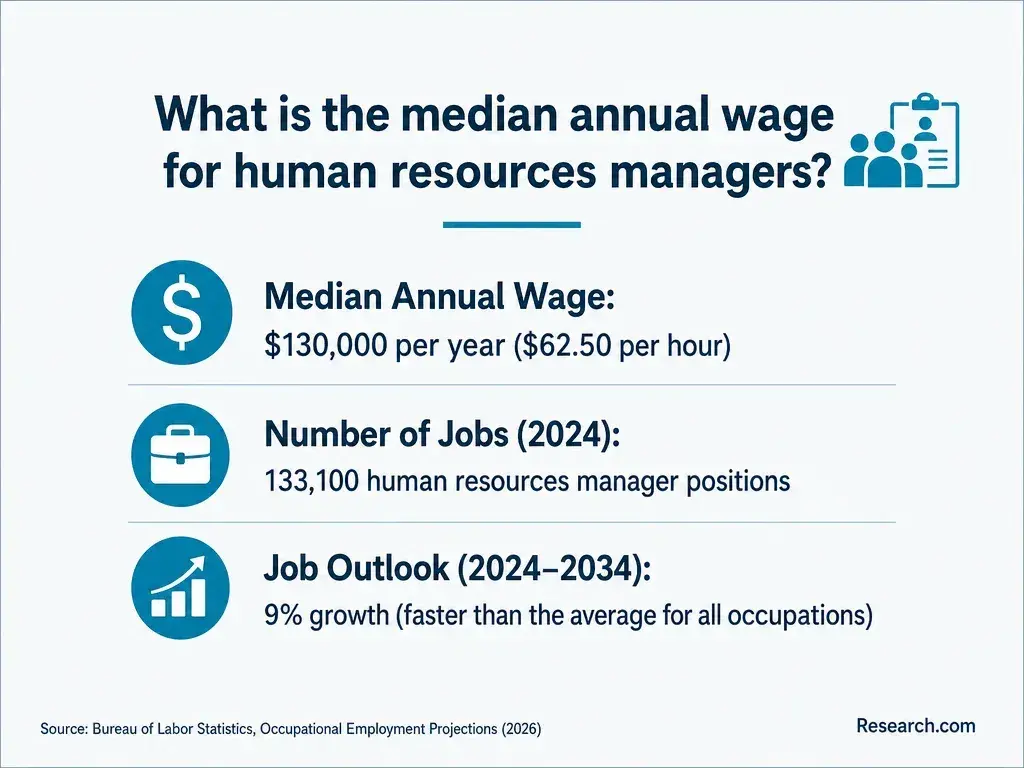
As one labor-market reference, the US Bureau of Labor Statistics reports a $75,940 median annual wage for human resources specialists in May 2025 and projects 6% employment growth from 2025 to 2035. That is an occupation-wide median, not an expected starting salary for a second-degree graduate. Compare local postings' tasks and experience requirements with your own evidence before using salary data to justify tuition.
If supply chain work is the target, assess whether general business coursework or a specialized degree better fills the gap. Claims about shorter completion timelines for supply chain bachelor's students still need to be tested against your individual transfer audit and the courses required for that role.
Does business administration require licensing or professional certification?
A general BS in Business Administration does not itself require an occupational license and does not award one. Specific work can have separate rules: public accounting licensure is governed by state boards, while certain financial-services activities require applicable licenses. HR and project management certifications have their own eligibility standards. A business course, concentration, or capstone is not automatically a professional credential.
If project management is your goal, keep academic credit and certification eligibility separate. Compare online undergraduate project management credit acceptance when weighing a specialized second degree, and check the relevant certifying organization directly before assuming coursework meets its requirements.
Other Things You Should Know About Business Administration
Usually not. Schools retain the academic record for the first degree and calculate new coursework under their own policies. Ask how the second-degree GPA will appear on your transcript.
List each awarded degree under its official title and institution. Put the one most relevant to the job first, or list them in reverse chronological order.
Some schools offer prior-learning assessment, but eligibility, documentation, fees, and the requirements those credits can satisfy vary. Ask for the written policy before relying on experience to shorten your plan.
Eligible loans may qualify for in-school deferment if you meet enrollment and loan requirements, but interest can continue to accrue. Confirm your status and options with your loan servicer.
- Student Eligibility for Pell Grants | ed.gov https://fsapartners.ed.gov/knowledge-center/fsa-handbook/2024-2025/vol7/ch1-student-eligibility-pell-grants
- Second Bachelor's - UF Online - University of Florida https://ufonline.ufl.edu/apply/admissions-requirements/second-bachelors/
- Financial Aid Eligibility After First Bachelor's Degree Have Been Met | The University of Iowa https://financialaid.uiowa.edu/eligibility/financial-aid-eligibility-after-first-bachelors-degree-have-been-met
- How Long Does It Take to Get a Business Degree? | The University of Olivet https://www.uolivet.edu/how-long-does-it-take-to-get-a-business-degree/
- College of Business Administration - Academic Catalog https://catalog.uic.edu/ucat/colleges-depts/business-administration/
- Transfer Credit and Credit for Prior Learning | University of the District of Columbia https://www.udc.edu/admissions/transfer-students/transfer-credit-policy
- Degree Requirements | Office of the Registrar https://www.lvc.edu/registrar/college-catalogue/academic-policies-procedures/degree-requirements/
- Degree Credit and Residency Requirements | Empire State University https://catalog.sunyempire.edu/undergraduate/academic-policies-procedures/degree-credit-residency-policy/
- Second Bachelor's Degree Admission - Academic Catalog https://catalog.ucdenver.edu/cu-denver/undergraduate/admissions/undergraduate-admissions/transfer-student-admission/second-bachelors-degree-admission/
- 10 Key Subjects Taught in a Bachelor of Business Administration Program | Carson-Newman University https://www.cn.edu/cps-blog/10-key-subjects-taught-in-a-bachelor-of-business-administration-program/