2027 Comparing Financial Aid Offers for a Business Administration BS: Grants, Loans, and Net Cost
Audited and Verified:
Our Editorial and Data Verification Process
Research.com uses government datasets, official education statistics and primary institutional information to support its career and degree guides. Our review process checks factual accuracy, occupational definitions, source dates and the requirements associated with the credentials discussed.
How This Article Was Fact-Checked
Our editorial team verifies salary estimates, employment projections, education requirements and program information against original data providers and official organizations. Salary figures are checked against the relevant occupational definitions and reporting periods. Information about licensure, accreditation and required in-person training is reviewed separately.
Fact-checked and verified on:

Co-Founder and Chief Data Scientist
A business administration BS offer can look affordable until you notice that its "total aid" includes loans, work-study earnings, or a scholarship that lasts only one year. If you are choosing between colleges - or returning to finish a degree - the useful comparison is what each school will cost you through graduation, not the largest award on the first letter. This guide shows you how to separate aid you keep from money you repay, calculate a comparable net price, and test how transfer credits, enrollment plans, and renewal rules could change your final debt.
Key Things You Should Know
- Compare net price, not total aid: Subtract grants and scholarships from the same school-defined cost of attendance; do not subtract loans or assumed work-study earnings.
- Project beyond the first year: A one-year award or an extra term of required business courses can reverse which offer is cheaper.
- Compare borrowing separately: Estimate student loans needed through completion, including the effect of interest and any parent or private borrowing.
What Is the Net Cost of a Business Administration BS After Financial Aid?
Net price is a school's estimated cost of attendance minus grants and scholarships that do not normally have to be repaid. Cost of attendance includes more than billed tuition: it is a planning budget for education-related expenses over a stated enrollment period. Loans change how you pay that price, not the price itself.
For a decision about completing a BS in Business Administration, calculate both annual net price and projected remaining-program net cost. The latter accounts for the credits that actually satisfy your degree requirements, the terms needed to finish, and whether aid continues. An accepted transfer credit may count only as an elective; it does not necessarily replace a required accounting, statistics, or business-core course.
A published "average net price" can provide context, but it is not your personalized offer. Compare your award letter and degree audit instead. If you are screening online options before requesting offers, you can compare low-cost online business administration pathways, then confirm each school's charges and your aid eligibility directly.
How Do You Compare Grants, Scholarships, Loans, and Work-Study Offers?
Sort every award by what it does to your cost and whether you must earn, renew, or repay it. The distinctions below prevent a large-looking aid package from masking a substantial financing gap.
| Offer component | Effect on comparison | Condition to check |
| Grant or scholarship | Generally reduces net price | Eligibility, covered terms, renewal, and enrollment requirements |
| Federal student loan | Finances net price; creates student debt | Loan type, amount accepted, interest, fees, and repayment terms |
| Parent or private loan | Finances net price; creates debt for the named borrower | Borrower responsibility, credit terms, and protections |
| Work-study | Potential wages, not an upfront discount | Job availability, hours, pay, and when wages arrive |
For each grant or scholarship, ask whether it is guaranteed for your remaining terms or contingent on GPA, major, credit load, or available funding. Federal subsidized and unsubsidized loans also differ in how interest is treated while you are in school; confirm which type appears on the offer. Do not count the full work-study allocation as cash available for a tuition bill before you have a job and earn the wages.
Students considering a project management focus can use undergraduate project management grants and scholarship planning to identify possible funding categories. Eligibility for an award still depends on its rules and the specific business administration program.
What Costs Should You Include When Comparing Business Degree Offers?
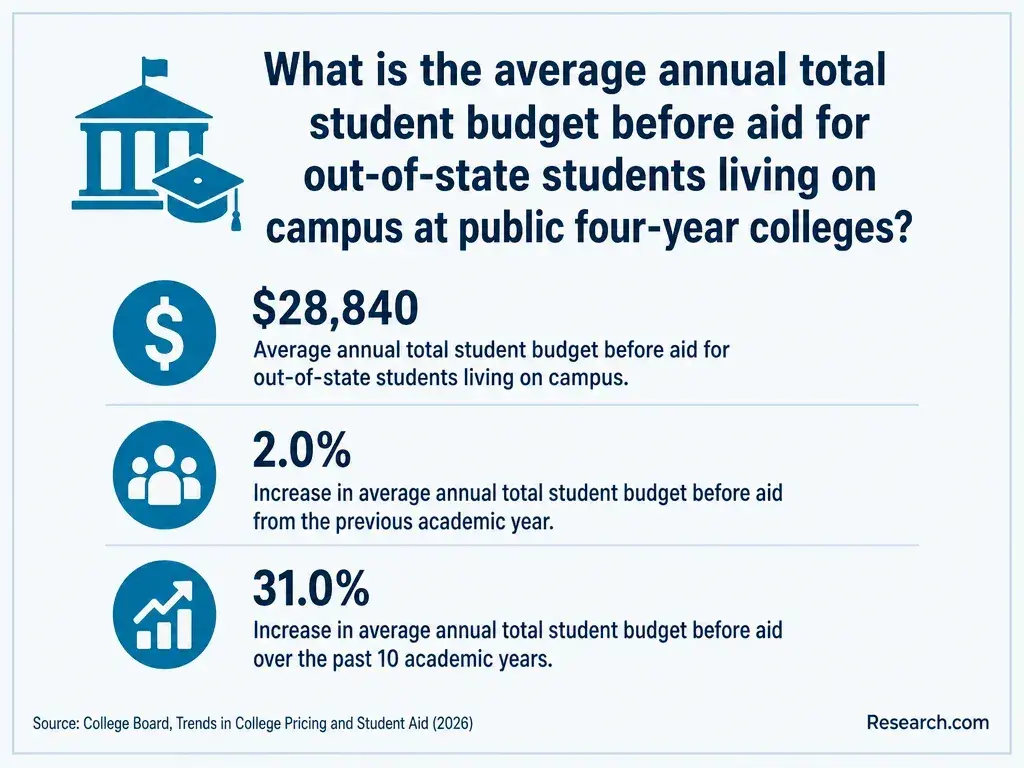
Start with each school's cost-of-attendance period, then replace generic estimates with expenses you realistically expect to incur. Separate charges paid to the college from living expenses and other costs; a lower tuition bill does not necessarily mean a lower total cost.
Include tuition and mandatory fees; books, access codes, software, and a suitable computer; housing, food, and transportation; and any required travel, proctoring, internship, or campus-visit expenses. For a working student, also consider reduced work hours and the timing of employer reimbursement. These opportunity and cash-flow costs matter even though they may not appear on an aid letter.
For transfer or returning students, the decisive cost is often the price of remaining required courses, not the advertised per-credit rate. Ask for a degree audit showing where prior credits apply and which required courses are offered in each term. If you are weighing shorter schedules against lower advertised tuition, economical business administration degrees with quicker study routes can be a starting point, but verify that the proposed pace is feasible for your coursework and budget.
Use the same enrollment period and comparable living arrangements for every offer. This sequence produces a net-price comparison without treating borrowed money as a discount.
- Record each school's cost of attendance for the academic period, noting which expenses are estimates rather than billed charges.
- Subtract grants and scholarships you are eligible to receive for that period; the result is estimated net price.
- Subtract funds you can actually use without borrowing, such as available savings or confirmed employer payments, to estimate the financing gap.
- Repeat for every remaining term using documented renewal conditions, expected enrollment, and the school-approved degree plan.
In short, cost of attendance − grants − scholarships = net price. Net price minus confirmed nonloan funding gives you a planning estimate of what you must cover through earnings, payment plans, or borrowing. Keep employer reimbursement separate until you know when it will be paid and whether grades or continued employment are conditions.
Use each college's financial aid office to reconcile the calculation with its award letter. When comparing online schools, compare business administration tuition and FAFSA eligibility before assuming that a low advertised rate comes with federal aid.
The lowest first-year net price does not automatically produce the least debt. Project how much you would borrow each term through graduation, rather than adding up every loan offered. Include expected changes in grants, tuition, enrollment, and completion time. Keep parent borrowing in a separate column: a parent loan is not student debt, but it is still a household obligation.
Consider two offers without assuming either is better: one has a larger first-year scholarship that requires renewal, while the other has a smaller award that is confirmed for the remaining degree plan. The better borrowing outcome depends on whether the first award continues and whether both schools accept and apply your credits in the same way. Obtain those answers in writing before projecting a winner.
Compare projected loan principal with repayment obligations, not principal alone; interest, loan fees, and private-loan terms can change the amount repaid. A faster route can reduce borrowing if it removes a term of expenses, but an accelerated schedule may also limit paid work. Review faster undergraduate completion pathways only after confirming your remaining courses, course availability, and manageable workload.
Delivery format alone does not determine whether a student receives federal aid. Eligibility depends on the institution and program, the student's circumstances, and applicable enrollment rules. An online student may avoid commuting or relocation expenses but face technology, proctoring, or occasional travel costs; a campus student may have access to services or experiences that matter to their completion plan.
Compare the actual online and campus charges at each school, including distance-learning fees and any differences in tuition by residency or enrollment status. Check whether required business courses, group work, exams, internships, and capstones can be completed in the advertised format. Online does not necessarily mean self-paced, and a faster calendar does not necessarily lower total tuition.
If speed is part of your cost strategy, business bachelor's rankings focused on completion speed can help generate a shortlist. Request a personalized schedule before treating any published completion time as your own.
Before comparing aid, verify that the institution is appropriately accredited and eligible to participate in the aid programs shown on its offer. Then check whether any claimed business accreditation - such as AACSB, ACBSP, or IACBE - covers the relevant school or program. Institutional accreditation and specialized business accreditation have different scopes; neither guarantees a job or makes a higher price worthwhile by itself.
Quality matters financially when it affects whether you can finish: required-course availability, reliable advising, transfer-credit application, academic support, and access to relevant projects or internships can all change time and cost. For a student targeting a particular function, inspect the curriculum rather than paying more for a broad reputation. Someone set on HR, for example, might compare business coursework with college pathways into human resources to see which requirements and learning opportunities fit the goal.
Admission to a college, admission to its business major, and eligibility for a particular award are separate decisions. Confirm the program's entry requirements and whether prerequisite or remedial coursework applies to your degree and aid eligibility. Transfer students should request an official evaluation: credits accepted by the college may not fulfill business-core requirements.
Submit the FAFSA for the appropriate award year using the school's correct identification information, and check federal, state, and college deadlines. The financial aid office can explain student eligibility, verification requests, enrollment-intensity rules, satisfactory academic progress, and whether a specific program qualifies for the aid offered. A scholarship may impose additional requirements even when federal aid remains available.
If you still need to establish academic eligibility, review qualifying for a business administration college program, then use the named institution's current requirements as the authority for your application.
Cost is only one part of value. Use the U.S. Department of Education's College Scorecard and each institution's published outcomes to examine completion, debt, and earnings where available. Check the reporting cohort and time period: an institution-wide graduation rate may not describe transfer students or the online business program, and reported earnings are not a prediction of your salary.
Ask whether the school publishes outcomes for its BS in Business Administration, how it counts graduates, and how many responded to any employment survey. Compare those limits alongside the opportunities you can actually use - career advising, relevant internships, and coursework connected to your target role. A business degree does not by itself qualify a graduate for a management position.
If your goal is specifically project management, compare the business program's preparation and total cost with affordable online project management degrees. The lower-cost choice is valuable only if its curriculum, transferable credits, and completion plan support the work you intend to pursue.
What Questions Should You Ask Colleges About Financial Aid Offers?
Request answers from the financial aid office and, for credits and scheduling, the registrar or academic adviser. These questions target the assumptions most likely to change an apparent bargain:
- Which grants and scholarships are renewable, for how long, and under what GPA, enrollment, or major requirements?
- What will I owe the college before any work-study wages or employer reimbursement arrive?
- How will an official degree audit apply my previous credits, and how many required terms remain?
- What happens to my aid and charges if I attend part time, withdraw, repeat a course, or need an additional term?
- Which offered loans would be in my name, and what are their interest, fee, and repayment terms?
Ask for a revised estimate when an answer changes your plan, and compare offers using the same assumptions. Application expenses also count before enrollment; if you are still building a shortlist, consider ways to reduce upfront college application expenses without assuming an advertised fee policy applies to every applicant.
Other Things You Should Know About Business Administration
No. Submitting the FAFSA is an application for aid, not an enrollment decision or acceptance of a student loan. Follow each college's separate steps and deadlines.
A refund may include loan proceeds after school charges are paid. Check its source before spending it; you generally remain responsible for repaying borrowed funds.
Not necessarily. Summer aid depends on the school's award-year policies, your remaining eligibility, and enrollment. Ask for a summer-specific estimate before registering.
Yes. Contact the financial aid office about its process for reviewing changed circumstances and the documentation it requires. Reconsideration is possible, but additional aid is not guaranteed.
- Comparing School Financial Aid Offers | studentaid.gov https://studentaid.gov/complete-aid-process/comparing-aid-offers
- The Federal Work-Study Program - FSA Partner Connect https://fsapartners.ed.gov/knowledge-center/fsa-handbook/2025-2026/vol6/ch2-federal-work-study-program
- Understanding the Financial Aid Process | baylor.edu https://onestop.web.baylor.edu/resources-forms/understanding-financial-aid-process
- Federal Direct Subsidized and Unsubsidized Loans | ufl.edu https://www.sfa.ufl.edu/types-of-aid/loans/subsidized-and-unsubsidized-loans/
- Renewable Aid | The Office of Financial Aid at UTD | UT Dallas https://finaid.utdallas.edu/maintaining-aid/renewable-aid/
- Grants, Scholarships & Loans: What's the Difference? | Goodwin College of Professional Studies https://drexel.edu/soe/admissions/financial-aid/difference-between-student-grants-vs-loans/
- Net Price Calculator | Office of Scholarships & Financial Aid https://financialaid.unl.edu/cost/net-price-calculator/
- General renewal requirements for K-State scholarships and awards | Kansas State University | Undergraduate Admission https://www.k-state.edu/sfa/scholarships-aid/awards/resources/renewal-requirements/
- Grants | Financial Aid & Scholarships https://financialaid.ucla.edu/types-of-aid/grants