
2027 A Department Contact Tree Exercise: A Healthcare Administration Student Portfolio Project

Co-Founder and Chief Data Scientist
A department contact tree can show whether a healthcare administration student understands how work moves across an organization - not just who appears on an org chart. For a portfolio project, the challenge is to map useful contacts and escalation paths without publishing private information or implying that a classroom diagram is an approved emergency procedure.
This guide explains what to include, how to verify it, and how to present it professionally. It also helps you decide whether the project supports your next step: an entry-level role, further healthcare administration study, or management education.
Key Things You Should Know
- A strong contact tree shows the responsible role, backup, communication channel, and escalation trigger for each defined situation; a list of department names is not enough.
- Use role-based or fictional contacts in a public portfolio. Only an organization-approved, access-controlled version should contain internal names or numbers.
- The project demonstrates coordination and process-design skills, but it does not confer clinical authority or replace the experience employers expect for management roles.
What is a department contact tree exercise in healthcare administration?
A department contact tree is a diagram or structured directory showing whom to contact first, who provides backup, and when an issue moves to another team or a higher decision-maker. In a healthcare administration exercise, students apply that structure to an operational scenario such as a scheduling disruption, a facilities issue, or a patient-access bottleneck. The result should answer a practical question: Who owns the next administrative action, and what happens if that person is unavailable?
A contact tree is not the same as an organizational chart. An org chart shows reporting relationships; a contact tree follows the path an issue takes. It is also not a clinical triage protocol or an authorized emergency plan. Students should define a narrow scenario and follow their organization's approved procedures wherever real operations are involved.
The project primarily examines administrative coordination. Students deciding whether their interests lie instead in records governance and data stewardship can compare degree routes in healthcare administration and HIM; the fields overlap, but they do not prepare students for identical responsibilities.
How does this portfolio project build healthcare administration skills?
Constructing the tree requires students to identify ownership, distinguish routine handoffs from escalation, and explain why information must reach a particular role. Those are more revealing skills than memorizing department names. A well-designed exercise also exposes a common operational weakness: a process that depends on one unavailable person has no reliable backup.
The most useful portfolio evidence is the reasoning behind the diagram. Briefly explain the scenario, assumptions, disputed handoffs, and revisions made after feedback. A prospective employer can then assess how you communicate across teams without mistaking the assignment for proof that you have managed a hospital department.
These skills are relevant to management career pathways within healthcare organizations, but a student project is an entry point, not a substitute for supervised operational experience. For someone changing careers, connecting the tree to prior work in scheduling, customer service, compliance, or logistics makes its transferable value clearer.
What should a healthcare administration department contact tree include?
Start with a defined setting and trigger - for example, an outpatient clinic whose appointment system is unavailable. State whether the tree covers routine coordination, an after-hours disruption, or another approved scenario. Its fields should make the diagram usable without turning it into an unrestricted directory.
The following components describe what each branch should communicate. Their exact content depends on the organization's policies and the assignment's scope.
- Issue and scope: The event that activates the branch, its location or service line, and what the tree does not cover.
- Primary owner and backup: Role titles rather than names in a public version, with a clear substitute when the first contact is unavailable.
- Contact method: An approved channel or, for a public sample, a placeholder showing where an internal channel would appear.
- Escalation rule: The condition that moves the issue onward, such as an unresolved service interruption or a decision outside the first role's authority.
- Document control: The owner of the tree, its review date, version, and a note that local policy takes precedence.
Keep the scope proportionate to the assignment. If you are comparing healthcare administration degrees with rolling start options, ask whether a project like this uses a fictional case or requires access to a partner organization; enrollment timing does not itself provide access to real contacts.
Include departments because the scenario calls for them, not because every hospital has them. The example below models an outpatient scheduling-system disruption. Role titles and responsibilities vary across organizations, so students should treat these as illustrative branches rather than a universal reporting structure.
| Function | Possible role in this scenario | Reason for inclusion |
| Clinic operations or patient access | Clinic manager or access lead | Coordinates the immediate scheduling workflow. |
| Information technology | Service desk or application support | Investigates the system interruption through an approved support channel. |
| Clinical leadership | Designated nurse or medical leader | Advises on patient-care implications within their authority. |
| Communications or patient relations | Authorized communications lead | Coordinates approved messages when patients need an update. |
| Privacy or compliance | Designated privacy or compliance contact | Assesses a suspected information-handling concern if one arises. |
A billing branch, facilities contact, or executive escalation may be appropriate for a different trigger. For students building experience from administrative support roles, associate-to-bachelor's pathways in healthcare administration may offer a way to deepen the coursework behind such an operational project. The diagram itself should still reflect the setting being studied, not a degree program's organizational chart.
Research the roles and workflow first; obtain actual contact details only when an organization has authorized their use. A hospital website may confirm that a department exists, but it rarely verifies an internal escalation route. Interviews and internal directories can help in a supervised placement, subject to the organization's access and confidentiality rules.
Use this sequence to separate a credible classroom model from an operational document:
- Define the scenario and ask the instructor or site supervisor whether fictional, public, or internal information is permitted.
- Identify the first owner, backup, and escalation authority using approved policy or a knowledgeable organizational contact.
- Confirm disputed handoffs with the appropriate department owner; record the role and date of confirmation, not unnecessary personal details.
- Test a plausible "no answer" case and a cross-department handoff with the supervisor.
- Remove internal names, direct numbers, access instructions, and patient information before creating a public portfolio copy.
If verification is impossible, label the tree illustrative and unvalidated rather than presenting invented contacts as real. Students considering online MHA degrees for healthcare management preparation should likewise ask how applied projects are supervised and whether any placement provides authorized access to organizational workflows.
Organizational behavior helps students distinguish formal authority from day-to-day coordination. Healthcare operations supports workflow mapping and backup planning; health information systems coursework helps them understand when an IT issue affects administrative work. Ethics, privacy, and quality-improvement courses add the discipline to limit access, document assumptions, and revise a process after testing it.
At the bachelor's level, the exercise can demonstrate foundational process analysis. At the master's level, an instructor might expect a stronger justification of governance, risk, and implementation choices. Students comparing completion times for healthcare management master's degrees should inspect the actual project requirements, not assume a shorter program offers less applied work.
Present the work as a small decision-support package, not a decorative chart. Put the scenario and limitations first, then provide a readable diagram, a short explanation of key handoffs, and a version note. Use consistent role labels and make both the primary route and backup route visible. A text outline alongside the diagram can improve accessibility and make the logic easier to review.
For a public portfolio, replace real names and direct numbers with titles and clearly marked placeholders. Add a statement such as "Fictional classroom example; not approved for operational use." If an employer or placement site owns the underlying material, obtain permission before sharing even an edited version.
An applicant considering choosing an accelerated MBA with a healthcare focus could use this artifact to discuss process improvement and stakeholder coordination. It does not, however, establish that a particular MBA accepts portfolio submissions or offers a healthcare concentration; verify those features with the school.
Either format can support a useful contact tree. In an online course, students may review a case and collaborate on a shared diagram; in a campus course, they may workshop handoffs in person. Neither format guarantees access to a healthcare site. What matters most is whether the instructor provides a realistic scenario, feedback from someone familiar with operations, and a chance to revise the work.
Before enrolling, ask whether the project uses simulated data, an approved employer-based case, or a required placement. Also ask how group work is scheduled, who reviews privacy-sensitive submissions, and whether students can publish a sanitized artifact. These questions matter more than an "online" label for students balancing study with work.
Students considering advanced study should make the same distinction when looking at online healthcare administration doctoral formats compared: remote coursework and access to an organization for applied research are separate features.
Choose a credential for the role you want, not for the contact tree itself. A healthcare administration bachelor's degree can provide broad preparation for administrative work; an MHA focuses graduate study on managing healthcare organizations. An MBA offers a broader business core, while a healthcare focus - if the school formally offers one - adds relevant coursework. Short courses or employer training may be enough if you need only workflow-mapping skills.
Admissions, tuition, accreditation, and applied-learning requirements vary by institution. Compare published curricula and total costs, and ask which assignments involve real organizational feedback. None of these credentials grants clinical authority simply because a student has mapped clinical and administrative contacts.
For experienced professionals considering research or senior-level practice beyond a master's degree, transfer policies in accelerated healthcare leadership doctoral programs can affect the time and cost of that separate decision. Doctoral study is not necessary to complete this portfolio exercise or to begin an administrative career.
What healthcare administration jobs can this portfolio project support?
The artifact is most directly useful when applying for roles involving coordination: patient-access coordinator, administrative assistant, operations coordinator, or project-support specialist. An applicant can use it to explain how they identify owners, handle unavailable contacts, and document a handoff. Actual titles and qualifications depend on the employer and setting.
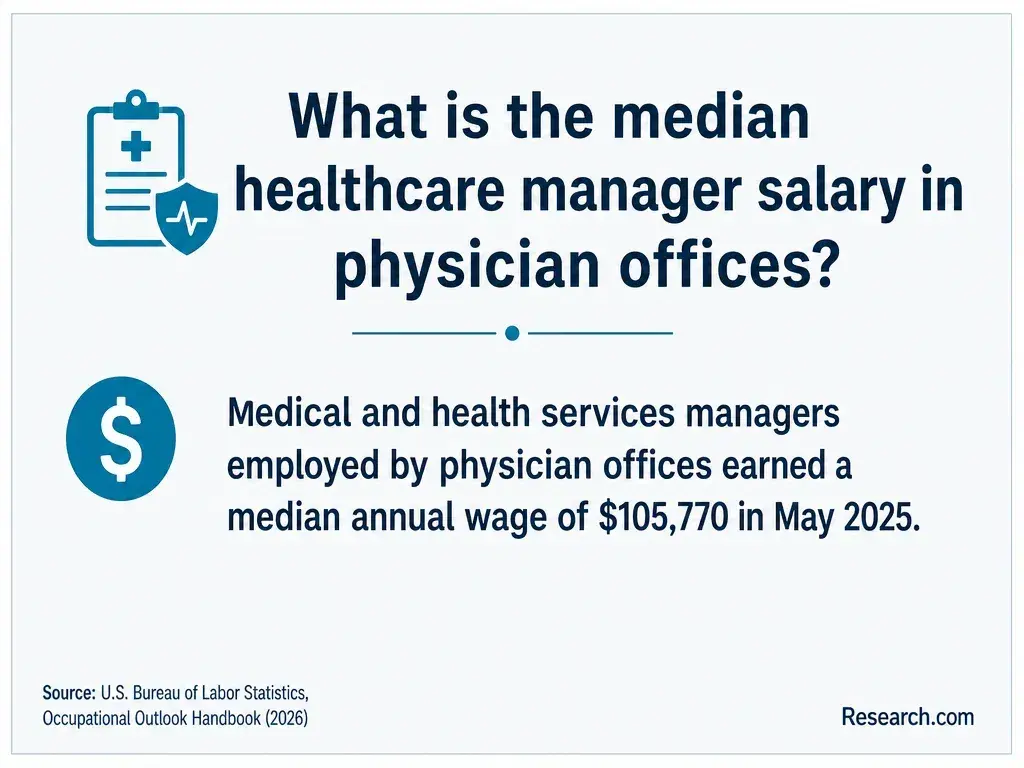
With relevant work experience, the same skills may support movement toward clinic operations or service-line management. The distinction matters: a portfolio demonstrates how you think, while management hiring also weighs responsibility you have held, decisions you have made, and results you can substantiate. The U.S. Bureau of Labor Statistics reports a $126,520 median annual wage for management occupations in May 2025. That figure covers management occupations broadly; it is neither an entry-level healthcare administration wage nor an expected salary for someone completing this project.
If your target roles consistently request graduate education, compare their requirements with completion times for healthcare management master's degrees before committing. If they primarily request hands-on scheduling, systems, or supervisory experience, a relevant job or placement may be the more direct next step.
Doctoral research addresses a different objective: producing or applying advanced research, rather than merely building a more elaborate contact list. Before considering lower-cost doctoral study in healthcare administration, decide whether your goal calls for research training or for more direct operational experience. Note: This paragraph contains a second link in the section and should not appear in a version that limits each section to one link.
Other Things You Should Know About Healthcare Administration
Only with your employer's permission. A fictionalized version is safer, but check that it does not reveal internal procedures, contact details, or other restricted information.
No. A document or diagramming tool is sufficient if the routes are readable and you can provide an accessible text version. Accuracy and clear labels matter more than the software.
Follow the organization's policy. It should also be checked when roles, contact channels, services, or escalation procedures change; a classroom sample should show its review date.
Describe it as coursework or a supervised project unless it was part of an actual job or placement. Employers can value the work sample without treating it as employment experience.
- Healthcare Facility Evacuation/Sheltering - aspr tracie - HHS.gov https://asprtracie.hhs.gov/technical-resources/57/healthcare-facility-evacuation-sheltering/0
- Protecting Personal Information: A Guide for Business | Federal Trade Commission https://www.ftc.gov/business-guidance/resources/protecting-personal-information-guide-business
- Privacy policy and procedures guide | U.S. General Services Administration https://www.gsa.gov/reference/gsa-privacy-program/privacy-policy-and-procedures-guide
- Contingency Planning Emergency Response and Safety - PMC https://pmc.ncbi.nlm.nih.gov/articles/PMC7149346/
- Responding to Patient Safety Events | PSNet https://psnet.ahrq.gov/primer/responding-patient-safety-events
- Call Tree Program | Office of Emergency Management | University of Houston https://www.uh.edu/emergency-management/emergency-alert-notification/call-tree-program/index.php
- Types of Potential Incidents | Claremont McKenna College https://www.cmc.edu/emergency/types-of-potential-incidents
- Data privacy and security | UC Berkeley Labor Center https://laborcenter.berkeley.edu/negotiating-tech/other-workplace-technology-provisions/data-collection-rights-and-security/data-privacy-and-security/
- How to Use Schoolwork to Create a Portfolio | SUU https://www.suu.edu/blog/2022/11/student-portfolio.html
- Emergency vs. Mass Notification System: Key Differences | Safereach https://safereach.com/en/blog/emergency-notification-system-vs-mass-notification-system/


