2027 Transfer Guide for Returning Students

Co-Founder and Chief Data Scientist
Returning to college often starts with one hard question: will your previous credits still count? The stakes are high because the National Student Clearinghouse reported in 2024 that 36.8 million U.S. adults under 65 had some college credits but no credential. This guide is for former students, adult learners, stop-outs, military-connected students, and transfer applicants who want a practical path back.
You will learn how to compare programs, protect transfer credits, estimate costs, avoid accreditation mistakes, and choose a degree plan that fits your schedule and career goals.
Key Things You Should Know
- Start with credit recovery: a school's transfer policy, residency requirement, and major-specific rules can matter more than its ranking because they determine how many previous credits apply to your new degree.
- Use total cost, not tuition alone: College Board's 2024 pricing data lists average 2024-25 tuition and fees at $4,050 for public two-year in-district colleges, $11,610 for public four-year in-state colleges, and $43,350 for private nonprofit four-year colleges.
- Check accreditation and outcomes before applying: regional or institutional accreditation affects federal financial aid, credit transfer, graduate admission, licensure eligibility, and employer recognition.
What should returning transfer students consider first when deciding whether to re-enroll?
Returning transfer students should begin by confirming whether re-enrollment is academically, financially, and personally realistic. A returning transfer student is someone who previously earned college credit, stopped out or changed schools, and now wants to apply those credits toward a credential at the same or a different institution.
The first decision is not simply "Which college should I attend?" It is "Which option gets me to a useful credential with the fewest lost credits, manageable cost, and a schedule I can actually sustain?" That framing is especially important for adult learners who may be balancing work, caregiving, debt, military benefits, or a major career change.
Before comparing schools, use this short sequence to clarify whether returning now makes sense and what kind of program you should pursue.
- Define the credential you need: decide whether your goal requires a certificate, associate degree, bachelor's degree, graduate degree, or licensure-track program.
- Collect every transcript: request official and unofficial transcripts from all colleges attended, including dual-enrollment, military, technical, and previously attempted coursework.
- Estimate usable credits: ask each prospective school for a preliminary transfer review or degree audit before committing.
- Check your academic standing: confirm whether you left in good standing, on probation, with a balance due, or under a dismissal policy that may affect readmission.
- Run a time-and-money test: compare remaining credits, expected course load, tuition, fees, aid eligibility, and income trade-offs while enrolled.
A common mistake is assuming that returning to the last college attended will always be easiest. It may be, but not if that school changed degree requirements, charges more than alternatives, or accepts fewer outside credits than another accredited institution.
| Decision factor | Why it matters | Best fit when | Red flag |
| Remaining credits | Determines time to completion and total cost | The school applies prior courses directly to general education, electives, or major requirements | Many credits transfer only as unused electives |
| Schedule format | Affects persistence for working adults | Courses are offered online, evenings, weekends, or in predictable terms | Required courses rotate rarely or conflict with work hours |
| Academic standing | Can affect readmission and aid eligibility | The school offers reinstatement, academic renewal, or success planning | You are admitted without a clear plan to restore satisfactory academic progress |
| Career alignment | Improves the odds that the credential supports a real goal | The degree connects to licensure, promotion, graduate study, or a defined occupation | The program sounds flexible but has unclear career outcomes |
How do you compare potential transfer colleges and programs as a returning student?
Compare colleges by how well they convert your existing credits into progress toward a specific credential. Rankings, campus amenities, and brand recognition can be useful secondary factors, but transfer friendliness is measured by degree applicability, advising quality, cost transparency, and course availability.
Returning students should request the same core information from every school. This makes the comparison fair and prevents you from choosing based on incomplete admissions promises.
- Ask for a written transfer credit estimate that separates accepted credits from credits that actually satisfy degree requirements.
- Request a remaining-course plan showing term-by-term sequencing, prerequisites, and expected graduation timing.
- Confirm whether the school has credit-for-prior-learning options, such as military training review, portfolio assessment, CLEP, DSST, industry certifications, or workplace learning evaluation.
- Compare total net price after grants, scholarships, employer tuition assistance, military benefits, and transfer scholarships.
- Review student support for returning learners, including adult advising, online tutoring, career services, emergency aid, and re-entry coaching.
Program level also matters. Some students are close to an associate degree and should finish that first, while others should move directly into a bachelor's program. If your main goal is a short credential, a fast track associates degree online may be worth comparing with traditional two-year options, but only if the school is accredited and your credits apply efficiently.
The table below summarizes common return-to-college pathways. Use it to identify which option fits your prior credit level and career objective before you apply.
| Pathway | Best for | Main advantage | Main trade-off |
| Return to previous college | Students close to finishing the same degree | Existing catalog rights or familiar systems may reduce friction | Prior balances, old GPA issues, or changed requirements may slow progress |
| Transfer to community college | Students needing affordable lower-division coursework or an associate degree | Lower tuition and strong transfer pathways in many states | May add another transfer step for bachelor's completion |
| Transfer to public four-year university | Students pursuing bachelor's degrees with recognized in-state options | Often balances cost, major depth, and employer recognition | Capacity-limited majors may have stricter admission rules |
| Transfer to private nonprofit college | Students seeking small classes, generous aid, or specialized programs | Institutional grants may reduce the sticker price | Published tuition can be high, so net price must be verified |
| Online adult-completion program | Working adults with substantial prior credits | Flexible pacing and transfer-focused advising | Not every online program fits licensure, lab, clinical, or internship requirements |
How can you maximize transfer credit when returning to complete your degree?
To maximize transfer credit, you need to understand the difference between accepted credit and applicable credit. Accepted credit appears on your record, but applicable credit counts toward general education, major, elective, residency, or graduation requirements. The second category is what shortens your time to completion.
Credit loss usually happens when courses are too old for a major, do not match the new school's curriculum, exceed elective limits, come from a non-accredited source, or were completed with grades below the receiving school's minimum. STEM, nursing, education, accounting, and technology programs may have stricter currency rules than liberal arts or general studies programs.
Use this process before you enroll, not after your first term begins. It can save time, money, and frustration.
- Send official transcripts from every institution, even if you think the credits are too old or unrelated.
- Ask for a degree audit for your intended major, not just a general transfer estimate.
- Challenge missing equivalencies by providing syllabi, course descriptions, lab hours, clinical documentation, or certification records.
- Ask whether alternative credit options can fill remaining general education or elective gaps.
- Confirm the residency requirement, which is the minimum number of credits you must complete at the new school to earn its degree.
- Get the final evaluation in writing before making a deposit or registering full time.
One useful benchmark is the student's break-even point: if a school accepts more credits but charges much higher tuition, it may or may not be cheaper overall. Compare remaining credits multiplied by tuition and fees, then add books, technology fees, transportation, childcare, and lost work hours if applicable.
The following table explains the transfer credit terms you are likely to see and how they affect your degree plan.
| Term | Meaning | Why returning students should care |
| Course equivalency | A previous course matches a specific course at the new school | This is usually the strongest form of transfer because it can satisfy exact requirements |
| General elective credit | A course transfers but does not match a required course | It may help total credits but may not reduce remaining major requirements |
| Block transfer | A completed credential or course package transfers as a unit | It can protect associate degree or general education completion |
| Credit for prior learning | College credit awarded for documented learning outside traditional courses | It may help adults with military, workplace, certification, or exam-based learning |
| Residency requirement | Credits that must be completed at the awarding institution | It sets the minimum coursework you cannot transfer around |
What admission requirements and application materials do returning transfer students need?
Returning transfer students usually need to submit more documentation than first-time applicants because colleges must evaluate prior coursework, academic standing, and eligibility for the intended major. Requirements vary by institution, but most schools separate general transfer admission from selective program admission.
Expect to prepare the following materials early. Missing transcripts are one of the most common reasons transfer decisions and credit evaluations are delayed.
- Completed transfer or readmission application, depending on whether you are returning to the same institution or applying elsewhere.
- Official transcripts from every college attended, including colleges where you withdrew, failed courses, or earned only a few credits.
- Final high school transcript or GED documentation if you have earned limited college credits.
- Personal statement or re-entry explanation if required, especially after academic dismissal or a long enrollment gap.
- Program-specific materials such as prerequisite proof, portfolio, audition, background check, entrance exam, or clinical documentation.
- Financial aid documents, including the FAFSA, scholarship applications, employer tuition assistance forms, or military education benefit paperwork.
Selective majors may require higher GPAs, completed prerequisites, or separate deadlines. Nursing, engineering, teacher education, business, social work, and allied health programs often review transfer students more closely because seats, labs, clinical placements, or accreditation rules limit capacity.
The table below shows common admission scenarios and what they usually mean for returning transfer students.
| Admission scenario | What it means | What to verify |
| Good academic standing | You left your prior institution without probation or dismissal barriers | Whether your GPA meets the new school's transfer and major requirements |
| Academic probation | Your prior GPA or completion rate fell below institutional standards | Whether you need an academic success plan or limited first-term course load |
| Academic dismissal | You may need reinstatement, appeal approval, or time away before admission | Whether the school offers academic renewal or conditional admission |
| Unpaid balance | A prior school may withhold registration or official transcript access depending on policy and law | Whether a payment plan, debt resolution, or transcript exception is available |
| Selective major review | Admission to the college does not guarantee admission to the major | Prerequisites, GPA thresholds, deadlines, and alternate major options |
How do online, hybrid, and campus-based programs differ for returning transfer students?
Online, hybrid, and campus-based programs can all work for returning students, but they solve different problems. The best format is the one that matches your learning style, work schedule, major requirements, and need for in-person support.
Online learning has become a mainstream option, especially for degree completion. NCES reported in 2024 that more than half of U.S. postsecondary students took at least one distance education course in fall 2022. For returning students, that means online courses are no longer unusual, but program quality and support still vary widely.
If you need maximum flexibility, an online bachelor degree can make sense when the program offers strong advising, clear transfer maps, and asynchronous courses. However, online is not automatically faster or easier; it requires self-management, reliable technology, and prompt communication with instructors.
This table compares the three main delivery formats so you can identify the best fit before applying.
| Format | Best for | Strengths | Limitations |
| Online | Working adults, caregivers, military-connected students, and students far from campus | Flexible location, often more scheduling options, easier access to adult-completion programs | May not fit lab, clinical, studio, or licensure requirements without local placements |
| Hybrid | Students who want flexibility but still need some face-to-face learning | Balances online convenience with campus labs, networking, and direct support | Commute requirements can still conflict with work or caregiving |
| Campus-based | Students who learn best in person or need intensive labs, studios, clinics, or campus resources | Direct access to faculty, peers, facilities, and structured schedules | Less flexible and may require relocation, commuting, or reduced work hours |
How does accreditation affect transfer credit, financial aid, and career options?
Accreditation is a quality review process that determines whether a college or program meets recognized academic standards. For returning transfer students, accreditation affects three major areas: whether credits are likely to transfer, whether students can access federal financial aid, and whether a credential meets employer, graduate school, or licensing expectations.
The most important starting point is institutional accreditation from an agency recognized by the U.S. Department of Education. Many fields also require or strongly prefer programmatic accreditation, such as nursing, education, social work, counseling, business, engineering, architecture, or allied health.
Use the following checks before you apply or accept admission. Accreditation mistakes can be expensive because they may not become obvious until you try to transfer again, sit for a licensing exam, or apply to graduate school.
- Search the U.S. Department of Education's Database of Accredited Postsecondary Institutions and Programs for the school's current accreditation status.
- Confirm that the accreditor is recognized and that the institution is not on probation, show-cause, or teach-out status.
- Check whether your specific program needs programmatic accreditation for licensure, certification, or employer recognition.
- Ask the receiving school how it treats credits from nationally accredited, formerly accredited, or nontraditional institutions.
- Save written confirmation from admissions, the registrar, or the department if accreditation affects your transfer or licensure plan.
A key red flag is a school that emphasizes speed, guaranteed transfer, or unusually low admission barriers while avoiding direct answers about accreditation. Legitimate schools can explain who accredits them, when their status was last reviewed, and whether the program meets state or professional requirements.
| Accreditation type | Applies to | Why it matters |
| Institutional accreditation | The entire college or university | Often affects federal aid eligibility, general credit transfer, and broad degree recognition |
| Programmatic accreditation | A specific degree, department, or professional program | May be required for licensure, certification, clinical placement, or specialized employment |
| State authorization | Online education offered across state lines | Helps determine whether an online school may enroll students in your state |
| Licensure approval | State-regulated fields such as teaching, nursing, counseling, and social work | Confirms whether the program aligns with state professional requirements |
Older adults and retirees may also compare shorter, structured options designed around flexible pacing. A one-year degree for seniors can be relevant for learners who want a focused credential rather than a long traditional pathway, but transferability and accreditation should still be verified.
What tuition, fees, and financial aid options apply specifically to returning transfer students?
Returning transfer students should evaluate the full cost to finish, not the sticker price for one year. The cost that matters is your remaining credits, required fees, course materials, transportation or technology expenses, and the financial aid you can actually use.
College Board's 2024 data shows that average published tuition and fees for 2024-25 were $11,610 at public four-year in-state institutions. That figure is a useful benchmark, but your net price may be lower or higher depending on transfer scholarships, grant eligibility, residency status, program fees, and how many credits the school applies to your degree.
Returning students should ask financial aid and admissions offices about aid categories that are especially relevant to transfers and adults. Some are automatic, while others require separate applications or employer documentation.
- Federal Pell Grants and federal student loans, based on FAFSA eligibility, enrollment level, lifetime limits, and satisfactory academic progress.
- State grants, reconnect programs, promise programs, or adult-completion grants, which may target students returning after a gap.
- Transfer scholarships for students entering with a minimum number of credits or an associate degree.
- Employer tuition assistance or reimbursement, which may require approved majors, minimum grades, or continued employment.
- Military and veteran education benefits, including GI Bill benefits, tuition assistance, or credit for military training where applicable.
- Institutional completion grants, emergency aid, or balance-forgiveness programs that help students close small financial gaps.
If affordability is your top priority, compare net price across schools rather than assuming online or public options are always cheapest. This is also a good idea for students pursuing quick masters degrees online.
The table below separates common cost categories so you can ask better questions and avoid underestimating the total price of returning.
| Cost category | What to include | Why it affects transfer students |
| Tuition | Per-credit or flat-rate tuition for remaining courses | Lost transfer credits increase the number of paid credits needed |
| Mandatory fees | Technology, student services, online course, lab, clinical, or graduation fees | Fees can narrow the price gap between schools |
| Course materials | Books, access codes, software, equipment, uniforms, or kits | Major-specific programs may require expensive materials |
| Living and work costs | Transportation, childcare, housing changes, reduced work hours, or schedule changes | Adult learners often face indirect costs that traditional estimates miss |
| Aid limits | Lifetime Pell use, loan limits, SAP status, and prior borrowing | Past enrollment can affect remaining aid eligibility |
How do you choose a major and map a degree pathway after transferring back?
Choosing a major as a returning student should be a decision about completion, career fit, and requirements-not just interest. The best major is one that uses your prior credits well, connects to a realistic goal, and offers courses in a sequence you can complete.
A practical degree pathway includes the courses you have already completed, the courses still required, prerequisites, course rotations, minimum grades, GPA requirements, internships, fieldwork, capstones, and licensure steps if applicable. Without this map, students can be admitted but still discover later that graduation will take longer than expected.
Use this major-selection process to avoid losing time after transfer.
- List your target roles and identify whether they require a specific degree, license, certification, or graduate program prerequisite.
- Compare how many prior credits apply to each possible major, not just how many credits transfer overall.
- Check whether required courses are offered every term or only once per year.
- Ask whether you can complete prerequisites and upper-division courses in the same format, such as fully online or evening-based.
- Review GPA rules for the major, graduation, internships, clinicals, student teaching, or graduate admission.
- Create a backup major that preserves career options if your first-choice program is selective or delayed.
Some students should choose a broad completion major, such as interdisciplinary studies, liberal studies, general studies, or professional studies, because it accepts more prior credit and supports promotion or graduate eligibility. Others should choose a tightly sequenced major, such as nursing, engineering, accounting, cybersecurity, or education, because the career requires specific technical preparation.
The table below shows how different major types affect transfer strategy and completion planning.
| Major type | Best for | Transfer advantage | Planning concern |
| General completion major | Students with many mixed credits who need a bachelor's degree for advancement | Often accepts more electives and prior coursework | Career value depends on experience, skills, and how the degree is presented |
| Career-specific major | Students targeting defined roles in business, IT, healthcare administration, or public service | Balances transfer flexibility with clearer job alignment | Prerequisites and major GPA rules may still apply |
| Licensure-track major | Students pursuing teaching, nursing, counseling, social work, or similar fields | Can lead to regulated professional pathways | State approval, clinical hours, exams, and background checks may limit flexibility |
| STEM or technical major | Students pursuing engineering, computing, lab science, analytics, or technical roles | Can support strong labor-market alignment in some fields | Older math, science, or technology credits may expire or need repeating |
What career outcomes, salary expectations, and job outlook can returning transfer students expect?
Career outcomes depend on the credential, major, work experience, location, industry, and whether the field requires licensure. Returning students often bring an advantage that traditional students may not have: prior work experience. A completed degree can help convert that experience into promotion eligibility, career mobility, or graduate school access.
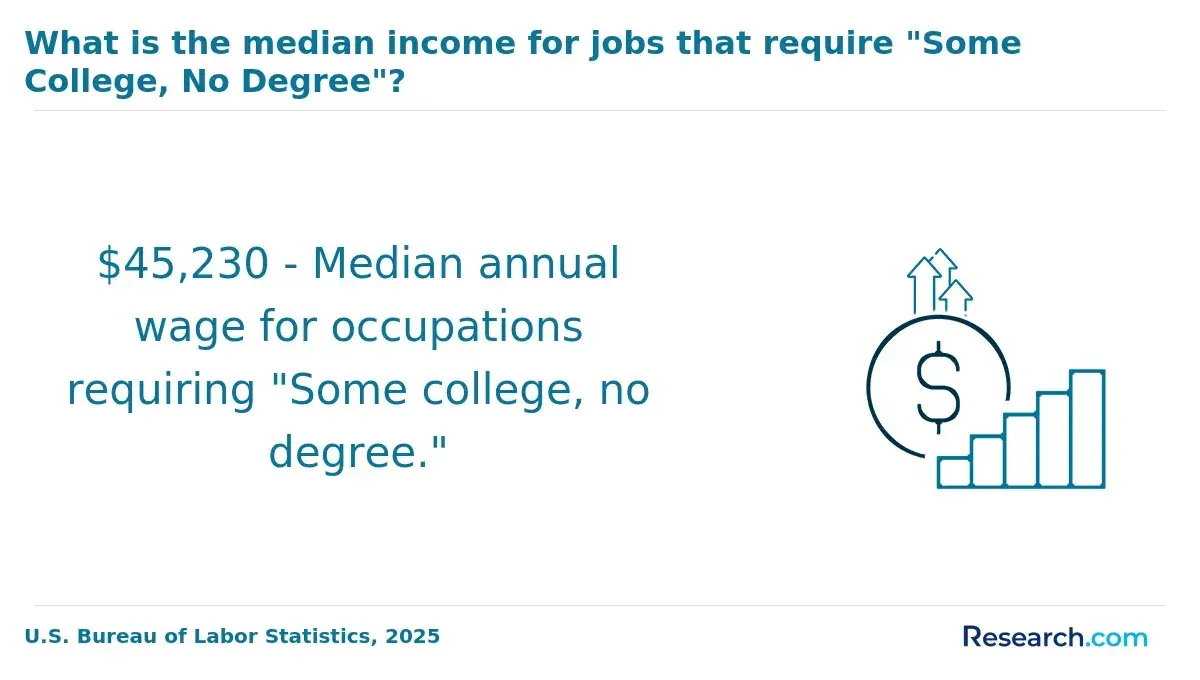
Education level is still associated with earnings, but it should not be treated as a guarantee. BLS 2024 labor force data shows median weekly earnings of $1,543 for workers age 25 and over with a bachelor's degree, compared with $1,004 for those with some college but no degree. For returning students, the practical takeaway is that finishing can improve access to roles with higher typical pay, but major choice and local labor demand matter heavily.
Career planning should begin before enrollment. Use the steps below to connect your transfer plan to realistic outcomes.
- Identify three target job titles and read current postings to see required degrees, skills, software, certifications, and experience.
- Ask the program for career outcomes by major, not institution-wide averages.
- Compare the remaining cost of the degree with salary ranges in your region and field.
- Build skills while enrolled through internships, projects, clinicals, portfolios, undergraduate research, or employer-sponsored assignments.
- Plan the next credential only if it is required or clearly valued; do not assume graduate school is always the best immediate step.
For students who already hold a bachelor's degree or who are planning beyond completion, online master's degrees may be useful in fields where advanced credentials support leadership, licensure, or specialization. Doctoral study is a separate decision; online PhD programs should be considered only when they align with research, academic, executive, or specialized professional goals.
The table below connects common returning-student goals with education paths and career considerations. It is not a salary promise; it is a planning tool for comparing options.
| Goal | Common credential path | Career consideration | Good fit when |
| Finish quickly for promotion | Degree-completion bachelor's program | Employer may value the completed credential more than the specific major | You already have experience and need a degree for advancement |
| Change careers | Career-specific bachelor's, certificate, or second-degree pathway | Prerequisites and entry-level experience may matter as much as the degree | You are willing to build a portfolio, internship record, or new technical skills |
| Enter a licensed field | Approved licensure-track program | State rules can determine eligibility for exams and practice | You have verified accreditation, clinical requirements, and state approval |
| Move into leadership | Bachelor's completion followed by selected graduate study | Graduate ROI depends on employer expectations and field norms | Your target roles commonly prefer or require advanced education |
How should returning transfer students verify licensing or certification requirements in their field?
Returning transfer students should verify licensing and certification requirements before choosing a program, especially in regulated fields. Licensure is permission from a state or board to practice a profession, while certification is usually a credential from a professional organization, employer, or industry body that validates specific skills.
Requirements vary by state, and online programs may not automatically meet the rules where you live. This is especially important for nursing, teaching, counseling, social work, psychology, accounting, law enforcement, real estate, emergency medical services, and many allied health roles.
Follow this verification process before enrolling in any licensure-related program.
- Identify the exact license or certification required for your target job title and state.
- Check the state licensing board or professional regulator for approved education pathways, exams, supervised hours, background checks, and renewal rules.
- Ask the college for written confirmation that the program meets educational requirements in your state.
- Confirm whether transfer credits, online courses, labs, clinicals, or field placements are accepted by the licensing board.
- Ask where clinical, practicum, internship, or student-teaching placements occur and who is responsible for securing them.
- Keep documentation from the school and licensing board in case requirements change during your enrollment.
A common mistake is assuming that accreditation alone equals licensure eligibility. Accreditation helps, but state approval, program design, supervised practice, exam eligibility, and background requirements can all be separate conditions.
The table below highlights fields where returning students should be especially careful before transferring credits into a new program.
| Field | What to verify | Why it matters |
| Nursing and allied health | State board approval, clinical hours, exam eligibility, and background requirements | Credits may transfer academically but not satisfy clinical or licensure standards |
| Teacher education | State-approved educator preparation, student teaching, subject exams, and reciprocity rules | Online or out-of-state programs may not meet local certification rules |
| Counseling and social work | Programmatic accreditation, supervised hours, state-specific coursework, and exam rules | Graduate admission and licensure can depend on specific accredited pathways |
| Accounting | CPA education rules, upper-division accounting credits, business credits, and state board requirements | A business degree alone may not satisfy CPA exam or licensure requirements |
| Information technology | Industry certifications, labs, portfolio expectations, and employer-preferred tools | Certification may be optional but valuable for entry or advancement in some roles |
Other Things You Should Know About
Yes, many colleges accept older credits, especially for general education or electives. However, programs in technology, science, healthcare, and business may require recent coursework for major requirements, so ask for a degree-specific credit evaluation.
It depends on your state transfer system, remaining credits, and target major. Finishing an associate degree can protect general education credits in some pathways, but transferring sooner may be better if your bachelor's major has strict prerequisites.
Usually, credits may transfer while the GPA does not calculate into the new institutional GPA. However, prior grades can still affect admission, major eligibility, financial aid satisfactory academic progress, and graduate or licensure applications.
The biggest mistake is enrolling before receiving a written transfer credit evaluation and degree plan. Without those documents, you may overestimate how close you are to graduation and underestimate the true cost of finishing.
References
- Should I Transfer Colleges? 6 Reasons You Should https://www.edvisorly.com/student-guides/should-i-transfer-colleges
- Financial Aid for Transfer Students | OEDb.org https://www.oedb.org/advice/financial-aid-for-transfer-students/
- How to Transfer Credits and Maximize What You’ve Already Done - ReUp Education https://reupeducation.com/blog/how-to-transfer-credits-and-maximize-what-youve-already-done/
- Transfer Access for All? Depends on Where You Start https://www.nists.org/post/transfer-access-for-all-depends-on-where-you-start
- Pathways and international degree transfers https://www.massey.ac.nz/study/international-students/qualifications-and-courses-for-international-students/pathways-and-international-degree-transfers/
- Hybrid College Classes: What They Are & How They Work https://beal.edu/what-are-hybrid-college-classes/
- Accredited vs. Credit-Recommended vs. Transfer Policy: What It All Means for Your College Credits https://www.straighterline.com/blog/transfer-accredited-vs-credit-recommended-vs-transfer-policy-what-it-all-means-for-your-college-credits
- Hybrid Programs- Which Students Want Them? https://encoura.org/resources/wake-up-call/hybrid-programs-which-students-want-them/
- Why Accreditation Matters | C-RAC https://www.c-rac.org/why-accreditation-matters
- Financial Aid for Transfer Students | DeVry University https://www.devry.edu/blog/financial-aid-for-transfer-students.html