2027 Summer Art Programs for High School Students: Guide for Parents, Teachers, and Students

Co-Founder and Chief Data Scientist
Choosing a summer art program is partly about talent, but it is also about fit, cost, supervision, and portfolio outcomes. The decision matters because the U.S. arts and cultural sector generated $1.1 trillion in economic activity, according to 2024 BEA and National Endowment for the Arts reporting, showing that creative skills connect to real academic and career pathways.
This guide is for parents, teachers, counselors, and students comparing pre-college, online, campus, nonprofit, and community options so they can choose a program that builds skills without overspending.
Key Things You Should Know
- Summer art programs work best when the student has a clear goal: portfolio development, skill exploration, college exposure, mentorship, or a lower-cost creative outlet.
- Costs vary widely, so families should compare tuition, housing, meals, supplies, travel, application fees, and scholarship deadlines rather than looking only at the advertised program price.
- The arts sector is large, but admissions and job outcomes depend on portfolio quality, technical skills, communication, adaptability, and sustained practice.
What are summer art programs for high school students and how do they work?
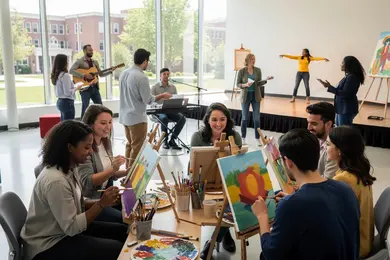
Summer art programs for high school students are short-term learning experiences that help teens develop visual, design, media, or studio skills outside the regular school year. They may be hosted by colleges, art schools, museums, community arts organizations, online education providers, or local studios. Some are selective and portfolio-based, while others are open-enrollment and designed for exploration.
Most programs combine instruction, guided studio time, critique, and a final project. The strongest ones do not simply give students more time to make art; they teach students how to make creative decisions, revise work, explain process, receive feedback, and document results. That matters because college-level art and design admissions often evaluate how a student thinks, not just whether a finished piece looks polished.
The table below explains the common operating models. It can help families quickly understand what a program actually offers before comparing price or prestige.
| Program format | How it usually works | Best fit | Possible limitation |
| Pre-college art program | Hosted by a college or art school, often with studio courses and campus activities | Students considering an art or design major | Can be expensive, especially with housing |
| Portfolio intensive | Focused on creating, editing, and presenting admissions-ready work | Rising juniors and seniors applying to art programs | May be too narrow for beginners |
| Exploratory studio camp | Introduces drawing, painting, photography, design, or mixed media | Students still testing interests | May not produce enough work for a portfolio |
| Online art program | Uses live or asynchronous instruction, digital critique, and home-based projects | Students needing flexibility or lower travel costs | Requires self-discipline and access to materials or software |
| Community or nonprofit program | Local arts centers, museums, libraries, or youth organizations provide classes | Families seeking accessible or lower-cost options | Course depth and instructor availability vary |
Students usually choose from fields such as drawing, painting, sculpture, animation, illustration, graphic design, fashion design, architecture, photography, film, game art, digital media, ceramics, or art history. A program does not need to be famous to be valuable; it needs to match the student's current level, goals, budget, and need for feedback.
What benefits do summer art programs offer for college admissions and portfolio development?
Summer art programs can help with college admissions, but they are not magic credentials. Admissions offices generally care more about the quality, originality, and development shown in a portfolio than the brand name of a summer program. A strong program helps students improve the work that colleges actually review.
The main benefit is structured critique. Many high school students create art in isolation, especially if their school has limited advanced studio courses. In a good summer program, students learn how to revise, defend choices, experiment with materials, and build a more cohesive body of work. Those habits can also help later if a student pursues advanced study, including an online masters degree in a creative, education, technology, or design-related field.
Families should think about admissions value in practical terms. The most useful programs tend to produce evidence of growth, not just a certificate of attendance:
- Portfolio improvement: Students may leave with new pieces, stronger documentation, better sequencing, and clearer artist statements.
- College readiness: Campus programs expose students to studio expectations, critique culture, deadlines, and independent work habits.
- Recommendation potential: Instructors may be able to comment on a student's process, reliability, and growth if the program is long and substantive enough.
- Major exploration: A student who likes drawing may discover animation, industrial design, architecture, or visual communication before committing to a college path.
- Confidence and vocabulary: Students learn how to discuss composition, concept, research, process, and revision in interviews or portfolio reviews.
There are limits. A costly program does not compensate for a weak portfolio, and a student should not enroll just to "look impressive." The best admissions-related reason to attend is to produce better work, receive serious feedback, and understand what college-level creative study demands.
How can families choose the best summer art program for a high school student?
The best summer art program is the one that fits the student's goal, skill level, learning style, budget, and safety needs. Prestige can matter in some cases, but it should not be the first filter. A lesser-known program with strong teaching, meaningful critique, and an affordable cost may be a better decision than a famous program that does not match the student's needs.
Use the following steps to narrow options. This sequence helps families move from big-picture goals to concrete questions before applying or paying a deposit:
- Define the student's main goal: exploration, portfolio building, college exposure, technical skill, career sampling, or creative community.
- Match the level of instruction to the student's experience; beginners often need fundamentals, while advanced students need critique and specialization.
- Review instructor qualifications, student work samples, curriculum details, critique structure, and final deliverables.
- Calculate total cost, including supplies, software, housing, meals, transportation, application fees, and optional field trips.
- Check supervision, emergency procedures, accessibility supports, housing rules, and communication policies for minors.
- Compare application requirements and deadlines early, especially if a portfolio, teacher recommendation, or scholarship essay is required.
- Ask how students receive feedback and whether they leave with documented work suitable for a portfolio or personal archive.
For students who are not sure whether art should become a college major, families can also compare art programs with broader academic options, including flexible lists of easy degrees to get online, to understand how different learning paths vary in workload, cost, and career alignment.
Common mistakes usually come from rushing the decision. Families should be especially cautious when a program uses vague promises, hides fees, provides little information about supervision, or markets itself as an admissions shortcut. A credible program should be able to explain what students will do each week, who will teach them, how feedback works, and what support is available if a student struggles.
What types of summer art programs exist, from pre-college to community options?
Summer art programs range from highly selective college experiences to open local workshops. The right type depends on whether the student needs depth, access, affordability, independence, or a low-pressure introduction to creative work.
The comparison below summarizes common options. It is useful because "summer art program" can mean very different levels of selectivity, supervision, and academic intensity.
| Type | Typical provider | Student profile | Main advantage | Key question to ask |
| Residential pre-college program | College, university, or art school | Older high school students ready for independence | Campus life, studio intensity, peer community | How are minors supervised outside class? |
| Commuter pre-college program | College or local art school | Students near the campus | College-level instruction without housing cost | Is the commute realistic for the schedule? |
| Portfolio preparation course | Art school, studio, nonprofit, or online provider | Students applying to art or design colleges | Focused critique and portfolio editing | Does the program teach concept development, not just polish? |
| Museum or nonprofit youth program | Museum, community arts center, youth organization | Students seeking access, mentorship, or local community | Often mission-driven and community-connected | Are scholarships or free materials available? |
| Community college course | Community college or continuing education division | Students who want structured classes close to home | Affordable exposure to college-style instruction | Can high school students enroll, and are credits available? |
| Online studio or digital media program | College, platform, private studio, or instructor collective | Students needing flexibility or specialized digital topics | No relocation and broader course access | Is critique live, recorded, written, or peer-based? |
A selective residential program can be worthwhile for a mature student who wants to test life at an art school. A local nonprofit or commuter class may be better for a beginner, a younger student, or a family trying to manage cost. Students with a specific interest, such as animation or architecture, should prioritize programs with that specialty rather than choosing a general art camp.
How do campus-based and online summer art programs compare in format and experience?
Campus-based and online summer art programs can both be valuable, but they create different learning experiences. The best choice depends on the student's independence, access to materials, need for peer interaction, and whether the family can manage travel and housing costs.
The table below highlights the practical trade-offs. Families can use it to decide whether the extra cost and logistics of a campus program are justified for the student's goals.
| Factor | Campus-based program | Online program | Decision guidance |
| Studio environment | Access to shared studios, equipment, labs, and campus facilities | Work happens at home using available tools and software | Choose campus for specialized equipment; choose online for flexibility |
| Peer community | Strong in-person interaction, critique, and social learning | Depends on live sessions, discussion boards, and instructor design | Social learners may benefit more from campus programs |
| Cost structure | May include tuition, housing, meals, travel, and activity fees | Usually avoids housing and travel but may require supplies or software | Compare total cost, not only tuition |
| Supervision | Requires clear residential rules, emergency policies, and staff coverage | Parents or guardians usually provide day-to-day supervision | Younger students may need stronger adult oversight |
| Portfolio output | Can support intensive making and documentation | Can be strong if critique and assignments are rigorous | Ask to see sample student outcomes from either format |
| Accessibility | May offer disability services but can involve mobility or housing barriers | May reduce travel barriers but requires reliable technology | Match format to the student's access needs |
Online programs have become more credible when they include live critique, clear assignment deadlines, recorded demonstrations, and instructor feedback. They are especially useful for students in rural areas, students with health or transportation constraints, or students exploring digital art, animation, game design, illustration, or design software. However, students who need studio equipment, in-person critique, or a taste of residential college life may gain more from a campus program.
What do students typically study in high school summer art programs?
Students typically study a mix of fundamentals and specialized media. The exact curriculum depends on the program's length and focus, but strong programs usually balance skill-building, experimentation, critique, and documentation.
These are the most common areas students may encounter. Reviewing this list can help a student choose a program that strengthens the right part of their portfolio.
- Drawing fundamentals: observation, proportion, perspective, value, composition, figure drawing, and sketchbook practice.
- Painting and color: acrylic, watercolor, oil, gouache, color theory, surface preparation, and visual mood.
- Design foundations: typography, layout, branding, visual hierarchy, user-centered thinking, and digital composition.
- Digital media: illustration software, animation, motion graphics, photo editing, video, game art, and digital storytelling.
- Three-dimensional work: sculpture, ceramics, installation, model making, product design, or spatial thinking.
- Photography and film: camera controls, lighting, editing, sequencing, visual narrative, and critique.
- Architecture or environmental design: drawing, model building, space planning, site analysis, and design presentation.
- Portfolio and presentation: photographing work, sequencing pieces, writing artist statements, and preparing for portfolio reviews.
A current trend families should notice is the rise of AI-assisted image tools. A good program should not ignore AI, but it also should not replace foundational skills with shortcuts. Students benefit most when programs discuss authorship, ethics, copyright awareness, prompt literacy, visual research, and how to use technology as part of a thoughtful creative process.
Students should also look for critique structure. A program that teaches students how to revise after feedback is usually more valuable than one that simply has students produce many finished pieces quickly. For college preparation, process work, sketchbook development, and conceptual clarity can matter as much as polished final images.
What are typical eligibility criteria, application materials, and deadlines for these programs?
Eligibility requirements vary widely. Some summer art programs accept middle and high school students by grade level, while selective pre-college programs may focus on rising juniors and seniors. Others are open to any motivated teen and do not require prior experience.
Most applications ask for some combination of the following materials:
- Basic application form with student and parent or guardian information.
- Grade level or age verification, especially for residential programs serving minors.
- Short personal statement explaining interests, goals, and preferred medium.
- Portfolio samples, often submitted as digital images, videos, or a link to an online folder.
- Teacher, counselor, or mentor recommendation for selective programs or scholarships.
- Transcript or recent report card if the program includes academic credit or college-level expectations.
- Financial aid application, tax information, or scholarship essay when need-based support is available.
- Health forms, emergency contacts, medication information, and consent forms for campus or residential programs.
Deadlines can fall months before the program begins, especially for residential pre-college programs and scholarship consideration. Families should create a calendar with three separate dates: the priority application deadline, the financial aid deadline, and the deposit or enrollment confirmation deadline. Missing the aid deadline can be more costly than missing the general application deadline.
Students should not submit every piece they have ever made. A smaller portfolio with careful selection, clear documentation, and visible range is usually stronger than a large folder of uneven work. If the program asks for 5 to 10 images, follow the instructions exactly and include titles, media, dimensions, and dates when requested.
How much do summer art programs cost, and what financial aid or scholarships exist?
Summer art program costs are not standardized, so families should ask for a complete cost breakdown before applying. A program that looks affordable at first may become expensive after adding supplies, software, travel, housing, meals, and deposit policies. Conversely, a higher advertised price may include meals, materials, museum trips, and supervised activities that other programs charge separately.
Families should compare prices in a full-cost way. Typical pricing categories may include the following:
- Free or subsidized youth arts programs offered by libraries, museums, public agencies, or nonprofits.
- Lower-cost local workshops that charge tuition plus separate supply fees.
- Community college, continuing education, or commuter programs that charge by course or session.
- Online programs that reduce travel and housing costs but may require software, tablets, cameras, or art materials.
- Residential pre-college programs that may bundle tuition, housing, meals, student activities, and supervision.
For context, College Board's 2024 Trends in College Pricing reported average published tuition and fees of $11,610 for in-state students at public four-year institutions and $43,350 at private nonprofit four-year institutions for the 2024-25 academic year. A summer program is much shorter than a full academic year, but this comparison reminds families to evaluate whether a costly pre-college experience fits the student's long-term education budget.
Financial aid can come from the program itself, a partner nonprofit, a school district, a local arts council, a museum fund, or a community foundation. Some programs offer need-based aid, merit scholarships, fee waivers, payment plans, sibling discounts, or supply support. Students should ask whether aid applies only to tuition or also to housing, meals, materials, and travel.
Cost-conscious families should also connect summer planning to college affordability. If a student is likely to pursue an art, design, education, communication, or technology-related major, comparing long-term options such as a cheap bachelor degree online can help the family keep summer spending in proportion to future tuition and credential costs.
Avoid paying a large nonrefundable deposit before reading the refund policy. Also check whether the program cancels sessions with low enrollment, whether travel insurance makes sense, and whether supplies purchased for the program can be reused for school, portfolio work, or future classes.
How do summer art programs connect to college majors and creative career pathways?
Summer art programs can help students connect creative interests to college majors and careers, but they should be viewed as exploration and preparation rather than a direct career pipeline. A student may use one program to discover whether they prefer fine arts, design, architecture, animation, art education, digital media, game design, fashion, photography, film, museum studies, or arts administration.
The U.S. Bureau of Labor Statistics' 2024 Occupational Outlook Handbook shows that creative careers vary significantly by role, industry, and technical specialization. That means students should not ask only, "Can I make a living in art?" A better question is, "Which creative role matches my skills, education plan, market demand, and willingness to keep learning technology?"
The table below connects common summer program interests with possible college and career directions. It is not a promise of employment; it is a planning tool for conversations with counselors, teachers, and admissions advisors.
| Summer art focus | Related college majors | Possible career pathways | Skills to build early |
| Drawing, painting, and mixed media | Fine arts, illustration, art education, studio art | Artist, illustrator, teacher, muralist, gallery assistant | Observation, critique, concept development, documentation |
| Graphic design and visual communication | Graphic design, communication design, marketing, UX design | Graphic designer, brand designer, production artist, UX assistant | Typography, layout, software fluency, client communication |
| Animation and digital media | Animation, game art, digital media, film, computer graphics | Animator, storyboard artist, motion designer, game artist | Storytelling, timing, digital tools, collaboration |
| Photography and film | Photography, film production, media studies, journalism | Photographer, videographer, editor, content producer | Lighting, sequencing, editing, visual ethics |
| Architecture and spatial design | Architecture, interior design, environmental design, urban studies | Architectural designer, model maker, visualization assistant | Perspective, model building, spatial reasoning, presentation |
| Fashion and product design | Fashion design, industrial design, textiles, merchandising | Fashion designer, product designer, pattern assistant, merchandiser | Research, materials, sketching, prototyping |
Students should also understand that not every creative pathway requires the same credential. Some roles expect a bachelor's degree and a portfolio, some value technical certificates or software skills, and some depend heavily on freelance experience. For students who want shorter skill-based pathways alongside art training, resources on easy licenses and certifications to get can help them compare practical credentials in adjacent fields.
The smartest career move in high school is to build a habit of making, revising, documenting, and explaining work. Employers and colleges increasingly expect creative students to combine visual skill with communication, collaboration, technology fluency, and ethical judgment. A summer program can support that growth when it gives students real feedback and not just a pleasant experience.
What safety, supervision, and accessibility considerations matter when evaluating summer art programs?
Safety and accessibility should be central to the decision, especially for residential programs serving minors. A beautiful campus or impressive course list does not replace clear supervision, emergency planning, transparent policies, and inclusive support.
Parents, guardians, and teachers should ask direct questions before enrollment. The answers will often reveal whether a program is organized and student-centered:
- Who supervises students outside class, during evenings, in residence halls, and on field trips?
- What is the staff-to-student ratio, and are staff trained to work with minors?
- How are medical needs, medications, allergies, mental health concerns, and emergencies handled?
- What are the housing arrangements, curfews, roommate policies, visitor rules, and check-in procedures?
- How does the program prevent and respond to bullying, harassment, discrimination, or unsafe behavior?
- Are studios, dorms, bathrooms, dining spaces, transportation, and field trip locations accessible?
- Can students receive accommodations for disability, chronic illness, neurodivergence, religious practice, language needs, or dietary restrictions?
- What happens if a student wants to leave early, becomes ill, or is not adjusting well?
Accessibility also includes financial, geographic, and personal circumstances. Some students may need local programs, online formats, sliding-scale tuition, trauma-informed staff, or alternative education pathways. For families navigating justice-system barriers or background-related concerns in future college planning, information on the best associate degrees for felons can be useful when comparing accessible postsecondary options later on.
Teachers and counselors can help by recommending programs that have served similar students well, reviewing portfolio materials, and checking whether the program's environment matches the student's maturity level. A student who thrives in a structured day program may not be ready for a residential experience, while a mature rising senior may benefit from the independence of campus life.
Red flags include unclear supervision, pressure to pay quickly, no named instructors, vague curriculum, no refund policy, poor communication, inaccessible facilities, or unrealistic promises about college admission. A trustworthy program should welcome questions because informed families are more likely to choose the right fit.
Other Things You Should Know About Summer Art Programs
They can be worth it when the program matches the student's goal and budget. The strongest value usually comes from critique, portfolio development, college exposure, mentorship, and access to materials or techniques the student cannot get at school.
Not always. Selective pre-college and portfolio-intensive programs often require samples of work, while exploratory camps and community programs may accept beginners. Students should follow submission instructions carefully and choose work that shows range, effort, and original thinking.
Yes, if it includes structured assignments, instructor feedback, critique, and clear expectations. Online programs can be especially helpful for digital art, illustration, animation, and students who need flexibility, but they require motivation and access to supplies or technology.
Parents should ask about total cost, refund rules, instructor qualifications, daily schedule, supervision, emergency procedures, accessibility support, portfolio outcomes, and scholarship options. For residential programs, housing rules and staff coverage are especially important.
References
- 50 Best Pre-College Summer Arts Programs For High School Students | BestCollegeReviews https://www.bestcollegereviews.org/features/pre-college-summer-arts-programs-high-school-students/
- Summer Art Portfolio Intensive Program Guide https://nyartstudio.com/blog/summer-art-portfolio-intensive-program
- Virtual vs. In-Person Summer Programs: Key Differences Explained https://www.deltainstitute.co/blog-delta-institute/virtual-vs-in-person-summer-programs-key-differences-explained
- 10 Summer Art Programs for High School Students: What to Know https://portfoliocc.com/summer-art-programs-for-high-school-students/
- Scholarships & Tuition Assistance https://www.usdan.org/scholarships
- High School Students Get an Early Start on College Portfolios Through Summer of Art Program https://www.otis.edu/about/otis-now/blog/otis-college-summer-art-portfolio-development.html
- Summer Camp 2023 | Allens Lane Art Center https://allenslane.org/summer-camp/scholarships/
- How to Choose Kids Art Camps That Feel Right https://emeraldartstudio.com/blogs/studio-stories/how-to-choose-kids-art-camps
- Scholarships & Financial Aid — Center for the Creative Arts https://www.ccarts.org/scholarships