2027 Social Work Supervision Capacity: Planning Qualified Support as Teams Grow
Audited and Verified:
Our Editorial and Data Verification Process
Research.com uses government datasets, official education statistics and primary institutional information to support its career and degree guides. Our review process checks factual accuracy, occupational definitions, source dates and the requirements associated with the credentials discussed.
How This Article Was Fact-Checked
Our editorial team verifies salary estimates, employment projections, education requirements and program information against original data providers and official organizations. Salary figures are checked against the relevant occupational definitions and reporting periods. Information about licensure, accreditation and required in-person training is reviewed separately.
Fact-checked and verified on:

Co-Founder and Chief Data Scientist
Adding social workers to a team also adds demand for case review, professional development, and - in some roles - supervision that meets clinical licensure rules. A supervisor's open calendar is not the same as capacity to provide reliable, qualified support.
This guide is for agency leaders, supervisors, and social workers evaluating a growing team. It explains how to estimate workload, check state requirements, choose between internal and external support, and budget for supervision without treating student field instruction and post-degree clinical supervision as interchangeable.
Key Things You Should Know
- Calculate capacity from protected supervisor hours, time needed per supervisee, and a reserve for documentation and urgent consultation - not headcount alone.
- Clinical licensure credit depends on the applicable state board's rules for supervisor qualifications, supervision format, experience, and records; an MSW or job title alone does not establish eligibility.
- In an illustrative schedule, six protected hours a week support four supervisees only if each requires 1.5 hours of supervision-related work weekly and no stricter rule or higher support need applies.
What is social work supervision capacity, and why does it matter as teams grow?
Social work supervision capacity is an agency's ability to provide timely, qualified, and useful oversight to everyone who needs it. That includes scheduled discussion, review of practice and documentation, consultation when risk arises, and support for professional development. For some staff, it also includes supervision that satisfies a state board's requirements for post-degree clinical experience.
Demand rises unevenly. A new hire learning agency procedures may need more review than an experienced colleague; a worker pursuing clinical licensure may need a particular supervisor and documented sessions. Count these needs separately before approving new positions or placements. Hiring from online social work degree programs does not remove an agency's responsibility to verify each new employee's preparation, role, and supervision needs.
Insufficient capacity can mean delayed decisions, rushed feedback, and missed supervision records. Protecting supervision time is therefore a staffing decision, not simply a benefit offered when schedules permit.
How do agencies calculate social work supervision capacity and supervisor-to-supervisee ratios?
Start with each supervisor's protected weekly hours, not their nominal full-time schedule. Subtract meetings and duties that cannot be moved. Then estimate scheduled supervision, preparation, record review, documentation, and a reserve for unscheduled consultation. Finally, check whether a board, field program, contract, or agency policy imposes a stricter limit.
For example, six protected hours divided by an illustrative 1.5 hours of supervision-related work per supervisee yields capacity for four people. That is a planning calculation, not a recommended or legally permitted supervisor-to-supervisee ratio. If one person needs intensive onboarding or the supervisor also oversees students, recalculate rather than assigning everyone the same allowance.
A simple capacity register makes the calculation auditable. Record who needs workplace oversight, academic field instruction, or licensure-qualifying supervision; identify the qualified person responsible for each; and compare required time with hours actually protected on that person's calendar. Agencies hosting students can use MSW programs with organized practicum resources as a prompt to ask schools exactly what the agency field instructor must provide.
Who qualifies to supervise social workers pursuing clinical licensure?
The licensing board in the jurisdiction where experience is being claimed determines who qualifies. Rules may address the supervisor's license category and status, clinical experience, training, disciplinary history, and relationship to the supervisee. Some boards require registration or approval before supervised work begins. An experienced manager or MSW graduate does not automatically meet those conditions.
Before pairing people, confirm the supervisee's current license or registration status, intended license category, work location, permitted activities, and the board's supervisor criteria. Obtain any required approval in writing and retain it with the supervision plan. Clinical coursework - including clinical social work master's preparation - supports learning but does not replace board-approved post-degree experience or authorize independent practice.
States can differ on the amount and timing of supervised experience, the required frequency and format of meetings, how group supervision counts, the number of participants allowed, and which records must be signed. Rules may also distinguish direct clinical work from other employment duties. An agency should never apply one state's template to every supervisee.
For each licensure track, check the board's current statutes, regulations, application instructions, and forms before counting hours. Build the required session details, experience categories, supervisor signatures, and submission deadlines into the agency record system. Audit records while the work is underway; reconstructing years of meetings from calendars may leave gaps a board will not accept.
For staff choosing a degree or work location, checking online MSW alignment with licensing goals is a useful starting point. The board - not a program description - decides whether an individual's education and supervised experience meet its requirements.
Requirements depend on what the person will supervise. A workplace supervisor needs competence in the team's services, ethical decision-making, feedback, and agency procedures. An MSW field instructor must meet the university's approved field-instruction criteria and coordinate with its field office. A clinical licensure supervisor must meet the applicable board's separate requirements. One person may fill several roles, but qualification for one does not establish qualification for all.
Developing supervisors may need training in observation and feedback, cultural responsiveness, confidentiality, documentation review, and responding to concerns about performance. Check whether the board mandates specific supervisor training or continuing education. A DSW or PhD is not ordinarily a substitute for a required license or board approval; leaders considering affordable online social work doctorates should assess those degrees against a distinct leadership, practice-improvement, or research goal rather than assume they increase licensure-supervision capacity.
Individual meetings give a supervisor room to review one worker's decisions and development. Groups can support shared learning and make some discussion time more efficient, but they still require preparation and meaningful participation from each person. Virtual meetings may reduce travel and help geographically dispersed teams, while introducing privacy, technology, and jurisdiction questions. None of these formats automatically qualifies for clinical licensure credit.
Use the board's rules to determine what counts, then assess what the worker actually needs. A group meeting should not become a substitute for private discussion of a performance concern or sensitive case issue. For student placements - including those connected to BSW program selection for prospective students - the school's field office must confirm acceptable field-instruction arrangements; online classes do not make on-site learning or approved supervision optional.
First, determine the bottleneck. If existing supervisors are qualified but overbooked, reduce competing duties or hire additional qualified staff. If no one holds the required clinical qualification, an external supervisor may fill that specific gap - provided the board permits the arrangement and the agency can support appropriate access to practice information.
Before contracting, assign responsibility for case consultation, emergencies, performance management, record access, confidentiality, payment, and supervision documentation. An external supervisor who meets a board requirement does not automatically replace day-to-day agency oversight. When planning a graduate hiring pipeline, shorter graduate pathways in social work may affect when candidates become available, but graduation timing does not determine whether they are licensed or ready for independent clinical duties.
Students should compare the field arrangement they will actually receive, not assume online or campus delivery determines its quality. Verify the specific program's CSWE accreditation status and applicable cohort, then ask the field office who finds sites, approves instructors, supports placements in the student's location, and intervenes if a site loses its supervisor. Institutional accreditation and CSWE programmatic accreditation answer different questions.
The comparison below separates features that are easy to confuse when evaluating a placement.
| Feature | What to compare | Why it matters |
| Site and instructor approval | Program criteria and responsibility for finding an eligible instructor | A convenient site may not meet field requirements. |
| Student support | Faculty liaison contact, feedback process, and disruption policy | Problems need a route to resolution during the placement. |
| Schedule and location | Agency hours, live seminars, travel, and any campus visits | Online coursework does not eliminate scheduled field learning. |
| Employment-based placement | Approval process and distinction between learning tasks and ordinary duties | A paid job does not automatically count as field education. |
Ask for policies applicable to your entry term and location. Students weighing choosing between two MSW study pathways should also confirm which field sequence applies to their approved route. Academic field hours and later post-degree clinical licensure hours serve different purposes.
What are social work supervisors' career options, salaries, and job outlook?
Experienced social workers may move into field instruction, clinical supervision, team leadership, program management, or training roles. The fit depends on their license, practice background, interest in coaching, and the agency's staffing model. Supervisory work adds responsibility for feedback, ethical consultation, and operational decisions; it is not necessarily a promotion away from all direct practice.
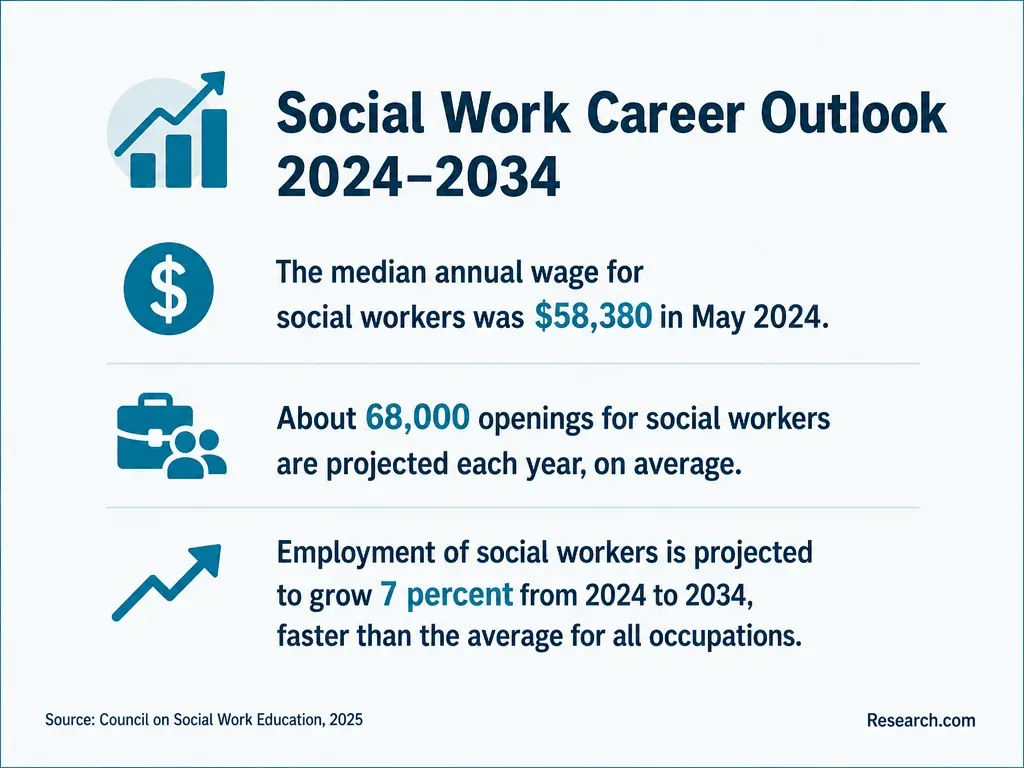
The U.S. Bureau of Labor Statistics reports a May 2025 median annual wage of $61,780 for social workers across specialties and projects 6% employment growth from 2025 to 2035. These figures describe the broad occupation, not a supervisor pay scale or a guaranteed raise. Agency setting, location, bargaining agreements, license requirements, and management duties can matter more to an individual offer. For geographic context, comparing pay locations for master's-prepared social workers can inform research, but applicants should request the actual position's salary range and supervision workload.
Other Things You Should Know About Social Work
Yes. Raise concerns through the agency's designated process and, for licensure supervision, check whether the board restricts the relationship. Address the issue early rather than assuming signed hours will resolve it.
Use the agency's coverage and escalation plan for immediate practice needs. For licensure credit, confirm whether a replacement must be approved before supervising or signing hours; do not assume missed sessions can be counted later.
Follow applicable law, agency consent and privacy policies, and professional obligations. Explain relevant uses of client information without promising confidentiality protections the agency cannot provide.
No. Staff need a way to obtain timely guidance between meetings, especially when a situation exceeds their authority or experience. Follow agency safety and escalation procedures rather than waiting for the next session.
- Title 201 Chapter 23 Regulation 070 | Legislative Research Commission https://apps.legislature.ky.gov/law/kar/titles/201/023/070/
- Supervision FAQs | Texas Behavioral Health Executive Council https://bhec.texas.gov/tbhec/supervision-faqs/
- Using and Providing Supervision - Office of the Professions - Nysed https://www.op.nysed.gov/professions/social-work/using-and-providing-supervision
- Levels and Eligibility Requirements | North Carolina Social Work Certification and Licensure Board https://www.ncswboard.gov/levels-and-eligibility-requirements/
- Social Work Supervision | Counselor and Social Worker Board https://cswmft.ohio.gov/for-professionals/resources-for-professionals/social-work-supervision
- Rapid Review of Reflective Supervision in Social Work | oup.com https://academic.oup.com/bjsw/article/53/4/1945/6884098
- School Social Work Supervision | nyssswa.org https://nyssswa.org/school-social-work-supervision/
- Clinical Supervision | abcsw.org https://www.abcsw.org/clinical-supervision
- Social Work Supervision in Illinois | NASW-Illinois Chapter https://www.naswil.org/supervision
- Connection Interrupted - | NBCC https://www.nbcc.org/resources/nccs/newsletter/understanding-proper-documentation-of-supervision