2027 Social Work Program Risk Registers: Identifying Operational and Service Risks
Audited and Verified:
Our Editorial and Data Verification Process
Research.com uses government datasets, official education statistics and primary institutional information to support its career and degree guides. Our review process checks factual accuracy, occupational definitions, source dates and the requirements associated with the credentials discussed.
How This Article Was Fact-Checked
Our editorial team verifies salary estimates, employment projections, education requirements and program information against original data providers and official organizations. Salary figures are checked against the relevant occupational definitions and reporting periods. Information about licensure, accreditation and required in-person training is reviewed separately.
Fact-checked and verified on:

Co-Founder and Chief Data Scientist
A missed referral, an unavailable supervisor, and a privacy breach can all disrupt a social work program, but they require different responses. A risk register helps agency leaders and field education partners identify such problems before they harm clients, students, staff, or service continuity.
This guide explains what to record, how to prioritize operational and service risks, and who should act on them. It is designed to help social services professionals turn a list of concerns into a manageable decision tool - not another document that sits unused.
Key Things You Should Know
- A useful register records each risk's cause, potential effect, existing controls, owner, response, review date, and evidence that the response worked.
- Track operational risks, such as staffing or system outages, separately from service risks, such as delayed referrals or unsafe handoffs; one event may create both.
- An illustrative 1-to-5 likelihood and impact scale can help sort risks, but credible threats to client safety or rights need prompt escalation even when a calculated score is low.
What is a social work program risk register?
A social work program risk register is a maintained record of uncertain events that could interfere with a program's objectives. Those objectives might include timely access to housing support, safe child welfare services, reliable field instruction, or protection of confidential information. Unlike an incident log, which records something that happened, a risk register anticipates what could happen and documents a planned response. An incident can, however, reveal a new risk or show that an existing control failed.
"Program" may mean an agency service or a BSW/MSW educational program. Define its boundaries first: an agency can own its referral process, while a university typically owns academic placement approval. The two organizations may share a concern but have different responsibilities. Prospective students using planning applications to accessible MSW programs should likewise distinguish admission accessibility from evidence of sound field supervision and student-support processes.
The register is a management tool, not a substitute for a safeguarding report, emergency procedure, clinical record, or legal compliance review. Keep identifying client details in the authorized system, not in a broadly shared risk spreadsheet.
What operational risks should social work programs include in a risk register?
Operational risks concern whether the program has the people, funding, systems, partnerships, and procedures needed to function. They matter because even a well-designed intervention cannot reach clients when the underlying operation fails. The following comparison separates a possible failure from the effect it could have; local evidence should determine whether each belongs on a particular register.
The examples show how an operational issue can create a measurable service consequence without assuming that it has occurred at any given agency.
| Operational risk | Possible warning sign | Potential program effect |
| Staffing or supervision gap | Unfilled positions or repeated supervision cancellations | Longer waits, unsupported decisions, or placement disruption |
| Funding interruption | Grant renewal uncertainty or spending above plan | Reduced service hours or loss of a referral partner |
| Record-system outage | Recurring downtime or unresolved access problems | Delayed documentation and coordination |
| Field-site capacity loss | A partner can no longer provide approved learning tasks | Interrupted competency development or placement changes |
Other setting-specific risks include transport, inaccessible facilities, staff safety, vendor failures, and unclear decision authority. For an educational program, student costs and placement capacity can interact: lower tuition does not fix an unworkable field schedule. Students comparing lower-cost MSW pathways should examine field-related expenses and support alongside the published price.
What service delivery risks should social work programs track?
Service delivery risks concern what clients and communities experience: delayed access, an incomplete assessment, a failed handoff, an inaccessible service, or an intervention outside a worker's role. Assess both immediate safety consequences and less visible harms, such as lost trust or repeated exclusion of people who cannot use a digital intake system.
Write risks as specific cause-and-effect statements. "If referral capacity is not confirmed before a case closes, a person may lose continuity of support" is more useful than "referral risk." Potential indicators include unconfirmed referrals, missed follow-ups, complaints about language access, or recurring documentation corrections. Interpret these alongside caseload and community context; a low complaint count does not prove that a service is accessible.
When students participate in services, include risks arising from unclear task boundaries, unavailable instruction, and weak handoffs between the agency and university. A student or prospective student assessing MSW field placement support and student responsibilities should ask who approves the site, provides field instruction, and responds if a placement becomes unsafe or unsuitable. Academic field instruction does not replace an agency's responsibility for client safety.
A practical approach rates likelihood and impact on clearly defined scales - for example, 1 to 5 for each - and combines them to sort risks for discussion. This is an illustrative local method, not an evidence-based probability calculation. Define what each level means for the program, including client safety, rights, service interruption, financial loss, and educational consequences. Record both the risk before controls and the remaining risk after existing controls, if the organization uses those distinctions.
A score must not override professional judgment. A credible threat of serious harm, a suspected privacy breach, or a potential reporting obligation may require immediate action under agency procedures even if it seems unlikely. Conversely, several modest delays affecting a large population may deserve priority because their cumulative effect is substantial. Note confidence in the evidence: "unknown because referrals are not tracked" is not the same as "low likelihood."
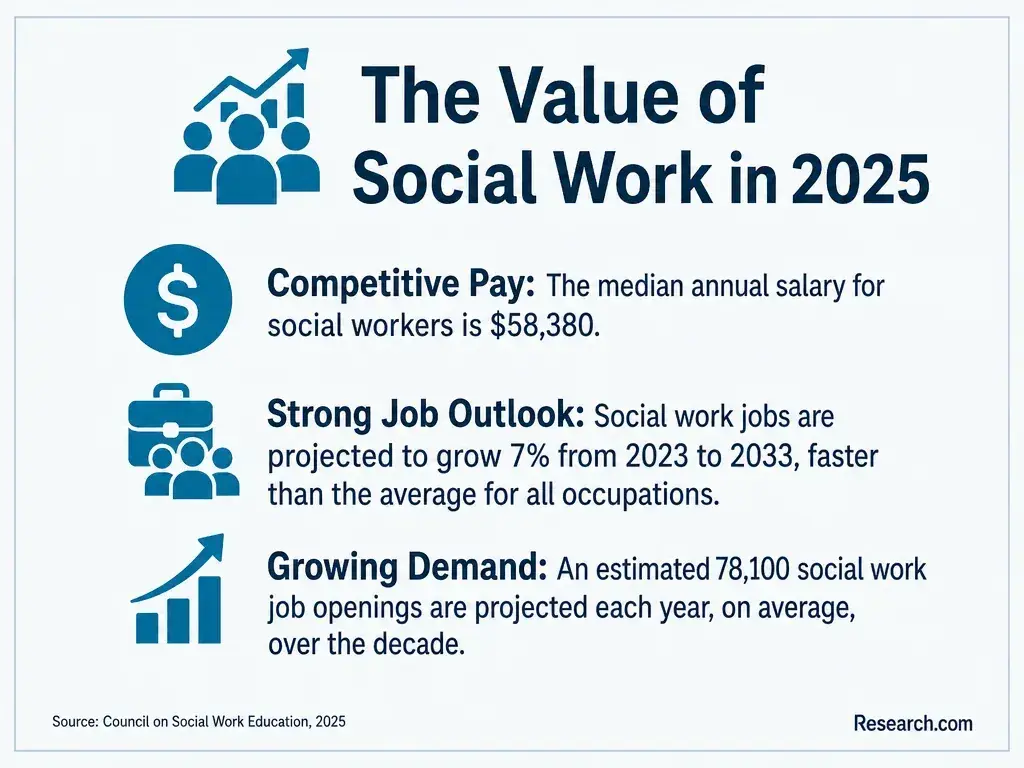
Staffing assumptions also need local evidence. The U.S. Bureau of Labor Statistics reports a May 2025 median annual wage of $61,780 for social workers across specialties, but that national occupational figure is not a local hiring budget or a predictor of turnover. Use actual vacancies, recruitment time, and compensation data when available; social worker earnings and location considerations can provide broader context without replacing local analysis.
Assign one owner with authority to coordinate each response, even when several teams contribute. An intake manager might own referral delays; an information-security lead might own system access; a field director might own placement-capacity planning. The owner is accountable for progress, not automatically responsible for personally performing every task. Name an escalation route when a response needs executive funding, clinical consultation, university approval, or a partner's decision.
Review frequency should match the risk and the pace of change. A high-consequence issue with a changing trigger may need attention at each operational meeting; a stable lower-priority issue may fit a scheduled quarterly review. At each review, check the warning sign, whether controls operated as intended, what remains unresolved, and whether the owner or deadline must change. Close an entry only when the threat has ended or has been accepted through the organization's authorized process - not simply because a task was completed.
Students may help analyze de-identified patterns through approved learning or work arrangements, but an assistantship does not make a student the accountable owner of agency safeguards. Those comparing assistantship opportunities for online social work students should verify the role's supervision, data access, and duties separately from field placement approval.
Which social work careers involve managing program and service risks?
Risk management appears in many roles, but the authority to change a program differs. A case manager may flag failed referrals and follow escalation procedures; a clinical supervisor may address practice and supervision concerns; a field director may manage placement continuity; and a program manager or quality-improvement lead may own cross-team controls and reporting. Public-sector administrators may also have formal accountability for budgets, contracts, and policy implementation.
Match the target job to its required education, license, experience, and decision authority. Some operations and evaluation positions accept public administration, public health, or human services preparation rather than a social work degree. Clinical roles can require state-specific licensure and supervision; a management title does not expand clinical scope. For someone with existing agency experience, training in data governance, process improvement, or supervision may be more direct than another degree. For someone entering regulated practice, check the actual employer and board requirements first.
The MSW education and career pathway connections can help readers place program leadership alongside direct-practice options. When evaluating a job, ask which risks the role can actually resolve, what support is available, and who carries final accountability.
Other Things You Should Know About Social Work
Usually not. A controlled spreadsheet or document may suffice if authorized staff can update it, restrict access, track owners and dates, and find the latest version. Choose software when coordination or audit needs justify it.
Check the agreement and agency approval process first. A funder may need a summary of material risks and responses, not unrestricted access to internal deliberations or confidential information.
Use accessible feedback methods and explain how input will be used. Invite perspectives on barriers and unintended effects without asking participants to disclose private case information in a group setting.
No. An incident report documents an event under the applicable agency procedure. The register tracks potential future problems and planned controls; incident trends may prompt a register update.
- Development of a risk assessment and risk management tool for an academic research organization - PMC https://pmc.ncbi.nlm.nih.gov/articles/PMC10388373/
- Refugee and migrant health | who.int https://www.who.int/news-room/fact-sheets/detail/refugee-and-migrant-health
- Summary of the HIPAA Security Rule | hhs.gov https://www.hhs.gov/hipaa/for-professionals/security/laws-regulations/index.html
- NASW Standards for Social Work Case Management | nycourts.gov https://www.nycourts.gov/reporter/webdocs/nasw_standards_socialwork_casemgt.htm
- Risk criteria examples | vmia.vic.gov.au https://www.vmia.vic.gov.au/risk-criteria-examples
- How to Rate Impact for Risk Assessments | Information Technology Services https://its.wsu.edu/information-security-services/policies-standards-and-procedures/how-to-rate-impact-for-risk-assessments/
- A systematic analysis of failures in protecting personal health data: A scoping review - ScienceDirect https://www.sciencedirect.com/science/article/pii/S0268401223001007
- Risk assessment process and key points to risk identification in virtual interactions - SCIE https://www.scie.org.uk/social-work/advice-best-practice/risk-assessment-process/
- Managing safeguarding risks | NCVO https://www.ncvo.org.uk/help-and-guidance/safeguarding/certain-roles/director-operations/managing-risks/