2027 Peer Review in Social Work Research: What It Adds and What It Cannot Guarantee
Audited and Verified:
Our Editorial and Data Verification Process
Research.com uses government datasets, official education statistics and primary institutional information to support its career and degree guides. Our review process checks factual accuracy, occupational definitions, source dates and the requirements associated with the credentials discussed.
How This Article Was Fact-Checked
Our editorial team verifies salary estimates, employment projections, education requirements and program information against original data providers and official organizations. Salary figures are checked against the relevant occupational definitions and reporting periods. Information about licensure, accreditation and required in-person training is reviewed separately.
Fact-checked and verified on:

Co-Founder and Chief Data Scientist
A peer-reviewed article can look like strong evidence for a social work intervention, policy, or agency decision. But publication tells you that a journal evaluated the manuscript - not that its findings will hold for every client or setting. For students, researchers, and practitioners facing a growing volume of published and rapidly shared research, that distinction matters.
This guide explains what reviewers check, what they can miss, and how to decide whether a study deserves weight in an assignment, program evaluation, or practice decision.
Key Things You Should Know
- Peer review is a quality check on a manuscript's methods, reasoning, ethics reporting, and contribution; it is not an independent replication of its findings.
- A useful study needs more than a peer-reviewed label: check its design, sample, measures, limitations, and fit with the population and setting you serve.
- Journal peer review, social work program accreditation, and state licensure assess different things; none substitutes for the others.
What is peer review in social work research?
Peer review is a journal's evaluation of a submitted manuscript by scholars or practitioners with relevant expertise. Reviewers assess whether the question matters, the methods are appropriate, the claims follow from the evidence, and the work contributes something worth publishing. An editor makes the publication decision; reviewers advise the editor.
Social work research includes intervention studies, interviews with service users, administrative-data analyses, policy research, and program evaluations. Reviewers therefore need to judge both technical quality and social work concerns such as structural context, community participation, confidentiality, and the implications of findings for people receiving services. Standards vary by journal and article type.
Peer review is relevant beyond a research career. A practitioner considering exploring affordable online DSW education, for example, should distinguish learning to appraise published evidence from learning to conduct and publish an applied study; a program's actual curriculum determines how much preparation it provides for each.
How does peer review improve social work research?
Good reviewers can identify a mismatch between a study's question and its design, ask authors to explain how participants were recruited, challenge unsupported causal claims, and request clearer reporting of missing data or ethical safeguards. Authors may then revise the analysis, narrow their conclusions, or make limitations more visible. Editors can reject work when the problems cannot be resolved.
That scrutiny is particularly valuable when research will influence services. A study of an agency intervention may report improved outcomes, but a reviewer can ask whether participants also received other support, whether people who left the program were counted, and whether the measures reflect outcomes clients value. Peer review cannot answer every question, but it can make these uncertainties easier for readers to see.
Students learning in agencies can practice the same habits when considering what evidence supports a field project. Those exploring MSW programs with practicum assistance can ask how field instructors help students connect published findings to the needs and constraints of an actual placement.
What can peer review not guarantee about a study?
Reviewers usually assess the material authors submit; they do not routinely observe services, audit every original record, or repeat the analysis. Publication cannot guarantee that data are accurate, a result will replicate, an intervention caused an observed change, or findings apply to a different population.
These distinctions help readers avoid giving a published conclusion more weight than its design supports.
| What peer review may assess | What publication does not establish |
| Whether a sample and recruitment process are described | That the sample represents all clients or communities |
| Whether the analysis is explained and plausible | That unmeasured factors cannot explain the result |
| Whether ethics and consent procedures are reported | That every practice or privacy concern has been resolved |
| Whether conclusions match reported findings | That an agency can achieve the same outcome with its staffing and resources |
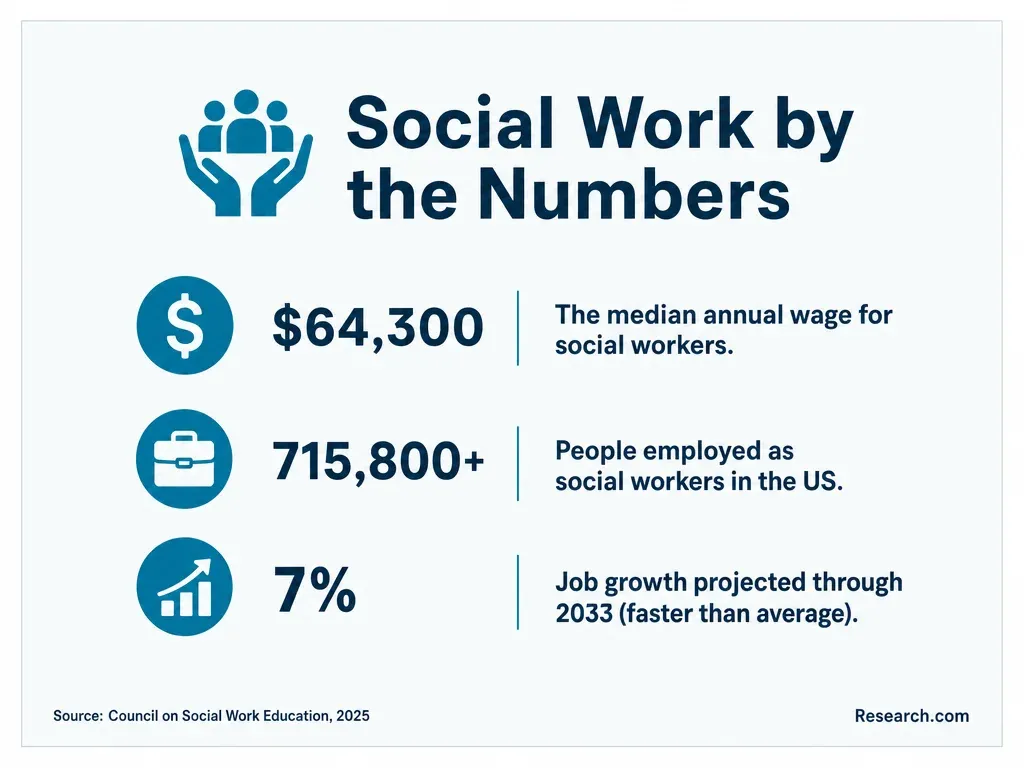
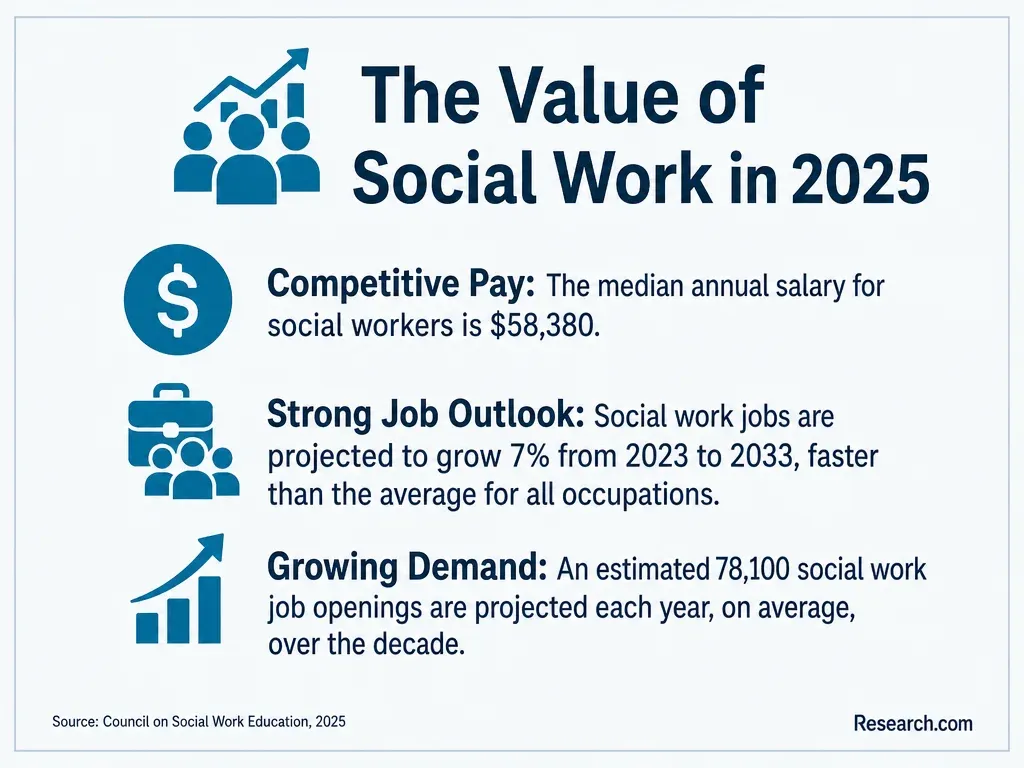
A peer-reviewed study of social work earnings, for instance, could describe an association without predicting an individual graduate's pay. Readers making geographic career decisions need current, occupation-appropriate information alongside research; MSW earnings and geographic career planning should not be reduced to one study's average.
Reviewers and editors bring expertise, but they also bring assumptions. They may favor familiar theories, quantitative methods, well-known institutions, statistically significant results, or interventions that fit prevailing practice. Reviewers with relevant experience may be difficult to recruit for research centered on a small community or a less-studied service setting. Anonymous review can reduce some reputation effects, but it cannot remove every bias.
Bias can also arise before submission. If agencies lack resources to collect data, or journals prefer positive findings, the published literature may underrepresent unsuccessful programs and community-defined outcomes. A collection of peer-reviewed articles can therefore give an incomplete picture of what works in routine services.
When considering exploring professional opportunities after MSW study, do not assume research concentrated in clinical settings describes school, housing, policy, or community-organizing work equally well. Look for whose perspectives and working conditions the evidence includes.
How does journal peer review differ from social work program accreditation and licensing?
Journal peer review evaluates a manuscript. Program accreditation evaluates an educational program against an accreditor's standards; for US social work education, CSWE programmatic accreditation is a separate matter from a university's institutional accreditation. A state licensing board determines whether an applicant meets that jurisdiction's requirements and what practice a license permits.
These checks cannot be substituted for one another. Citing peer-reviewed articles does not establish that a degree program is accredited. Graduating from an accredited program does not make every study a graduate cites reliable, and neither publication nor graduation issues a license. If education is intended to support licensure, confirm the applicable board's rules and the program's status for the relevant cohort. A starting point for that separate decision is MSW programs and state licensure education requirements.
Other Things You Should Know About Social Work
Check the instructor's rules. A preprint can be useful for emerging research, but label it as not yet peer-reviewed and avoid treating its findings as settled.
No. A systematic review can synthesize multiple studies, but its value depends on its search, inclusion criteria, appraisal, and the quality and relevance of the studies it contains.
Often, yes. Authors may be able to share a permitted version. Your library can also help you find lawful access when the publisher's version is unavailable.
Follow the agency's and any affiliated institution's review procedures. Whether a project needs formal review depends on its purpose, activities, data, and applicable policies; do not make that determination solely from its "program evaluation" label.
- Indigenous approaches to evaluation and research | justice.gc.ca https://www.justice.gc.ca/eng/rp-pr/jr/eiaer-eaame/approaches-approches.html
- The limitations to our understanding of peer review - PMC https://pmc.ncbi.nlm.nih.gov/articles/PMC7191707/
- Mitigating Bias in the Peer and Merit Review Processes | cihr-irsc.gc.ca https://cihr-irsc.gc.ca/e/54538.html
- Definition of Research Misconduct | The Office of Research Integrity https://ori.hhs.gov/definition-research-misconduct
- What is Peer Review? - Social Work https://libguides.sunysccc.edu/socialwork
- Peer Review | Research and Innovation | Western Michigan University https://wmich.edu/research/compliance/ethicscenter/peer
- Ask the expert: Peer review, what it is and why it matters | MSUToday https://msutoday.msu.edu/news/2025/09/ask-the-expert-peer-review
- Peer Review & Evaluation - Social Work Research https://guides.lib.utexas.edu/socialwork/peerreview
- Types of Peer Review | Wiley https://authors.wiley.com/Reviewers/journal-reviewers/what-is-peer-review/types-of-peer-review.html
- Guidance for preparing a review | apa.org https://www.apa.org/pubs/journals/resources/preparing-peer-review