2027 Post-MSW Clinical Supervision in Colorado: Supervisor Approval, Records, and Work Settings
Audited and Verified:
Our Editorial and Data Verification Process
Research.com uses government datasets, official education statistics and primary institutional information to support its career and degree guides. Our review process checks factual accuracy, occupational definitions, source dates and the requirements associated with the credentials discussed.
How This Article Was Fact-Checked
Our editorial team verifies salary estimates, employment projections, education requirements and program information against original data providers and official organizations. Salary figures are checked against the relevant occupational definitions and reporting periods. Information about licensure, accreditation and required in-person training is reviewed separately.
Fact-checked and verified on:

Co-Founder and Chief Data Scientist
A post-MSW job can move you toward Colorado LCSW licensure only if the work, supervision, and records satisfy the state board's requirements. That makes the offer you accept - and the supervisor you arrange before starting - more important than the job title alone. This guide is for new MSW graduates and early-career social workers planning clinical practice in Colorado. It explains the hour thresholds, how to evaluate supervisors and settings, what to document, and which details to confirm with the Colorado State Board of Social Work Examiners before relying on your hours.
Key Things You Should Know
- Colorado's LCSW pathway generally requires 3,360 hours of post-degree supervised experience over at least 24 months, including 1,680 hours of qualifying clinical practice, plus 96 hours of supervision; confirm the rules that apply when you apply.
- Arrange an eligible supervisor and appropriate Colorado credential before providing clinical services. An MSW field instructor, workplace manager, or independently licensed clinician is not automatically an eligible LCSW supervisor.
- Keep a contemporaneous record of clinical duties, hours, supervision format, supervisor credentials, and employment dates. A job title or total hours worked alone will not establish that experience qualifies.
How many supervised hours are required for Colorado LCSW licensure?
Colorado's LCSW experience standard generally calls for 3,360 hours of post-degree supervised experience accumulated over at least 24 months. Within that experience, candidates need 1,680 hours of qualifying clinical practice involving direct client contact and 96 hours of supervision, including at least 48 hours of individual supervision.
Verify the current definitions and any limits on group supervision in the board's rules and application materials before building your schedule.
These are separate tests: reaching 3,360 paid hours does not establish that 1,680 were qualifying clinical hours, and finishing the hour totals in less than 24 months does not eliminate the minimum time period. At 40 hours a week, 3,360 hours represents 84 full-time workweeks before leave or nonqualifying time; the calendar requirement still applies. A part-time role may take longer.
Graduate field placement, coursework, and pre-degree employment serve different purposes and should not be entered as post-MSW experience. For a broader way to organize planning supervised experience in a social work career, start with the hours and activity categories your licensing board actually uses.
Who can supervise post-MSW clinical experience in Colorado?
Do not select a supervisor by job title alone. Confirm that the proposed supervisor holds a current, appropriate independent clinical license, meets Colorado's profession-specific supervisor qualifications, and can oversee the clinical social work you will perform.
The Colorado State Board of Social Work Examiners - not an employer or university - determines whether supervision satisfies its licensure rules. A clinician who is excellent at mentoring may still be ineligible to verify particular LCSW experience.
Before the first supervised shift, ask for the supervisor's license type and number, issuing jurisdiction, status, and any required experience as a licensed clinician. Confirm which services they will review, how often you will meet, how emergencies and absences will be handled, and whether they will sign the board's verification.
If a proposed supervisor is licensed in another profession or state, request clarification from the board rather than assuming that clinical independence makes them eligible.
An MSW field instructor oversees educational learning under a school's rules; that designation does not itself establish eligibility to supervise later LCSW hours. When comparing advanced standing vs standard MSW coursework, keep either track's field experience separate from the post-degree supervision arrangement.
How do Colorado LCSW candidates document supervised experience?
Build records as the experience occurs rather than reconstructing them at application time. Use the board's current experience-verification and application instructions to determine which forms a supervisor must complete; maintain your own dated log so you can reconcile those forms before either of you changes jobs.
A practical log separates the categories the board will need to assess:
- Employment dates, setting, role, weekly hours, and periods of leave.
- Qualifying direct clinical practice hours, distinguished from other work hours.
- Each supervision meeting's date, duration, individual or group format, supervisor, and clinical focus - without identifying clients in a personal log.
- Supervisor license details and any change in supervisor, duties, credential, or work location.
Review totals with your supervisor regularly and retain employment records that support dates and duties. Store any client information only in authorized agency systems.
If a supervisor leaves unexpectedly, ask the employer and board how to verify the period already completed; an unsigned retrospective estimate is a weak substitute for contemporaneous records. Schools may help students compare social work placement support policies, but university field records do not replace documentation of post-degree clinical employment.
Colorado candidates may find potentially suitable clinical work in community mental health, hospitals, substance use treatment, integrated care, or other agencies that provide clinical social work services. The setting's name does not make every hour count. What matters is whether your authorized duties include qualifying clinical practice, the required supervision is available, and the experience can be documented under board rules.
Compare offers by their actual caseload and supervision arrangements. A hospital discharge-planning job may offer valuable social work experience but little qualifying clinical practice; a behavioral health job may provide substantial direct work yet lack an eligible supervisor.
Ask the employer to identify anticipated clinical duties, expected direct-contact hours, supervisor availability, documentation access, and whether the organization permits supervision by someone outside the agency.
If the role is primarily outreach, benefits navigation, policy, or administration, it may be better suited to a nonclinical goal. Comparing clinical and nonclinical MSW career directions can help you decide whether LCSW supervision is necessary for the work you want to do.
Start with a qualifying MSW and determine which Colorado social work credential you need for the position and services you will provide. Colorado has distinct pathways for social work candidates, licensed social workers, and licensed clinical social workers; an MSW diploma or an application in progress is not itself authorization to practice independently.
Check the board's current education, application, examination, and credential rules before counting work toward an LCSW application. Ask the employer which credential must be active on your start date, which clinical duties it permits under supervision, and whether billing or payer rules impose additional restrictions.
If your degree was earned outside a conventional U.S. accredited MSW pathway, obtain an eligibility determination rather than assuming the employer's acceptance of the degree settles licensure eligibility. This distinction also matters when considering MSW entry options beyond highly selective programs: ease of admission does not determine whether a program's graduates meet Colorado's licensing requirements.
Qualifying clinical experience centers on supervised clinical social work with clients, such as assessment, diagnosis or treatment activities performed within your current credential's lawful scope and the agency's policies.
Keep direct client-contact time distinct from related but different work, including scheduling, general case coordination, staff meetings, training, and paperwork. Those duties may be part of an appropriate job without all qualifying toward the clinical-practice component.
Ask your supervisor to review the board's definitions against your real assignments - not a generic job description. For example, a role that combines psychotherapy sessions, care coordination, and documentation needs a consistent way to categorize each activity. Telehealth client contact should be evaluated under current board requirements and applicable practice rules rather than automatically included or excluded.
A clinical MSW education and professional development guide can help identify preparation gaps, but clinical coursework or a concentration cannot substitute for qualifying post-degree practice or expand the scope of a candidate credential.
Remote and group meetings can affect whether supervision counts, so confirm the board's current rules before relying on either format. Colorado's 96-hour supervision requirement includes at least 48 hours of individual supervision; group meetings cannot replace that individual minimum. Ask how the board defines acceptable real-time remote supervision, group size, supervisor presence, and documentation of meeting format.
Also check whether an employer permits discussion of clinical work through its approved, confidential video systems. Working from home does not remove client-privacy obligations or make an informal video call an adequate supervision arrangement. An online degree or shorter graduate pathway in social work likewise does not shorten Colorado's post-degree minimum experience period.
First ask prospective employers whether qualified clinical supervision is included in paid work time. Compare that benefit with an otherwise attractive offer that expects you to locate, schedule, and pay an outside supervisor. An outside arrangement may improve access or continuity, but it needs employer permission where clinical records or case discussions are involved and must satisfy board rules.
When interviewing potential supervisors, request their credentials, availability, fee structure, cancellation policy, approach to reviewing clinical decisions, and willingness to complete verification forms.
Calculate the cost against the required supervision schedule - not just an hourly fee - and account for unpaid meeting time or travel. Get the arrangement in writing and clarify what happens if your caseload or supervisor changes.
Graduate tuition and post-degree supervision are different expenses. An online social work master's affordability guide may help someone still choosing a degree, but a graduate comparing jobs should prioritize the employer's actual supervision support and total out-of-pocket cost.
Reconcile your dates, total experience, qualifying clinical hours, and individual and other supervision hours with each supervisor before submitting an LCSW application. Obtain the board's current forms and confirm its examination, application, background-check, and fee requirements. If you worked under multiple supervisors, make sure each qualifying period has the documentation the board requests.
Do not advertise or practice as an LCSW merely because you finished supervision or passed an examination. Independent clinical authority follows issuance of the license, subject to its status and scope. Until then, continue to follow the requirements of your existing credential and employer.
If the board questions education or experience, respond with records rather than assuming a supervisor's signature guarantees acceptance. Checking professional eligibility when choosing an MSW is best done before enrollment, but graduates with an eligibility concern should resolve it directly with the board before making practice plans.
What are the salary and job outlook for Colorado clinical social workers?
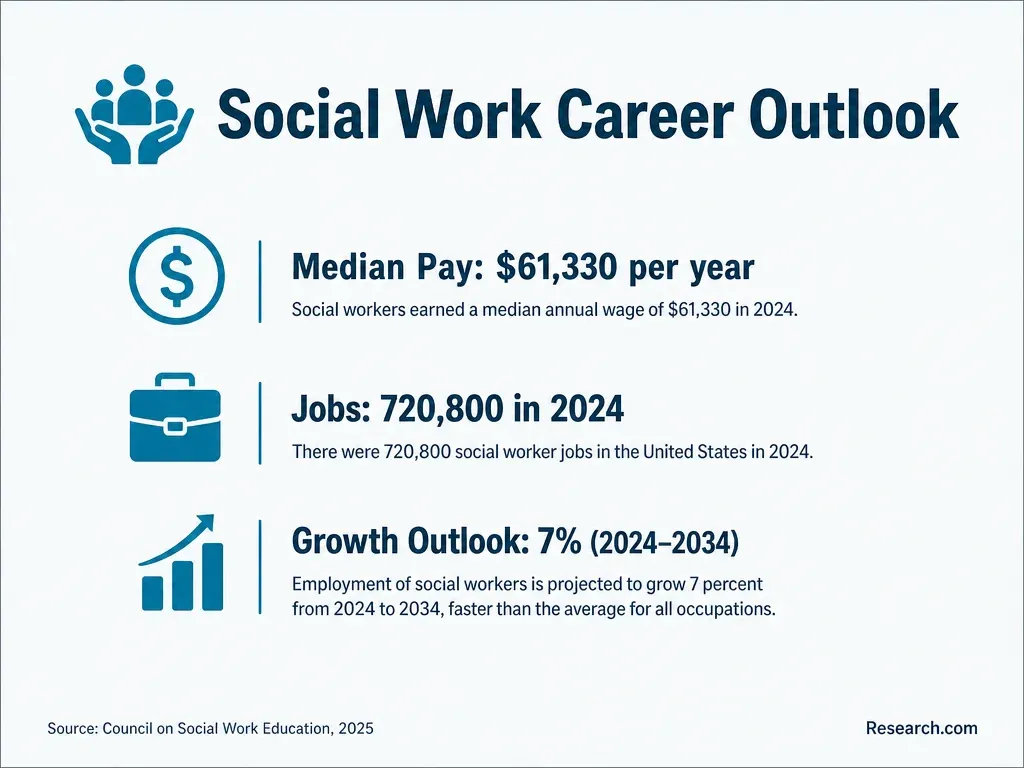
Salary depends on setting, duties, experience, and employer - not simply on holding an LCSW. A useful national comparison is the U.S. Bureau of Labor Statistics category mental health and substance abuse social workers, which reports a May 2025 median annual wage of $60,280 and projected employment growth of 10% from 2025 to 2035.
Healthcare social workers have a national median of $67,880 and projected growth of 8% over the same period. These are U.S. occupational figures, not Colorado LCSW salaries or guaranteed offers. The categories include workers with different credentials and job duties.
For a Colorado decision, compare actual postings and offers for the clinical role you want, including supervision benefits, caseload, documentation time, schedule, and compensation. Broader social work master's cost and salary context is useful only if you keep education costs, licensing costs, and occupation-wide wages separate.
Other Things You Should Know About Social Work
Possibly, but do not assume it transfers automatically. Ask the Colorado board to evaluate the dates, duties, supervisor qualifications, credential held while practicing, and documentation against its requirements.
A break does not necessarily erase documented experience, but it can extend the time needed to reach the hour totals. Record the interruption and confirm any applicable board rules before resuming.
No. Courses can develop clinical skills, but they do not substitute for required supervised experience or meetings with a qualified supervisor.
Check your employer's coverage, any payer or contract requirements, and whether individual coverage is appropriate for your role. Insurance does not change your credential's scope or make otherwise ineligible hours count.
- Colorado Social Work Applications and Forms https://dpo.colorado.gov/SocialWork/Applications
- Code of Colorado Regulations | coloradosos.gov https://www.coloradosos.gov/CCR/GenerateRulePdf.do
- Supervision FAQs | Texas Behavioral Health Executive Council https://bhec.texas.gov/tbhec/supervision-faqs/
- GAC - Chapter 135-5 REQUIREMENTS FOR LICENSURE https://rules.sos.ga.gov/gac/135-5
- Virginia Board of Social Work - General FAQs https://www.dhp.virginia.gov/Boards/SocialWork/ApplicantResources/GeneralFAQs/
- 4 CCR 726-1.14 - LICENSURE BY EXAMINATION (C.R.S. section 12-245-404) | LII / Legal Information Institute https://www.law.cornell.edu/regulations/colorado/4-CCR-726-1.14
- Colorado Social Work Licensure | MSU Denver https://www.msudenver.edu/sw-licensure-flowchart-4-2025/
- Become an LCSW in Colorado - University of Denver | University of Denver's Online MSW https://onlinemsw.du.edu/lcsw/
- Colorado LPC License Requirements | Public Health - https://www.publichealthonline.org/mental-health/counseling-licensure-colorado/
- Code of Colorado Regulations | state.co.us https://www.sos.state.co.us/CCR/GenerateRulePdf.do