2027 Implementation Outcomes in Social Work Research: Adoption, Reach, Fidelity, and Sustainability
Audited and Verified:
Our Editorial and Data Verification Process
Research.com uses government datasets, official education statistics and primary institutional information to support its career and degree guides. Our review process checks factual accuracy, occupational definitions, source dates and the requirements associated with the credentials discussed.
How This Article Was Fact-Checked
Our editorial team verifies salary estimates, employment projections, education requirements and program information against original data providers and official organizations. Salary figures are checked against the relevant occupational definitions and reporting periods. Information about licensure, accreditation and required in-person training is reviewed separately.
Fact-checked and verified on:

Co-Founder and Chief Data Scientist
A social work intervention can perform well in a study yet help few people if agencies never adopt it, referrals miss eligible clients, or delivery changes in ways that weaken its essential components. Implementation research examines that gap between an intervention and routine service.
For students, agency evaluators, and social workers considering research training, this guide explains four central outcomes - adoption, reach, fidelity, and sustainability - along with practical measures, study designs, ethical safeguards, and education and career choices. The goal is to help you build an evaluation that answers a useful agency decision, not merely generates a favorable number.
Key Things You Should Know
- Measure different units: Adoption concerns organizations or staff starting a practice; reach concerns eligible people who participate; fidelity concerns delivery as intended; sustainability concerns continued delivery over time.
- Define denominators before collecting data: A hypothetical 40 participants among 100 eligible people indicates 40% reach, but says nothing by itself about who was missed or whether services were delivered well.
- Choose training for the work you want to do: Agency evaluation may call for methods experience rather than another degree; independent research leadership may require doctoral-level preparation.
What are implementation outcomes in social work research?
Implementation outcomes describe what happens when people and organizations put an intervention into practice. They differ from client outcomes, such as improved housing stability or reduced symptoms. A program might improve outcomes for participants while reaching only a small share of eligible families. Conversely, a widely adopted service might produce little benefit if its essential components are not delivered.
Researchers commonly draw on Proctor and colleagues' implementation-outcomes framework and the RE-AIM framework. These frameworks do not use every term identically: RE-AIM distinguishes organizational adoption from individual reach and examines maintenance at both organizational and individual levels. Specify your definitions rather than treating framework labels as interchangeable.
The table shows a practical starting point for an agency study. Each example is a possible measure, not a universal standard.
| Outcome | Primary unit | Example measure | What the measure cannot establish alone |
| Adoption | Agency, team, or practitioner | Teams beginning the practice ÷ eligible teams | Whether eligible clients receive it |
| Reach | Eligible person or household | Participants ÷ eligible people | Whether participation was meaningful or equitable |
| Fidelity | Session, case, or delivery team | Required components delivered ÷ components expected | Whether every adaptation was harmful |
| Sustainability | Program or organization over time | Continued delivery after initial support ends | Whether service quality or benefits persist |
Students planning undergraduate study in social work can use this distinction to assess whether a research course teaches them to connect agency processes with client outcomes. A BSW is not required to learn evaluation methods, but social work training adds context about service systems, ethics, and access barriers.
How is adoption measured in social work programs?
Adoption measures whether an eligible organization or practitioner decides to begin using an intervention. Define the decision maker and the qualifying action first. For a school-based referral protocol, a signed agreement may indicate intent; documented use with a first eligible referral is stronger evidence of initial adoption.
A useful adoption rate is the number of eligible agencies, teams, or practitioners that start using the practice divided by the number offered a genuine opportunity to adopt it. Report the time window and exclusions. If 8 of 12 invited teams started within six months, adoption is 8/12 for that defined group - not necessarily for all teams in the service system. Interviews can explain why a team declined, while records or observations can check whether reported adoption became actual use.
Separate adoption from implementation intensity: a team that uses a protocol once and a team that uses it routinely should not be described as equally active. For a student evaluating an agency partnership, planning local placements through an online MSW program also means confirming that the site and school permit the proposed evaluation tasks and data access; placement approval is not permission to use client records.
How do researchers measure the reach of social work interventions?
Reach is the proportion and characteristics of eligible people who participate. Researchers need a defensible eligibility definition, a count of eligible people, and a consistent definition of participation. An initial contact, enrollment, and completion answer different questions; report them separately when possible.
A hypothetical agency that enrolls 40 of 100 eligible households has 40% enrollment reach. That figure becomes more useful when compared across referral source, neighborhood, language access, disability accommodation, or other relevant characteristics - with appropriate privacy safeguards and sufficiently reliable data. A low rate for one group may reflect transportation, trust, hours of service, or an inaccessible referral process rather than lack of interest.
Missing eligibility information is a common threat to interpretation. If the agency only records people who accepted a referral, its database cannot establish reach among everyone who could have qualified. Describe that limitation instead of calling an enrollment count a population rate. Researchers assessing digital outreach should apply the same rule: interest in exploring online social work qualifications, for example, would not demonstrate equitable access to a related community service. The denominator must represent the service's eligible population.
Sustainability means a useful practice continues after initial implementation support changes or ends. Continued service volume matters, but a durable program also needs acceptable quality, organizational ownership, and a way to respond to changing community needs. Define the follow-up period and what "continued" means before declaring success.
Staff turnover, unstable grants, incompatible record systems, supervision capacity, and referral bottlenecks can undermine continuation. Programs are better positioned when leaders budget for training and replacement staff, incorporate tasks into ordinary workflows, retain community input, and review reach and fidelity alongside service volume. Those are plausible supports, not guarantees: funding and policy changes can still interrupt delivery.
An agency considering staff education should compare the recurring cost of training with its actual workforce need. Planning the cost of an online MSW may matter if an employee needs that qualification for a defined role, but an MSW is not automatically the least expensive or most direct way to sustain a referral protocol. Targeted onboarding, protected supervision time, or an evaluator position may address the bottleneck more directly.
Frameworks help researchers choose what to examine; study designs determine how convincingly they can answer a question. RE-AIM is useful for organizing reach, effectiveness, adoption, implementation, and maintenance. The Consolidated Framework for Implementation Research, or CFIR, helps examine influences such as setting, people, and implementation processes. Neither framework substitutes for a sampling plan or a validated measure suited to the setting.
A feasible agency evaluation might combine administrative counts for adoption and reach, sampled observations for fidelity, and interviews about barriers to continued delivery. Repeated measurements can show whether use changes after a grant ends. A comparison group, interrupted time series, or hybrid effectiveness-implementation design may support stronger causal claims when feasible; a simple before-and-after count usually cannot rule out changes in staffing, eligibility, or demand.
Before collecting information, researchers should settle several decisions in this order:
- State the agency decision and define each outcome, unit, denominator, and measurement period.
- Check data quality and whether groups at risk of being missed appear in available records.
- Agree with the agency on access, storage, reporting, consent where needed, and applicable institutional review or other oversight.
- Plan how findings - including uncertainty and unfavorable results - will be shared with staff and affected communities.
Doctoral applicants should assess whether an advisor and agency partner can support that design before committing to a dissertation topic. A social work doctoral program cost guide can inform the funding comparison, but affordable tuition cannot compensate for unavailable data, weak mentorship, or an infeasible partnership.
For a BSW or MSW, check the institution's accreditation and the specific social work program's CSWE accreditation status, including its applicability to your cohort. Then check the program's admissions criteria, research options, field arrangements, and total cost. Doctoral applicants should verify the degree's actual research requirements, advisor fit, funding terms, and completion expectations rather than assuming all DSW or PhD programs follow one model.
Costs include more than tuition: fees, software or technology, travel, unpaid project or field time, and reduced work hours may affect feasibility. Ask for a written estimate based on your likely pace. If an admissions barrier is driving your search, MSW programs that do not require recommendation letters may be worth reviewing, but confirm the current application rules and evaluate research mentoring rather than choosing on that condition alone.
A social work degree does not issue a license. Licensure matters if your intended job includes activities or titles regulated by a state board; many evaluation and research roles are not clinical practice roles. Check the relevant board and employer separately instead of paying for a clinical pathway that your target research job does not require.
What careers, salaries, and job prospects are available in implementation research?
Relevant roles include agency program evaluator, implementation specialist, research coordinator, quality-improvement analyst, and, with appropriate preparation, research investigator or faculty member. Day-to-day work may involve building measures, training staff to record them consistently, interviewing partners, analyzing disparities in reach, and explaining findings to funders and communities. Employers may hire people with social work, public health, statistics, or related backgrounds; requirements depend on the role.
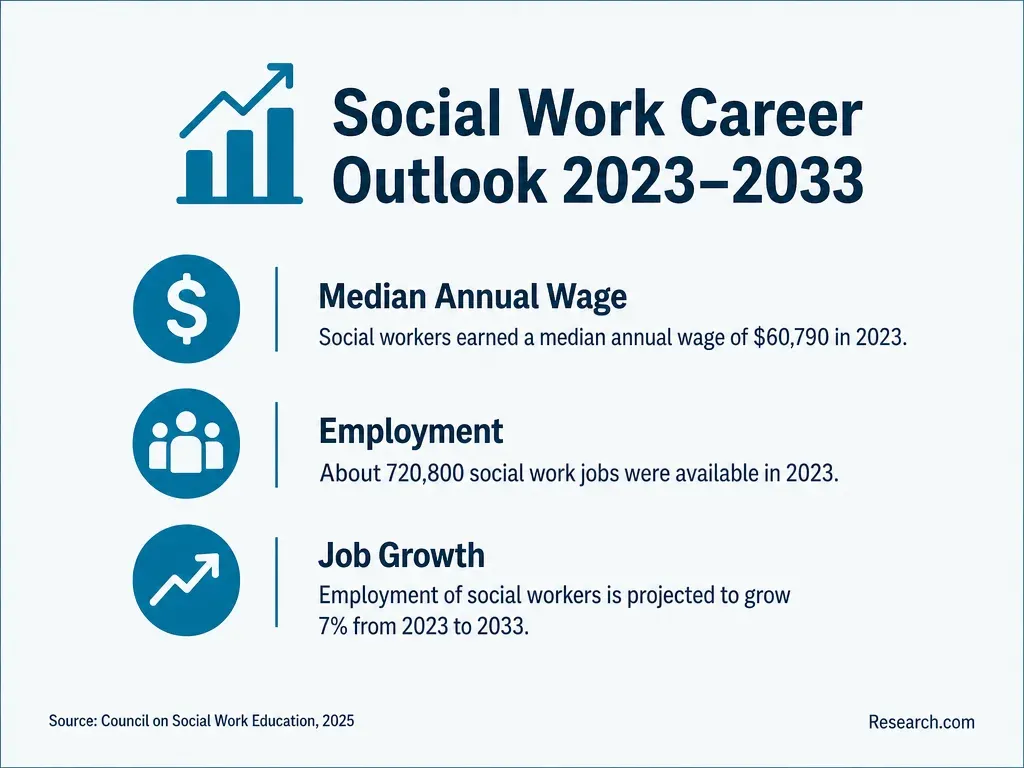
There is no single Bureau of Labor Statistics wage category for "social work implementation researcher." For context only, BLS reports a $61,780 median annual wage for social workers in May 2025 and 6% projected employment growth from 2025 to 2035. Those figures describe the broader social worker occupation, not the pay or outlook for an evaluator, doctoral researcher, or MSW graduate. Compare actual job postings by duties, location, degree requirements, and salary range before estimating a return on further study.
If your aim is agency evaluation, start by seeking a supervised measurement or improvement project and building a portfolio that shares methods without disclosing client or agency-confidential information. For broader practice and leadership options, planning professional progression with an MSW can help frame the choice. If the target employer values analytic experience rather than a social work credential, focused methods training may be the better next step.
Other Things You Should Know About Social Work
Yes. A small agency can define a short measurement period, use consistent counts, and interview staff or participants with appropriate permissions. Report small denominators and avoid treating unstable percentages as precise estimates.
They can report them responsibly. Explain the measure, limitations, and corrective actions without identifying clients or unfairly assigning blame to staff or communities.
Report the missingness and its likely effect on comparisons. Do not assume that the people with complete records represent everyone eligible for the service.
Not necessarily. Research, quality improvement, and program evaluation may receive different oversight, but labels alone do not determine the answer. Consult the relevant institutional and agency review authorities before collecting or sharing data.
- Outcomes for Implementation Research: Conceptual... - PMC https://pmc.ncbi.nlm.nih.gov/articles/PMC3068522/
- CDC Program Evaluation Framework, 2024 | MMWR https://www.cdc.gov/mmwr/volumes/73/rr/rr7306a1.htm
- Using implementation science theories and frameworks in global health | BMJ Global Health https://gh.bmj.com/content/5/4/e002269
- Section 10. Community-Level Indicators: Some Examples | ku.edu https://ctb.ku.edu/en/table-of-contents/evaluate/evaluate-community-initiatives/examples-of-community-level-indicators/main
- Practice Research Methods in Social Work - PDXScholar https://pdxscholar.library.pdx.edu/cgi/viewcontent.cgi
- Sustainability | dissemination-implementation.org https://dissemination-implementation.org/constructs/sustainability/
- Theories, Models, & Frameworks | Implementation Science at UW https://impsciuw.org/the-university-of-washington-implementation-science-resource-hub/research/frameworks/
- Evidence-Based Practice | socialworkers.org https://www.socialworkers.org/News/Research-Data/Social-Work-Policy-Research/Evidence-Based-Practice