2027 Mediators vs Moderators in Social Work Research: Different Explanations of Research Effects
Audited and Verified:
Our Editorial and Data Verification Process
Research.com uses government datasets, official education statistics and primary institutional information to support its career and degree guides. Our review process checks factual accuracy, occupational definitions, source dates and the requirements associated with the credentials discussed.
How This Article Was Fact-Checked
Our editorial team verifies salary estimates, employment projections, education requirements and program information against original data providers and official organizations. Salary figures are checked against the relevant occupational definitions and reporting periods. Information about licensure, accreditation and required in-person training is reviewed separately.
Fact-checked and verified on:

Co-Founder and Chief Data Scientist
A social work program may improve outcomes overall while leaving two important questions unanswered: What produced the improvement, and did everyone benefit equally? Mediators address the first question; moderators address the second. The distinction matters when agencies decide which program components to preserve, whom to reach differently, and what further evidence they need. This guide is for social work students, practitioners, and evaluators reading intervention studies or planning feasible projects. It explains the variables, tests, limitations, and training choices that make these findings useful without overstating what the data prove.
Key Things You Should Know
- A mediator is a proposed pathway between an intervention and an outcome; a moderator changes the size or direction of the intervention's association with that outcome.
- Testing mediation generally requires measurements in a credible time order; testing moderation requires enough participants in relevant groups to estimate differences reliably.
- Neither a statistically significant indirect effect nor a subgroup difference alone proves why an intervention worked or justifies changing services for a particular client.
What is the difference between a mediator and a moderator in social work research?
A mediator helps explain how an intervention may affect an outcome. A moderator identifies a condition under which the effect differs. In a housing-support evaluation, improved access to benefits might mediate an effect on housing stability. Initial housing insecurity might moderate the effect if participants starting at different levels benefit differently.
The distinction depends on the research question and timing, not the variable's label. Baseline social support could be a moderator; social support measured after an intervention intended to strengthen relationships could be a mediator. Researchers must also consider whether a third factor, such as referral access, influences both the proposed mediator and the outcome.
These concepts apply across educational routes. A student comparing advanced standing eligibility and traditional MSW options should examine the actual methods curriculum rather than assume that one entry route teaches these analyses more thoroughly.
What is a mediator variable, and how does it explain research effects?
A mediator sits on a proposed pathway: intervention → mediator → outcome. Suppose a hypothetical family-resource program helps participants complete benefits applications, which reduces financial strain. Application completion is a plausible mediator of any later change in strain - but only if it is measured after the program begins and before the outcome it is meant to explain.
Researchers often call the portion of an effect estimated through the mediator an indirect effect. The remaining estimated association is sometimes called a direct effect; it does not necessarily represent a single alternative mechanism. A finding consistent with mediation is stronger when the measure captures a meaningful process, its timing is clear, and competing explanations have been considered. Statistical mediation by itself does not establish that changing that process would change outcomes.
Students building this foundation can look for research literacy and statistics alongside practice courses when planning undergraduate study in social work. A course title alone does not show whether students practice designing or interpreting mediation analyses.
What is a moderator variable, and how does it affect research results?
A moderator answers for whom, where, or under what conditions an intervention's effect differs. An agency might examine whether a transportation-support program has different effects in rural and urban service areas. Location is a moderator if the estimated intervention-outcome relationship varies by location; it is not a mediator merely because location is associated with the outcome.
Moderators can be characteristics measured before services, such as baseline need, or features of implementation, such as available appointment times. A subgroup difference requires a direct comparison of effects. Finding a statistically significant effect in one group but not another does not, by itself, establish that the groups differ.
Prior preparation can also matter when evaluating research instruction: students with different quantitative backgrounds may respond differently to the same course. For prospective students considering broader admission pathways into MSW study, that possibility is a reason to assess available methods support, not to treat an admissions route as a precise measure of ability.
Researchers first specify the intervention, outcome, proposed pathway or subgroup, and measurement times. The analysis then depends on the design and the type of outcome; a single regression formula is not suitable for every agency dataset.
- Plan the comparison: Define the intervention and an appropriate comparison condition, identify baseline characteristics, and document which differences are planned rather than discovered after viewing results.
- Test mediation: Estimate how the intervention relates to the proposed mediator and how that mediator relates to the later outcome, accounting for the design and credible confounders. Report the indirect effect with an uncertainty interval and explain the causal assumptions.
- Test moderation: Include an intervention-by-moderator interaction, or use an appropriate equivalent model. Report estimated effects and uncertainty within relevant groups as well as the comparison between groups.
- Check robustness: Examine missing data, measurement quality, plausible alternative explanations, and whether conclusions change under reasonable modeling choices.
Random assignment to an intervention helps establish the intervention's effect, but it does not usually randomize the mediator. A small MSW capstone may be better suited to a carefully framed exploratory analysis than a definitive claim about mechanisms. Students considering exploring shorter online MSW degree options should check whether the schedule leaves enough time for methods instruction, mentoring, and approved data access - not just whether a capstone fits the calendar.
Mediation is especially vulnerable to mistaken causal interpretation. A mediator and outcome may share an unmeasured cause, such as case complexity. Measuring both only at program exit makes their order unclear. An intervention may also change another factor that affects both, complicating a simple indirect-effect estimate. Researchers should state these assumptions and, where feasible, conduct sensitivity analyses.
For moderation, small subgroups can produce unstable estimates, while testing many unplanned subgroups increases the chance of a misleading result. A variable recorded as a broad category may also hide meaningful variation within a community. Missing records, inconsistent service delivery, and outcome measures that are not accessible or culturally appropriate can affect either analysis.
Ethical feasibility is part of methodological quality. Client records require authorized access, privacy protections, and any applicable agency or institutional review; a capstone assignment does not grant permission to use them. If the goal is only to gain these research skills, a targeted course or employer-supported training may be more proportionate than another degree. Anyone weighing a full program should compare the entire educational commitment, including field-related costs, rather than relying on online MSW tuition comparisons alone.
What careers use these research skills, and do they require social work licensure?
Program evaluators, research coordinators, policy analysts, and agency quality-improvement staff may use mediation or moderation to investigate how services operate and where results differ. Their employers may value statistics, data governance, community collaboration, and clear reporting; these functions do not universally require social work licensure. Required degrees and experience depend on the position. A licensed clinical role is different: its practice authority comes from the applicable state board, not from proficiency with research methods.
To assess career fit, read job descriptions for the actual mix of data analysis, direct service, grant reporting, and stakeholder engagement. Someone already experienced in social services may need a methods course and supervised project experience rather than another social work degree. Conversely, a role that requires a specific social work qualification cannot be reached through statistics training alone.
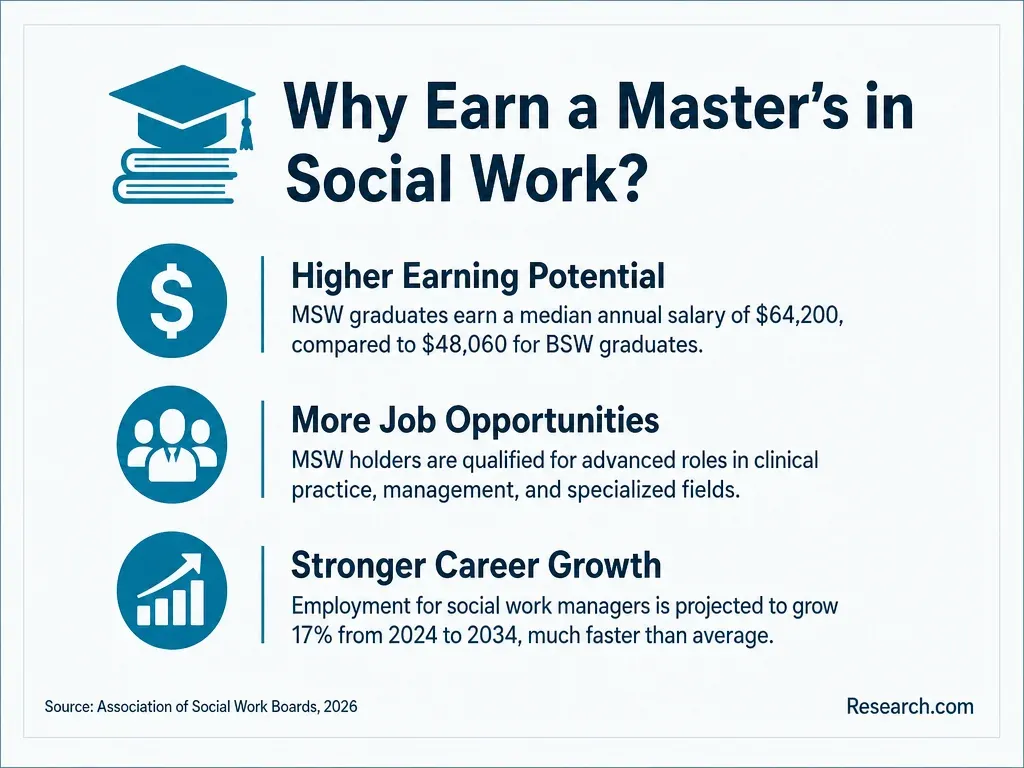
Pay varies with occupation, employer, and location; there is no single "mediation analyst" social work wage category. Exploring regional pay patterns for MSW careers may provide context, but those figures should not be treated as salaries promised to program evaluators or to graduates with a particular degree.
Other Things You Should Know About Social Work
Yes. With appropriate consent and oversight, interviews can reveal how participants experience a service and suggest pathways worth testing. They do not, by themselves, estimate a statistical indirect effect.
It may be useful to report them if privacy is protected and the exploratory status is explicit. Include group sizes, uncertainty, and a warning against treating small-group estimates as settled evidence.
Specify the intervention, comparison, measures, timing, proposed mediators or moderators, intended analyses, and approach to missing data. Record later changes so readers can distinguish planned tests from exploratory ones.
No universal answer applies. The project's purpose, design, setting, funding, and data use determine which reviews are required. Ask the responsible institution and agency before collecting or accessing information.
- Integrating Mediators and Moderators in Research Design | nih.gov https://pmc.ncbi.nlm.nih.gov/articles/PMC3366634/
- Mediation, Moderation, and Conditional Process Analysis | Cambridge Core https://www.cambridge.org/core/journals/spanish-journal-of-psychology/article/mediation-moderation-and-conditional-process-analysis-concepts-computations-and-some-common-confusions/79C2B729BB79FD0BC9B8266F0298D09B
- Causal Mediation | Columbia University Mailman School of Public Health https://www.publichealth.columbia.edu/research/population-health-methods/causal-mediation
- Moderated Mediation Analysis | umass.edu https://openpublishing.library.umass.edu/pare/article/1615/galley/1566/view/
- Chapter 7 Subgroup Analyses | doing-meta.guide https://doing-meta.guide/subgroup
- Which Variables Should You Measure for Moderation? | Manuel B. Garcia https://manuelgarcia.info/guides/research/guide/variables-effect-heterogeneity-moderation