2027 Social Workers and Agency Volunteers: Training, Boundaries, and Service Coordination
Audited and Verified:
Our Editorial and Data Verification Process
Research.com uses government datasets, official education statistics and primary institutional information to support its career and degree guides. Our review process checks factual accuracy, occupational definitions, source dates and the requirements associated with the credentials discussed.
How This Article Was Fact-Checked
Our editorial team verifies salary estimates, employment projections, education requirements and program information against original data providers and official organizations. Salary figures are checked against the relevant occupational definitions and reporting periods. Information about licensure, accreditation and required in-person training is reviewed separately.
Fact-checked and verified on:

Co-Founder and Chief Data Scientist
Volunteers can extend an agency's reach, but goodwill alone does not authorize someone to assess clients, manage cases, or handle sensitive records. Social workers, volunteer coordinators, students, and nonprofit staff need a shared understanding of who does what - and when a concern must move to a qualified professional.
This guide explains practical training, boundaries, referral and supervision procedures, then places degrees, licensure, field education, and career prospects in context. Use it to define a safer volunteer role or decide whether your intended work requires formal social work education.
Key Things You Should Know
- Give volunteers written, task-specific duties and an escalation route; a volunteer role does not authorize clinical assessment, independent case decisions, or access to every client record.
- Train volunteers before client contact on confidentiality, boundaries, accessibility, safety, and referrals, then check their performance through supervision rather than treating orientation as proof of competence.
- A BSW or MSW may prepare someone for social work roles, but graduation is not a license; state rules and the actual job duties determine whether additional credentials or post-degree supervision are required.
How do social workers' roles differ from agency volunteers' roles?
Social workers may assess needs, develop service plans, coordinate complex cases, advocate for clients, and document professional decisions within their qualifications and agency authority. Some roles require a state social work license; clinical services require the particular authorization applicable in that state. Volunteers generally contribute defined support - such as greeting visitors, preparing supplies, assisting with an approved outreach event, or helping a client navigate a resource list under staff direction.
The dividing line is accountability for judgment, not whether a task appears helpful. A volunteer might notice that a housing applicant mentions an urgent safety concern, but should not investigate, promise a placement, or decide eligibility. They should follow the agency's escalation procedure so qualified staff can respond. Agencies should match tasks to training, screening, insurance coverage, and the client's informed choice about volunteer involvement.
If volunteering is a step toward paid practice, compare the duties you enjoy with employer requirements before enrolling in a degree. Guidance on planning professional progression with an MSW can help distinguish positions that require graduate preparation from support roles that do not.
What training do agency volunteers need to support social workers?
Training should match the population and tasks. Someone packing food boxes needs a different orientation from a volunteer making supervised follow-up calls. Before client contact, an agency should confirm that volunteers can explain these essentials in plain language:
- Their assigned tasks, prohibited tasks, supervisor, and procedure for declining work beyond their role.
- Confidentiality, approved communication and recordkeeping tools, and what to do after a privacy error.
- Respectful communication, accessibility, cultural responsiveness, and the limits of promises about services.
- Site safety, emergency escalation, and applicable reporting procedures, without expecting volunteers to make legal or clinical determinations independently.
Demonstrations, role-play, observation, and refresher training are more informative than a signed handbook alone. Agencies serving children, patients, or other populations may also require screening or setting-specific instruction. Ask a supervisor to verify readiness for each new task rather than assuming prior volunteer experience transfers automatically.
For someone seeking a professional role, volunteer onboarding is a starting point, not a substitute for a degree or supervised field education. Explore online social work education options for career planning only after checking whether target employers actually require social work qualifications.
What boundaries should social workers and volunteers maintain with clients?
Both groups should explain their roles honestly and protect client choice. A volunteer should not imply they are a social worker, offer therapy, give personal contact information without authorization, connect with clients on personal social media, or arrange an off-the-books visit. Staff also need boundaries: they should not use a volunteer as an informal therapist, interpreter, or substitute caseworker because the agency is short-handed.
Gifts, transportation, photographs, and relationships outside the agency can create safety, privacy, or conflicts-of-interest concerns. The right response is to consult written policy and a supervisor before acting, not to rely on a personal judgment that an exception seems harmless. Clients should know when they may decline volunteer assistance without jeopardizing access to services.
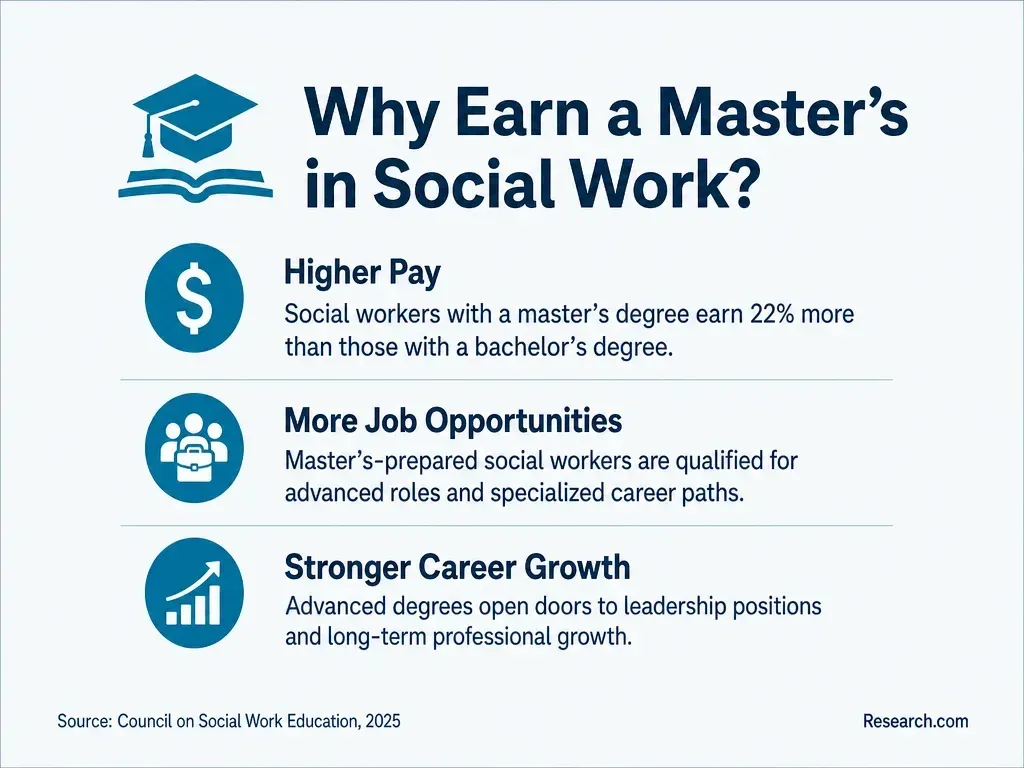
If a person's goal is to provide psychotherapy rather than support an agency's nonclinical activities, compare clinical Master of Social Work pathways alongside state licensing requirements. A clinical concentration alone does not authorize independent treatment.
Requirements follow the job duties and jurisdiction, not the agency's preferred title. A BSW commonly prepares graduates for generalist roles; a traditional MSW admits eligible graduates from various undergraduate disciplines and adds graduate social work preparation. Advanced-standing MSW routes are for applicants with qualifying prior social work education under the program's rules. State boards - not universities or agencies - determine license eligibility and permitted practice.
Some outreach and service-support jobs accept a human services degree or relevant experience instead of a social work degree. Other positions require a BSW, MSW, active license, or setting-specific qualification. Independent clinical practice generally involves additional state-defined requirements after the qualifying degree, potentially including supervised experience and an examination. Check the current board rules and the employer's position description before selecting a program.
A practice-focused doctorate is not an entry credential for volunteer coordination or a replacement for initial social work qualifications. DSW programs with condensed study schedules are worth considering only if an experienced practitioner's leadership or advanced-practice goals justify doctoral study.
What are the salaries and job prospects for agency social workers?
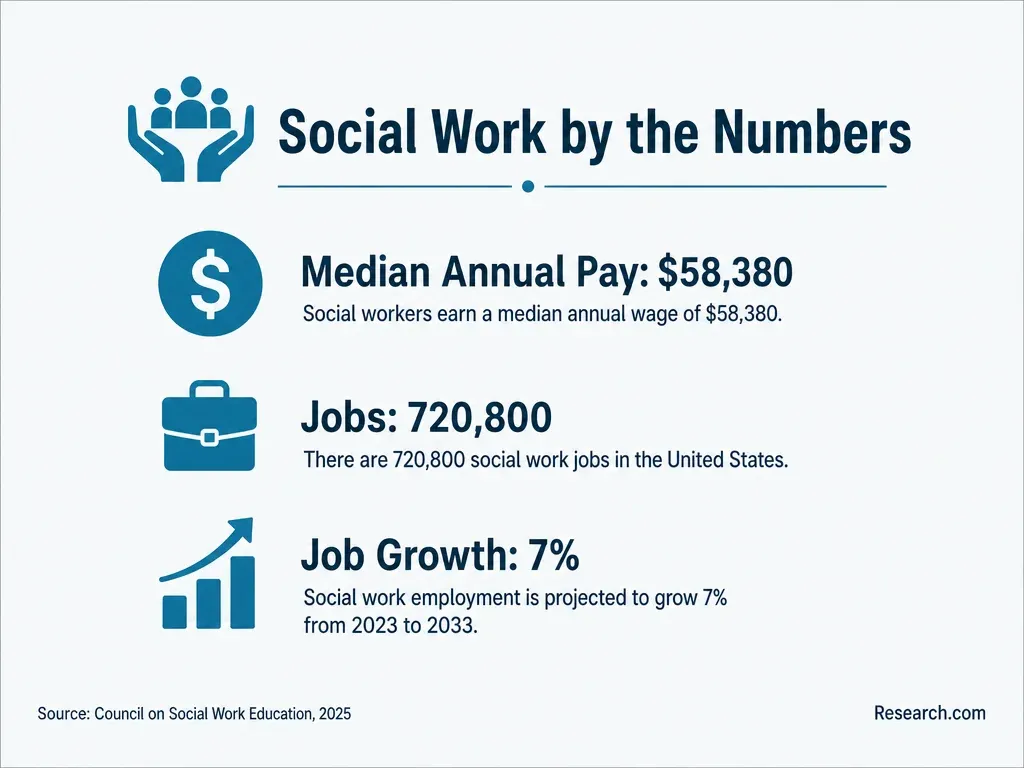
Agency pay depends on the population served, duties, location, funding, experience, and required license. U.S. Bureau of Labor Statistics figures give occupational context, not a starting salary or a promised return on an MSW. The following May 2025 median annual wages and 2025-2035 employment projections distinguish several social work occupations:
| Occupation | Median annual wage | Projected employment growth |
| Child, family, and school social workers | $59,550 | 4% |
| Healthcare social workers | $67,880 | 8% |
| Mental health and substance abuse social workers | $60,280 | 10% |
| Social workers, all specialties | $61,780 | 6% |
These categories do not describe volunteer compensation or every agency support position. Use the closest occupational category, then compare actual local vacancies for required credentials, supervision, caseload, travel, schedule, and pay. If an MSW is necessary for your target jobs, compare the full cost of attendance - not tuition alone - using online MSW tuition comparisons as a starting point. A lower-cost program is worthwhile only if its accreditation, field arrangements, and schedule meet your needs.
Other Things You Should Know About Social Work
It depends on the setting, duties, applicable law, and agency policy. Ask the volunteer coordinator what screening is required before accepting an assignment, especially one involving children or access to sensitive information.
Sometimes. Suitable tasks may include approved administrative or outreach work, but the agency must provide secure tools, clear supervision, and a role that can be performed without unauthorized access to client information.
Listen without promising an outcome, explain the agency's complaint channel, and connect the client with the designated person. Do not investigate the complaint independently or discourage the client from raising it.
Give the coordinator notice when possible, complete an approved handoff, return agency property, and confirm that system access is closed. Confidentiality obligations continue after the assignment ends.
- OCCUPATIONS CODE CHAPTER 505. SOCIAL WORKERS | texas.gov https://statutes.capitol.texas.gov/docs/OC/htm/OC.505.htm
- Defining Service Coordination: A Social Work Perspective - PMC https://pmc.ncbi.nlm.nih.gov/articles/PMC2992332/
- elaws - Fair Labor Standards Act Advisor https://webapps.dol.gov/elaws/whd/flsa/docs/volunteers.asp
- OVC Model Standards - Office of Justice Programs https://ovc.ojp.gov/sites/ovc/files/model-standards/6/program_standards_4.html
- Code of Virginia Code - Chapter 37. Social Work https://law.lis.virginia.gov/vacodefull/title54.1/chapter37/
- Summary of the HIPAA Privacy Rule | hhs.gov https://www.hhs.gov/hipaa/for-professionals/privacy/laws-regulations/index.html
- NASW Standards for Social Work Case Management | nycourts.gov https://www.nycourts.gov/reporter/webdocs/nasw_standards_socialwork_casemgt.htm
- Case Coordination and Case Conferencing | ny.gov https://www.health.ny.gov/diseases/aids/providers/standards/casemanagement/case_coordination_conferencing.htm
- ORR Unaccompanied Alien Children Bureau Policy Guide | The Administration for Children and Families https://acf.gov/orr/policy-guidance/uac-program-policy-guide-section-4
- Privacy | volunteer.gov https://www.volunteer.gov/s/privacy