2027 Social Work in Disability Policy: Access, Participation, and Systems Change
Audited and Verified:
Our Editorial and Data Verification Process
Research.com uses government datasets, official education statistics and primary institutional information to support its career and degree guides. Our review process checks factual accuracy, occupational definitions, source dates and the requirements associated with the credentials discussed.
How This Article Was Fact-Checked
Our editorial team verifies salary estimates, employment projections, education requirements and program information against original data providers and official organizations. Salary figures are checked against the relevant occupational definitions and reporting periods. Information about licensure, accreditation and required in-person training is reviewed separately.
Fact-checked and verified on:

Co-Founder and Chief Data Scientist
A disability service can exist on paper yet remain inaccessible because its application, transportation options, eligibility rules, or public meetings exclude the people it is meant to serve. Social workers can identify those gaps through direct service, community partnerships, policy analysis, and program leadership. This guide is for students and professionals considering disability policy work in the United States. It explains how to choose a role and educational path, assess licensing and field-placement requirements, and turn access and participation goals into changes an agency can evaluate.
Key Things You Should Know
- Disability policy work spans benefits, housing, healthcare, education, and community living; policy and advocacy jobs do not automatically require a clinical social work license.
- Choose education by the target job: a BSW can support generalist service work, an MSW can prepare graduates for advanced practice or policy leadership, and an MPA or MPH may be more direct for some analyst roles.
- The U.S. Bureau of Labor Statistics reports a $61,780 median annual wage for social workers across specialties in May 2025 and projects 6% employment growth from 2025 to 2035; neither figure describes disability policy jobs specifically.
What is the role of social work in disability policy?
Social work in disability policy connects people's experiences with the rules and institutions that shape their options. A practitioner might help someone navigate a service today, then document a recurring barrier - such as an inaccessible intake process - and work with the agency to change it. This is a person-in-environment approach: the problem is not assumed to reside solely with an individual when eligibility rules, communication methods, transportation, or discrimination also affect participation.
In the United States, relevant systems include Medicaid home- and community-based services, public benefits, employment supports, housing, schools, and healthcare. The Americans with Disabilities Act and Section 504 of the Rehabilitation Act provide important civil-rights frameworks, but their application depends on the organization and circumstances. Social workers need to distinguish explaining options and documenting barriers from making legal determinations.
Policy work may be a full-time role or part of a service, management, or organizing job. For a broader view of where an MSW can lead, compare exploring roles for master's-prepared social workers with job descriptions that explicitly mention disability access or policy implementation.
What degrees prepare social workers for disability policy careers?
The best qualification depends on whether the intended job centers on service delivery, policy analysis, organizational leadership, or research. The routes below differ in entry requirements and what they prepare graduates to do.
| Route | Useful fit for disability policy | Important limit |
| BSW | Generalist service coordination, outreach, and community work | May not meet requirements for advanced or licensed social work roles |
| Traditional or foundation MSW | Advanced practice and policy preparation for graduates with a bachelor's degree in another field | Includes foundational social work study and approved field education |
| Advanced-standing MSW | A shorter MSW route for applicants with a qualifying BSW who meet program rules | A psychology, sociology, or human services degree alone does not establish eligibility |
| MPA or MPH | Public administration, budgeting, population health, or policy analysis | Does not substitute for a social work degree where one is required |
| DSW or PhD | Practice leadership and improvement, or research and academic careers, depending on the program | Usually unnecessary for entry into disability policy work |
Someone already working in government analysis or disability organizing may need targeted training and policy experience rather than another degree. If an MSW is necessary, compare the entire sequence - including field education - before considering faster graduate social work study routes; a compressed calendar is not a waiver of required learning.
What disability policy jobs can social workers pursue?
Search by duties as well as title. "Disability policy" may appear in a job description for a benefits specialist, community organizer, program manager, or government analyst rather than in the job title itself. These examples show why the required qualification must be checked position by position.
| Role | Typical contribution | Qualification to check |
| Service coordinator or case manager | Connects people with supports and identifies recurring access barriers | Degree, population experience, caseload, and agency training |
| Disability rights organizer or advocate | Builds community participation and communicates proposed changes | Organizing experience, accessibility skills, and employer requirements |
| Policy analyst or legislative staff member | Reviews proposals, budgets, implementation data, and public input | Writing, research, and policy experience; a social work degree may not be required |
| Program manager | Changes intake, contracting, staffing, or service procedures | Management experience, funding knowledge, and any role-specific credential |
Before applying, compare the actual work: public-sector jobs may have civil-service classifications and fixed pay bands, while nonprofit roles may depend on grant funding. Ask about decision-making authority, accessible community engagement, supervision, travel, and documentation workload. If an MSW is under consideration primarily for earnings, use social work master's tuition and earnings comparisons as a starting point - not evidence that a particular policy job will pay more.
For a BSW or MSW, verify the exact program and its Council on Social Work Education accreditation status, including whether that status applies to your expected cohort. Institutional accreditation is a separate matter, and neither form of accreditation alone guarantees a license or job. Ask the relevant state board whether the proposed education meets its requirements if licensure is part of your plan.
For disability policy work, examine evidence beyond a concentration label: faculty expertise, disability-led community partnerships, accessible teaching and field sites, policy courses, and placements where students can observe how rules are implemented. Ask the field office who secures placements and whether policy-oriented tasks can be included in an approved learning agreement. Applicants starting with undergraduate study can compare comparing online BSW program structures, then verify each program's current accreditation and field arrangements directly.
Look for coursework in social welfare policy, research and program evaluation, community practice, disability rights, public benefits, and accessible service design. Useful field settings may include a center for independent living, disability rights organization, public agency, school system, or healthcare organization - provided the program approves the site and its learning opportunities.
A strong placement lets a student connect individual experiences to a feasible systems question. For example, an approved project could assess whether publicly available application instructions offer accessible formats, then propose revisions for agency review. The student should agree on tasks with the field instructor and faculty liaison, protect confidential information, and avoid presenting a proposal as an implemented outcome.
Research or policy assistantships can build complementary skills, but paid research duties do not automatically count as curricular field education. If funding and experience are both priorities, investigate exploring assistantship support for online MSW education and ask the program to distinguish assistantship obligations from approved placement hours.
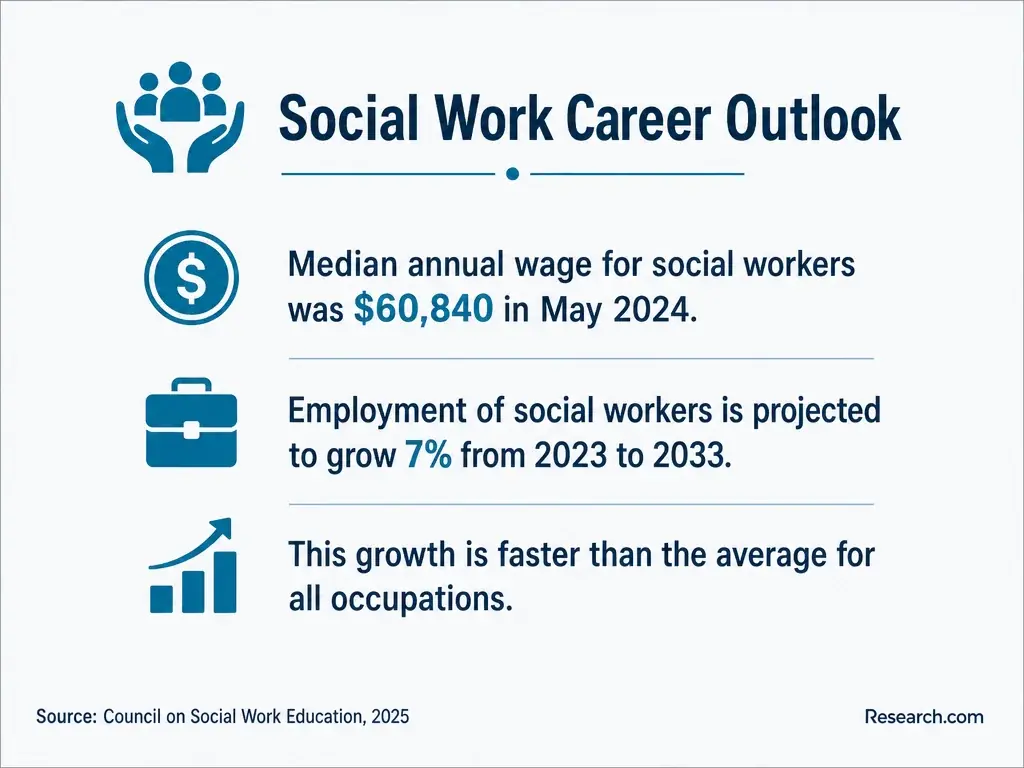
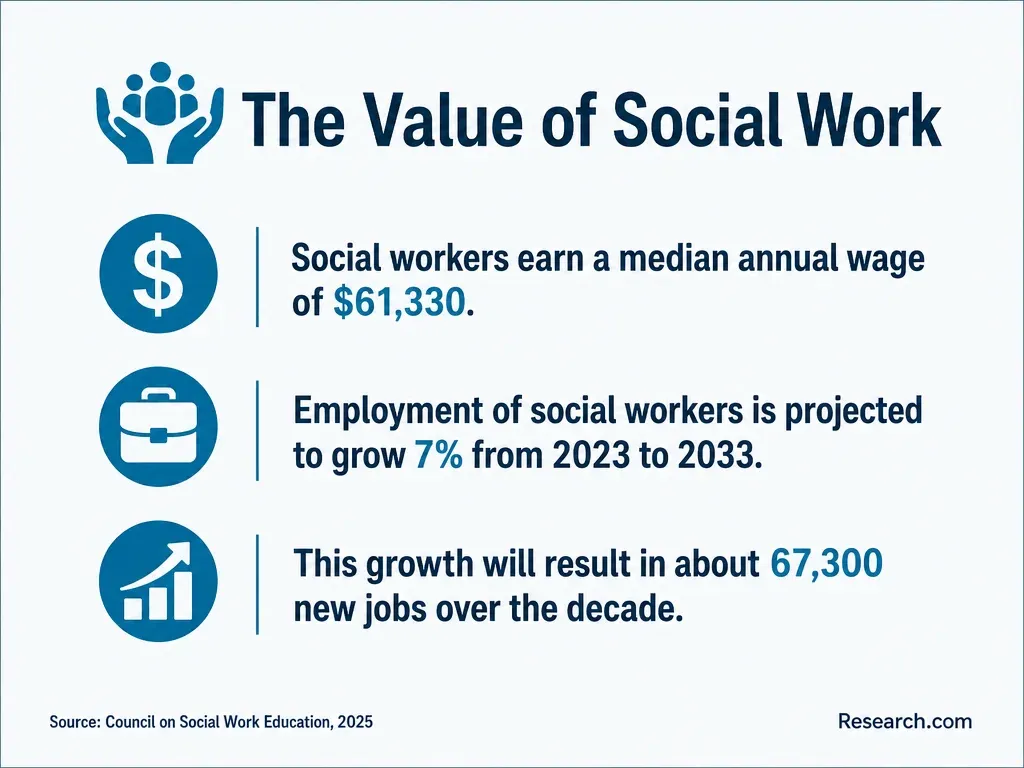
There is no single U.S. Bureau of Labor Statistics occupation called "disability policy social worker." BLS reports a May 2025 median annual wage of $61,780 for social workers across specialties and projects 6% employment growth from 2025 to 2035. The figures describe a broad occupation, not the pay or growth of disability policy positions. A policy analyst hired under another occupational classification may have a substantially different wage profile.
Use posted salaries or public pay bands for the roles and locations you would actually consider, then account for degree costs and time away from paid work. Geography matters; social work salary differences across states provide context, but statewide figures cannot predict an offer from a particular agency.
How do social workers advance disability access, participation, and systems change?
Access means people can find, understand, reach, and use a service. Participation means disabled people have meaningful influence over decisions affecting them. Systems change means an organization alters rules, resources, or accountability - not merely resolves one person's difficulty.
Effective work starts by identifying a specific barrier with people who encounter it, including those often missed by standard outreach. A team can then review the policy and workflow behind that barrier, propose an accessible alternative, assign responsibility, and evaluate whether access improved. Measures might include the availability of requested communication formats or where applicants leave an intake process; interpretation should account for privacy, consent, and who was able to participate in the evaluation.
Social workers should seek paid or otherwise appropriately supported input from disability-led organizations, respect individuals' preferences and self-determination, and avoid treating a single consultation as community approval. For professionals who need an MSW to move into a target role, social work master's study on a budget may be worth comparing with employer training or an MPA or MPH. The useful credential is the one that closes a documented qualification gap and leaves room to do the work well.
Other Things You Should Know About Social Work
No. Universal design aims to make a service usable by a broad range of people from the outset. A reasonable accommodation or modification addresses a person's access need in a particular context. General accessibility does not eliminate the need to respond to individual requests.
Offer clear materials in accessible formats, multiple ways to participate, adequate notice, and a straightforward way to request communication support. Ask participants what works for them rather than assuming one format meets every need.
Preferences vary. Follow an individual's stated preference and ask community partners how they describe themselves. Use precise language and avoid defining people solely by a diagnosis or service category.
Not automatically. Obtain appropriate consent and follow applicable confidentiality law and agency policy. Even a story without a name can identify someone through its details; aggregated or appropriately de-identified information may be safer.
- Disability | who.int https://www.who.int/news-room/fact-sheets/detail/disability-and-health
- Guide to Disability Rights Laws | ADA.gov https://www.ada.gov/resources/disability-rights-guide/
- Disability Barriers to Inclusion | cdc.gov https://www.cdc.gov/disability-inclusion/barriers/index.html
- Addressing the Challenges Facing SSA's Disability Programs https://www.ssa.gov/policy/docs/ssb/v66n3/v66n3p29.html
- Policy Advocacy and Practice in Social Work | Tulane University https://online.tulane.edu/social-work/blog/policy-advocacy
- The Role of Social Work in Public Health - Online M.S.W. | Virginia Commonwealth University https://onlinesocialwork.vcu.edu/blog/role-of-social-work-in-public-health/
- Section 4. Ensuring Access for People with Disabilities | ku.edu https://ctb.ku.edu/en/table-of-contents/implement/physical-social-environment/housing-accessibility-disabilities/main
- Civic Engagement and People with Disabilities | The Heller School https://heller.brandeis.edu/lurie/publications/policy/titles/civic-engagement-report.html
- Living independently and being included in the community | United Nations https://www.un.org/development/desa/disabilities/convention-on-the-rights-of-persons-with-disabilities/article-19-living-independently-and-being-included-in-the-community.html
- Convention on the Rights of Persons with Disabilities | ohchr.org https://www.ohchr.org/en/instruments-mechanisms/instruments/convention-rights-persons-disabilities